


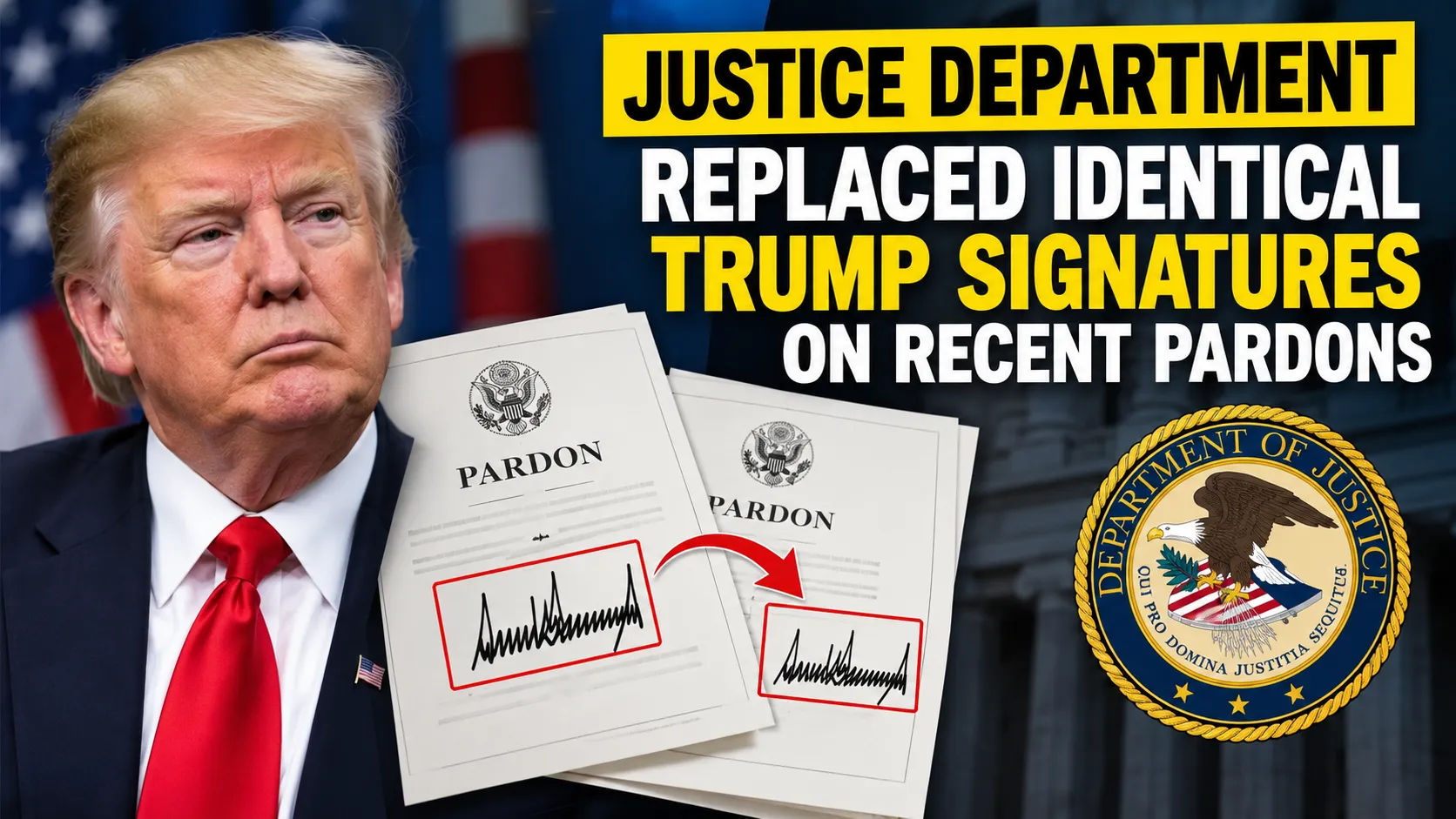
The U.S. Justice Department replaced online copies of seven presidential pardons in November 2025 after identical images of President Donald Trump’s signature appeared on multiple documents. The department attributed the problem to a technical error and staffing issues, insisting that Trump had personally signed each pardon, while forensic document experts confirmed that the originally published signatures were identical. The episode raised questions about document handling, presidential accountability and the administration’s previous criticism of autopen signatures. (Associated Press reporting)
The controversy attracted national attention because Trump had repeatedly criticized former President Joe Biden’s use of an autopen, a device that reproduces a person’s signature. However, the discovery of identical signature images on published pardon documents did not, by itself, establish that an autopen was used on the original documents or that the pardons were legally invalid.

What Happened With Trump’s Pardon Signatures?
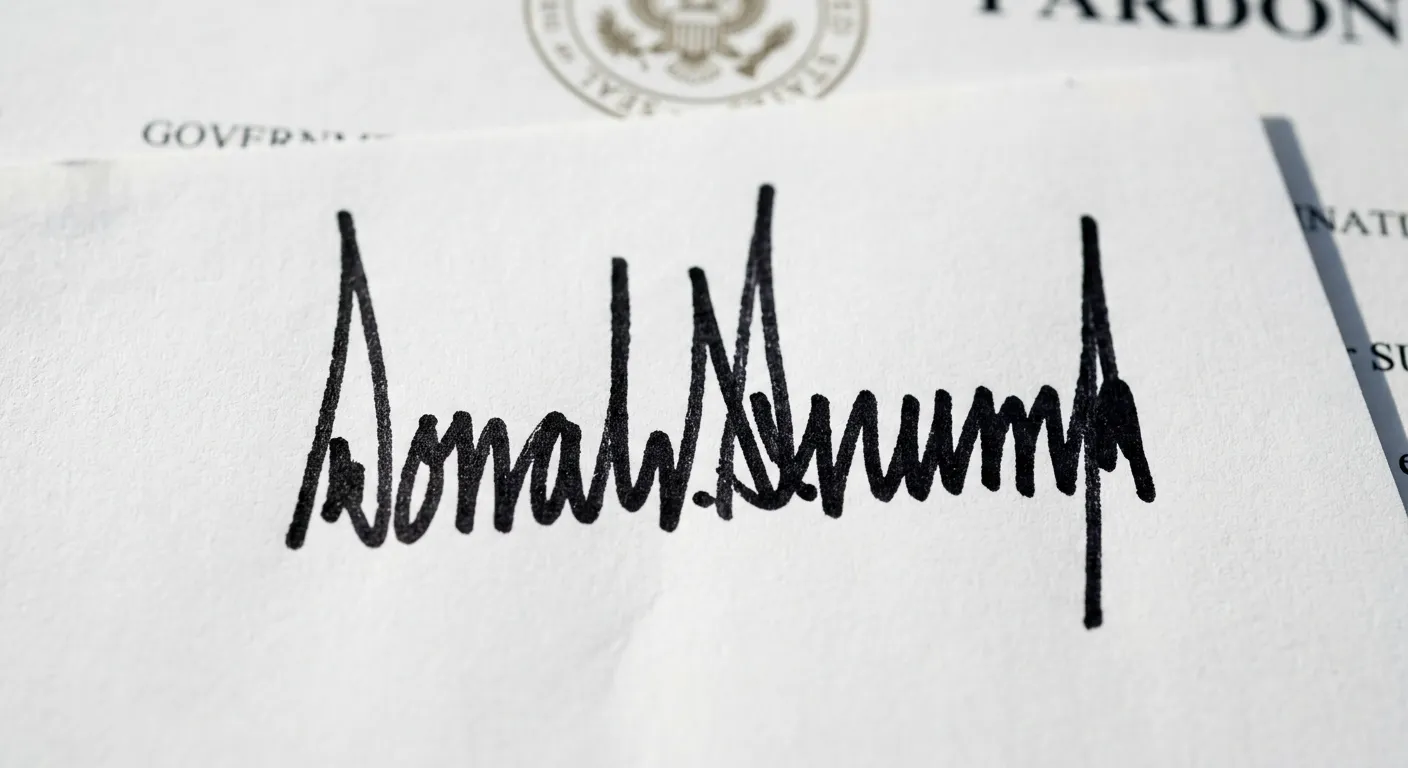
The controversy emerged in mid-November 2025, when observers noticed that several pardons dated November 7 featured apparently identical images of Trump’s signature. The documents had been published on the Justice Department’s website as part of a series of individual presidential clemency grants.
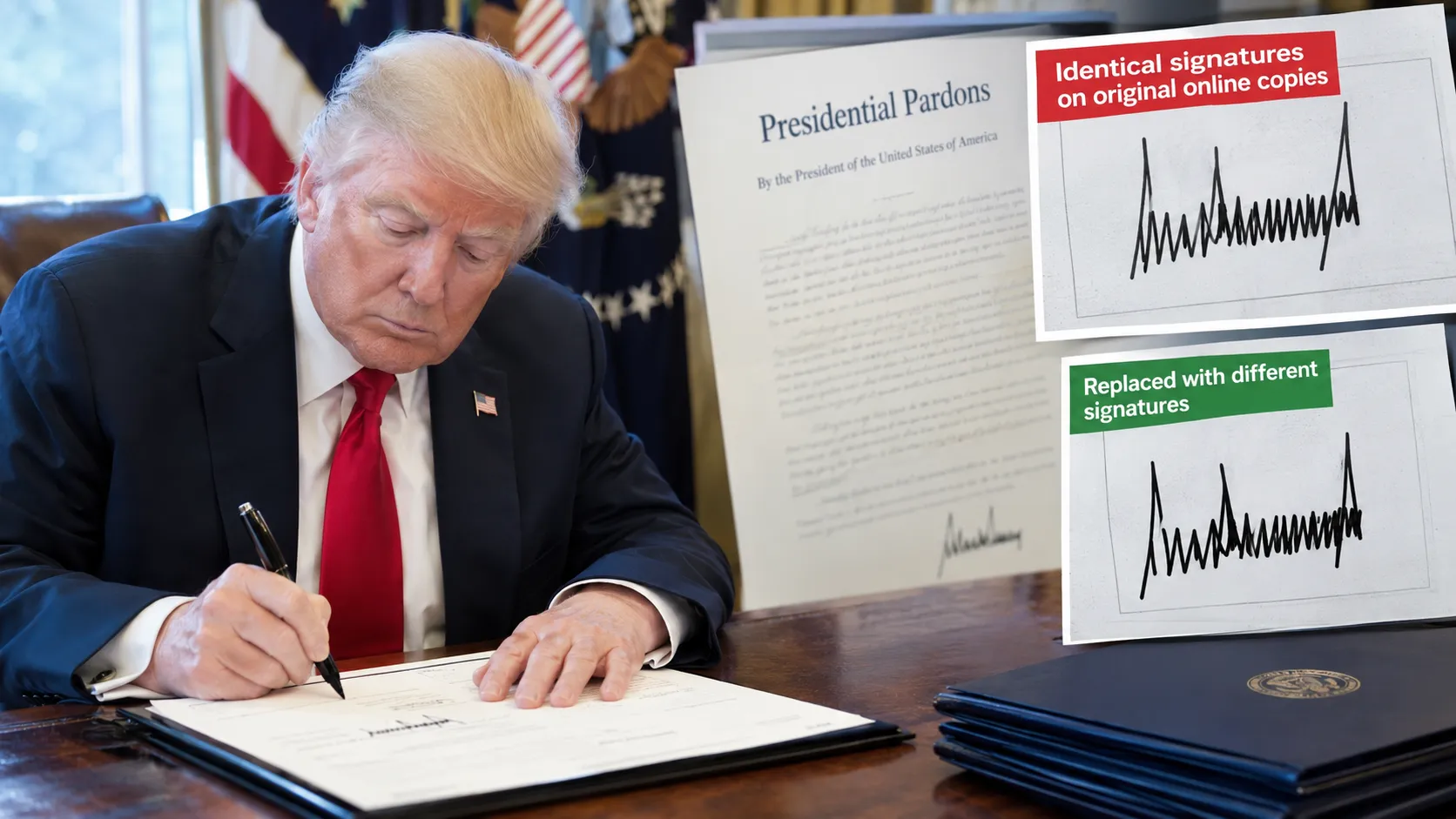
According to the Associated Press (AP), two forensic document experts confirmed that the signatures on several initially published copies were identical. One expert, Tom Vastrick, president of the American Society of Questioned Document Examiners, explained that independently handwritten signatures would not be expected to reproduce precisely the same design features in every detail.
After the similarities attracted public attention, the Justice Department replaced the online documents with versions displaying different signatures. The corrections occurred within a short period of the online scrutiny, but officials maintained that the underlying pardons had been personally signed by Trump.
The central issue was therefore not simply whether the published signatures looked alike. It was whether the department had accurately reproduced the original pardon documents and whether the explanation for the duplication could be independently verified.
Why Did the Justice Department Replace the Documents?
The Justice Department described the incident as a technical error involving the repeated uploading of a signature image. Its explanation was that one signature personally written by Trump had mistakenly appeared on multiple documents because of staffing problems during the federal government shutdown.
DOJ spokesperson Chad Gilmartin told the Associated Press that the department had corrected the website and that Trump had personally signed all seven pardons. White House spokesperson Abigail Jackson also maintained that Trump signed each pardon by hand.
The administration rejected the suggestion that the incident demonstrated unauthorized use of a signature-reproducing device. It characterized the matter as an error in the publication process rather than a problem with the president’s clemency decisions.
However, the public explanation did not independently establish every step of the document-handling process. The fact that the department published corrected versions showed that the online records had changed, but the identical images alone could not establish exactly how the original documents had been signed.
As of October 10, 2026, the publicly available reporting identified for this article does not establish a formal finding that Trump failed to authorize these pardons.
Also Read: Saddleback College Early Childhood Education AS-T: 2026–27 Guide
Which Trump Pardons Were Involved?
The incident concerned seven individual pardons dated November 7, 2025. Three recipients specifically highlighted in the AP report were former baseball player Darryl Strawberry, former Tennessee House speaker Glen Casada and former New York City police sergeant Michael McMahon.
The Justice Department’s official clemency records identify the seven recipients and the underlying offenses.
| Pardon recipient | Underlying case or offense |
|---|---|
| Glen Casada | Federal conspiracy, honest-services wire fraud and money-laundering offenses |
| Cade Cothren | Federal conspiracy, wire fraud and money-laundering offenses |
| Robert Henry Harshbarger Jr. | Introducing misbranded drugs into interstate commerce and health care fraud |
| Troy Lake | Conspiracy to violate the Clean Air Act |
| Michael McMahon | Acting as an agent of a foreign government without required notification and stalking-related offenses |
| Darryl Strawberry Sr. | Income tax evasion |
| Michelino Sunseri | Violating park rules by leaving the designated Garnet Canyon Trail to use a shortcut |
These cases involved different circumstances, ranging from financial and corruption-related offenses to environmental and park regulations. Their inclusion in the same group of pardon documents did not mean the recipients had been convicted of the same conduct.
The November 7 date also coincided with a separate presidential proclamation granting pardons for certain conduct connected to the 2020 presidential election. That broader clemency action was distinct from the seven individual pardon documents at the center of the signature controversy. The proclamation is available through the U.S. Government Publishing Office’s official presidential documents collection.
Did Trump Use an Autopen to Sign the Pardons?
The available evidence established that identical signature images appeared on the original online copies. It did not conclusively establish that Trump used an autopen to sign the physical pardon documents.
An autopen is a mechanical device that reproduces a person’s signature using a writing instrument. It has been used in government and other settings where a person needs to authorize documents without personally writing each signature by hand.
The distinction between a duplicated image and an autopen is important. A scanned signature can be copied into several digital documents during document preparation or publication. That process can produce identical signature images even if the original physical documents contain different handwritten signatures.
In this case, the Justice Department specifically said that a signature Trump had personally written was mistakenly uploaded multiple times. The department subsequently published copies with unique signatures. The initial duplication prompted scrutiny, but the available public evidence did not independently verify the department’s complete explanation or prove that an autopen had been used.
The Associated Press reported that the original online copies were no longer displayed on the department’s website after the replacements. The archived versions allowed the earlier signature images to be compared with the corrected documents.
Why Did the Incident Become a Political Controversy?
The signature issue drew particular attention because Trump and his Republican allies had previously questioned Biden’s use of an autopen to conduct presidential business.
In 2025, House Republicans released a report criticizing Biden’s use of the device and raising questions about authorization and oversight. The report argued that executive actions signed by an autopen without appropriate approval should be considered invalid. That was the committee’s position, not a blanket judicial ruling that all autopen-signed presidential actions were unlawful.
Against that background, the appearance of identical Trump signature images created an obvious political contrast. Representative Dave Min, a California Democrat serving on the House Oversight Committee, called for further scrutiny of the incident, according to AP reporting.
The administration disputed the comparison with Biden’s situation, maintaining that Trump personally signed the pardons and that the problem arose when the documents were uploaded.
The episode therefore raised two separate questions. One concerned the accuracy and transparency of the Justice Department’s public records. The other concerned whether the president personally authorized each clemency decision. Identical images on published copies were relevant to the first question, but they did not independently settle the second.
Are the Pardons Legally Valid?
The signature controversy did not automatically invalidate the pardons. The president’s constitutional authority to grant pardons for federal offenses comes from Article II, Section 2 of the U.S. Constitution, subject to the constitutional exception for impeachment cases. The Constitution Annotated resource maintained by Congress explains the scope of this clemency power.
Legal historian Frank Bowman, a professor emeritus at the University of Missouri School of Law, told AP that the key question for a pardon’s validity is whether the president intended to grant it. His assessment distinguished the president’s underlying authorization from the appearance of a signature on a published document.
There is also relevant, but narrower, federal legal guidance concerning autopens. In a 2005 opinion, the Justice Department’s Office of Legal Counsel concluded that a president could direct a subordinate to affix the president’s signature to a bill, including through an autopen. That opinion addressed the signing of legislation, rather than the specific pardon-signature incident, so it should not be treated as a direct legal ruling on these seven documents. The official Justice Department opinion explains the distinction.
The available evidence does not establish that a court invalidated these pardons because of the signature duplication. Nor does the duplication alone prove that the president did not authorize them.
What Is the Current Status of the Pardon Signature Controversy?
The incident occurred in November 2025, and the Justice Department replaced the affected online copies after the repeated signature images were identified. Officials continued to maintain that Trump had signed the seven pardons personally.
The department’s official clemency grants page, updated September 9, 2026, continues to list the November 7, 2025, pardons. The publicly available sources reviewed for this article do not establish that those clemency grants were subsequently withdrawn or invalidated because of the signature issue.
It is important to distinguish the confirmed facts from the unresolved questions. The duplicate signature images were documented, the Justice Department acknowledged and corrected the publication error, and officials defended the authenticity of the pardons. The available evidence does not independently establish that an autopen was used on the original documents or that the president failed to authorize the clemency decisions.
Frequently Asked Questions
1. Why did the Justice Department replace Trump’s pardon signatures?
The Justice Department replaced online copies of seven pardons after identical signature images were discovered. Officials attributed the duplication to a technical error and staffing problems during the federal government shutdown.
2. Did Trump use an autopen to sign the pardons?
The publicly reported evidence did not conclusively establish autopen use on the original pardon documents. The Justice Department maintained that Trump signed each pardon by hand and that a signature image was mistakenly uploaded multiple times.
3. Which pardon recipients were involved in the controversy?
The seven recipients were Glen Casada, Cade Cothren, Robert Henry Harshbarger Jr., Troy Lake, Michael McMahon, Darryl Strawberry Sr. and Michelino Sunseri.
4. Were the pardons declared invalid because of the signatures?
The available sources do not establish that the pardons were invalidated because of the duplicated images. Legal experts cited by AP emphasized that presidential authorization is central to the question of pardon validity.
5. Why was the signature controversy politically significant?
The incident attracted attention because Trump and Republican allies had previously criticized Biden’s use of an autopen. The similarities prompted questions about consistent standards for presidential signatures, document transparency and authorization of executive actions.
Also Read: Research Dossier for Target Company: Complete Guide
