



CeraVe is generally a strong choice for gentle cleansing, everyday hydration, and maintaining the skin barrier, while The Ordinary is particularly useful for targeting concerns such as acne, excess oil, uneven skin tone, and rough texture. Neither brand is universally more effective. The better choice depends on your skin type, the ingredients in individual products, and how consistently you use them.
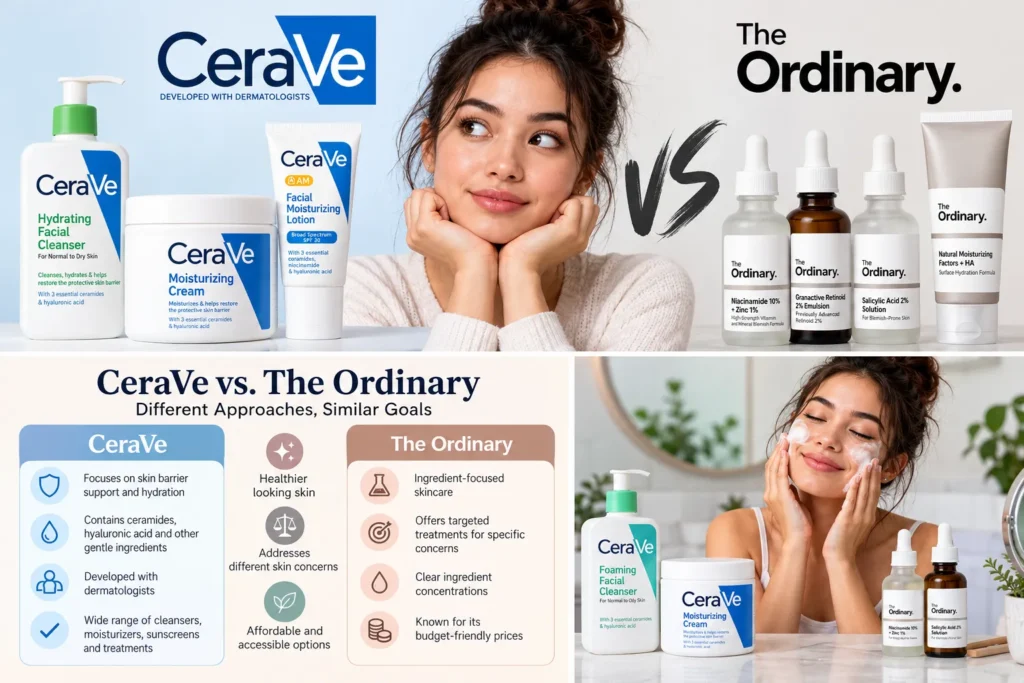
For a Gen Z woman building a skincare routine, both brands offer accessible alternatives to expensive beauty products. However, their approaches differ. CeraVe emphasizes barrier-supporting formulations developed with dermatologists, whereas The Ordinary is known for ingredient-focused products that allow users to address specific concerns.
A routine combining products from both brands may be more useful than choosing one exclusively. The important question is not which brand is more popular on social media, but which products provide measurable benefits without causing unnecessary irritation.

I Am a Gen Z Woman. How Does CeraVe Compare to The Ordinary in Terms of Skincare Effectiveness?
The most important difference between CeraVe and The Ordinary is their approach to skincare formulation.
CeraVe was established in 2005 and focuses heavily on maintaining the skin’s protective barrier. Its formulations commonly contain ceramides, hyaluronic acid, and other moisturizing ingredients. The brand offers cleansers, moisturizers, sunscreens, and acne treatments.
The Ordinary takes a more ingredient-centered approach. Its product range includes niacinamide, salicylic acid, azelaic acid, retinoids, and moisturizers designed for different skincare concerns.
Importantly, these approaches overlap. CeraVe also sells acne treatments and retinol products, while The Ordinary offers gentle cleansers and barrier-supporting moisturizers. The difference is therefore about product emphasis rather than one brand treating skin and the other merely moisturizing it.
CeraVe describes its formulations as incorporating three essential ceramides, while The Ordinary provides detailed ingredient information and concentrations for many of its treatment products.
CeraVe vs. The Ordinary: Key Differences
| Feature | CeraVe | The Ordinary |
|---|---|---|
| Primary approach | Barrier support and everyday skincare | Ingredient-focused skincare and targeted treatments |
| Cleansers | Broad selection for different skin types | Gentle cleansing options, including Squalane Cleanser |
| Moisturizers | Ceramide-rich creams and lotions | Natural Moisturizing Factors and other hydrating formulas |
| Acne treatments | Salicylic acid and benzoyl peroxide options | Salicylic acid and other targeted products |
| Uneven skin tone | Retinol and other skincare formulations | Azelaic acid, niacinamide, and exfoliating acids |
| Sensitive skin | Multiple gentle options | Suitable options, but stronger treatments require caution |
| Product affordability | Often practical for basic daily routines | Particularly accessible entry prices for many serums |
| Best use | Building a consistent skincare foundation | Addressing individual concerns with selected ingredients |
These comparisons describe the brands’ general product ranges, not clinically established rankings. A specific product from either brand may outperform another depending on the formulation and the person’s skin.
Which Brand Is More Effective for Acne-Prone Skin?
Both CeraVe and The Ordinary offer products that can help manage mild acne. Their effectiveness depends largely on the type of breakout being treated.
The American Academy of Dermatology identifies benzoyl peroxide, topical retinoids, salicylic acid, and azelaic acid among evidence-supported acne treatments. Its guidelines give stronger recommendations to some treatments, including benzoyl peroxide and topical retinoids, than to salicylic acid and azelaic acid.
CeraVe for Acne-Prone Skin
This cleanser contains 2% salicylic acid, which helps clear clogged pores and reduce blackheads. The formula also incorporates ceramides and niacinamide.
It can be a useful option for people who want acne-fighting ingredients in a wash-off product rather than an additional leave-on serum.
CeraVe also offers an Acne Foaming Cream Cleanser containing 4% benzoyl peroxide. Benzoyl peroxide is particularly relevant for inflammatory acne because it reduces acne-associated bacteria.
However, acne cleansers can still cause dryness, especially when combined with other treatments. A gentle cleanser alone is not necessarily sufficient for persistent acne.
The Ordinary for Acne-Prone Skin
This leave-on treatment contains 2% salicylic acid, a beta-hydroxy acid that helps exfoliate skin and clear congested pores.
It may be particularly relevant for blackheads, whiteheads, and mild blemishes. However, it can irritate sensitive skin, and the manufacturer warns against combining it with other strong active products without considering compatibility.
The Ordinary also offers Niacinamide 10% + Zinc 1%, marketed for excess shine, congestion, and uneven-looking skin.
Niacinamide can be a useful supporting ingredient, but this serum should not be considered equivalent to a clinically established acne medication such as adapalene or benzoyl peroxide.
Which is better for acne? CeraVe offers a broader choice of acne-medicated cleansers, including benzoyl peroxide options. The Ordinary provides convenient leave-on treatments for specific concerns. Neither has been established as the overall winner through a comprehensive clinical comparison of the two brands.
For painful cystic acne, persistent inflammatory breakouts, or acne that causes scarring, professional treatment is more appropriate than repeatedly trying new cosmetic products.
Which Brand Is Better for Dry or Sensitive Skin?
CeraVe is a particularly practical starting point for dry or easily irritated skin because its product range emphasizes moisturization and barrier support.
The skin barrier is the outer protective layer that helps prevent excessive moisture loss and protects the skin from environmental irritants.
A disrupted barrier can contribute to dryness, tightness, flaking, and discomfort. Maintaining hydration is therefore important even when the main skincare concern is acne.
CeraVe Moisturizing Cream
CeraVe Moisturizing Cream contains ceramides, hyaluronic acid, dimethicone, and petrolatum.
These ingredients help maintain hydration and limit water loss. Its rich texture makes it a reasonable option for normal-to-dry skin, especially when lighter moisturizers are insufficient.
The cream can be used on the face and body, although someone with oily skin may prefer a lighter lotion.
The Ordinary Natural Moisturizing Factors + HA
The Ordinary Natural Moisturizing Factors + HA contains ingredients such as amino acids, glycerin, sodium PCA, and hyaluronic acid.
Its purpose is to replenish moisture and support the skin’s outer layer. The formula demonstrates that The Ordinary is not limited to exfoliating acids and strong serums.
Both brands therefore offer credible moisturizing options. CeraVe Moisturizing Cream may be preferable when a richer formula is needed, while The Ordinary’s moisturizer provides an alternative for people who prefer its particular texture and ingredient combination.
For highly reactive skin, product tolerance matters more than marketing claims. Even fragrance-free or dermatologist-developed formulations can cause reactions in some individuals.
Which Is Better for Oily and Combination Skin?
Oily skin does not necessarily need aggressive cleansing or daily exfoliation. Excessive washing and irritating products can disrupt the skin barrier without solving the underlying causes of oil production.
For everyday cleansing, CeraVe Foaming Facial Cleanser is formulated for normal-to-oily skin and contains ceramides, hyaluronic acid, and niacinamide. It is intended to remove excess oil and debris without leaving the skin excessively dry.
The Ordinary’s Niacinamide 10% + Zinc 1% is a different type of product. As a leave-on serum, it targets visible shine and other cosmetic concerns.
The Ordinary Niacinamide 10% + Zinc 1%
This formula combines niacinamide with zinc PCA and is marketed to improve the appearance of oily, congested skin.
Its concentration is clearly disclosed, but a 10% niacinamide formula is not automatically more effective than every lower-concentration formulation. Overall formulation and skin tolerance also matter.
For combination skin, using a gentle cleanser and lightweight moisturizer may be sufficient for everyday care. A targeted serum can be considered if excess shine or uneven texture remains a concern.
Also Read: I am a Gen Z man. How does the Nivea Men line stack up against Bulldog or Lumin?
CeraVe vs. The Ordinary for Dark Spots and Uneven Skin Tone
The Ordinary may be especially appealing to people looking for individual treatments for post-acne marks, dullness, or uneven skin texture. However, CeraVe also has products targeting these concerns.
Dark spots following acne are often associated with post-inflammatory hyperpigmentation, which occurs when inflammation stimulates excess pigment production.
These marks can be particularly persistent in deeper skin tones. Irritation from aggressive treatments may also worsen discoloration, making a gentle routine important.
The Ordinary’s Targeted Ingredients
The Ordinary offers several products relevant to uneven skin tone.
Its Azelaic Acid Suspension 10% is marketed to smooth texture and improve brightness. Azelaic acid is also recognized in dermatology for its role in treating acne and post-acne discoloration.
However, evidence for prescription-strength azelaic acid formulations should not automatically be treated as proof that every cosmetic 10% formula produces identical results.
The Ordinary also offers glycolic acid exfoliating products. These may improve the appearance of rough or dull skin, but unnecessary exfoliation can create irritation rather than better results.
CeraVe’s Approach to Uneven Texture
CeraVe offers products such as Resurfacing Retinol Serum for post-acne skin.
Retinol belongs to the retinoid family. Retinoids can help improve certain pigmentation concerns and mild textural irregularities over time, although products differ in strength and clinical evidence.
The American Academy of Dermatology recommends introducing retinoids gradually because irritation can occur, particularly in sensitive skin.
For a woman concerned about persistent dark spots, the better option is the one combining an appropriate treatment with consistent sun protection and minimal irritation.

Does a Higher Active-Ingredient Concentration Mean Better Results?
Not necessarily. A higher concentration may increase an ingredient’s activity, but it can also increase the likelihood of irritation.
Skincare performance depends on several factors:
- The active ingredient and its concentration.
- The complete product formulation and delivery system.
- How long the product remains on the skin.
- Frequency of application and consistency.
- Individual skin sensitivity and underlying conditions.
For example, a 2% salicylic acid cleanser and a 2% salicylic acid leave-on serum should not be expected to perform identically simply because they contain the same percentage.
Similarly, adding a concentrated niacinamide serum to a moisturizer that already contains niacinamide is not necessarily beneficial.
The aim should be effective treatment with the least unnecessary irritation, rather than collecting the highest possible concentrations of popular ingredients.
Which Brand Offers Better Value for Money?
Both brands operate in the accessible skincare market, although their product sizes and pricing structures differ.
The Ordinary’s ingredient-focused products often have low individual entry prices. Its US website, for example, lists Niacinamide 10% + Zinc 1% at $6.00 for 30 ml and Salicylic Acid 2% Solution at $6.70 for 30 ml. Prices can change and differ internationally.
CeraVe products can cost more per package, particularly certain facial products, but many of its moisturizers and cleansers come in larger sizes.
Comparing the price per 100 ml can be useful for similar cleansers or moisturizers. For concentrated treatment serums, cost per use and the product’s actual purpose are often more meaningful.
Buying a low-priced serum that irritates your skin is not good value. Likewise, purchasing several overlapping treatments may be more expensive than using one appropriately selected product.
For students and young professionals managing a skincare budget, investing first in a suitable cleanser, moisturizer, and sunscreen is a sensible approach.
How to Build an Effective Routine Using Both Brands
A skincare routine does not have to use products from a single company. CeraVe and The Ordinary can be combined when the individual formulas are compatible.
The American Academy of Dermatology recommends gentle cleansing, regular moisturization, and adequate sun protection. These basics remain important regardless of which treatment products are added.
Morning Routine
- Cleanse: Use a gentle cleanser suited to your skin type, such as CeraVe Hydrating Facial Cleanser for normal-to-dry skin or Foaming Facial Cleanser for normal-to-oily skin.
- Target a concern, if needed: Consider a suitable The Ordinary serum rather than layering several products unnecessarily.
- Moisturize: Choose CeraVe PM Facial Moisturizing Lotion, another suitable CeraVe moisturizer, or The Ordinary Natural Moisturizing Factors + HA.
- Protect: Finish with broad-spectrum sunscreen rated SPF 30 or higher.
CeraVe AM Facial Moisturizing Lotion SPF 30 can combine moisturizing and sun protection in one step. However, it must be applied adequately and reapplied when needed, just like other sunscreens.
Evening Routine
- Cleanse gently to remove sunscreen, makeup, and accumulated debris.
- Apply one appropriate treatment if your skin needs it.
- Follow with moisturizer to support hydration.
For example, someone with mild clogged pores might consider The Ordinary Salicylic Acid 2% Solution as their treatment step, following the current product directions.
Avoid introducing salicylic acid, glycolic acid, and retinol all at once. Using multiple irritating treatments together may cause dryness, peeling, and worsening discomfort.
Start new active products gradually, patch-test them as directed, and discontinue products that cause significant irritation. Product instructions should take precedence over a generic routine.
Common Skincare Mistakes Gen Z Women Should Avoid
Social media can make complicated skincare routines appear necessary. In practice, more products do not automatically produce healthier skin.
Over-exfoliation is one common concern. Repeated use of acid-based treatments can irritate the skin, especially when someone already uses acne medication.
Another mistake is treating every breakout as a problem that can be solved with a new serum. Persistent acne may involve hormonal influences or require prescription treatment.
Skipping sunscreen can also undermine attempts to improve discoloration. The American Academy of Dermatology recommends broad-spectrum SPF 30 or higher, and notes that tinted sunscreens containing iron oxides can provide additional protection against visible light associated with dark spots.
Finally, avoid judging products after only a few applications. Acne treatments often require several weeks or months to show meaningful results. Frequently switching routines can make it more difficult to determine what is helping.
An important safety consideration: Anyone who is pregnant or planning pregnancy should avoid retinoids unless specifically advised otherwise by their healthcare professional. The same precaution applies to retinol-containing products from either brand.

Which Should You Choose Based on Your Skin Type?
| Skin concern | Practical starting choice | Reason |
|---|---|---|
| Dry or tight skin | CeraVe Moisturizing Cream | Rich barrier-supporting moisturizer |
| Oily skin | CeraVe Foaming Facial Cleanser | Gentle daily cleansing |
| Mild clogged pores | A suitable salicylic acid product from either brand | Helps address pore congestion |
| Post-acne dark spots | The Ordinary Azelaic Acid Suspension 10%, if tolerated | Targeted ingredient for uneven-looking tone |
| Sensitive skin | A gentle CeraVe cleanser and moisturizer, or tolerated equivalents | Simpler routine with fewer potential irritants |
| Dullness or rough texture | A carefully selected treatment from either brand | Allows targeted treatment without unnecessary products |
| Minimal routine | CeraVe cleanser and moisturizer plus suitable sunscreen | Straightforward everyday skincare foundation |
These are starting points rather than guaranteed recommendations. Sensitive, acne-prone, or eczema-affected skin may respond differently to products with similar advertised benefits.
Frequently Asked Questions
1. Is CeraVe better than The Ordinary for everyday skincare?
CeraVe may be more convenient for a simple everyday routine because it offers a broad selection of gentle cleansers, moisturizers, and SPF products. The Ordinary is equally worth considering for its moisturizing products and when a specific treatment ingredient is needed.
2. Can I use CeraVe and The Ordinary together?
Yes. Many products from the two brands can be used in the same skincare routine. Check ingredient compatibility, avoid unnecessary duplication, and be particularly careful when combining exfoliating acids, retinoids, or acne medications.
3. Is The Ordinary too strong for young skin?
Not inherently. The Ordinary offers both gentle moisturizers and more intensive treatment products. Suitability depends on the specific formula, concentration, frequency of use, and individual skin sensitivity rather than age or brand identity alone.
4. Which brand is better for hormonal acne?
Neither brand has been shown to consistently outperform the other for hormonally influenced acne. Their over-the-counter products may help mild breakouts, but recurring or persistent hormonal acne may require treatments such as prescription retinoids, hormonal medication, or other dermatologist-directed care.
5. Do women in their early twenties need retinol?
Not necessarily. Retinol may be useful for particular concerns, but it is not an essential step for everyone in their twenties. Gentle cleansing, appropriate moisturizing, and sun protection are reasonable priorities, with targeted treatment added according to actual skin needs.
6. How long does it take to see results from CeraVe or The Ordinary?
Moisturizers may make skin feel more comfortable relatively quickly, while changes in acne, texture, or discoloration often take longer. Acne treatments may need several weeks to months of consistent use. The precise timeline depends on the product, concern, and individual response.
Final Verdict: CeraVe or The Ordinary?
For a Gen Z woman choosing between CeraVe and The Ordinary, CeraVe is a practical first choice for establishing a gentle skincare routine, while The Ordinary provides useful options for addressing specific concerns with selected active ingredients.
Neither company has a proven overall advantage across every aspect of skincare effectiveness. Both sell products with ingredients supported by dermatological research, but evidence for an ingredient does not guarantee the same outcome from every formulation.
If your skin is generally healthy, you may not need several treatment serums. If you struggle with oily skin, clogged pores, or post-acne marks, one carefully chosen active product may be more beneficial than an elaborate routine.
The most effective approach is to identify your main skin concern, choose well-formulated products you can tolerate, use sunscreen consistently, and evaluate progress over time. A routine combining suitable products from both brands can be an excellent option without requiring an expensive or complicated collection.
Also Read: I Am a College Student. Are La Roche-Posay Products Better for Acne-Prone Skin Than Neutrogena?
