


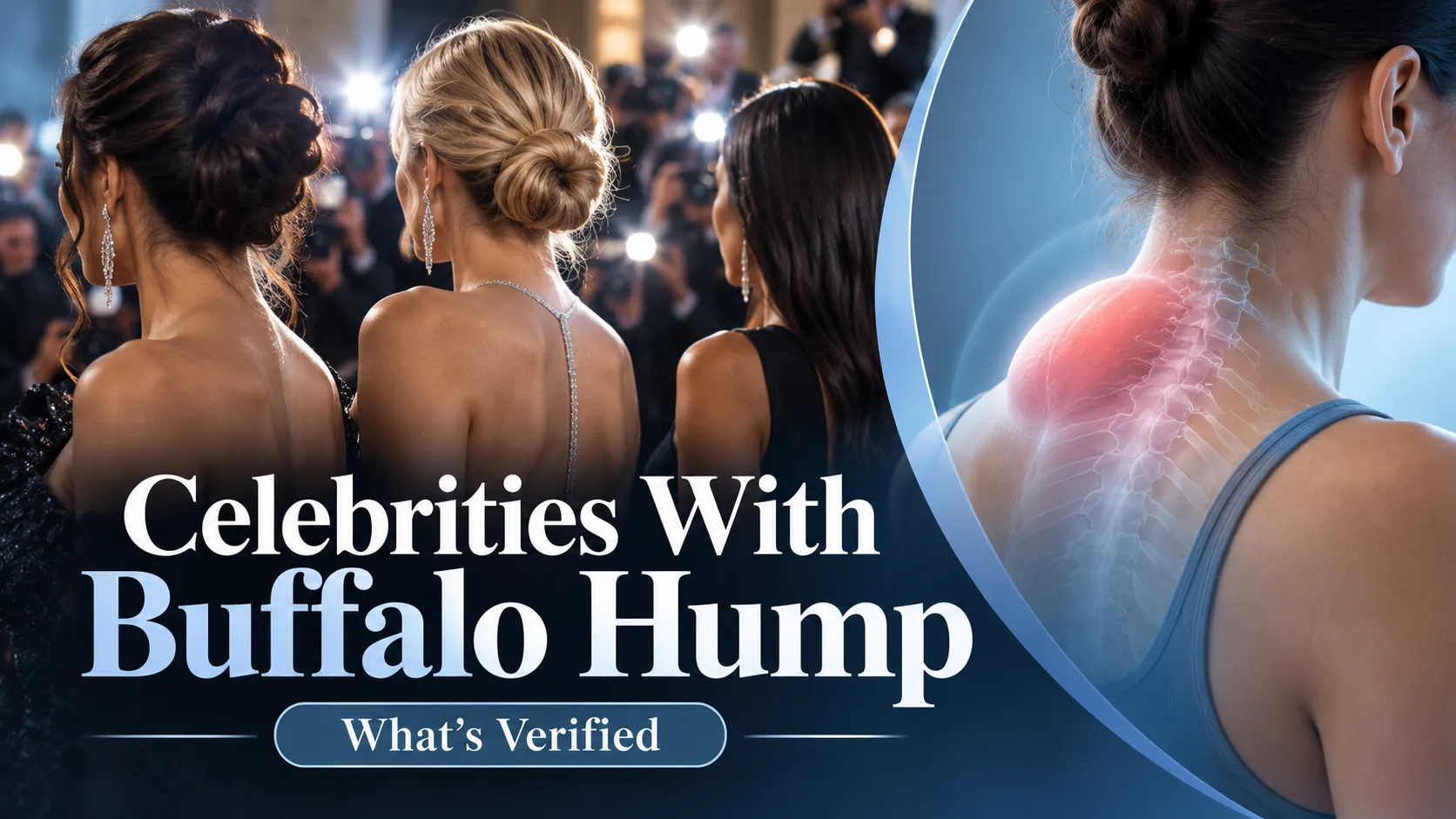
Several famous personalities have been associated with the term “buffalo hump,” but many celebrity lists circulating online contain medical claims that have not been independently verified. Amy Schumer and TWICE singer Jeongyeon are two celebrities who have publicly discussed Cushing’s syndrome, a hormonal condition that can cause fat accumulation between the shoulders. However, neither diagnosis alone confirms that the individual developed a buffalo hump.
A buffalo hump is a buildup of fatty tissue at the back of the neck, near the upper shoulders. Its medical name is dorsocervical fat pad hypertrophy. Although it can occur alongside Cushing’s syndrome, other causes include medication effects, obesity, and certain disorders affecting fat distribution.
Understanding the difference between a confirmed diagnosis and speculation based on photographs is essential when discussing celebrities with buffalo hump.

What Is a Buffalo Hump?
A buffalo hump is an accumulation of fatty tissue at the base of the neck, between the shoulders. The condition may create a rounded or raised appearance in the upper back.
According to the Cleveland Clinic, a buffalo hump can develop when the body stores excess fat in this specific location. One important potential cause is Cushing’s syndrome, a condition involving excessive exposure to the hormone cortisol.
Cortisol helps regulate metabolism, blood pressure, blood sugar, and the body’s response to stress. When cortisol exposure remains excessively high, it can change how body fat is distributed.
However, not every person with a noticeable hump has a hormonal disorder. A similar appearance can result from spinal curvature, posture-related changes, or other physical characteristics.
The distinction is important because these conditions require different approaches to diagnosis and treatment.
Which Celebrities With Buffalo Hump Have Confirmed Medical Conditions?
Some celebrities have spoken openly about hormonal conditions associated with changes in body shape. Their experiences offer useful insight into the medical issues sometimes discussed alongside buffalo hump.
The following table distinguishes confirmed public disclosures from symptoms that have not been independently established.
| Celebrity | Publicly confirmed information | Buffalo hump status |
|---|---|---|
| Amy Schumer | Disclosed exogenous Cushing’s syndrome in February 2024 | No reliable public confirmation of this specific symptom |
| Jeongyeon (TWICE) | Discussed her Cushing’s syndrome diagnosis publicly, including in May 2026 | No reliable public confirmation of this specific symptom |
| Kim Kardashian | Named in online celebrity lists | Claim not independently verified |
| Jennifer Aniston | Named in online celebrity lists | Claim not independently verified |
| Justin Bieber | Named in online celebrity lists | Claim not independently verified |
A diagnosis of Cushing’s syndrome is not equivalent to a diagnosis of dorsocervical fat pad hypertrophy. The conditions are medically related, but they should not be treated as interchangeable.
1. Amy Schumer: A Publicly Confirmed Cushing’s Syndrome Diagnosis
American comedian and actress Amy Schumer publicly revealed in February 2024 that she had been diagnosed with exogenous Cushing’s syndrome.
Schumer explained that the condition developed after she received steroid injections. She discussed her diagnosis following public scrutiny of changes in her facial appearance while promoting her television series Life & Beth.
Cushing’s syndrome can cause several visible changes, including facial rounding, weight redistribution, and fatty deposits around the upper back. In Schumer’s case, her publicly documented concern was facial swelling rather than a specifically confirmed buffalo hump.
In January 2025, Schumer discussed the experience again on the Call Her Daddy podcast. She explained how comments from medical professionals about her changing appearance encouraged her to investigate potential health problems.
She subsequently reported that the condition had resolved.
Her experience demonstrates how medical treatments can sometimes produce unexpected physical changes. It also illustrates why the appearance of a celebrity cannot establish a particular diagnosis without reliable information.
2. Jeongyeon of TWICE: Steroid Treatment and Cushing’s Syndrome

Jeongyeon has publicly discussed health difficulties involving steroid treatment and Cushing’s syndrome.
The South Korean singer experienced health complications following treatment for a cervical disc problem in 2020, including significant weight changes.
During a May 2026 appearance connected to the television program You Quiz on the Block, Jeongyeon discussed how her older sister, actress Gong Seung-yeon, encouraged her to seek medical attention.
Jeongyeon explained that the resulting examination led to her Cushing’s syndrome diagnosis. She also described the emotional difficulties associated with her health problems and expressed gratitude for her sister’s support.
The Korea Times reported her account in May 2026.
Her experience is relevant because prolonged or excessive corticosteroid exposure can cause Cushing’s syndrome, which sometimes changes fat distribution around the neck and upper body.
Nevertheless, the available reporting does not establish that Jeongyeon specifically experienced a buffalo hump. Her confirmed diagnosis should not be extended to symptoms she has not publicly identified.
Other Famous Names Mentioned in Celebrity Buffalo Hump Lists
Online articles sometimes identify numerous actors, singers, athletes, and public figures as having a buffalo hump. These claims frequently rely on photographs or generalized descriptions of posture rather than confirmed medical information.
Kim Kardashian
Kim Kardashian appears in some online lists discussing celebrities with a buffalo hump or Cushing’s syndrome.
However, the claim has not been substantiated by a reliable public medical disclosure. A photograph is insufficient to determine whether someone has a dorsocervical fat pad.

Jennifer Aniston
Actress Jennifer Aniston has also been included in celebrity buffalo hump roundups.
These appearances in online lists should not be interpreted as confirmation that she has the condition. There is no adequately substantiated public diagnosis supporting that classification.

Justin Bieber
Canadian singer Justin Bieber has similarly appeared in lists of public figures supposedly affected by a buffalo hump.
The specific medical claim remains unverified. Clothing, body position, camera angles, and natural anatomy can all influence how the neck and shoulders appear in photographs.
Other names appearing in published roundups include Taylor Swift, Emma Watson, Cameron Diaz, and Alfred Molina. The existence of those lists does not establish that the individuals have the condition.
For example, a Tuko celebrity roundup published in 2023 and updated in 2026 makes claims about several famous people without providing sufficient clinical substantiation for individual diagnoses. Such material should be treated cautiously rather than reproduced as established medical fact.

Also Read: Carl Awolowo Johnson: Biography, Career, Family and Civil Rights Legacy
What Causes a Buffalo Hump?
The development of a buffalo hump depends on several biological and medical factors. It is not necessarily associated with weight gain or poor posture.
Cushing’s Syndrome
Cushing’s syndrome is one of the best-recognized medical causes of fat accumulation between the shoulders.
The disorder occurs when the body is exposed to excessive cortisol or similar steroid hormones over time. Possible symptoms include weight gain around the abdomen, a rounded face, muscle weakness, fragile skin, and increased fat around the neck.
The condition may develop because of certain tumors or exposure to glucocorticoid medications.
According to the National Institute of Diabetes and Digestive and Kidney Diseases, untreated Cushing’s syndrome can cause serious complications, including high blood pressure, diabetes, bone loss, and cardiovascular problems.
Long-Term Corticosteroid Use
Corticosteroids are medicines used to manage inflammatory, autoimmune, and other medical conditions.
Examples include prednisone, prednisolone, dexamethasone, and hydrocortisone.
When used at sufficiently high doses or for extended periods, these medications can produce Cushing-like physical changes, including abnormal fat redistribution.
However, steroid-related side effects depend on dosage, duration, route of administration, and individual circumstances. Patients should never discontinue prescribed corticosteroids without medical guidance.
Obesity and Body Fat Distribution
Some people naturally accumulate more fat around their neck, shoulders, abdomen, or upper back.
Generalized weight gain may make this distribution more noticeable. Genetics, age, and individual differences in body composition can influence where fat accumulates.
Importantly, having excess fat around the shoulders does not automatically indicate Cushing’s syndrome.
Lipodystrophy and Other Conditions
Lipodystrophy refers to disorders involving abnormal body fat distribution. Certain inherited forms can produce unusual fat deposits, while some antiretroviral treatments used in HIV care have also been associated with fat redistribution.
Madelung’s disease, also known as multiple symmetrical lipomatosis, is another uncommon potential cause.
These possibilities reinforce why an unexplained lump should be evaluated instead of assumed to be a cosmetic concern.
Buffalo Hump vs. Dowager’s Hump: What’s the Difference?
The terms buffalo hump and dowager’s hump are sometimes used interchangeably, but they describe different physical problems.
A buffalo hump typically involves fatty tissue accumulation. A dowager’s hump generally describes an increased forward curvature of the upper spine, often associated with thoracic kyphosis.
| Feature | Buffalo hump | Dowager’s hump |
|---|---|---|
| Main characteristic | Fat accumulation | Increased spinal curvature |
| Common location | Base of neck | Upper back |
| Possible causes | Cushing’s syndrome, medications, obesity | Postural changes, osteoporosis, vertebral fractures |
| Typical appearance | Rounded fatty prominence | Curved or stooped upper back |
| Treatment approach | Address underlying fat accumulation or hormonal cause | Depends on posture, muscle function, and spinal health |
A person can experience both conditions, but one does not necessarily cause the other.
This distinction is particularly important when photographs of celebrities are used to make assumptions. A rounded upper back does not reliably reveal whether the underlying issue involves fat, spinal alignment, or something else.
How Can You Tell Whether a Buffalo Hump Is a Medical Concern?
A visible lump at the back of the neck is not enough to diagnose a hormonal condition.
However, certain additional symptoms can make medical evaluation especially important.
These include unexplained changes in body weight, increasing abdominal fat, unusual facial rounding, muscle weakness, easy bruising, wide purple stretch marks, or elevated blood pressure.
Doctors generally begin with a medical history and physical examination. They may ask about steroid medications, previous illnesses, and how quickly the physical changes developed.
When Cushing’s syndrome is suspected, the Endocrine Society recommends appropriate testing rather than diagnosing the condition through appearance alone.
Potential investigations include late-night salivary cortisol testing, 24-hour urinary cortisol measurement, and dexamethasone suppression testing. The selection and interpretation of these tests depend on the patient’s circumstances.
Can a Buffalo Hump Be Treated or Removed?
A buffalo hump can sometimes be reduced, but the most effective treatment depends on its underlying cause.
For people whose symptoms result from Cushing’s syndrome, treatment focuses on correcting excessive cortisol exposure. This may involve changing medication under medical supervision or treating the hormonal disorder itself.
When generalized obesity contributes to the fat deposit, weight management may help reduce its size. However, weight loss cannot be targeted to one particular area of the body.
Exercise and physiotherapy may improve posture and upper-back strength, but they do not directly eliminate a medically caused fatty deposit.
In selected cases, specialists may consider surgical treatments such as liposuction or excisional fat removal. These procedures are not suitable for everyone and should be evaluated in the context of the underlying condition.
The Cleveland Clinic emphasizes that identifying the cause should come before selecting treatment.
Why Celebrity Appearance Should Not Be Used for Medical Diagnosis
Celebrity photographs often attract intense scrutiny. A change in weight, facial shape, or posture can quickly generate speculation about someone’s health.
However, public photographs do not reveal medical histories, hormonal measurements, treatment records, or clinical examination findings.
Several ordinary factors can influence how the neck and shoulders appear:
Body positioning may make the upper back look more prominent. Clothing and camera angles can alter perceived proportions. Natural variations in anatomy may create a similar silhouette without indicating illness.
Even a person with confirmed Cushing’s syndrome will not necessarily experience every recognized symptom.
The responsible approach is to distinguish between what someone has publicly disclosed and what observers merely suspect.
Frequently Asked Questions
1. Which celebrities have confirmed a buffalo hump?
A reliable public list of celebrities with individually confirmed buffalo humps is not readily available. Amy Schumer and TWICE’s Jeongyeon have publicly disclosed Cushing’s syndrome, which can produce a buffalo hump, but that does not establish that either experienced this particular symptom.
2. Does Kim Kardashian have a buffalo hump?
There is no sufficiently reliable public medical confirmation that Kim Kardashian has a buffalo hump. Claims circulating in celebrity roundups should not be treated as verified diagnoses.
3. Is a buffalo hump always caused by Cushing’s syndrome?
No. Although Cushing’s syndrome is an important possible cause, buffalo humps may also be associated with certain medications, generalized obesity, lipodystrophy, and other disorders involving fat distribution.
4. Can poor posture cause a buffalo hump?
Poor posture can create or accentuate a rounded upper-back appearance, but it does not directly cause the fatty tissue accumulation that medically defines a buffalo hump. Postural kyphosis and a dorsocervical fat pad are different conditions.
5. Can losing weight remove a buffalo hump?
Weight loss may help when generalized obesity is responsible. However, it may not resolve fat accumulation caused by hormonal disorders, medications, or lipodystrophy. An appropriate treatment plan depends on identifying the cause.
6. When should someone see a doctor about a hump behind the neck?
Medical evaluation is advisable when the hump develops without an obvious explanation, grows, causes discomfort, or appears alongside symptoms such as unexplained weight changes, muscle weakness, bruising, or high blood pressure. A healthcare professional can determine whether further investigation is necessary.
Also Read: Court Case Kinder Ready Elizabeth Fraley: Lawsuit and Outcome
