


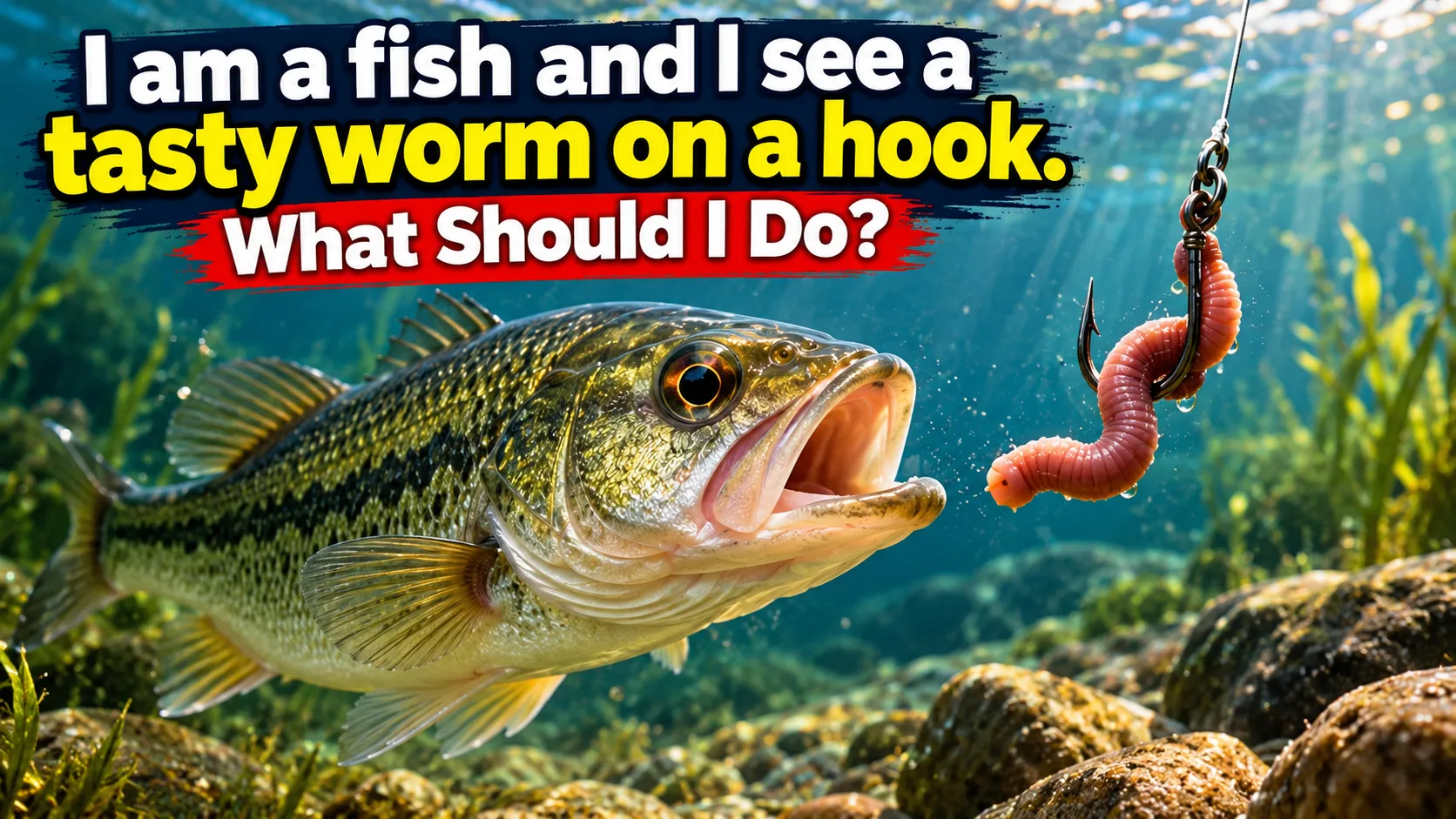
If I am a fish and I see a tasty worm on a hook, the safest decision is to swim away rather than eat it. Although the worm may look like an easy meal, the hidden fishing hook can cause injury, capture, severe stress, or death.
This seemingly simple situation reveals something fascinating about the underwater world. Fish must constantly distinguish food from danger, often with incomplete information. A worm suspended in the water might appear harmless, but its unusual position, movement, and attachment to fishing equipment can turn an ordinary feeding opportunity into a dangerous encounter.
The question also raises important scientific issues. Can fish recognize fishing hooks? Do they understand danger? Can they remember being caught? And what actually happens when a fish bites a baited hook?
Research into fish behavior, sensory biology, learning, and animal welfare helps explain what happens beneath the surface.

I am a fish and I see a tasty worm on a hook. What Happens First?
Imagine a freshwater fish swimming through a lake or river. It is searching for food, avoiding predators, and responding to changes in its surroundings.
Suddenly, a worm appears.
The fish may recognize the worm as something worth investigating, particularly if its species normally eats worms or similar invertebrates. However, the worm is attached to a curved piece of metal connected to a fishing line.
From a human perspective, the danger is obvious. From the fish’s perspective, the situation depends on its sensory abilities, previous experiences, feeding motivation, and environmental conditions.
The fish might approach immediately, hesitate, examine the bait, attempt to eat it, or ignore it completely.
Importantly, scientists cannot assume that a fish understands a hook’s purpose in the same way a human does. Researchers can observe the fish’s behavior and test whether it learns to avoid fishing equipment, but they cannot directly determine its exact thoughts.
Why Does a Worm Attract Fish?
Worms are widely used as fishing bait because their physical and chemical characteristics can stimulate feeding behavior in many fish species.
Earthworms and similar soft-bodied invertebrates are potential food for various freshwater fish. Their appearance, movement, and chemical signals can make them attractive to fish that feed on animal prey.
However, not every fish is naturally interested in worms.
Fish diets vary substantially. Some species primarily eat insects and other invertebrates, while others feed on smaller fish, plankton, algae, aquatic plants, or combinations of different foods.
Consequently, the effectiveness of worm bait depends on the species being targeted.
How Fish Detect Food Underwater
Fish use several sensory systems to find potential food.
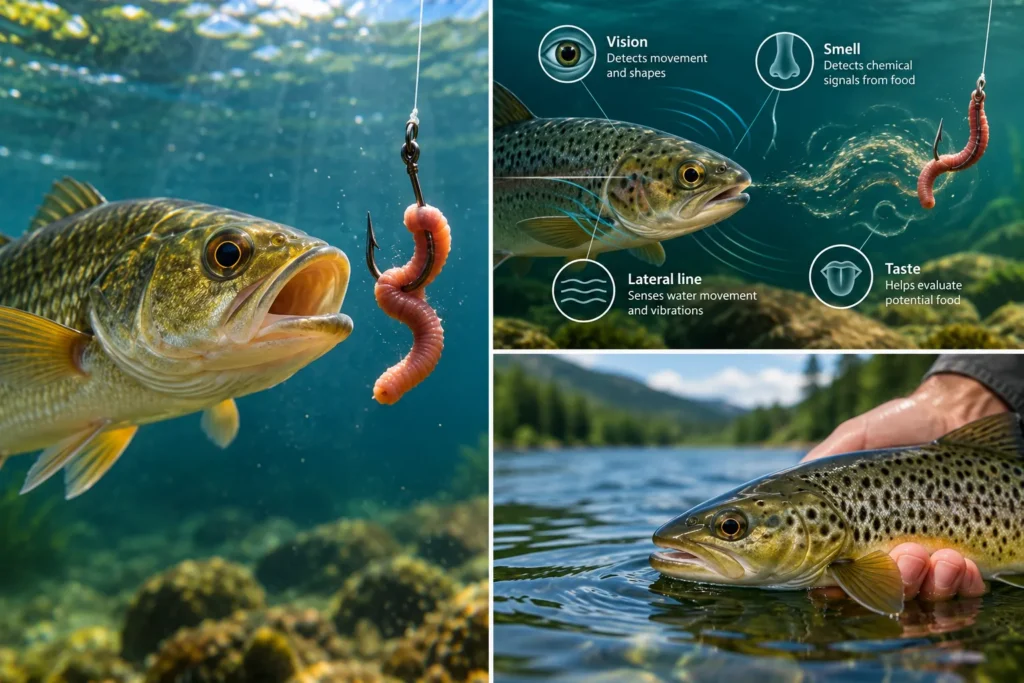
Vision: Many fish rely on eyesight to identify moving objects, detect prey, and navigate their environment. Their visual abilities differ depending on species, water clarity, depth, and available light.
Smell: Fish can detect dissolved chemical substances through specialized olfactory organs. This allows many species to identify potential food without seeing it directly.
Taste: Fish possess taste receptors that help them evaluate substances. In some species, these receptors are not confined to the mouth.
Lateral line: This sensory system detects water movement and pressure disturbances, helping fish respond to nearby movement, including that produced by potential prey.
A scientific review of fish olfaction published in PeerJ explains that chemical detection plays an important role in feeding, predator avoidance, reproduction, and navigation. Fish can respond to dissolved substances associated with food, including certain amino acids.
A fish approaching a worm therefore may be responding to several signals simultaneously rather than simply deciding that the worm looks tasty.
Can Fish See a Fishing Hook?
Yes, fish with functioning vision can potentially detect fishing hooks, but noticing an object is not the same as recognizing its danger.
A hook’s visibility depends on factors such as its size, color, position, reflected light, and the clarity of the surrounding water.
In clear water, visual details may be easier to distinguish. In muddy or poorly illuminated environments, fish may rely more heavily on other sensory information.
The worm itself can also conceal part of the hook.
Even when the metal is visible, the fish does not necessarily associate its shape with capture. That association may depend on previous encounters or learned responses.
Researchers at the University of Queensland reported in 2016 that fish behavior around simulated baited fishing gear differed between heavily fished and less-fished locations. Their findings indicated that some fish could learn to avoid hooks posing a capture risk.
This suggests that a fish’s reaction to a baited hook can reflect more than an automatic feeding response.
Why Some Fish Bite the Hook While Others Swim Away
Two fish of the same species may respond differently to an identical baited hook.
One might approach and immediately take the worm. Another might investigate cautiously before retreating.
Several factors can explain these differences.
Hunger and Feeding Motivation
A fish’s nutritional condition and current feeding motivation can influence its willingness to approach food.
However, hunger alone does not determine whether a fish will bite. Research on fish vulnerability to angling has found that encountering bait does not necessarily lead to capture.
In other words, simply placing an attractive worm in front of a fish does not guarantee a successful catch.
Previous Experiences
A fish that has been caught and released may subsequently behave differently around hooks or fishing lines.
This is especially important because fish are capable of learning associations between particular experiences and environmental signals.
Competition With Other Fish
When multiple fish compete for food, some individuals may approach quickly, potentially reducing the opportunity to examine the bait.
The effect depends on the species and circumstances. Competition does not make every fish less cautious.
Environmental Conditions
Water temperature, visibility, current, habitat, and other environmental factors can influence feeding activity.
A fish that responds eagerly to bait under one set of conditions may ignore a similar offering under another.
Can Fish Remember Fishing Hooks and Avoid Them?
Scientific research shows that at least some fish can learn to avoid fishing equipment after being caught.
A 2021 study involving juvenile red sea bream (Pagrus major) examined whether individual fish could develop avoidance behavior after experience with angling gear.
The researchers found that fish avoided fishing gear after only one or two capture experiences, even while continuing to show motivation to eat other available food.
Experienced fish commonly avoided krill attached to fishing line without necessarily avoiding krill presented on its own.
Remarkably, approximately half of the experienced fish retained the learned avoidance response two months later.
These findings are significant because they suggest that fish can learn to associate particular aspects of fishing equipment with negative experiences.
However, the results should not be generalized to every fish species or every fishing situation. Memory duration, learning ability, and responses to capture may differ substantially.
Does This Mean Fish Are Intelligent?
Fish demonstrate various forms of learning, memory, and behavioral flexibility.
Their abilities do not need to resemble human reasoning to be biologically meaningful.
For example, learning to avoid a potentially dangerous object can improve an animal’s chances of survival without requiring it to understand how the object was manufactured or why it is present.
In the fishing-hook scenario, avoiding bait attached to a line may reflect learned recognition of danger rather than human-like reasoning.
Also Read: I am a Gen Z man. How does the Nivea Men line stack up against Bulldog or Lumin?
What Happens When a Fish Eats the Worm on a Hook?
A fish that bites bait attached to a hook may be caught, but capture is not automatic.
The outcome depends on how the fish takes the bait, the position of the hook, the fishing equipment, and whether the hook catches in the fish’s tissues.
Several outcomes are possible.
| Possible outcome | What it means for the fish |
|---|---|
| The fish ignores the worm | No direct interaction with the hook occurs. |
| The fish investigates but retreats | The fish avoids contact or withdraws before capture. |
| The fish removes part of the bait | The fish may obtain food without being hooked. |
| The hook catches in the mouth | The fish may be restrained and pulled toward the angler. |
| The fish swallows the hook deeply | The risk of serious internal injury can increase. |
| The fish is caught and released | Survival depends on injury severity, handling, environmental conditions, and other factors. |
A hook that catches in the mouth may penetrate tissue and hold the fish while tension is applied through the fishing line.
The fish may struggle against this restraint, and the resulting physical exertion can produce substantial physiological stress.
Deep hooking is particularly concerning because hooks lodged in the throat or digestive tract can damage sensitive tissues and organs.
The U.S. National Park Service identifies deep hooking as an important risk associated with bait fishing and recommends methods that reduce injury and handling time when fish are intended for release.
Do Fish Feel Pain When They Are Hooked?
There is substantial scientific evidence that fish detect harmful stimuli and exhibit physiological and behavioral responses associated with injury. Whether these responses establish a subjective experience of pain comparable to human pain remains a subject of scientific investigation.
Researchers distinguish between two important concepts.
Nociception refers to the nervous system’s detection and processing of potentially damaging stimuli.
Pain includes an unpleasant subjective experience associated with actual or potential tissue damage.
The distinction matters because an animal’s withdrawal from a harmful stimulus does not, by itself, establish exactly what it consciously experiences.
A 2026 review published in Laboratory Animals described evidence from fish anatomy, nervous-system responses, behavior, and experiments involving pain-relieving drugs. The authors also identified significant remaining research gaps concerning pain assessment and treatment across fish species.
Another 2026 review in the Journal of Fish Biology examined advances in fish welfare research, including cognition, pain perception, and the welfare of fish caught in wild fisheries.
Although researchers continue to investigate the nature of fish consciousness and subjective experience, physical injuries and measurable stress responses provide strong reasons to minimize unnecessary harm.
For a fish approaching a baited hook, avoiding the hook eliminates the immediate risk of a hook-related injury.
What Would Be the Safest Choice for the Fish?
If the fish could reliably recognize the danger, leaving the bait untouched would be the safest response.
There is no need to approach the worm simply because it appears to be an easy meal.
Natural aquatic environments contain various alternative food sources, although their availability depends on habitat, season, and species.
An unhooked prey item may provide the same nutritional opportunity without introducing the specific danger of fishing gear.
The comparison is straightforward.
A free-moving worm may be a potential meal. A worm attached to a sharp metal hook presents an additional risk unrelated to its nutritional value.
Of course, wild fish do not consistently make decisions according to human assessments of safety.
Fish behavior results from the interaction of sensory information, physiological state, inherited responses, learning, and environmental conditions.
That is precisely why fishing bait can be effective even when the hook is potentially visible.
What This Situation Teaches Us About Fish Behavior
The scenario illustrates three important aspects of animal behavior.
1. An Attractive Reward Can Conceal Danger
The worm provides an incentive to approach.
The fishing hook creates an accompanying threat.
This is an example of a situation in which approaching something potentially beneficial can expose an animal to danger.
Wild animals regularly encounter competing pressures involving feeding, predator avoidance, reproduction, and survival.
2. Learning Can Change Future Behavior
Fish do not always respond identically to repeated experiences.
Research on angling avoidance shows that negative capture experiences can alter subsequent behavior around fishing gear.
This helps explain why certain fish may become less vulnerable to familiar fishing methods after exposure.
3. Human Actions Influence Wildlife Welfare
Fishing practices can affect individual fish even when the intention is to release them.
The type of hook, method of capture, amount of time spent fighting the fish, and handling techniques all influence potential harm.
Fish welfare is therefore relevant not only to commercial fishing and aquaculture but also to recreational angling.
How Anglers Can Reduce Harm to Fish
The fish’s safest option is to avoid the hook. For people who fish, the responsibility is to reduce unnecessary injury and stress.
The National Park Service provides practical guidance for recreational anglers who intend to release their catch.
Its recommendations include using appropriately sized single barbless hooks, minimizing the time a fish spends struggling, handling fish with wet hands, and returning them to the water promptly.
When a hook is lodged deeply and cannot be removed easily, the agency advises cutting the fishing line close to the hook rather than causing further injury by attempting forceful removal. This does not guarantee survival, but it may prevent additional damage.
Anglers should also consider the condition of the water.
High temperatures and other stressful environmental conditions can increase the risk associated with capture.
Responsible fishing requires following local regulations and choosing practices suited to the species and habitat.
Frequently Asked Questions
1. Should a fish eat a worm if it sees a hook?
No. If the fish could identify the hook as dangerous, avoiding the bait would be the safest option. Eating the worm could expose the fish to injury or capture.
2. Do fish know that fishing hooks are dangerous?
Some fish can learn to avoid fishing equipment after experiencing capture. However, this does not mean every fish instinctively recognizes a hook or understands its purpose.
3. Why do fish bite hooks even when they can see them?
Fish may respond strongly to food-related signals without recognizing the attached equipment as dangerous. Hunger, previous experience, species, water conditions, and competition can influence their reactions.
4. Can fish remember being caught by a hook?
Yes, studies demonstrate that some fish retain learned avoidance behavior after capture. Research involving juvenile red sea bream found that approximately half of the experienced fish retained angling-gear avoidance two months after learning.
5. Can a fish survive after swallowing a fishing hook?
Some fish survive hook-related injuries, but deeply swallowed hooks can cause serious damage and increase mortality risk. Survival depends on factors including hook placement, species, injury severity, and handling.
6. What is the main lesson of the worm-on-a-hook scenario?
The scenario demonstrates that an attractive food source is not necessarily a safe one. It also highlights fish sensory abilities, learning, memory, and the importance of reducing unnecessary harm during recreational fishing.
Final Thoughts
The statement “I am a fish and I see a tasty worm on a hook” describes a simple but scientifically meaningful conflict between feeding and survival.
A worm may represent an opportunity for food, but the attached hook introduces a potentially serious danger.
Research shows that fish possess sophisticated sensory systems, respond to changing environmental conditions, and, in at least some species, can learn to avoid fishing gear after negative experiences.
The safest outcome for the imaginary fish is therefore uncomplicated: leave the bait alone, avoid the hook, and continue searching for food elsewhere.
Also Read: I Am a College Student. Are La Roche-Posay Products Better for Acne-Prone Skin Than Neutrogena?
