


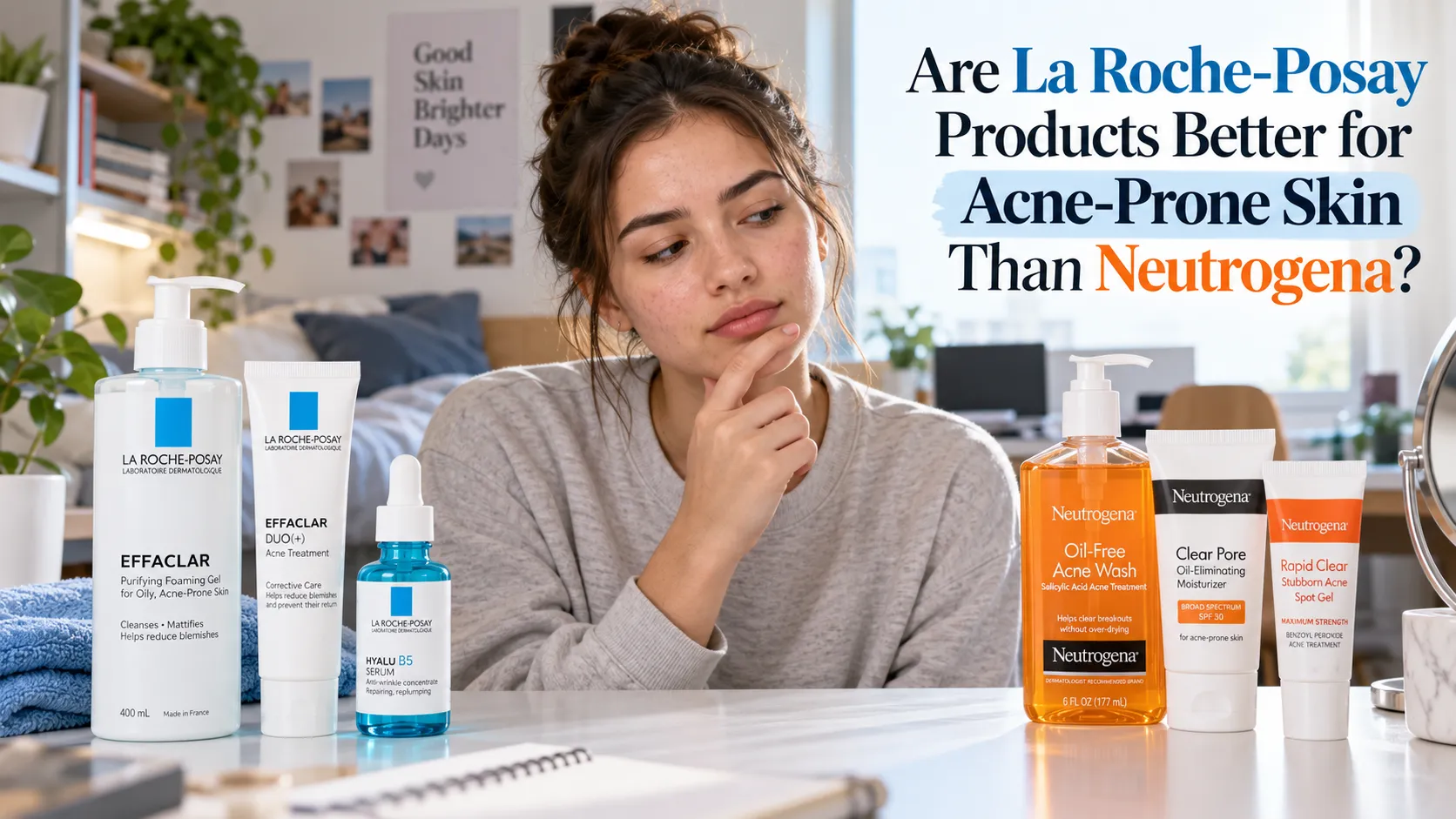
La Roche-Posay is not automatically better than Neutrogena for acne-prone skin. Both brands offer effective skincare products, but the better choice depends on your acne type, skin sensitivity, treatment needs, and budget. La Roche-Posay has appealing options for sensitive or easily irritated skin, while Neutrogena offers accessible acne treatments that can be particularly practical for college students.
If you are dealing with breakouts while managing classes, assignments, social activities, and limited spending money, choosing skincare products can feel unnecessarily complicated. Expensive products may look more promising, especially when marketed as dermatologist-tested, but a higher price does not guarantee clearer skin.
The American Academy of Dermatology (AAD) recommends acne treatments based on scientifically supported ingredients, including benzoyl peroxide, topical retinoids, and salicylic acid. These ingredients can be found in products from both brands, although their concentrations and formulations differ.
Understanding those differences is more useful than deciding which brand has the better reputation.

La Roche-Posay vs Neutrogena: Which Is Better for College Students?
For a college student with mild or moderate acne, Neutrogena may offer better value, particularly when affordability and access to proven acne medications are the priorities. La Roche-Posay may be worth considering when you prefer certain fragrance-free cleansers and moisturizers or need skincare that supports an easily irritated skin barrier.
Neither brand has been established as universally superior through independent, head-to-head clinical evidence covering its entire acne product range.
Here is how the two compare.
| Comparison factor | La Roche-Posay | Neutrogena |
|---|---|---|
| Acne treatment ingredients | Benzoyl peroxide, salicylic acid and other targeted ingredients | Benzoyl peroxide, salicylic acid and adapalene |
| Sensitive skin | Several fragrance-free, barrier-supporting options | Also offers gentle, fragrance-free options |
| Oily skin | Effaclar cleansers and targeted treatments | Oil-Free Acne Wash and other acne products |
| Dry or irritated skin | Toleriane moisturizers and gentle cleansers | Hydro Boost and Ultra Gentle products |
| Affordability | Generally positioned at a higher price point | Often offers more economical alternatives |
| Effectiveness | Depends on the specific medication and formulation | Depends on the specific medication and formulation |
| Best reason to choose | A particular formula suits your skin well | Effective ingredients at a manageable cost |
The important distinction is between acne medication and supportive skincare. A gentle cleanser or moisturizer can improve comfort and help prevent irritation, but it does not necessarily treat acne as effectively as a medication containing an appropriate active ingredient.
Understanding the Ingredients That Actually Treat Acne
Before spending money on either brand, it helps to understand what causes acne and which ingredients can address it.
Acne develops when hair follicles become blocked by excess oil and dead skin cells. Bacteria called Cutibacterium acnes and the body’s inflammatory response can contribute to red, swollen pimples.
Different ingredients target different parts of this process.
1. Salicylic Acid: Best for Clogged Pores and Blackheads
Salicylic acid is a beta-hydroxy acid (BHA) that helps remove dead skin cells and keep pores clear. It is particularly useful for blackheads, whiteheads, and some forms of mild acne.
Both brands offer cleansers containing 2% salicylic acid:
- La Roche-Posay Effaclar Medicated Acne Face Wash.
- Neutrogena Oil-Free Acne Wash.
Because both products contain the same concentration of salicylic acid, there is no reliable basis for assuming the La Roche-Posay cleanser will automatically provide better acne control.
Their other ingredients differ, however, and those differences may affect skin comfort.
2. Benzoyl Peroxide: Best for Inflamed Pimples
Benzoyl peroxide helps reduce acne-associated bacteria and is supported by strong clinical evidence.
Two relevant treatments are:
La Roche-Posay Effaclar BPO Multi-Target Acne Treatment: Contains 5.5% micronized benzoyl peroxide.
Neutrogena Stubborn Acne AM Treatment: Contains 2.5% benzoyl peroxide.
The higher concentration in La Roche-Posay’s product does not automatically mean it will deliver better results for everyone.
The AAD advises people trying nonprescription benzoyl peroxide for mild acne to consider starting at 2.5%, particularly to limit dryness and irritation.
For college students who have never used acne medication before, a lower-concentration treatment may be a more manageable starting point.
3. Adapalene: A Strong Option for Persistent Acne
Adapalene is a topical retinoid that regulates skin cell turnover, helping prevent pores from becoming clogged. It is effective against blackheads, whiteheads, and inflammatory acne.
Neutrogena sells products containing 0.1% adapalene, including its Evenly Clear Retinoid Adapalene Gel.
Unlike a typical spot treatment, adapalene is intended for regular application over acne-affected areas according to its label.
Retinoids have strong support in the AAD’s acne treatment guidelines. However, adapalene can initially cause dryness, peeling, or irritation, and it should be avoided during pregnancy.
Comparing Specific La Roche-Posay and Neutrogena Products
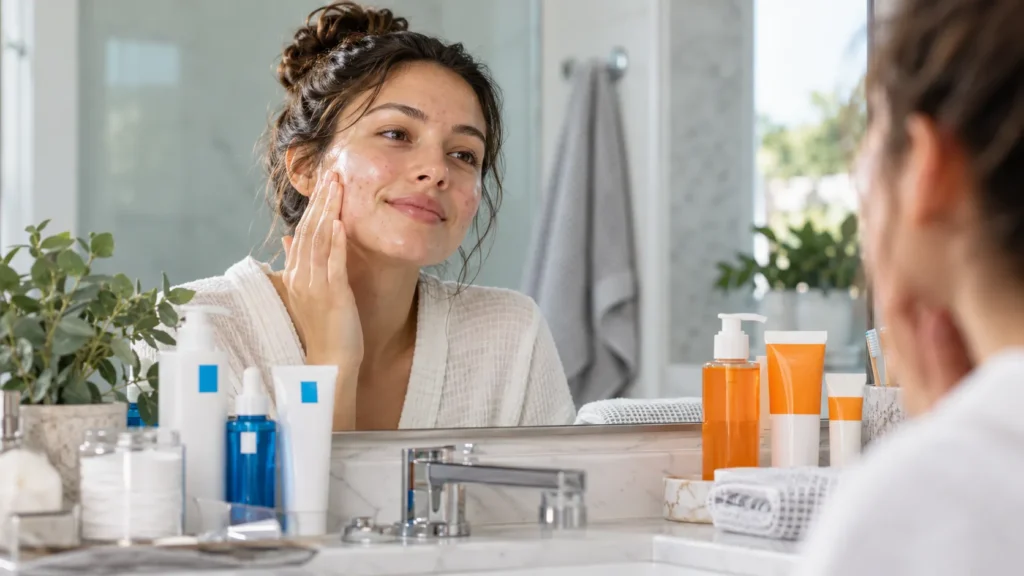
Comparing the actual formulations provides a clearer picture than comparing brand reputation.
La Roche-Posay Effaclar Medicated Cleanser vs Neutrogena Oil-Free Acne Wash
Both contain 2% salicylic acid, but their formulas differ.
La Roche-Posay includes glycerin, zinc gluconate, and lipo-hydroxy acid, alongside its cleansing ingredients. Its listed formula also contains menthol.
Neutrogena’s Oil-Free Acne Wash includes glycerin and botanical extracts, but its listed ingredients also include fragrance and dyes.
Neither cleanser should automatically be considered ideal for extremely sensitive skin. Both contain ingredients that some individuals may find irritating.
For someone with a damaged skin barrier, a gentle cleanser without acne medication may be preferable while introducing a separate leave-on treatment.
La Roche-Posay Effaclar Treatments vs Neutrogena Stubborn Acne AM
There is an important distinction between products bearing the Effaclar name.
La Roche-Posay’s older U.S. Effaclar Duo Acne Spot Treatment, containing 5.5% benzoyl peroxide, is listed as discontinued on the brand’s website.
Its newer U.S. offerings include:
- Effaclar BPO Multi-Target Acne Treatment: 5.5% benzoyl peroxide.
- Effaclar Duo+M Multi-Target Acne Treatment: 0.5% salicylic acid.
These products should not be confused. The Duo+M formulation also lists fragrance among its ingredients.
For inflamed pimples, Neutrogena’s 2.5% benzoyl peroxide treatment and La Roche-Posay’s 5.5% benzoyl peroxide treatment are more directly comparable than Neutrogena’s product and Effaclar Duo+M.
For predominantly blackheads and clogged pores, a salicylic acid formulation may be more relevant.
Always check the ingredient label and country-specific formulation before purchasing. Products with similar names are not necessarily identical.
Which Brand Is Better for Sensitive, Oily, or Combination Skin?
Sensitive and Easily Irritated Skin
La Roche-Posay’s Toleriane range includes options designed to support the skin’s moisture barrier.
For example, Toleriane Purifying Foaming Face Wash contains glycerin, ceramide NP, and niacinamide. The U.S. formulation is described as fragrance-free and suitable for normal-to-oily sensitive skin.
Neutrogena also provides gentle options, including its fragrance-free Ultra Gentle Daily Cleanser.
The practical choice depends on which formula your skin tolerates.
If your face burns after washing, feels uncomfortably tight, or develops excessive peeling, switching to another powerful acne cleanser is unlikely to solve the underlying irritation.
Oily and Acne-Prone Skin
Both brands provide products that remove surface oil and treat clogged pores.
La Roche-Posay Effaclar Medicated Acne Face Wash and Neutrogena Oil-Free Acne Wash are reasonable products to compare for oily skin.
However, oily skin does not need to be completely stripped of moisture. Excessive cleansing can cause irritation and make an acne routine harder to tolerate.
The AAD recommends gentle washing rather than aggressive scrubbing or repeated cleansing throughout the day.
Combination Skin
Combination skin commonly includes an oily forehead, nose, and chin, with drier cheeks.
Students with this skin type may benefit from using a gentle cleanser across the face, applying acne medication where appropriate, and moisturizing dry areas.
A lightweight, non-comedogenic moisturizer from either brand can help maintain comfort without requiring an expensive, multi-product routine.
Also Read: Sosoactive: What It Is and How It Operates
Is La Roche-Posay Worth the Extra Money?
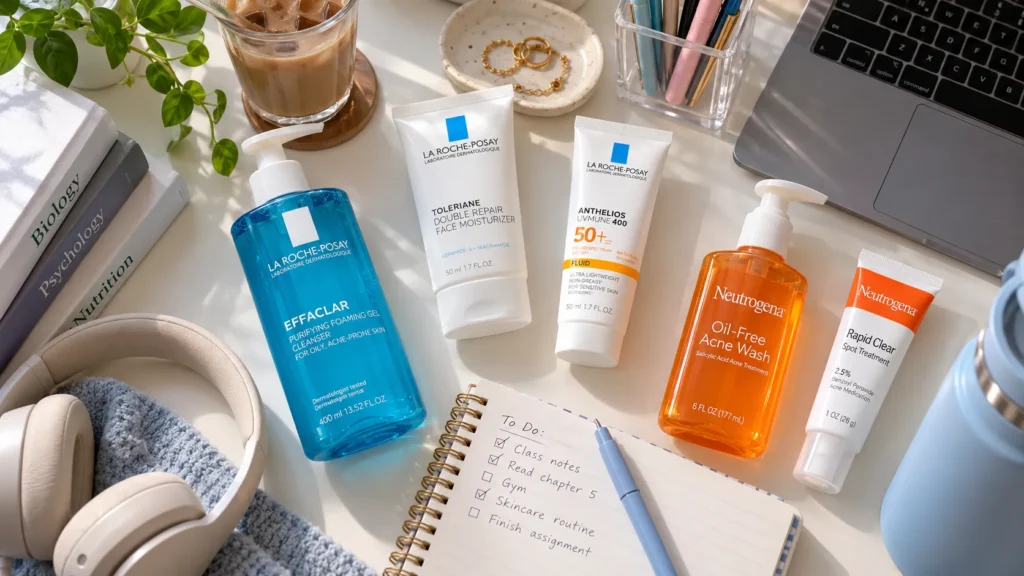
La Roche-Posay can be worth the additional expense if a particular formulation is comfortable, suitable for your skin, and helps you maintain a consistent routine.
But paying more is not a reliable way to obtain stronger acne treatment.
To illustrate the price difference, the U.S. La Roche-Posay website listed its Effaclar BPO treatment at $39.99 for 40 mL, while U.S. retailer Harris Teeter listed Neutrogena Stubborn Acne AM at $11.99 for 2 ounces. These are retail examples, not standardized prices, and availability and promotions can change.
The products also have different strengths and formulations, so this comparison demonstrates cost rather than equal effectiveness.
For a college student, a basic routine containing an appropriate acne treatment, moisturizer, cleanser, and sunscreen is often a more sensible investment than purchasing multiple premium products.
If your current Neutrogena product is helping without causing irritation, there is no evidence-based reason to replace it solely because La Roche-Posay is more expensive.
A Simple Acne Skincare Routine for College Students
An effective acne routine does not need seven or eight steps. Keeping it simple also makes it easier to follow consistently during exams, late-night study sessions, and busy mornings.
Morning Routine
Step 1: Cleanse gently.
Wash your face with a mild cleanser appropriate for your skin type.
If you already use a separate acne treatment, you may not need a medicated face wash.
Step 2: Apply your acne treatment if appropriate.
For inflammatory acne, a benzoyl peroxide product may be useful. Follow the manufacturer’s directions and begin gradually to assess skin tolerance.
Avoid layering multiple powerful acne treatments without guidance.
Step 3: Moisturize.
Choose a non-comedogenic moisturizer, even if your skin is oily.
The AAD explains that moisturizers help reduce dryness associated with medications such as benzoyl peroxide, salicylic acid, and adapalene.
Step 4: Apply sunscreen.
Use a broad-spectrum sunscreen with SPF 30 or higher. Choose a non-comedogenic, water-resistant formula for outdoor activities.
Reapply approximately every two hours while outdoors and after swimming or sweating, following the sunscreen label.
Evening Routine
At night, cleanse your skin gently and remove sunscreen or makeup.
If you are using adapalene, apply a thin layer to the affected area according to the product instructions. Introduce it cautiously because irritation is common during the adjustment period.
Follow with moisturizer as needed.
For someone beginning acne treatment, introducing one medication at a time makes it easier to recognize irritation and determine whether the treatment is helping.
Benzoyl peroxide and adapalene may be combined in treatment plans, but that does not mean a beginner needs to start both simultaneously.
Common Skincare Mistakes That Can Make College Acne Worse
A good product cannot compensate for a routine that repeatedly irritates the skin.
Several habits are particularly worth avoiding.
Changing products too frequently: Acne medications need time to work. Replacing a treatment every few days makes effectiveness difficult to assess.
Using too many active ingredients: Combining exfoliating toners, acne washes, retinoids, and benzoyl peroxide without a plan can cause excessive dryness and peeling.
Skipping moisturizer: Even oily skin can become dehydrated or irritated during acne treatment.
Scrubbing pimples: Harsh exfoliation does not remove acne from deep inside the pores and may worsen inflammation.
Picking at blemishes: Squeezing pimples can increase the risk of scarring and post-inflammatory dark marks.
Ignoring product warnings: Benzoyl peroxide can bleach fabrics, and acne medications may cause irritation. Follow their directions rather than increasing the amount to accelerate results.
These recommendations are consistent with the AAD’s guidance on avoiding skincare habits that can worsen acne.
How Long Should You Use Acne Products Before Judging Results?
Most acne treatments require several weeks of consistent use before their effectiveness becomes clear.
According to the AAD, fewer breakouts may become noticeable after approximately four to eight weeks, while more substantial clearing can take around three to four months.
A product that does not produce dramatic improvement after three days has not necessarily failed.
However, severe burning, swelling, blistering, or an allergic reaction is not something to tolerate while waiting for results. Stop the suspected product and seek appropriate medical advice.
Consider professional treatment if acne is deep, painful, causing scars, affecting your emotional well-being, or remaining troublesome despite a consistent routine.
Prescription medications may be more appropriate than repeatedly purchasing new over-the-counter products.
Frequently Asked Questions
1. Is La Roche-Posay better than Neutrogena for acne-prone skin?
Not necessarily. Both brands offer acne treatments with evidence-supported ingredients. La Roche-Posay may have a particular cleanser or moisturizer that works better for your skin, while Neutrogena may provide a more affordable medication with similar therapeutic goals.
2. Which brand is better for college students on a budget?
Neutrogena is often the more economical starting point. Its product range includes benzoyl peroxide, salicylic acid, and adapalene treatments. There is no need to pay a premium when a lower-priced product is effective and well tolerated.
3. Can I use La Roche-Posay cleanser with Neutrogena acne treatment?
Yes, products from different brands can be used together when their ingredients are compatible. For example, a gentle La Roche-Posay cleanser can be paired with a Neutrogena acne medication.
Avoid combining several medicated products unnecessarily, and introduce treatments gradually.
4. Is La Roche-Posay better for sensitive acne-prone skin?
Some La Roche-Posay Toleriane products are designed for sensitive skin, but Neutrogena also offers fragrance-free, gentle formulations.
The individual product matters more than the brand. Certain Effaclar products contain fragrance or menthol, so it is important to examine their ingredients rather than assume every La Roche-Posay product is suitable for sensitive skin.
5. Can Neutrogena clear acne as effectively as expensive skincare brands?
Neutrogena products can effectively treat certain forms of acne when they contain appropriate active ingredients and are used correctly.
The AAD’s treatment recommendations focus on medications and their supporting evidence, not premium brand status. Results still depend on acne severity, skin tolerance, and consistent use.
6. Should I see a dermatologist before choosing between the two brands?
Not everyone with mild acne needs an immediate dermatology appointment. However, professional advice is valuable when acne is painful, deep, causing scars, or not improving with appropriate nonprescription treatment.
If you are pregnant or planning pregnancy, consult a healthcare professional before using acne medications, especially topical retinoids.
Final Verdict: Which Brand Should You Choose?
For most college students, the strongest approach is to choose skincare based on ingredients, skin tolerance, and affordability rather than brand prestige.
Neutrogena is a practical starting choice when you want established acne-fighting ingredients without spending heavily. La Roche-Posay is worth considering when one of its specific formulations provides better comfort or suits your skincare needs.
You can also combine compatible products from the two brands. There is no scientific requirement to use a cleanser, moisturizer, sunscreen, and acne treatment from the same manufacturer.
The goal is not to own the most expensive skincare routine. It is to find a simple, evidence-informed routine that controls breakouts, protects your skin barrier, and fits comfortably into student life.
Also Read: Do the Driving Modes in Cadillac LYRIQ Offer Different Ranges or Battery Usages?
