


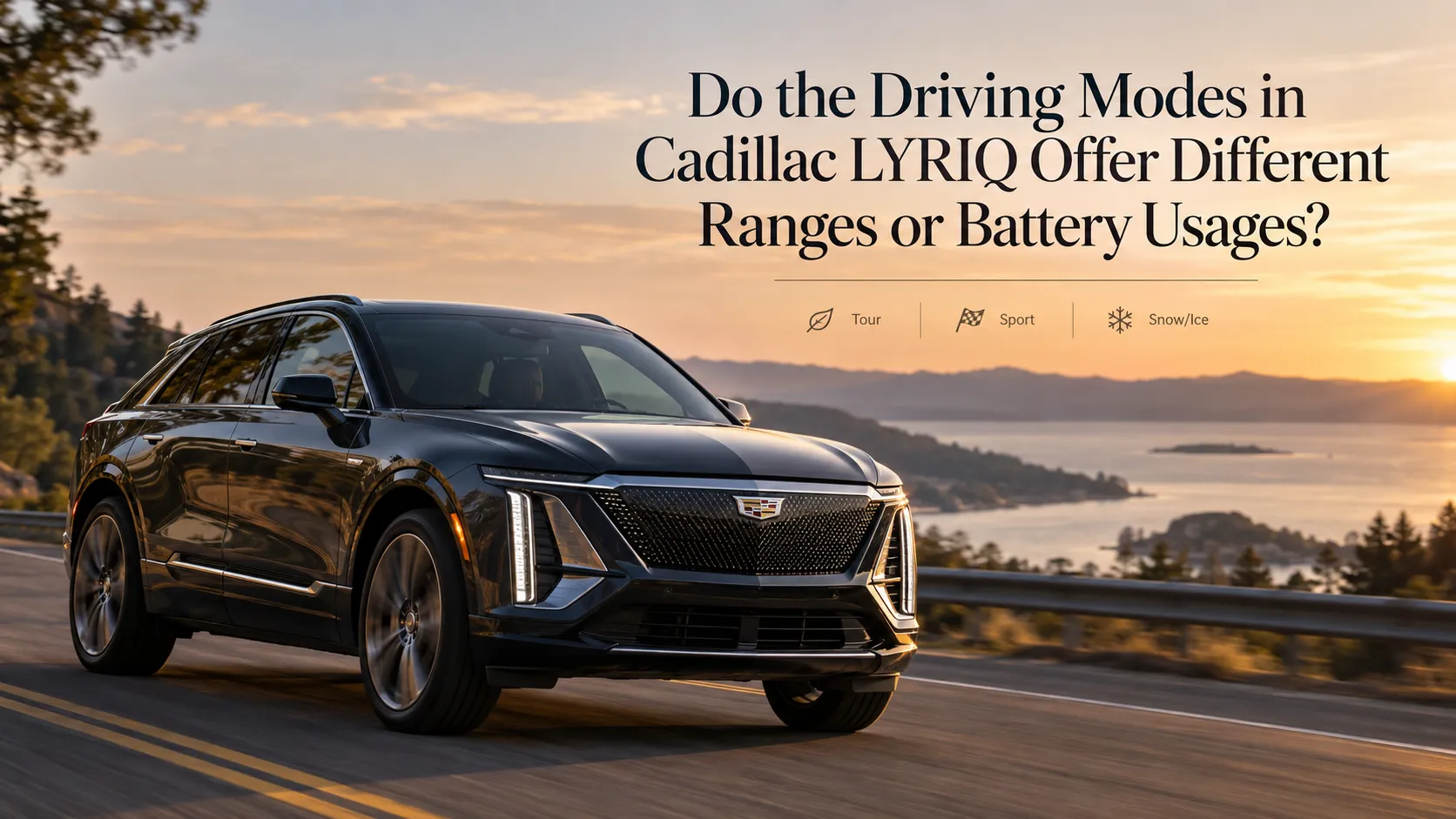
Yes, the driving modes in the Cadillac LYRIQ can affect battery consumption and real-world driving range, primarily by changing accelerator responsiveness, power delivery, traction behavior, and driving characteristics. However, Cadillac does not publish separate EPA range ratings for Tour, Sport, Snow/Ice, or My Mode, and switching between these modes does not change the battery’s physical capacity.
Tour Mode is generally the best starting point for efficient everyday driving, while Sport Mode encourages more responsive acceleration that can increase energy consumption. Snow/Ice Mode prioritizes traction rather than maximum range, and My Mode allows drivers to customize the vehicle’s behavior.
Understanding these differences is important because the Cadillac LYRIQ combines a high-capacity electric battery with several electronically controlled driving settings. Choosing an appropriate mode can improve the driving experience, but actual electricity consumption depends heavily on speed, temperature, terrain, acceleration, and climate control usage.
According to Cadillac’s official specifications, the 2026 LYRIQ offers an EPA-estimated range of up to 326 miles for the single-motor rear-wheel-drive configuration and up to 319 miles for certain dual-motor all-wheel-drive configurations. These figures apply to specific vehicle configurations, not individual driving modes.

How Do the Cadillac LYRIQ Driving Modes Work?
The Cadillac LYRIQ uses an electronic Driver Mode Control system to adjust how the vehicle responds to different driving conditions. Unlike a traditional gasoline-powered vehicle, which may change engine and transmission behavior, the LYRIQ manages the response of its electric propulsion system and other electronically controlled components.
Depending on the model year, trim, and equipment, these adjustments can include accelerator sensitivity, steering effort, suspension settings, braking feel, and electric motor sound enhancement.
The main driving modes on the standard LYRIQ are Tour, Sport, Snow/Ice, and My Mode. The performance-oriented LYRIQ-V also offers V-Mode and Velocity Max functionality.
Cadillac LYRIQ Driving Mode Comparison
| Driving mode | Primary purpose | Potential effect on battery usage |
|---|---|---|
| Tour | Smooth, balanced everyday driving | Generally the best baseline for efficient driving |
| Sport | Faster accelerator response and sportier handling | May increase consumption when driven aggressively |
| Snow/Ice | Improved control on slippery surfaces | Depends on traction, temperature, and road conditions |
| My Mode | Personalized driving characteristics | Depends on selected settings and driving behavior |
| V-Mode (LYRIQ-V) | Customizable performance-oriented driving | Can increase consumption during performance driving |
| Velocity Max (LYRIQ-V) | Maximum available propulsion performance | Extended use reduces range, according to Cadillac |
The important distinction is that driving modes influence how the vehicle uses energy rather than providing separate batteries or fixed mileage allowances. Cadillac’s official owner’s manual describes their operating characteristics but does not assign a specific battery-consumption percentage to each standard mode.
Tour Mode: The Best Choice for Everyday Efficiency
Tour Mode is the standard Cadillac LYRIQ driving setting, designed to provide comfortable acceleration, predictable handling, and a smooth ride during normal city and highway driving.
It balances steering response, vehicle control, and ride comfort without emphasizing aggressive performance.
Does Tour Mode Save Battery Power?
Tour Mode can help drivers maintain efficient driving habits because its accelerator behavior is less performance-focused than Sport Mode. A smoother response makes it easier to accelerate gradually and avoid unnecessary bursts of power.
That does not mean Tour Mode automatically produces a fixed increase in range. A driver accelerating aggressively in Tour Mode can consume more electricity than someone driving gently in Sport Mode.
For most owners, Tour is the most sensible default because it provides sufficient performance without encouraging excessive acceleration.
Cadillac’s general Driver Mode Control guidance also identifies Tour/Normal as the most economical everyday setting.
When Should You Use Tour Mode?
Tour Mode is suitable for daily commuting, city traffic, relaxed highway travel, family trips, and long-distance journeys where smoothness and predictable energy usage matter.
When combined with moderate driving speeds, properly inflated tires, and appropriate regenerative braking, it provides a practical foundation for maximizing the LYRIQ’s range.
Sport Mode: Does Better Performance Use More Battery?
Sport Mode makes the Cadillac LYRIQ feel more responsive by adjusting accelerator calibration and steering behavior. Depending on equipment, it can also modify suspension tuning, electric vehicle sound enhancement, and adaptive cruise control characteristics.
The vehicle responds more immediately to driver inputs, creating a sportier driving experience.
How Sport Mode Affects Energy Consumption
Sport Mode can lead to greater battery consumption when its sharper acceleration response encourages drivers to request more power frequently.
Electric motors can deliver substantial torque almost instantly. Rapid acceleration requires a high level of electrical power, even though the vehicle may reach its desired speed quickly.
However, selecting Sport Mode does not necessarily cause a dramatic or measurable range reduction by itself. If two identical LYRIQs travel at the same speed, along the same route, under comparable conditions, with similar acceleration patterns, their energy usage may be quite close despite different mode selections.
Cadillac has not published a verified percentage showing that Sport Mode reduces standard LYRIQ range by a particular amount. Claims that it always decreases range by 10%, 15%, or another fixed figure should therefore be treated as unverified.
The practical difference is how the driver uses the increased responsiveness, rather than a guaranteed battery penalty simply for selecting the setting.
Snow/Ice Mode: Traction Matters More Than Range
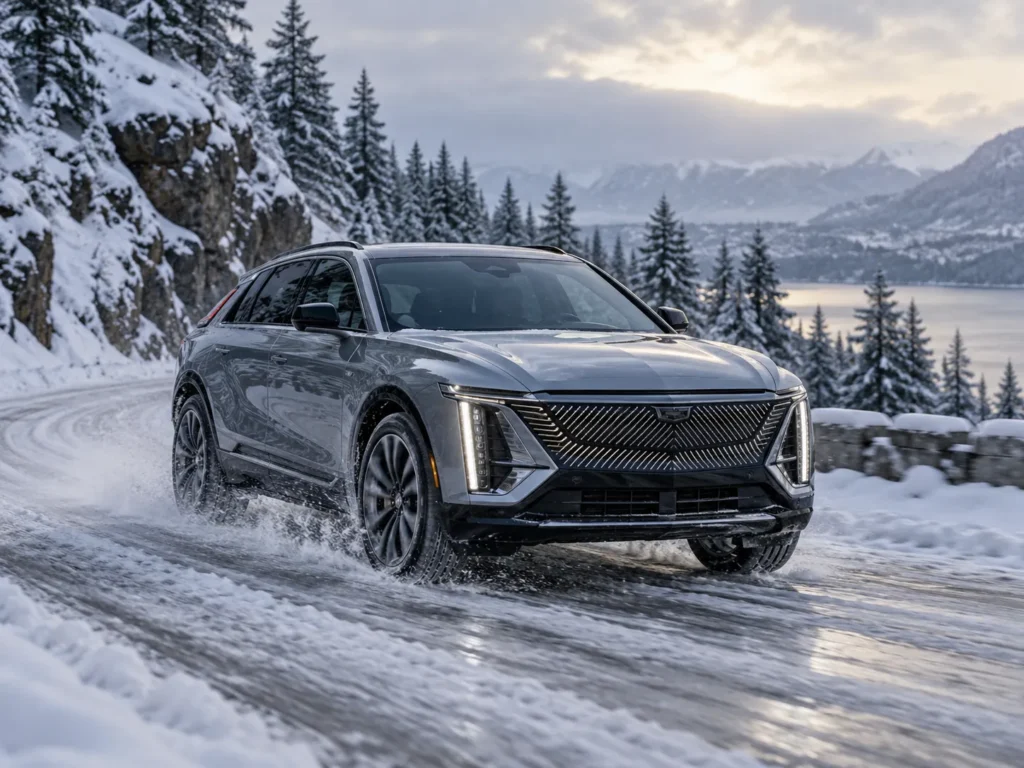
Snow/Ice Mode adjusts the LYRIQ’s accelerator response to help control wheelspin on slippery roads. On equipped vehicles, it also modifies the operation of the electric all-wheel-drive system.
The purpose is to deliver power more controllably where snow, ice, or reduced traction could make abrupt acceleration dangerous.
Does Snow/Ice Mode Improve Battery Efficiency?
Snow/Ice Mode may encourage smoother acceleration, but it is not a dedicated energy-saving setting. Any efficiency benefit from gentler power delivery can be offset by the additional energy required during cold-weather driving.
Cold temperatures affect electric vehicles in several ways. Battery performance can change, the passenger compartment requires heating, and snow-covered roads may increase rolling resistance.
The U.S. Department of Energy confirms that low temperatures, cabin heating, and driving conditions can substantially affect electric vehicle range.
Consequently, Snow/Ice Mode should be chosen primarily for safer, more controlled driving on slippery surfaces, rather than as a way to increase mileage.
It is also important to understand that this mode cannot overcome the limitations of inadequate tires or unsafe speeds. Winter tires, gentle steering, appropriate braking, and additional following distance remain essential in severe conditions.
My Mode: Can You Customize the LYRIQ for Better Range?
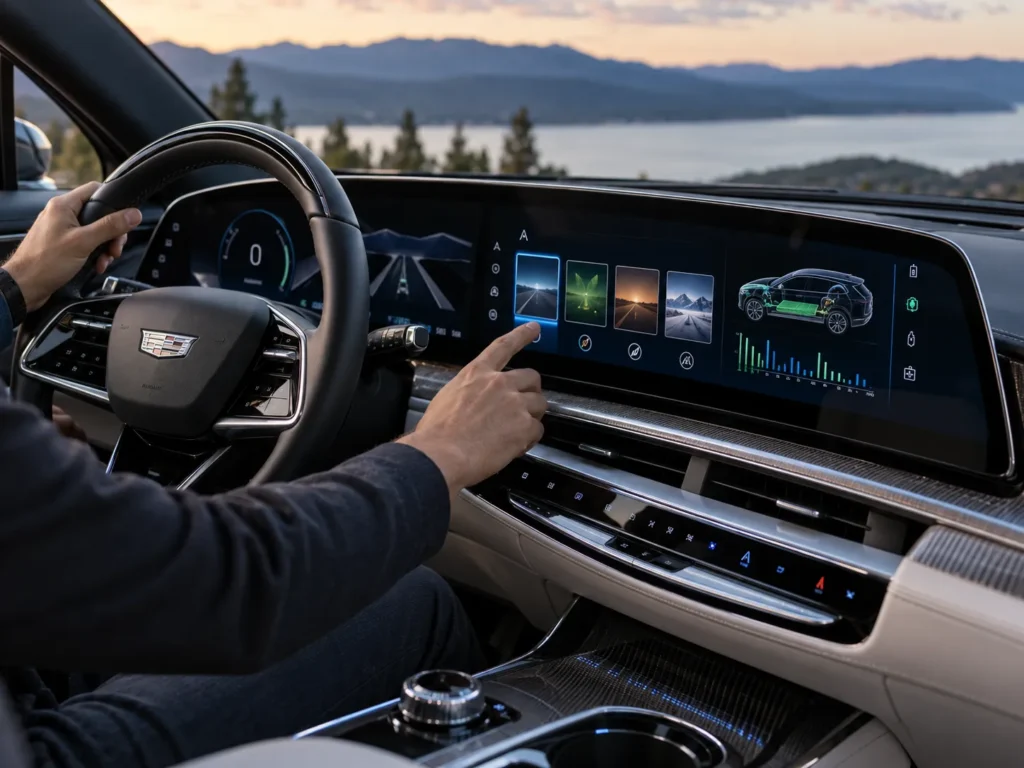
My Mode allows Cadillac LYRIQ drivers to personalize several driving characteristics without using a fully predefined performance setting.
According to the 2026 LYRIQ owner’s manual, available customization options include:
- Acceleration Feel: Relaxed, Tour, or Sport.
- Brake Feel: Tour or Sport.
- Steering: Tour or Sport.
- Suspension: Tour or Sport, where supported.
- Motor Sound: Different sound profiles depending on the model.
Drivers interested in efficiency may prefer the Relaxed acceleration setting because it provides gentler accelerator response. This can make smooth driving easier, particularly in congested traffic.
However, Relaxed acceleration is not an officially rated economy mode. It changes how the vehicle responds to accelerator inputs rather than guaranteeing a particular reduction in electricity consumption.
For a comfortable daily setup, Relaxed acceleration combined with Tour-style steering and suspension is a reasonable starting point. The most important factor remains how consistently the driver avoids unnecessary acceleration and braking.
LYRIQ-V Performance Modes and Battery Consumption
The Cadillac LYRIQ-V adds performance-oriented features that distinguish it from the standard model.
V-Mode allows drivers to customize steering, suspension, acceleration, braking, motor sound, and certain performance-control systems.
The LYRIQ-V also offers Velocity Max, which increases available propulsion performance. Cadillac specifically states in its 2026 owner’s manual that extended use of Velocity Max reduces vehicle range and that the feature is not designed for daily use.
Unlike the more nuanced efficiency differences between standard driving modes, this is an explicit manufacturer warning about a performance setting.
Velocity Max does not replace the selected driving mode. Instead, it overrides certain propulsion settings to provide additional motor torque. Its availability can also be restricted when battery charge is low.
What Is the Actual Cadillac LYRIQ Battery Range?
The Cadillac LYRIQ’s official driving range depends on its powertrain and vehicle configuration, not simply whether Tour or Sport Mode is selected.
For the U.S.-market 2026 Cadillac LYRIQ, the published EPA-estimated figures are:
| 2026 Cadillac LYRIQ configuration | EPA-estimated range |
|---|---|
| Single-motor RWD | 326 miles |
| Dual-motor AWD with standard 11.5 kW onboard charging | 319 miles |
| Dual-motor AWD with available 19.2 kW onboard charging | 303 miles |
| LYRIQ-V dual-motor AWD | 285 miles |
Source: Cadillac’s official 2026 U.S. LYRIQ specifications. Figures represent full-charge estimates under standardized testing, not guaranteed real-world distances.
Cadillac lists a rated battery energy capacity of 102 kWh for the 2026 LYRIQ platform. The different official ranges reflect vehicle configuration and efficiency characteristics rather than different drive-mode-specific battery capacities.
The onboard charging specification deserves particular attention. The difference between the 319-mile and 303-mile AWD configurations should not be interpreted as proof that faster AC charging directly drains the battery while driving. These are published ratings for differently equipped configurations.
Likewise, the LYRIQ-V’s 285-mile rating should not be treated as the range a standard LYRIQ automatically receives when Sport Mode is activated. The LYRIQ-V is a separate performance vehicle with different hardware and specifications.
Also Read: TheJavaSea.me Leaks AIO-TLP371: What You Need to Know
What Affects Cadillac LYRIQ Range More Than Driving Modes?
Driving modes influence vehicle behavior, but several other factors can have a larger impact on actual electricity consumption.
1. Highway Speed
Higher speeds increase aerodynamic resistance, requiring more energy to move the vehicle through the air.
A LYRIQ driven continuously at high highway speeds may consume substantially more electricity than the same vehicle traveling at moderate speeds, regardless of whether Tour or Sport Mode is selected.
2. Acceleration and Braking
Repeated hard acceleration consumes additional energy. Frequent unnecessary braking can also waste energy that might otherwise have been conserved through smoother driving.
Cadillac recommends gradual acceleration, anticipating traffic conditions, and avoiding unnecessary changes in speed.
3. Heating and Air Conditioning
Heating or cooling the passenger compartment requires electricity from the battery.
Cold weather is particularly important because energy may be needed to warm both the cabin and vehicle systems. Preconditioning the cabin while connected to external power can reduce the amount of battery energy needed after departure.
4. Road Conditions and Terrain
Steep climbs, heavy cargo, towing, and unfavorable road surfaces can increase energy consumption.
Traveling downhill may allow regenerative braking to recover some energy, although not all energy spent climbing can be recovered.
5. Tires and Vehicle Configuration
Tire pressure, wheel design, tire selection, and vehicle weight can influence rolling resistance and efficiency.
For that reason, comparing the range of two LYRIQs with different equipment is not necessarily an accurate way to measure the effect of their driving modes.
These factors are consistent with Cadillac’s efficiency guidance and the U.S. Department of Energy’s explanation of electric vehicle range variability.
Does Regenerative Braking Increase Cadillac LYRIQ Range?
Regenerative braking allows the LYRIQ to recover some of its kinetic energy during deceleration and store that electricity in the high-voltage battery.
The vehicle provides two related features: One-Pedal Driving and Regen on Demand.
One-Pedal Driving allows the driver to control acceleration and much of the vehicle’s deceleration using the accelerator pedal. Cadillac also offers different deceleration levels on supported configurations.
Regen on Demand uses a steering-wheel paddle to increase regenerative deceleration when needed.
Both can help recover energy, particularly in stop-and-go traffic. However, neither creates electricity without an energy cost. Avoiding unnecessary braking through anticipation and smooth driving is still important.
Cadillac also notes that regenerative braking can be limited when the battery is cold or nearly fully charged.
For slippery roads, Cadillac advises against using One-Pedal Driving and the Regen on Demand paddle. Drivers should follow the owner’s manual and use the regular brakes as necessary.
How to Check Which LYRIQ Driving Mode Uses Less Battery
Rather than relying on unsupported estimates, owners can use the LYRIQ’s energy information displays to compare actual efficiency.
The 2026 owner’s manual describes an Energy Info feature within the Vehicle Status app. Depending on equipment, it can show total energy usage, driving energy consumption, climate-related consumption, and efficiency over a recent driving distance.
For a meaningful comparison, follow this process:
- Choose a familiar route with relatively consistent traffic and road conditions.
- Record the starting battery percentage and trip efficiency.
- Complete the route in Tour Mode, driving normally and safely.
- Repeat the route in Sport Mode under comparable conditions.
- Compare the reported energy consumption, ideally in kWh per 100 miles or miles per kWh.
- Repeat the comparison over several journeys to reduce the effect of unusual traffic or weather.
For example, if the vehicle consumes 30 kWh over 100 miles, its efficiency is 30 kWh/100 miles, equivalent to approximately 3.33 miles per kWh. This is an illustrative calculation, not a measured LYRIQ result.
Comparisons should focus on actual energy consumed over comparable distances rather than just dashboard range predictions. A single journey is unlikely to isolate the effect of a driving mode perfectly.
Practical Tips for Maximizing Cadillac LYRIQ Battery Range
The most effective approach combines sensible mode selection with established EV efficiency practices.
For everyday travel, use Tour Mode or configure My Mode with a comfortable acceleration response. Accelerate progressively and maintain a steady speed when safe.
On highways, prioritize reasonable speeds and smooth traffic flow instead of assuming a particular mode will compensate for aggressive driving.
In cold weather, precondition the cabin while plugged in when possible. Heated seats can also be more energy-efficient than increasing whole-cabin heating, although comfort and visibility should never be compromised.
Maintain recommended tire pressures, avoid carrying unnecessary weight, and use regenerative braking appropriately.
For long journeys, plan charging stops around actual conditions and a suitable battery reserve rather than relying exclusively on the maximum advertised EPA range.
Frequently Asked Questions
1. Which Cadillac LYRIQ driving mode offers the longest range?
Tour Mode is generally the most practical choice for efficient everyday driving. However, Cadillac does not provide separate EPA range ratings by driving mode, so there is no verified mileage advantage that applies universally.
2. Does Sport Mode drain the LYRIQ battery faster?
Sport Mode can increase battery consumption when drivers take advantage of its sharper acceleration response. Smooth driving in Sport Mode may produce similar efficiency to Tour Mode under comparable conditions.
3. Does Snow/Ice Mode use more electricity?
Not necessarily. Snow/Ice Mode changes power delivery to improve traction, but cold temperatures, heating demands, and challenging road conditions can increase energy consumption regardless of the selected mode.
4. Does switching driving modes change the LYRIQ’s battery capacity?
No. Driving modes adjust the vehicle’s electronic operating characteristics. They do not change the battery’s rated physical energy capacity or create additional stored electricity.
5. Can My Mode improve Cadillac LYRIQ efficiency?
My Mode can make efficient driving easier by allowing a gentler accelerator response. Nevertheless, it is not a guaranteed range-extending feature, and actual savings depend on driving behavior and conditions.
6. Can the Cadillac LYRIQ achieve its full EPA-estimated range in Sport Mode?
It is possible for real-world range to approach or even exceed an EPA estimate under favorable conditions, but no particular result is guaranteed. The EPA figure is not a Sport Mode-specific rating, and frequent high-power acceleration can reduce the distance achievable on a charge.
Final Verdict: Do Cadillac LYRIQ Driving Modes Really Affect Range?
Cadillac LYRIQ driving modes can influence battery usage, but they do not provide fixed, officially rated ranges for each setting.
Tour Mode is the sensible everyday efficiency choice, Sport Mode emphasizes responsiveness, Snow/Ice Mode prioritizes traction, and My Mode allows personalized vehicle behavior. On the LYRIQ-V, prolonged Velocity Max use is specifically identified by Cadillac as a cause of reduced range.
For owners seeking maximum mileage, driving habits, vehicle configuration, temperature, speed, and efficient climate control usage are generally more important than the selected mode alone.
The best approach is to choose the mode appropriate for road conditions, monitor actual energy consumption, and adapt driving behavior to preserve range without compromising safety.
Also Read: Sosoactive: What It Is and How It Operates
