


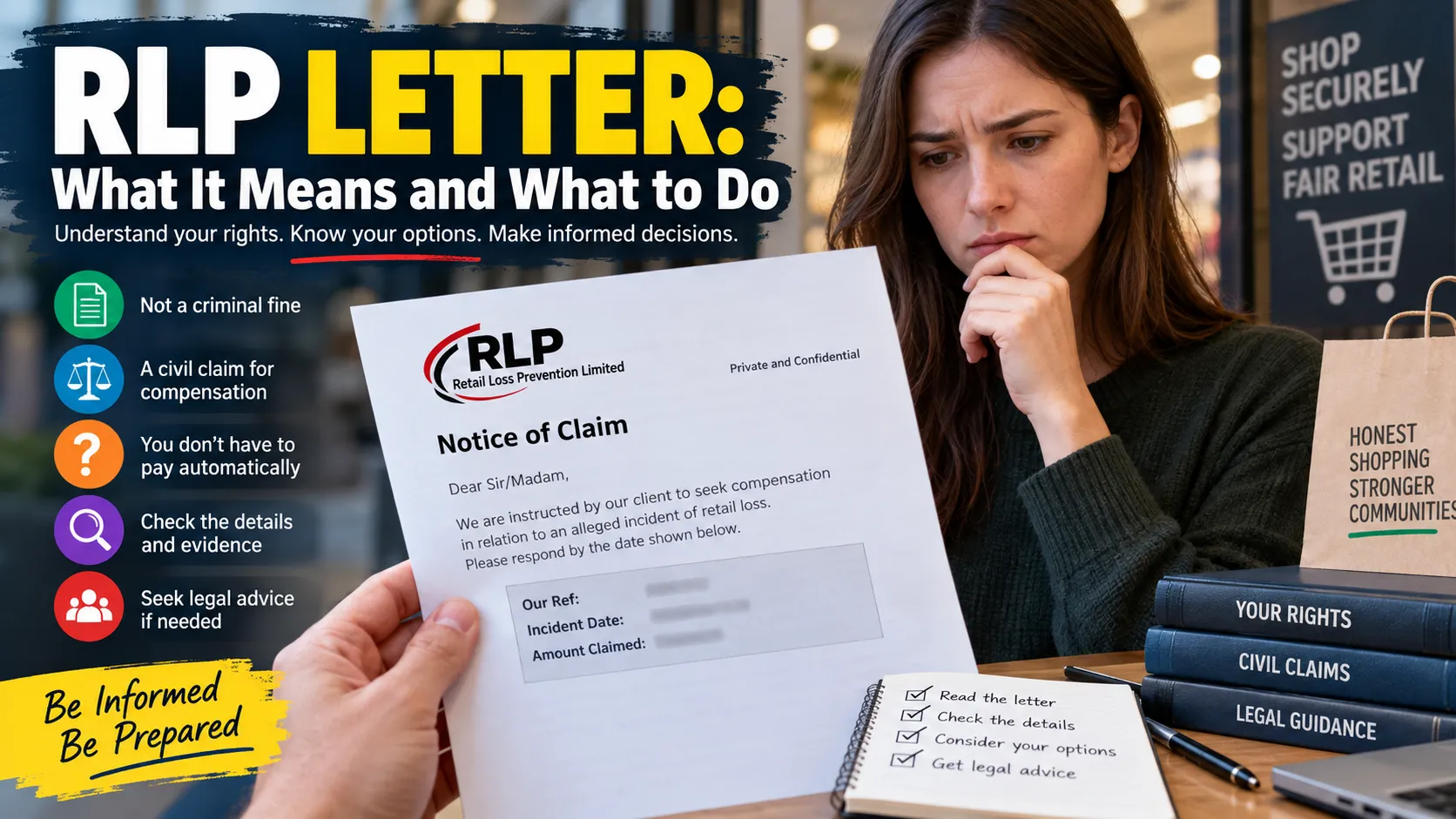
An RLP Letter usually refers to correspondence from Retail Loss Prevention Limited after an alleged incident such as shoplifting, retail theft, fraud, employee theft, or another event said to have caused a retailer financial loss. It is normally a civil recovery demand, not a criminal fine, court judgment, or automatic proof that the amount requested is legally owed.
Receiving one can still have legal consequences if the retailer ultimately starts court proceedings. The safest approach is to understand exactly what is being claimed, preserve the documents, examine the evidence and claimed losses, and obtain legal advice where the allegation or amount is disputed.
What Is an RLP Letter?
RLP stands for Retail Loss Prevention Limited, a UK company providing civil recovery services to businesses. Companies House records Retail Loss Prevention Limited, company number 04802733, as an active private company incorporated on 18 June 2003.
RLP explains that retailers use its services to seek compensation for losses allegedly resulting from wrongdoing. Citizens Advice specifically identifies Retail Loss Prevention as one of the organisations that may send demands on behalf of retailers following accusations such as shoplifting or employee theft.
A typical RLP Letter may identify:
- the retailer or business making the claim
- the date and location of the alleged incident
- the type of alleged wrongdoing
- goods or money said to have been lost
- staff, administration or security costs
- the compensation requested
- a deadline for responding or paying
- possible civil court action if the matter remains unresolved
The precise wording and amount can vary considerably between cases.
Is an RLP Letter a Fine?
No. An RLP Letter is generally not a criminal fine.
RLP itself describes the process as a claim for damages rather than a fine or ordinary debt. Civil proceedings are separate from criminal proceedings, meaning a retailer may pursue compensation regardless of whether police attended or criminal charges were brought.
This distinction is important.
| Document or action | What it normally means |
|---|---|
| RLP Letter | Private civil demand for compensation |
| Police fixed penalty or other criminal disposal | Part of the criminal justice process |
| Court claim form | Formal civil proceedings have begun |
| County Court Judgment | A court has formally determined that money is owed |
| Bailiff enforcement | Enforcement that normally follows an enforceable court judgment or other legal authority |
A demand from RLP therefore does not have the same status as an order issued by a court.
Do You Have to Pay an RLP Letter?
Not automatically. Receiving the letter does not itself establish that the retailer is legally entitled to the amount requested.
Citizens Advice states that a business can recover compensation only if it can prove its entitlement in court. It must establish the underlying liability and show that the losses claimed are legally recoverable.
The answer in any individual case depends on factors such as:
- what actually happened
- whether the allegation is admitted or disputed
- CCTV, witness statements or other evidence
- whether goods were recovered
- whether goods were damaged or became unsaleable
- whether staff were genuinely diverted from normal duties
- whether measurable additional costs were incurred
- any police caution, conviction or admission
- how the requested figure was calculated
A person should therefore avoid assuming either that every RLP demand must be paid or that every demand can safely be ignored.
What Can a Retailer Claim For?
A retailer may potentially claim compensation for actual losses caused by wrongful conduct.
Citizens Advice gives examples including the value of stolen cash or goods, investigation costs, administration expenses and some security-related costs. However, it also states that such costs must be reasonable and that staff, administration and security costs must be proved in relation to the individual case rather than simply imposed as fixed costs.
RLP describes its claims somewhat differently. Its current website says claims may contain contributions towards staff time, administration, security measures and goods that were not recovered or could not be resold. RLP argues that a contribution-based approach can be lawful where the amount does not exceed the retailer’s actual losses.
That difference between RLP’s position and the guidance published by Citizens Advice is one reason the breakdown of the claimed sum matters.
Recovered Goods Do Not Automatically End the Issue
People sometimes assume there can be no civil claim when the retailer recovered everything.
That is too broad. A business may still allege that the incident caused additional losses. Citizens Advice confirms that civil proceedings are possible even where the goods were recovered.
The more important legal question is whether the retailer can demonstrate compensable losses that were actually caused by the incident.
Why the 2012 Oxford RLP Case Is Important
One of the most significant cases concerning this type of retail civil recovery claim is A Retailer v Ms B & Ms K, decided in Oxford County Court on 9 May 2012 by His Honour Judge Charles Harris QC.
The defendants admitted taking goods, which were recovered undamaged. The retailer sought £137.50 consisting of £82.50 for staff and management time, £24.75 in administration costs and £30.50 representing security and surveillance costs.
The retailer did not succeed.
The judge found that the security employees were carrying out the security duties for which they were already employed. There was no evidence that the retailer’s business had suffered significant disruption, that non-security staff had been diverted, or that the security and administration expenditure was caused specifically by the defendants’ actions. The claims were therefore dismissed.
The judgment also recognised that genuinely attributable losses could potentially be recoverable. Examples discussed included lost goods, physical damage, specific additional expenses and staff being diverted from their normal revenue-producing work.
The decision came from a County Court and should not be treated as a binding appellate precedent governing every future case. Its importance lies in illustrating a basic issue that remains highly relevant: a claimant seeking damages must be able to connect the claimed loss to the defendant’s conduct.
Also Read: Frehf Explained: Meaning, Framework, and What Is Verified
RLP Letter and Civil Liability vs Criminal Proceedings
Civil recovery and criminal prosecution operate separately.
A retailer does not necessarily need a criminal conviction before pursuing a civil claim. RLP states that even where the police take no action, a civil case can still be pursued using the civil standard of proof. Citizens Advice similarly explains that a retailer may pursue civil compensation separately from criminal proceedings.
The standards of proof are also different. Criminal allegations normally require proof beyond reasonable doubt, while civil liability is generally determined on the balance of probabilities, meaning the court decides which version is more likely than not.
A police caution, admission or criminal conviction can consequently become relevant evidence in a later civil claim.

Does an RLP Letter Give You a Criminal Record?
An RLP Letter by itself does not create a criminal record.
RLP explicitly states that its civil recovery process is separate from criminal proceedings and that conclusion of a civil claim does not itself give someone a criminal record.
Whether someone has a criminal record depends on what happened separately through the police and criminal justice system, such as a conviction, caution or another recorded disposal.
Paying an RLP civil demand should therefore not be confused with paying a criminal fine.
Can an RLP Letter Affect Your Credit Score?
The letter itself is not a County Court Judgment and does not automatically damage a credit file.
The position can change if a retailer issues a court claim, succeeds and obtains a CCJ. GOV.UK explains that a County Court Judgment is a formal court determination that money is owed. Most registered judgments remain on the Register of Judgments, Orders and Fines for six years, although a judgment paid in full within one month can be removed from the register.
This creates an important distinction:
RLP demand → not a CCJ
Court proceedings → potential CCJ if the claimant succeeds or a claim goes unanswered
Actual court documents should never be ignored. HM Courts & Tribunals Service warns that failing to respond to a money claim by its deadline can allow a claimant to seek judgment against the defendant.
What Should You Do After Receiving an RLP Letter?
There is no universal response suitable for every RLP case. Citizens Advice recommends considering both the strength of the evidence and whether the losses being claimed are reasonable before deciding what to do.
1. Check That the Letter Is Genuine
Confirm the sender, case reference, retailer, incident date and payment details.
Retail Loss Prevention currently publishes its official contact information on its own website. Where there is any doubt, contact the organisation through independently verified details rather than relying on a phone number or payment link contained in an unexpected message.
2. Keep Every Document
Keep the original letter, envelope, emails and any later correspondence.
Also preserve anything relating to the underlying incident, such as receipts, photographs, payment records, police paperwork or communications with the retailer.
3. Read Exactly What Is Alleged
Separate the allegation itself from the money being demanded.
Someone might agree that an incident occurred but dispute the amount claimed. Another person may dispute both liability and the factual allegation. Those are different legal positions.
4. Examine the Breakdown of the Amount
Look for specific figures for:
- missing or damaged goods
- staff time
- administration
- security
- investigation
- other claimed losses
The Civil Procedure Rules’ general pre-action guidance says that, before litigation, a claimant should normally explain the basis of the claim, summarise the relevant facts, state what is being sought and explain how a monetary amount has been calculated.
5. Raise Genuine Disputes Clearly
If important facts are incorrect, explain what is disputed and retain evidence supporting your account.
RLP’s own published guidance says it will investigate representations about mistakes, lack of intention and other potential defences.
Because statements made during correspondence can later become relevant if proceedings are issued, anyone facing a serious allegation should consider obtaining legal advice before making detailed admissions.
6. Do Not Ignore Court Papers
An ordinary demand letter and a court claim are not the same thing.
If documents arrive from HM Courts & Tribunals Service or a court, check the response deadline immediately. Failure to respond can lead to judgment being entered even where the underlying claim could otherwise have been defended.
Should You Ignore an RLP Letter?
Ignoring an RLP Letter is possible, but it carries risk.
Citizens Advice identifies ignoring the demand as one possible course of action while making clear that further letters are likely and there is no guarantee the retailer will not commence court proceedings. It also lists disputing liability, negotiating an offer and paying as possible responses depending on the circumstances.
For that reason, blanket online advice stating that people should “always ignore RLP” is too simplistic.
Equally, a demand should not be treated as automatically enforceable merely because it threatens legal proceedings.
What Is a Letter Before Claim?
Some correspondence may be described as a Letter Before Claim, Letter of Claim or similar wording.
This generally indicates that the claimant is presenting the dispute as being at the pre-court stage. Under the Civil Procedure Rules, parties are ordinarily expected to exchange enough information to understand each other’s position and explore whether litigation can be avoided. A claimant’s letter should normally explain the factual and legal basis of the case and, where money is sought, how the figure has been calculated.
The significance of the exact document therefore matters. An initial payment request, formal pre-action letter and actual County Court claim should not be treated as interchangeable.
Can Debt Collectors or Bailiffs Become Involved?
RLP’s data notice states that information may be passed to external solicitors, enquiry agents and debt-recovery specialists where considered necessary for pursuing a claim.
A debt-recovery letter is not the same as bailiff enforcement.
For ordinary County Court enforcement, a judgment normally has to exist before court bailiffs can be used to enforce the judgment. HMCTS explains that once a claimant has obtained a CCJ, enforcement options can include asking the court to send bailiffs.
This is another reason to distinguish routine collection correspondence from genuine court documents.
What Information Does RLP Hold About You?
RLP says incident information is normally supplied by its retailer client. Its published data notice states that the retailer acts as the data controller for the original incident data while RLP processes the information in connection with the civil claim. It says information may also be shared with relevant solicitors or recovery specialists.
RLP’s notice currently states a retention period of up to six years for cases in England, Wales and Northern Ireland and five years in Scotland, subject to the circumstances described in its notice.
Can You Ask to See the Data?
Yes.
The Information Commissioner’s Office explains that individuals have a right to request copies of personal information held about them through a subject access request, commonly called a SAR. A request can normally be made in writing or verbally, and organisations generally have one month to respond unless an extension is permitted.
Citizens Advice also notes that people told their information is held on a dishonesty-related database have the right to find out what information is being held about them.
When Professional Legal Advice Is Especially Important
Independent advice becomes particularly useful when:
- the allegation is completely disputed
- the requested amount is substantial
- multiple incidents are alleged
- RLP alleges previous incidents after reviewing CCTV
- you have received a formal Letter Before Claim
- solicitors become involved
- police proceedings are continuing
- you received a caution or were convicted
- employment-related theft is alleged
- the matter could affect professional registration or immigration issues
- actual County Court papers have arrived
Citizens Advice specifically recommends speaking to an adviser when deciding how to handle a civil recovery demand and seeking legal advice if court proceedings begin.
RLP Letter FAQ
Is an RLP Letter legally enforceable?
The letter itself is not a court order. A retailer would need an agreement with you or, if the claim remained disputed, ultimately establish its entitlement through the civil court process before a disputed amount became enforceable as a judgment.
Do I have to pay RLP if the shop recovered the goods?
Not necessarily, but recovery of the goods does not automatically prevent a civil claim. The retailer may claim other losses, although those losses still need a proper legal and evidential basis.
Can RLP take me to court?
The underlying retailer can pursue civil proceedings, and RLP acts for businesses pursuing such claims. Whether litigation actually occurs in a particular case depends on the retailer’s decision and circumstances. A threat of proceedings should therefore not be confused with proceedings already having been issued.
Will an RLP Letter give me a CCJ?
No. An RLP Letter itself does not create a CCJ. A CCJ can arise only through the court process, for example if a claimant successfully proves the claim or obtains judgment after the defendant fails to respond.
Does an RLP Letter mean I have a criminal record?
No. The RLP process is civil. Any criminal record would depend on separate police or criminal court action, not simply on receiving or settling an RLP civil recovery letter.
Can I challenge the amount in an RLP Letter?
Yes. Liability and the amount claimed can be disputed where there are legitimate grounds. Citizens Advice says investigation, administration and security costs must be reasonable and supported by evidence of the costs incurred in the particular case.
Also Read: Inbredward: Meaning, Origin and Squidward Meme Explained
