


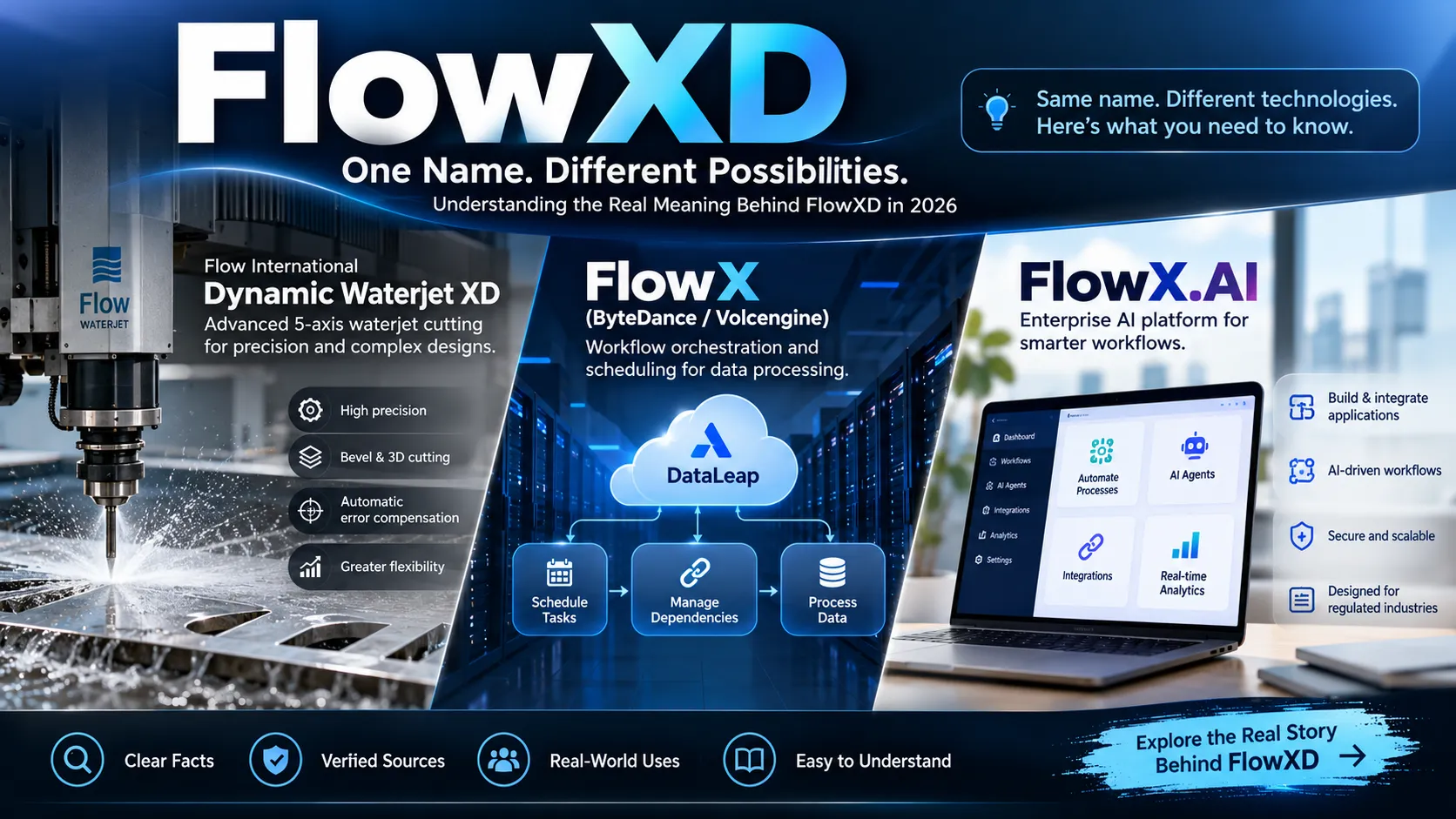
FlowXD does not currently appear to be the official name of one clearly established software platform. As of September 2026, the strongest verifiable uses of the term point to Flow International’s Dynamic Waterjet XD technology and, in some technical references, FlowX, a workflow orchestration system associated with ByteDance and Volcengine DataLeap.
This distinction matters because numerous recent web pages describe FlowXD as an AI-powered productivity or workflow automation application, complete with dashboards, analytics, integrations, and intelligent automation. Those descriptions are difficult to substantiate through an official FlowXD website, product documentation, company profile, or other primary source.
What Is FlowXD?
The most accurate answer is that FlowXD is an ambiguous search term rather than a universally recognized product name.
There are three established technologies with similar names that can easily become mixed together:
| Name | What it actually is | Verified source |
|---|---|---|
| Dynamic Waterjet XD | Multi-axis waterjet cutting technology from Flow International | Flow Waterjet |
| FlowX | Workflow orchestration and scheduling technology connected with Volcengine DataLeap | Volcengine |
| FlowX.AI | Enterprise AI and application modernization platform | FlowX.AI |
| “FlowXD” AI workflow platform | Described by various third-party websites | No clear primary product source identified |
Because search results increasingly use these names interchangeably, readers should verify exactly which technology is being discussed before relying on specifications, features, pricing, or security claims.
The Strongest Match: Flow Dynamic Waterjet XD
For readers encountering FlowXD in manufacturing, CNC machining, fabrication, or industrial cutting, the term most likely points to Dynamic Waterjet® XD, a technology developed by Flow International.
Flow describes Dynamic Waterjet XD as a system for faster and more accurate bevel and three-dimensional waterjet cutting. It combines multi-axis movement with automatic compensation for errors that naturally occur when a high-speed waterjet passes through material.
Importantly, FlowXD is not the official product name shown by the manufacturer. Flow uses names including “Dynamic Waterjet XD” and “Dynamic XD.”
How Dynamic Waterjet XD Works
Conventional abrasive waterjet cutting generally sends a narrow stream of high-pressure water mixed with abrasive material through a workpiece. Although the process is extremely versatile, two physical effects can influence cut geometry: taper and stream lag.
Taper means the width or position of the cut can vary between the top and bottom of the material. Stream lag occurs because the lower part of the cutting jet trails slightly behind the point where it enters the workpiece, especially as cutting speed increases.
Flow’s Dynamic technology automatically changes the cutting-head angle to compensate for these effects. According to the company’s technical description, the adjustment happens automatically rather than requiring an operator to manually calculate each correction angle.
Dynamic XD extends this approach to bevels and three-dimensional parts.
Why Five-Axis Motion Matters
A standard cutting head is mainly suited to vertical cuts. Dynamic Waterjet XD adds controlled articulation so the machine can approach material at different angles.
Flow describes the technology as capable of accurate five-axis motion and compound-angle cutting. Its official specifications list wrist articulation of up to 89 degrees of motion and vertical travel of 12 inches, or 305 mm.
That additional movement allows manufacturers to produce geometry such as angled edges, weld preparations, complex profiles, and certain 3D parts directly on the waterjet.
The benefit is not simply that the head tilts. The system combines that motion with Flow’s Active Tolerance Control, which compensates for stream lag and taper while the tool follows the programmed cutting path.
Important Dynamic XD Features
Flow’s current product information identifies several notable capabilities.
Active Tolerance Control
The system uses mathematical models to compensate automatically for waterjet cutting errors. The objective is to maintain more accurate part geometry while allowing higher cutting speeds than would otherwise be practical.
Bevel and 3D Cutting
Dynamic XD applies the company’s compensation technology to angled and three-dimensional cuts rather than restricting it to flat 2D profiles.
Closed-Loop Position Feedback
Flow says high-resolution motors provide both position and velocity feedback. Closed-loop feedback allows the control system to compare commanded movement with actual cutting-head movement.
Rapid Lift and Drop
The cutting head can move vertically to avoid clamps and areas that have already been cut while attempting to keep the effect on overall cycle time low.
FlowXpert Infinity Software
Flow identifies FlowXpert Infinity as the software associated with Dynamic Waterjet XD. This is another reason searches for “FlowXD” can become confusing, because several different Flow and FlowX names appear in the same technology space.
Where Dynamic XD Can Be Used
Dynamic XD is particularly relevant where a manufacturer needs more than straight 2D cutting.
Potential applications include precision metal fabrication, aerospace components, machine parts, architectural stone, complex bevels, and components that require angled mating surfaces.
Flow lists Dynamic Waterjet XD as a cutting-head option on machines including the Mach 500 and Mach 700. The Mach 700 description specifically identifies it as a five-axis solution capable of cutting compound angles.
Whether the additional capability is worthwhile depends on the job. A business producing mostly straightforward flat components may not need the complexity of a five-axis head, while a shop performing frequent bevel and 3D work could gain significantly more flexibility.
FlowXD and FlowX: The ByteDance Connection
There is another technically credible reason someone may encounter “FlowXD” online.
An article originally attributed to the ByteDance Data Platform team discusses the internal workflow scheduling system supporting Volcengine’s DataLeap platform. The title reproduced on one publishing platform contains “FlowXd,” while the Volcengine developer version and the body of the technical material identify the actual system as FlowX.
This FlowX is entirely different from Flow International’s waterjet technology.
What the FlowX Scheduler Does
FlowX was designed to coordinate complex data-processing workflows in which one task may depend on another.
For example, a data-processing job may need to wait until an upstream table has been generated successfully. A later calculation can then begin only when all required inputs are available.
The system supports both scheduled and dependency-based execution. The published technical description includes recurring jobs, upstream task dependencies, HDFS and Hive data dependencies, retries, historical backfills, reruns, concurrency controls, alerts, and dependency recommendations.
The architecture was designed around high availability and horizontal scalability because the scheduler could sit underneath important data-processing pipelines.
Also Read: Eidesk: History, Features, and Current Status
How the FlowX Scheduling Architecture Works
The published architecture separates responsibilities across several components.
The WebService handles interaction with users and external systems, including task configuration, operations, permissions, logs, and project management.
The Master manages dependency graphs, scheduling priorities, quotas, instance distribution, and monitoring of Scheduler and Worker nodes.
The Scheduler evaluates whether dependencies have been satisfied and whether a task’s execution time has arrived. Rather than constantly polling unresolved upstream dependencies, the design can use events to trigger later processing.
The Worker executes jobs and monitors their status, while ZooKeeper is used for functions including master election, node health awareness, and service discovery.
Volcengine currently continues to operate DataLeap as its big-data development and governance platform. Its current product material describes capabilities covering multimodal data integration, development and operations, data governance, and multiple analytics or processing engines.
That supports the continuing relevance of DataLeap, but it does not establish “FlowXD” as a separate public product.

FlowXD Is Also Not the Same as FlowX.AI
Another frequent source of confusion is FlowX.AI.
FlowX.AI is a separate enterprise technology company. Its current platform is designed to build, integrate, run, and govern mission-critical applications and AI-driven workflows, particularly in regulated industries.
The company states that FlowX.AI was launched in 2021, introduced its AI multi-agent platform in 2024, launched FlowX 5 and an AI Agent Builder in 2025, and shipped FlowX 6 in 2026.
Its platform currently includes a visual design environment, journey engine, integration layer, web and mobile application capabilities, AI agents, and security and governance controls.
FlowX.AI also has a component explicitly called the Scheduler. Its documentation says the service can schedule messages for later processing and communicates with the FlowX Engine through Kafka events. Current setup documentation lists MongoDB, Kafka, and OpenID Connect among the relevant infrastructure requirements.
Despite the similar terminology, there is no basis for automatically treating FlowXD, FlowX.AI, and ByteDance’s FlowX scheduler as the same technology.
Are Claims About an AI “FlowXD Platform” Reliable?
Readers should be cautious.
Several third-party pages published during 2026 describe FlowXD as a sophisticated AI workflow or productivity system. Depending on the page, claimed capabilities include task management, low-code automation, AI decision making, collaboration, analytics, dashboards, integrations, and real-time data processing.
The problem is verification.
A genuine commercial software platform would normally be expected to leave a primary-source trail such as an official company website, documentation portal, identifiable developer, terms of service, privacy policy, product release history, app listing, pricing documentation, corporate announcement, or technical repository.
The generic FlowXD descriptions found across multiple sites do not provide enough consistent primary evidence to independently establish such a product and all the capabilities attributed to it.
That does not prove that no privately developed project using the name has ever existed. It means specific claims about an established FlowXD AI platform should be treated as unconfirmed unless they can be linked to its actual developer or official documentation.
Why Search Results for FlowXD Are So Confusing
The confusion appears to come from several factors operating at the same time.
First, “Flow” is already used heavily in software terminology because workflows describe sequences of tasks or processes. Adding “XD” produces a short brand-like term that can easily be interpreted as a product name.
Second, several genuine technologies already use extremely similar names, including FlowX, FlowX.AI, FlowXpert and Dynamic XD.
Third, recent web articles have repeated competing interpretations of the keyword. Some identify it with an AI automation platform, while others connect it with Flow Waterjet’s Dynamic XD system.
For readers and search engines alike, repetition alone does not establish that a claim is correct. Primary documentation is more valuable than the number of websites repeating a description.
How to Identify Which FlowXD You Are Looking For
Context is usually enough to distinguish the technologies.
If the page mentions waterjets, CNC machines, cutting heads, metal, stone, bevels, taper compensation or five-axis cutting, it almost certainly concerns Flow International Dynamic Waterjet XD.
If it discusses DataLeap, data warehouses, DAGs, Hive, HDFS, task dependencies, schedulers, Workers or ByteDance, it most likely concerns the FlowX workflow orchestration system.
If the context includes enterprise AI agents, banking, insurance, logistics, journey orchestration or application modernization, it may refer to FlowX.AI, whose current platform is independently documented.
A description of a generic “FlowXD AI productivity platform” should be checked more carefully, particularly when no official product page or developer is identified.
Current Status of FlowXD in 2026
As of September 2026, there is no strong primary-source basis for presenting FlowXD as one unified, established AI productivity product with a definitive feature list.
What can be verified is more specific:
Dynamic Waterjet XD remains an active Flow International technology for precision bevel and three-dimensional waterjet cutting. Flow continues to list it on its official website and as an option for current waterjet systems.
Volcengine DataLeap remains an active data-development and governance product, and published Volcengine technical material documents the FlowX scheduling architecture that has supported the platform.
FlowX.AI is also active, but it is a distinct enterprise AI company and platform rather than evidence for a separate product officially called FlowXD. The company says FlowX 6 was released in 2026, and its current materials describe production AI deployments across industries such as banking, insurance and logistics.
FAQ About FlowXD
What is FlowXD?
FlowXD is an ambiguous term rather than a clearly documented universal product name. The strongest verified matches are Flow International’s Dynamic Waterjet XD cutting technology and references that appear to be variations of the FlowX workflow scheduler associated with Volcengine DataLeap.
Is FlowXD an AI workflow automation platform?
That description appears on several third-party websites, but a corresponding authoritative FlowXD product source has not been clearly established. Features attributed to such a platform should therefore not be treated as verified solely because they appear in search results.
Is FlowXD the same as FlowX.AI?
No confirmed evidence establishes them as the same product. FlowX.AI is a documented enterprise AI platform with its own company, official website, product architecture and technical documentation.
What is Dynamic Waterjet XD?
Dynamic Waterjet XD is Flow International’s advanced waterjet cutting technology for bevel and 3D cutting. It combines multi-axis motion with automatic compensation for taper and stream lag and supports wrist articulation of up to 89 degrees.
What is the FlowX system behind DataLeap?
FlowX is a workflow orchestration and scheduling system documented in technical material associated with ByteDance’s data platform and Volcengine. It manages timed and dependency-driven tasks, retries, backfills, external data dependencies and distributed execution.
Is FlowXD safe to download or use?
There is no single verified FlowXD download that can be evaluated as a universal product. Before installing anything using this name, confirm the actual developer, official domain, software signature, documentation, privacy terms and download source. For Dynamic Waterjet XD, FlowX.AI or Volcengine services, use the respective vendor’s official resources rather than unrelated third-party downloads.
Also Read: CDiPhone: Meaning, Facts, and How CDs Work With iPhone
