


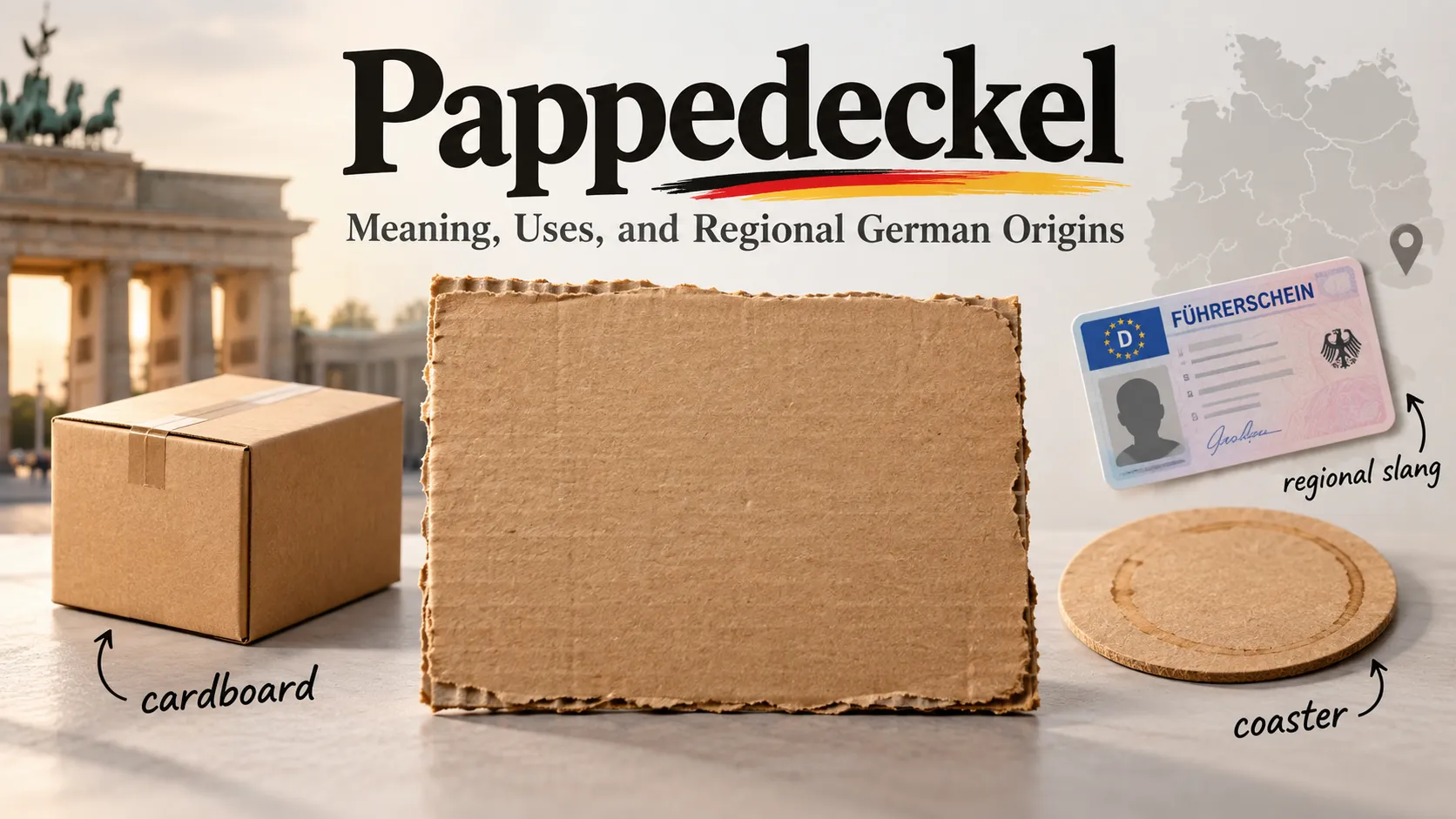
Pappedeckel is a regional German word associated with cardboard, paperboard, or a piece of stiff cardboard. Depending on the region and context, it can also be used informally for a driver’s license, while the standard German forms most commonly documented in dictionaries are Pappdeckel and Pappendeckel.
The spelling can be confusing because several nearly identical words appear across standard German and regional dialects. The safest interpretation is therefore not simply “cardboard lid.” The surrounding sentence, location, and intended object determine whether Pappedeckel means cardboard, a cardboard piece, packaging material, a coaster-like object, or, in some dialects, a driving licence.
What Does Pappedeckel Mean?
In its basic sense, Pappedeckel means cardboard or a piece of cardboard. Regional Alemannic sources record Pappedeckel and the dialect form Pabbedeggel with the meaning Karton, while the closely related standard German word Pappdeckel is defined by Duden as a piece of cardboard.
Duden also recognizes Pappendeckel as a related standard form with essentially the same meaning. It describes the word as a rectangular piece of cardboard or stiff board.
This distinction matters for English translation. Depending on context, Pappedeckel may best be rendered as cardboard, piece of cardboard, paperboard, cardboard cover, or occasionally cardboard lid.
Is Pappedeckel Correct German?
Pappedeckel exists in regional German speech, but it is not the main spelling used in standard German dictionaries. Duden lists Pappdeckel and Pappendeckel, while regional dialect sources document Pappedeckel as a local variant.
This does not make Pappedeckel a meaningless misspelling. German dialects frequently alter consonants, vowels, and word endings, especially when spoken forms are written phonetically.
The Bayerische Akademie der Wissenschaften’ Bayerns Dialekte Online database provides particularly useful evidence. Its entry for Pappendeckel records the dialect form Babbǝdeckl in Bavarian Swabia for cardboard or Pappe. It also documents regional figurative meanings including identification documents and a driver’s license.
Pappedeckel, Pappdeckel, and Pappendeckel
The three forms are closely related but should not always be treated as completely interchangeable.
| Term | Typical status | Main documented meaning |
|---|---|---|
| Pappedeckel | Regional or dialect spelling | Cardboard, carton, sometimes driver’s license |
| Pappdeckel | Standard German dictionary form | Piece of cardboard |
| Pappendeckel | Standard related form | Piece of cardboard or stiff board |
| Babbedeckel / Babbadeckel | Regional dialect forms | Cardboard, sometimes driver’s license |
| Bierdeckel | Standard German | Drink or beer coaster |
Duden explicitly treats Pappdeckel and Pappendeckel as related forms. The regional variants become more diverse as pronunciation changes between Alemannic, Bavarian, Swabian, Palatinate, and other dialect areas.
Where Does the Word Come From?
The meaning becomes clearer when the compound is divided into its components.
Pappe in German means a stiff material made from paper layers or fibres. Duden describes it as a firm, relatively rigid paper-based material commonly used for packaging and also lists Pappdeckel among related terms.
Deckel normally means a lid, cover, removable closure, or the rigid front or back section of a book cover.
A literal reading of Pappdeckel can therefore suggest “cardboard lid” or “cardboard cover.” Actual usage is broader. Duden defines the compound primarily as a piece of cardboard, demonstrating why translating it mechanically as “cardboard lid” can be inaccurate.
Does Pappedeckel Mean a Driver’s License?
In some German-speaking regions, yes. Pappedeckel and related dialect forms have been used jokingly or colloquially for a driver’s license, although this is not their primary standard-German meaning.
Bayerns Dialekte Online records a dialect form from Augsburg meaning an ID card or driver’s license, labelled as humorous usage.
An Alemannic regional dictionary likewise notes that Pabbedeggel or Pappedeckel can mean Karton and, in some places, a Führerschein, the German word for driving licence. Another entry documents Babbedeckel in Alemannic areas, parts of the Palatinate, and southern Hesse, again noting its use as a synonym for a driver’s license.
The association is understandable historically. Driving licences and other official documents were once more visibly physical documents rather than the plastic cards familiar today. German slang also uses Pappe itself for a driver’s license. Duden explicitly records this colloquial meaning of Pappe.
So if someone says that a driver “lost his Pappedeckel,” cardboard is probably not the intended meaning. Context indicates that the speaker is referring to the driving licence.
Also Read: RLP Letter: What It Means and What to Do
Is Pappedeckel the Same as a Bierdeckel?
Not exactly.
A Bierdeckel is specifically a coaster placed underneath a beer glass, mug, bottle, or other drink. Pappdeckel is broader and describes a cardboard piece rather than one particular object.
The overlap exists because traditional beer coasters are commonly made from absorbent cardboard. Duden even illustrates Pappdeckel with an example involving serving a drink on one, which shows that a Pappdeckel can function as a coaster.
Nevertheless, if the object is clearly a pub or drink coaster, Bierdeckel is the more precise standard-German word.
This is important for translators. Translating every instance of Pappedeckel as “beer coaster” would be just as inaccurate as translating every instance as “cardboard lid.”
What Is a Physical Pappedeckel Made From?
When Pappedeckel refers to an actual cardboard object, its basic material belongs to the broad family of paper, board, and cardboard products manufactured from cellulose fibres.
The exact construction can vary significantly. A simple piece may consist almost entirely of fibre-based board, while packaging components can contain printing inks, adhesives, coatings, barrier layers, or plastic films.
That distinction affects both performance and recycling. A plain cardboard component is generally much easier to recycle than a multilayer composite containing plastic or other materials.
Germany’s Federal Environment Agency, the Umweltbundesamt, specifically warns that combinations of materials can make packaging recycling more difficult. It notes that plastic-coated paper layers can require additional processing before their fibres can be recovered.

Common Uses of Cardboard Pappedeckel
A cardboard piece matching the general meaning of Pappedeckel can serve many ordinary purposes.
It may function as part of a box, a protective cover, backing material, a separator between products, craft material, packaging reinforcement, a temporary protective sheet, or an absorbent drink coaster.
The word itself does not define a precise technical specification. Thickness, fibre composition, shape, coating, strength, and moisture resistance depend on the intended application.
That is another reason some online explanations describing Pappedeckel as one specific type of modern “eco-friendly lid” are too narrow. The established linguistic evidence points to a much broader cardboard-related meaning.
Is Pappedeckel Environmentally Friendly?
A cardboard Pappedeckel can be recyclable, but cardboard is not automatically environmentally harmless.
The environmental result depends on factors such as the amount of material used, recycled fibre content, coatings, adhesives, whether different materials can be separated, how the item is disposed of, and whether a reusable alternative could have avoided the waste entirely.
Germany generated about 17.9 million tonnes of packaging waste in 2023, according to the Umweltbundesamt. Paper, cardboard, and carton packaging made up the largest material category at roughly 7.9 million tonnes.
Across all packaging materials, Germany recycled 69.4 percent of packaging waste generated in 2023. The country’s recycling requirements for packaging collected through dual systems are particularly high for paper, cardboard, and carton.
Still, recycling is not the first environmental priority. The Umweltbundesamt recommends avoiding unnecessary packaging, minimizing material use, choosing reusable solutions where practical, and keeping packaging materials easy to separate and recycle.
How Should a Cardboard Pappedeckel Be Disposed Of?
In Germany, empty packaging made solely from paper, cardboard, or carton generally belongs in the waste-paper collection system. The Umweltbundesamt states that paper, cardboard, and carton packaging should be placed in the designated paper recycling collection.
Composite packaging requires more attention. A component containing permanently bonded plastic, aluminium, or other materials may be treated differently because it is no longer simply paper or cardboard.
Food contamination can also affect local disposal practices. Consumers should therefore follow the waste-separation instructions provided by their municipality or waste-management service when the material is unclear.
Why Is Pappedeckel Appearing More Often Online?
Search results for Pappedeckel have expanded because the word sits at the intersection of several topics: German vocabulary, regional dialect, packaging, sustainability, translation, and slang.
This has also produced misleading explanations. Some websites present Pappedeckel exclusively as a special paper lid developed to replace disposable plastic. That interpretation is possible when a specific packaging product is being discussed, but it should not be mistaken for the established general meaning of the word.
Dictionary and dialect evidence is much broader. Standard Pappdeckel and Pappendeckel refer to cardboard or a piece of cardboard, while regional Pappedeckel can additionally carry dialect meanings such as a driver’s license.
For readers encountering the word without context, the most accurate first interpretation is therefore cardboard or a piece of cardboard, followed by a check of the sentence and regional setting.
How to Translate Pappedeckel Into English
There is no single English translation that works in every sentence.
If the speaker is discussing raw material, cardboard or paperboard is usually appropriate. If a flat object is involved, piece of cardboard may be clearer. For packaging, cardboard cover or cardboard lid can work when the object genuinely closes or covers something.
When the term is being used regionally for a Führerschein, the correct translation is simply driver’s license or driving licence, not anything involving cardboard.
For a drink coaster, beer coaster or drink coaster will normally be more natural English.
FAQ About Pappedeckel
What does Pappedeckel mean in German?
Pappedeckel is a regional German expression generally associated with cardboard, carton, or a piece of cardboard. Closely related standard forms are Pappdeckel and Pappendeckel.
Is Pappedeckel a standard German word?
It is better described as a regional or dialect variant. Standard dictionaries document Pappdeckel and Pappendeckel, while regional sources record forms including Pappedeckel, Pabbedeggel, and Babbedeckel.
Why can Pappedeckel mean a driver’s license?
Certain southern and southwestern German dialects use cardboard-related expressions humorously for official documents, including driving licences. Bayerns Dialekte Online documents this meaning in Augsburg, and Alemannic sources report similar usage.
Does Pappedeckel mean cardboard lid?
It can in the right packaging context, but “cardboard lid” is too narrow as a universal translation. Standard Pappdeckel primarily means a piece of cardboard, so the English translation should depend on the object being discussed.
Is a Pappedeckel the same thing as a beer coaster?
Sometimes a cardboard piece may function as a coaster, but the normal German term for a beer or drink coaster is Bierdeckel. Pappedeckel has a broader cardboard-related meaning.
Can Pappedeckel be recycled?
A clean item made entirely from paper, cardboard, or carton is generally suitable for waste-paper collection in Germany. Plastic coatings, multilayer structures, adhesives, and other composite materials can make recycling more difficult.
Also Read: Frehf Explained: Meaning, Framework, and What Is Verified
