


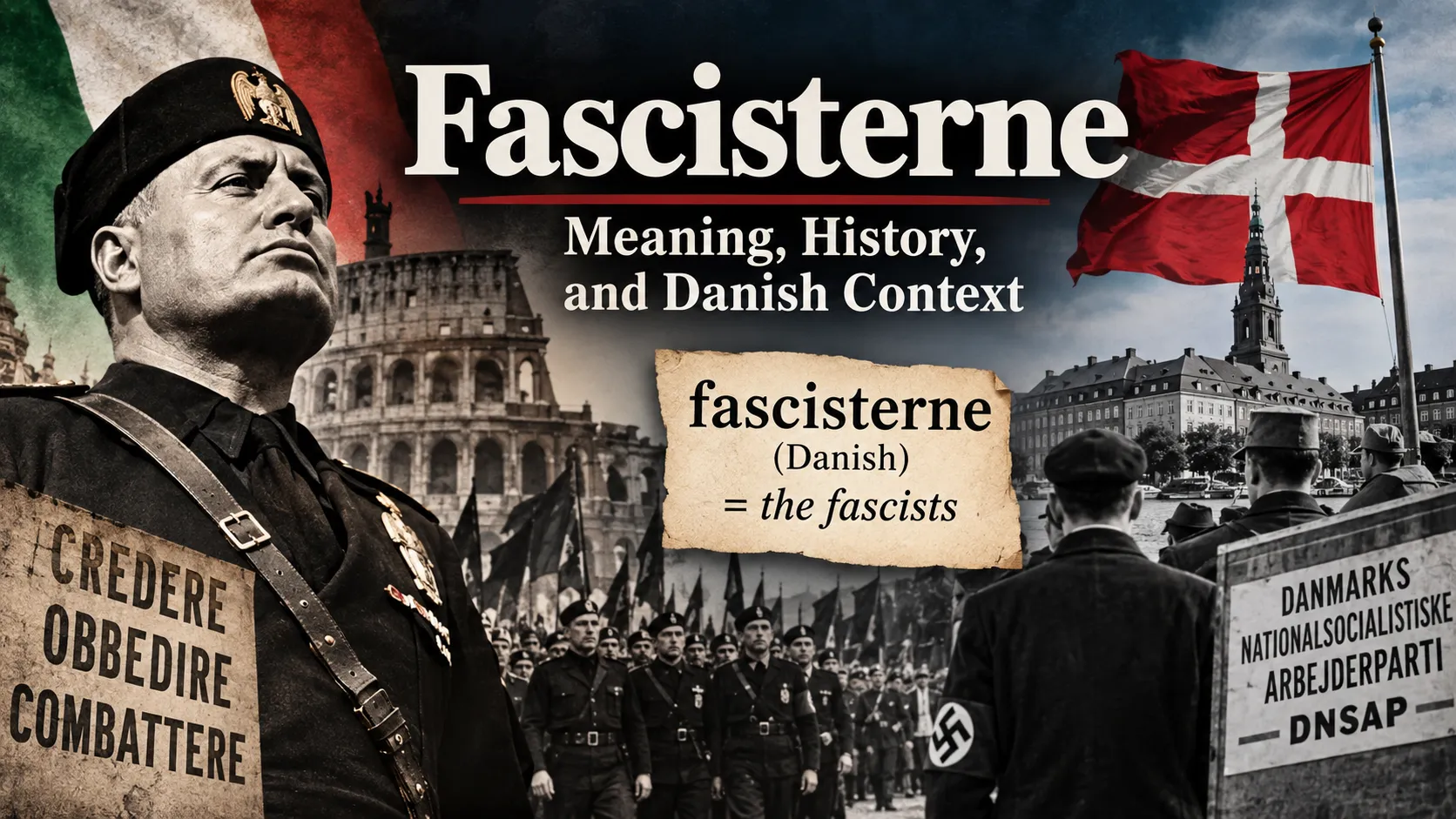

Fascisterne is the Danish definite plural of fascist and translates most directly as “the fascists” in English. It describes people identified as supporters of fascism, but it is not the name of a single political party or a separate ideology.
The exact meaning depends on context. In a text about Benito Mussolini, fascisterne may refer to Italian Fascists. In Danish material about the 1930s or German occupation of Denmark, it may refer to Danish fascists, Nazis, or a particular organization such as Danmarks Nationalsocialistiske Arbejderparti (DNSAP). Those categories overlap historically, but they should not automatically be treated as identical.
What Does Fascisterne Mean?
The simplest Fascisterne meaning is “the fascists.” Den Danske Ordbog defines a fascist as a supporter of fascism and lists the Danish inflections as -en, -er, -erne. That makes fascisterne the definite plural form.
The grammar can be understood like this:
| Danish | English meaning | Form |
|---|---|---|
| fascist | a fascist / fascist | singular |
| fascisten | the fascist | definite singular |
| fascister | fascists | plural |
| fascisterne | the fascists | definite plural |
| fascisme | fascism | the ideology |
This distinction matters because fascisterne refers to people, whereas fascisme refers to the political ideology or movement. Den Danske Ordbog defines fascisme separately as a political movement that places the state and people above the individual and sets aside democracy through dictatorial means.
The capitalized form “Fascisterne” may appear at the beginning of a sentence or in a heading, but capitalization does not normally turn it into the formal name of an organization.
Where Does the Word Come From?
The Danish terms fascist and fascisme ultimately trace back through Italian to the Latin word fascis, meaning a bundle. The related Roman fasces, a bundle of rods traditionally associated with official authority, became an important symbol of Italian Fascism.
Modern political fascism emerged in Italy after World War I. Lex dates the foundation of Benito Mussolini’s Fasci di combattimento to 23 March 1919 in Milan, describing the early movement as nationalist, anti-democratic and anti-socialist and noting its use of political violence.
Mussolini’s movement later developed into the National Fascist Party. Following the March on Rome in October 1922, King Victor Emmanuel III appointed Mussolini prime minister. Fascists progressively consolidated power, and by 1925 Italy was developing into an authoritarian dictatorship dominated by Mussolini and his party.
What Did Historical Fascists Believe?
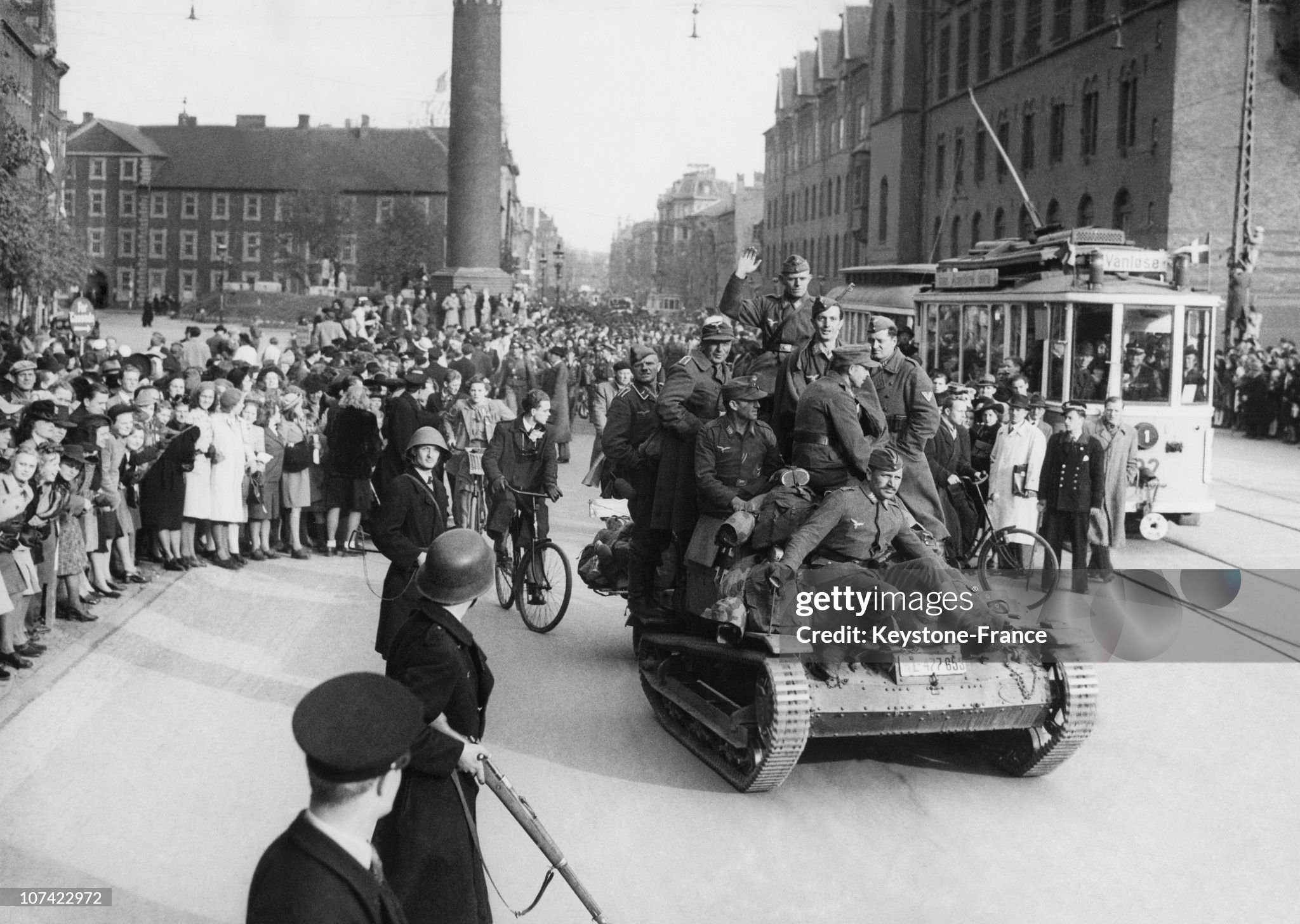
There is no single definition accepted without qualification by every historian, because fascist movements differed between countries. Still, major reference works identify a set of recurring characteristics.
The United States Holocaust Memorial Museum describes fascism as an ultranationalist and authoritarian political philosophy that subordinates the individual to the nation and rejects liberal democratic government, pluralism and political equality. Historical fascist movements also frequently emphasized militarism, powerful leadership, national unity and suppression of political opposition.
Common historical characteristics included:
- extreme or exclusionary nationalism
- rejection of liberal parliamentary democracy
- concentration of political authority
- a strong leader or leadership principle
- hostility toward socialism and communism
- suppression of organized political opposition
- acceptance or glorification of political violence
- efforts to mobilize society around a supposedly unified national community
These features should be understood as historical analytical characteristics rather than a checklist that automatically determines whether every authoritarian movement is fascist. Political movements can share some features without being identical in ideology or organization.
Fascisterne and Mussolini’s Italy
When fascisterne appears in Danish writing about Italy between the world wars, it often literally means Mussolini’s Fascists.
Italian Fascism is the historical movement from which the political term originated. According to Lex, the Fascist Party entered government in October 1922 and from 1925 monopolized political power while constructing an authoritarian system. The party became the only permitted political party under the regime.
The regime sought a highly centralized state in which the interests of individuals and social classes were subordinated to the nation and state. Fascist Italy also pursued imperial expansion and increasingly aligned itself with Nazi Germany during the 1930s.
In 1938, Mussolini’s government introduced antisemitic measures in Italy. Italy formally aligned itself with Germany through the Pact of Steel in 1939 and entered World War II against Britain and France in June 1940.
Mussolini was removed from power in July 1943. German intervention subsequently enabled him to lead the German-backed Italian Social Republic in northern Italy until the final phase of the war.
Fascisterne in Denmark
Denmark also developed fascist and National Socialist movements, although none achieved the electoral dominance obtained by Mussolini in Italy or Hitler’s Nazi Party in Germany.
The most important Danish Nazi organization was Danmarks Nationalsocialistiske Arbejderparti, commonly abbreviated DNSAP. It was founded on 16 November 1930 by Cay Lembcke. Frits Clausen replaced Lembcke as party leader in July 1933.
According to Denmark’s national encyclopedia, Lex, DNSAP consciously modeled important elements of its organization, symbolism and political program on Germany’s National Socialist German Workers’ Party. Its program included the leadership principle, racial ideology and antisemitism.
How Much Support Did DNSAP Receive?
DNSAP remained a relatively small electoral force.
At Denmark’s 1939 parliamentary election, it received 31,032 votes and three seats in the Folketing. That was the first time the party entered parliament.
During the German occupation, membership increased. Lex estimates roughly 5,000 members in 1939 and about 21,500 by the beginning of 1943, although membership numbers did not translate into broad electoral support.
At the 23 March 1943 election, the party received 43,309 votes, or 2.15 percent of valid votes, and again won only three seats. Overall turnout was exceptionally high at about 89.5 percent.
| Election | DNSAP votes | Vote share | Seats |
|---|---|---|---|
| 1939 | 31,032 | about 1.8% | 3 |
| 1943 | 43,309 | 2.15% | 3 |
The results are important historically because German occupation did not produce a major electoral breakthrough for DNSAP. Lex notes that the party hoped to obtain power with German assistance but failed to develop sufficient popular support, even with substantial German financial backing.
After the 1943 election, DNSAP began moving toward partial organizational collapse.
Also Read: Mansutfer: Meaning, Origins, and What We Know
Does Fascisterne Always Mean Danish Nazis?
No. Fascisterne is an ordinary Danish noun form, not another name for DNSAP.
A Danish sentence might use fascisterne for:
- Mussolini’s followers in Italy
- fascist organizations elsewhere in Europe
- Danish fascist activists
- members or supporters of a previously mentioned fascist movement
- people being described as fascists in modern political discussion
The surrounding text determines which group is meant.
This is especially important when researching Danish World War II material. Terms such as fascist, Nazi, National Socialist, collaborator, and German occupation supporter describe concepts that can overlap but are not automatically interchangeable.
Are Fascism and Nazism the Same Thing?
They are closely related historically, but the terms should not simply be treated as synonyms.
Italian Fascism originated with Mussolini’s movement, while National Socialism, or Nazism, developed in Germany under Adolf Hitler and the Nazi Party. Lex describes Nazism as a variant of the broader fascist phenomenon while noting the similarities between the movements.
Nazism placed an especially central emphasis on a pseudoscientific racial hierarchy and antisemitism. Nazi ideology portrayed Jews as a racial enemy and promoted the false idea of a biologically superior “Aryan” race. These ideas became state policy after Hitler took power and ultimately contributed to the Holocaust, including the murder of six million Jews and the persecution and killing of millions of other victims.
So a useful distinction is:
Fascism is the broader political category associated historically with ultranationalist, anti-democratic and authoritarian movements.
Nazism refers specifically to Hitler’s National Socialist movement and regime, with its particular racial ideology, antisemitism, expansionism and genocidal policies.
Why the Word Can Be Confusing Today
The historical definition of fascist is more specific than many casual uses of the word.
Den Danske Ordbog records both the primary meaning, a supporter of fascism, and a broader transferred meaning referring to someone characterized by strongly right-wing nationalist ideas or support for authoritarian suppression of people with different views.
That broader usage explains why fascisterne can appear in contemporary political arguments even when no historical Fascist organization is being discussed.
For readers, the safest approach is to separate description from labeling. When a writer calls a modern individual or organization fascist, the label itself should not be treated as proof. Look instead for the stated policies, ideology, organizational structure and conduct being used to support the description.
Historical institutions also caution against loose Nazi and Holocaust analogies because they can obscure important differences between contemporary events and specific historical regimes.
How to Translate Fascisterne Correctly
In most sentences, “the fascists” is the correct English translation.
For example:
Danish: Fascisterne kom til magten i Italien.
English: The fascists came to power in Italy.
The historical Ordbog over det danske Sprog records the word in early Danish material about Fascists taking power in Italy, showing that the form has been used in Danish political writing since the early decades of the fascist era.
A translator should normally resist replacing fascisterne with “the Nazis” unless the surrounding text clearly identifies Nazis as the group being discussed. Doing so without context can change the historical meaning.
Fascisterne vs. Related Danish Terms
Several similar words can appear in Danish historical or political material.
| Danish term | Approximate English meaning |
|---|---|
| fascist | fascist |
| fascisten | the fascist |
| fascister | fascists |
| fascisterne | the fascists |
| fascistisk | fascist / fascistic |
| fascisme | fascism |
| antifascist | anti-fascist |
| nazist | Nazi |
| nazisme | Nazism |
| nationalsocialisme | National Socialism |
Den Danske Ordbog defines fascistisk as something relating or belonging to fascism, while fascisme refers to the movement or ideology itself.
Why Historical Context Matters
A single translation does not tell readers which historical movement a source is discussing.
If a Danish document from 1920s Italy uses fascisterne, Mussolini’s movement is the obvious context. If a Danish source from the occupation years uses it, the writer might be discussing DNSAP, German Nazis or fascist politics more generally.
Dates, organization names, national context and surrounding sentences therefore matter more than the word alone.
This is also why claims that Fascisterne is the formal name of a mysterious Danish organization should be treated cautiously. Danish dictionary evidence shows that it is simply an inflected form of fascist.

FAQ About Fascisterne
What does Fascisterne mean in English?
Fascisterne means “the fascists.” It is the definite plural form of the Danish noun fascist.
Is Fascisterne the name of a Danish political party?
No. Fascisterne is a normal Danish grammatical form rather than the official name of one party. Denmark’s best-known historical Nazi party was Danmarks Nationalsocialistiske Arbejderparti, or DNSAP.
What is the Danish word for fascism?
The Danish word for the ideology is fascisme. A fascist is a supporter of fascism, while fascisterne means “the fascists.”
Were there fascists in Denmark during World War II?
Yes. Denmark had fascist and National Socialist organizations, most notably DNSAP. The party held three Folketing seats after both the 1939 and 1943 elections but never achieved broad electoral support.
Is every Nazi a fascist?
Major historical reference works generally place Nazism within the broader family of fascist movements, but Nazism had distinctive features, particularly its extreme racial ideology, antisemitism and genocidal policies. For precise historical writing, “Nazi” and “fascist” should therefore not be used interchangeably in every context.
Can Fascisterne refer to people today?
Yes. Danish can use the word in contemporary political discussion, and the dictionary also records a broader transferred meaning. However, whether the historical label fascist accurately describes a particular modern organization or individual requires evidence about their ideology and conduct rather than the label alone.
Also Read: Streman: Meaning, Origin, History, and Surname Records
