


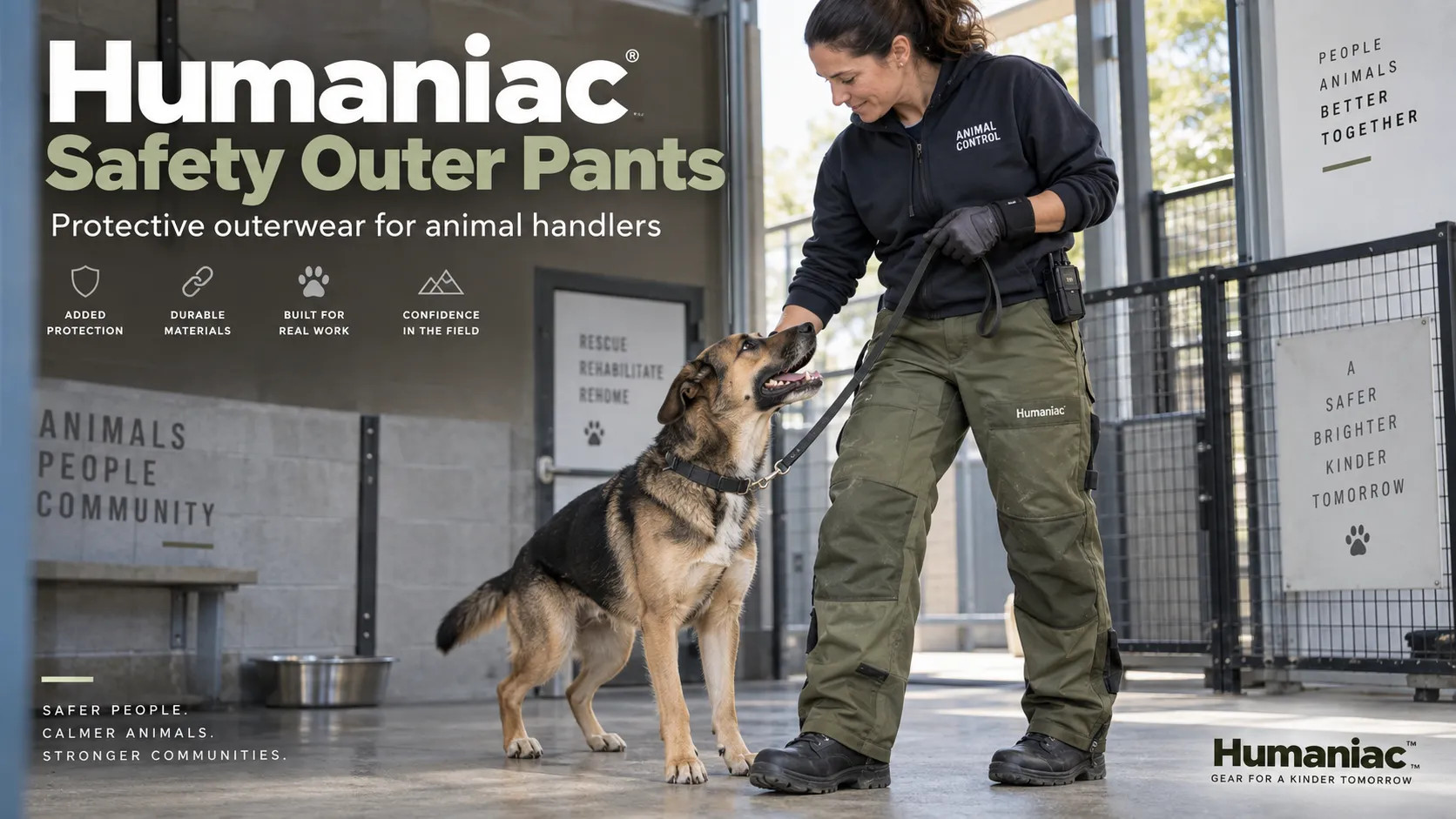
Humaniac Safety Outer Pants are protective over-trousers designed for animal handlers who may face bites, scratches, or sudden attacks from dogs and other animals. They use a Cordura outer fabric with a Kevlar lining and are intended to be worn over normal clothing for added lower-body protection.
Unlike a heavily padded dog-training bite suit, these pants are designed to look and function more like practical workwear. Their main purpose is to add a protective layer around the legs while allowing the wearer to continue normal animal-handling tasks.
What Are Humaniac Safety Outer Pants?
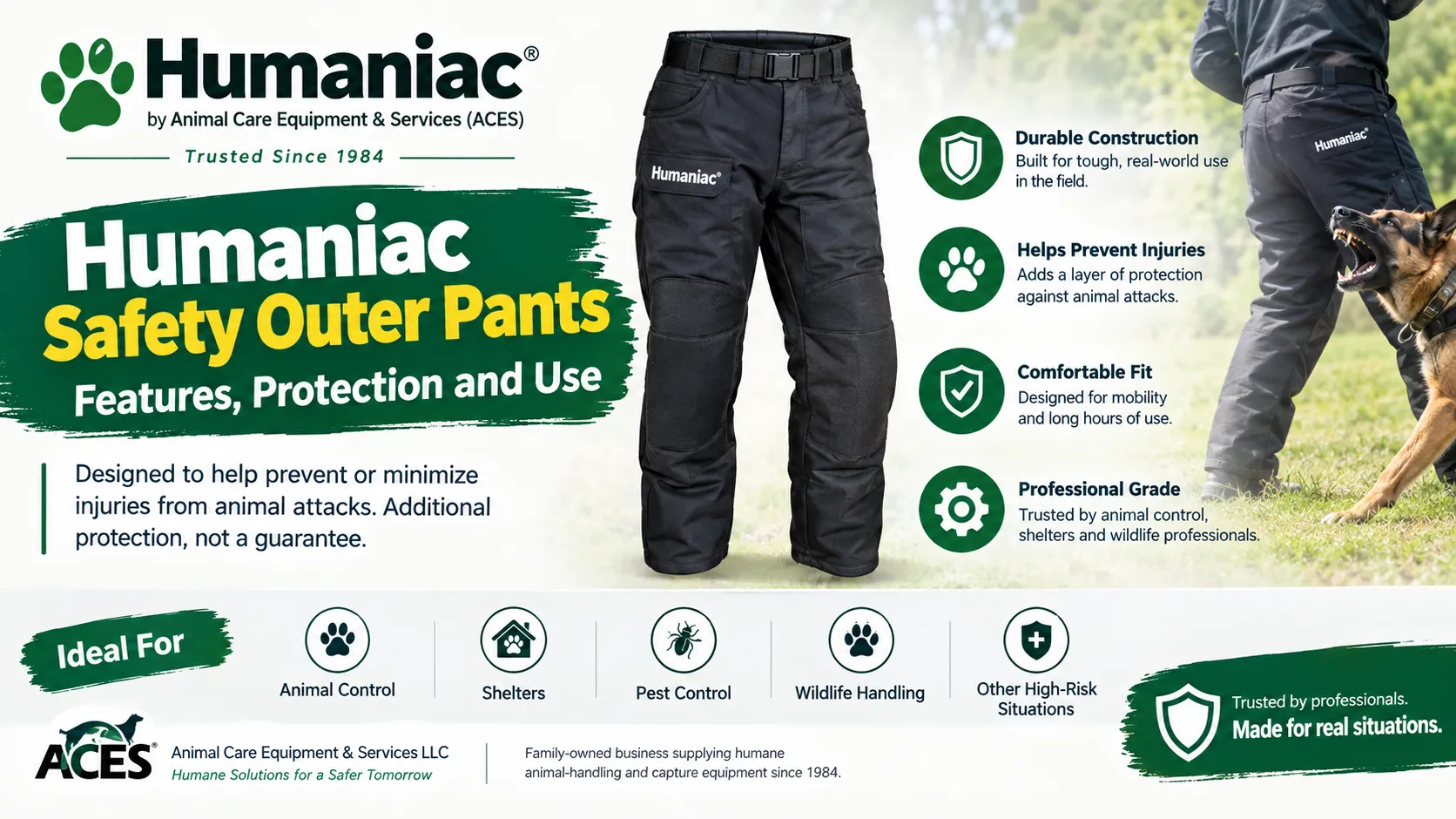
The humaniac safety outer pants are made by the Humaniac brand of Animal Care Equipment & Services, commonly known as ACES. The company describes itself as a family-owned business that has supplied humane animal-handling and capture equipment since 1984. Humaniac is a registered trademark of Animal Care Equipment & Services LLC.
ACES places the pants within its professional protective-equipment range for animal control, shelters, pest-control work, wildlife handling, and other situations in which workers may come into close contact with unpredictable animals.
The company specifically states that the trousers are designed to help prevent or minimize injuries associated with dog or animal attacks. That wording is important. They should be understood as additional protection, not as a guarantee against penetration or crushing injuries.
Humaniac Safety Outer Pants Specifications
The current ACES product listing provides the following details.
| Feature | Current Product Information |
|---|---|
| Product | Safety Outer Pants by Humaniac |
| Main purpose | Added protection during animal handling |
| Outer material | Cordura |
| Inner protective layer | Kevlar |
| Color | Olive green |
| Design | Over-pants worn above everyday trousers |
| Waist | Adjustable |
| Pockets | Two |
| Ankle design | Zippers for easier removal |
| Listed weight | 6 lb |
| Listed dimensions | 10 × 10 × 4 in |
| Example fit | 6 ft 3 in, 210 lb model wearing XL |
| Current listed price | $107.85 |
| U.S. shipping | Free shipping to the lower 48 states, according to ACES |
The 10 × 10 × 4-inch dimensions appear in the product’s “additional information” area and should not be interpreted as actual body measurements for the trousers. Buyers should select the appropriate product variant and confirm fit before ordering.
The official store currently presents multiple selectable variants rather than a single one-size product.
How the Protective Construction Works
The basic protective concept is straightforward. A durable Cordura shell is combined with a Kevlar lining so the pants provide a tougher barrier than ordinary work trousers.
Both materials contribute differently.
Cordura Outer Layer
CORDURA describes its Classic fabric as a high-tenacity nylon 6,6 material engineered for strong abrasion and tear resistance. The fabric family is widely used in demanding applications including workwear, garment reinforcement, military equipment, motorcycle clothing, backpacks, footwear, and protective outerwear.
For animal-handling pants, those characteristics make sense. A tough outer material may help the garment withstand scratching, pulling, contact with kennel surfaces, claws, and general wear better than conventional lightweight trousers.
However, the Humaniac product page does not state the exact Cordura fabric weight, denier, weave, or laboratory abrasion rating used in these pants. Buyers should therefore avoid assuming that the pants have the same performance as every other product carrying the Cordura name.
Kevlar Protective Lining
Kevlar is a para-aramid synthetic fiber developed by DuPont. It is used in protective products because of its high strength-to-weight ratio and resistance to hazards such as cuts, abrasion, and puncture in appropriately engineered applications.
DuPont also makes an important point about protective clothing: material alone does not determine the final level of protection. Fabric construction, material weight, coatings, layering, garment design, and the complete protective system can significantly affect performance.
This distinction matters for Humaniac Safety Outer Pants. The presence of Kevlar is meaningful, but simply seeing “Kevlar-lined” should not be interpreted as proof that the trousers are impossible for an animal’s teeth to penetrate.
Are Humaniac Safety Outer Pants Bite-Proof?
No credible evidence supports describing the pants as completely bite-proof.
ACES says the Cordura and Kevlar construction is intended to prevent or minimize damage during a dog or animal attack. The manufacturer does not claim on the current product page that all bites will be stopped.
There is also no published ANSI/ISEA cut rating, ASTM puncture rating, EN protective-clothing rating, dog-bite force rating, or similar numerical certification displayed on the current ACES product listing.
That does not mean the trousers provide no meaningful protection. It means their exact resistance to specific bite forces cannot responsibly be quantified from the information ACES currently publishes.
This is one of the most important details for prospective buyers because “Kevlar-lined” and “bite-proof” are not interchangeable terms.
What Type of Injuries Could They Help Reduce?
Animal attacks can involve several different forces. Teeth may puncture or tear skin, claws can scratch, and a powerful dog’s jaw can create significant crushing pressure even when teeth do not completely penetrate protective clothing.
The Humaniac pants appear primarily designed to provide an extra physical barrier against:
- bites to the thighs and lower legs
- scratches and claw injuries
- tearing of normal clothing
- abrasion during close-contact restraint
- accidental contact during lunging or defensive behavior
They should not be assumed to eliminate crushing trauma from a strong bite. Protective textiles can reduce penetration or surface injury while significant pressure may still be transferred to the body underneath.
This is why appropriate animal-control techniques and distance-based equipment remain important even when protective clothing is worn.
Why the Over-Pants Design Matters
Humaniac designed these trousers to be worn over everyday pants rather than as ordinary standalone work trousers.
That approach has several advantages.
The worker can put them on when entering a higher-risk situation and remove them afterward without completely changing clothes. An adjustable waist helps accommodate another layer underneath, while ankle zippers make it easier to pull the trousers on or off around footwear.
The two pockets also make the garment more practical for field use.
At the same time, extra layers can add weight and heat. ACES lists the product at 6 pounds, so workers who spend long periods walking, restraining animals, climbing stairs, or working outdoors should consider mobility and thermal comfort alongside protection.
Who Are Humaniac Safety Outer Pants Designed For?
The trousers make the most sense for people whose work creates a realistic risk of contact with frightened, aggressive, injured, or unpredictable animals.
Potential users include animal-control officers, shelter personnel, rescue workers, veterinary teams, wildlife personnel, emergency responders, pest-control professionals, and trained handlers dealing with dogs that may lunge or bite.
NIOSH notes that animal handlers, shelter workers, police, firefighters, veterinarians, veterinary technicians, and similar workers can face safety risks when handling distressed or displaced domestic animals. It recommends appropriate protective clothing and emphasizes that direct animal handling should be performed by trained and properly equipped personnel.
The pants are less relevant for normal pet ownership where there is no identified bite hazard. They are specialist protective equipment rather than general-purpose outdoor trousers.
Humaniac Pants vs. a Full Bite Suit
These products serve related but different purposes.
A full dog-training bite suit is normally designed around intentional bite engagement. It is often bulky and heavily padded because the wearer expects a trained working dog to bite and hold the garment during controlled exercises.
Humaniac Safety Outer Pants are more discreet. ACES specifically says they do not look or feel like a bite suit.
That makes them potentially more practical for routine professional duties such as entering kennels, transferring difficult animals, responding to calls, or carrying out shelter work where mobility matters and a full training suit would be excessive.
The tradeoff is important. Less bulk should not automatically be interpreted as offering the same protection as specialized bite-training equipment.
They Should Be Part of a Larger PPE System
Protective pants alone are not a complete animal-handling safety system.
Depending on the risk, an appropriate setup may also involve animal-handling gloves, forearm protection, protective footwear, eye protection, restraint tools, barriers, catch poles, or other purpose-specific equipment.
NIOSH recommends sturdy clothing and protective footwear with non-slip soles for workers dealing with animals. It specifically notes that ordinary tennis shoes or sneakers do not protect against bite, puncture, or crushing injuries.
ACES itself markets the Safety Outer Pants alongside protective animal-handling gloves and arm protectors as part of a broader lower- and upper-body protection system.
PPE Does Not Replace Animal-Handling Training
This point is particularly important for professional users.
OSHA’s general PPE rules require employers to assess workplace hazards, select equipment appropriate to those hazards, ensure proper fit, and train workers in how PPE should be worn, maintained, and understood.
OSHA’s PPE guidance also states that protective equipment should not be relied upon as the only method of controlling hazards. PPE should work alongside safer procedures and other appropriate controls.
Applied to animal handling, that means safety pants should not encourage workers to deliberately move closer to an aggressive animal than they otherwise would.
Good restraint technique, understanding animal behavior, maintaining safe distance, using appropriate capture tools, and knowing when not to make physical contact remain critical.
What Buyers Should Check Before Purchasing
The product’s core design is clear, but ACES publishes relatively limited technical test data. That makes careful purchasing especially important for organizations planning to treat the trousers as occupational PPE.
Before ordering, confirm the correct size and intended application. ACES provides one useful fit reference: its 6-foot-3-inch, 210-pound model is shown wearing XL.
For institutional or high-risk use, it would also be reasonable to ask ACES directly about:
- current size measurements
- exact Kevlar coverage within the garment
- areas with seams or reduced coverage
- cleaning and laundering instructions
- expected service life
- inspection criteria after an animal attack
- whether any independent puncture or bite-resistance testing exists
- replacement recommendations following significant damage
These questions matter because the current product listing does not publish detailed laundering instructions, fabric weights, standardized protective ratings, or a defined maximum bite resistance.
Current Price and Availability
At the time of research in September 2026, the official ACES U.S. store listed Humaniac Safety Outer Pants at $107.85. The page also advertised free shipping within the lower 48 U.S. states.
Pricing can change, particularly for specialist protective equipment, so buyers should check the current ACES listing immediately before purchasing.
An Australian ACES site also lists the product, showing that the Humaniac trousers are available outside the United States through regional distribution, although pricing differs substantially by market and currency.
Main Advantages and Limitations
The strongest feature of Humaniac Safety Outer Pants is their combination of a tough Cordura exterior and Kevlar lining in a design that can be worn over normal clothing.
The adjustable waist, ankle zippers, pockets, and relatively conventional appearance make them more suitable for everyday professional animal-handling work than a bulky full bite suit.
Their biggest limitation is the lack of publicly stated standardized bite or puncture performance data on the current product page. Buyers can verify what materials are used, but they cannot use the published information to determine exactly how much bite force or tooth penetration the trousers can withstand.
For that reason, the most accurate description is protective or bite-resistant animal-handling outerwear, rather than bite-proof pants.
What to Do If a Bite Penetrates the Pants
Protective clothing can reduce risk, but any bite that reaches the skin should be treated seriously.
NIOSH recommends thoroughly washing animal bites and scratches with soap and water and obtaining immediate medical evaluation for a bite wound. Occupational incidents should also be reported according to workplace procedures, and medical professionals may need to assess infection and rabies exposure risks.
A garment involved in a significant bite should also be carefully inspected before being used again. Any tears, damaged seams, punctures, or compromised protective material may reduce future performance.
Frequently Asked Questions
Are Humaniac Safety Outer Pants made with real Kevlar?
Yes. ACES states that the pants have a Cordura outer construction lined with DuPont Kevlar. The company’s website also identifies Kevlar as a DuPont trademark.
Are Humaniac Safety Outer Pants dog-bite proof?
They should not be described as completely bite-proof. ACES says they are intended to prevent or minimize damage from animal attacks, but the current product page does not publish a standardized maximum dog-bite or puncture rating.
Do you wear the Humaniac pants over normal clothing?
Yes. They are specifically designed as outer pants and ACES recommends wearing them over everyday trousers for additional protection.
How much do Humaniac Safety Outer Pants cost?
The official ACES U.S. website listed them at $107.85 during research in September 2026. Prices and shipping terms may change, so the current product listing should be checked before ordering.
Who should use Humaniac Safety Outer Pants?
They are mainly intended for professional or higher-risk animal handling, including animal control, shelters, rescue operations, veterinary environments and other situations where bites or scratches are a realistic occupational hazard. Protective pants should be combined with appropriate training and other PPE selected for the specific risk.
Are they a replacement for animal-handling gloves or a bite suit?
No. They protect the lower body and should be considered one component of a larger safety system. Gloves, forearm protection, footwear, restraint equipment, or more substantial protective clothing may still be necessary depending on the animal and task.
Also Read: Blue Raider Adventure Park Accounting
