


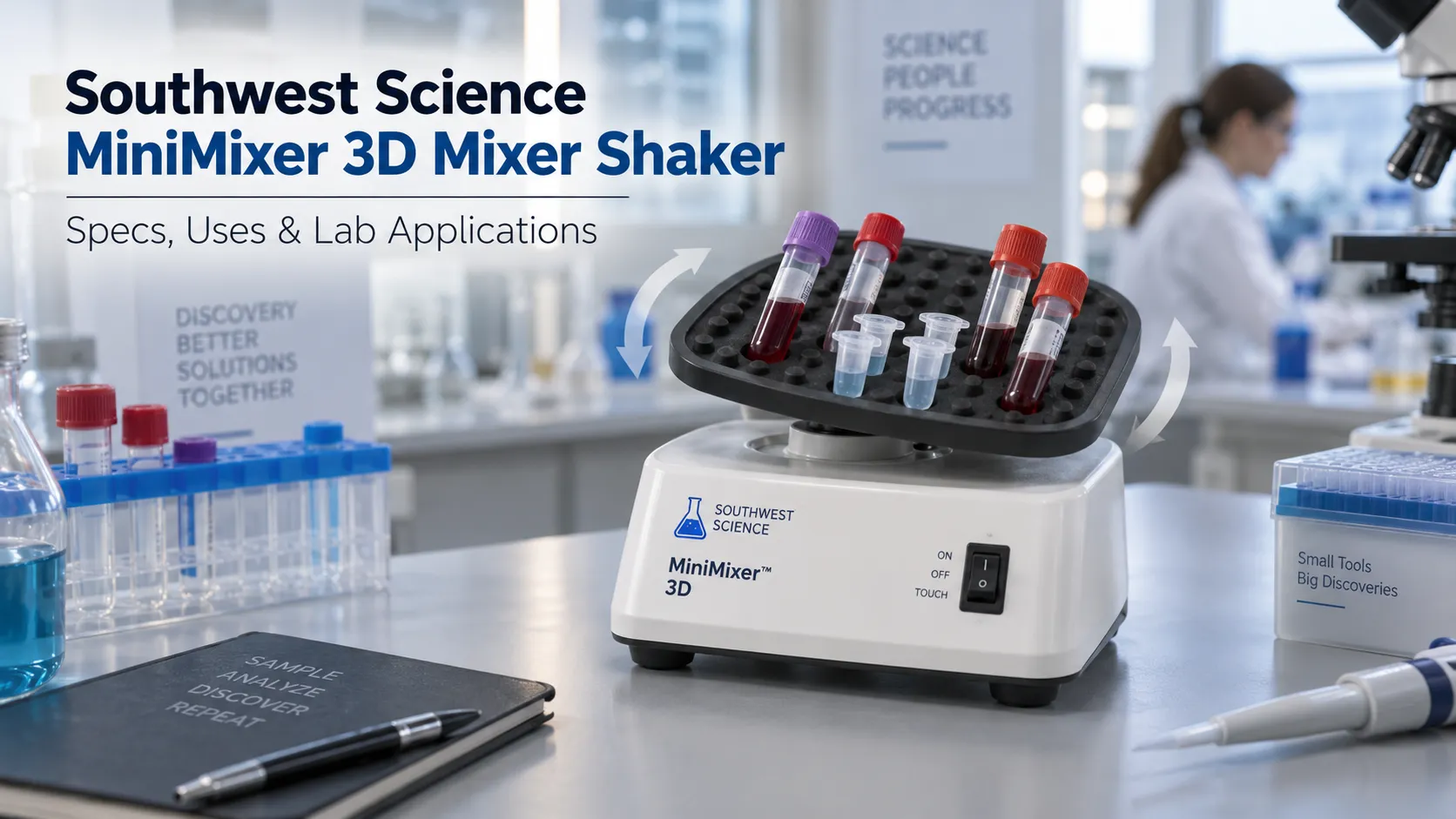
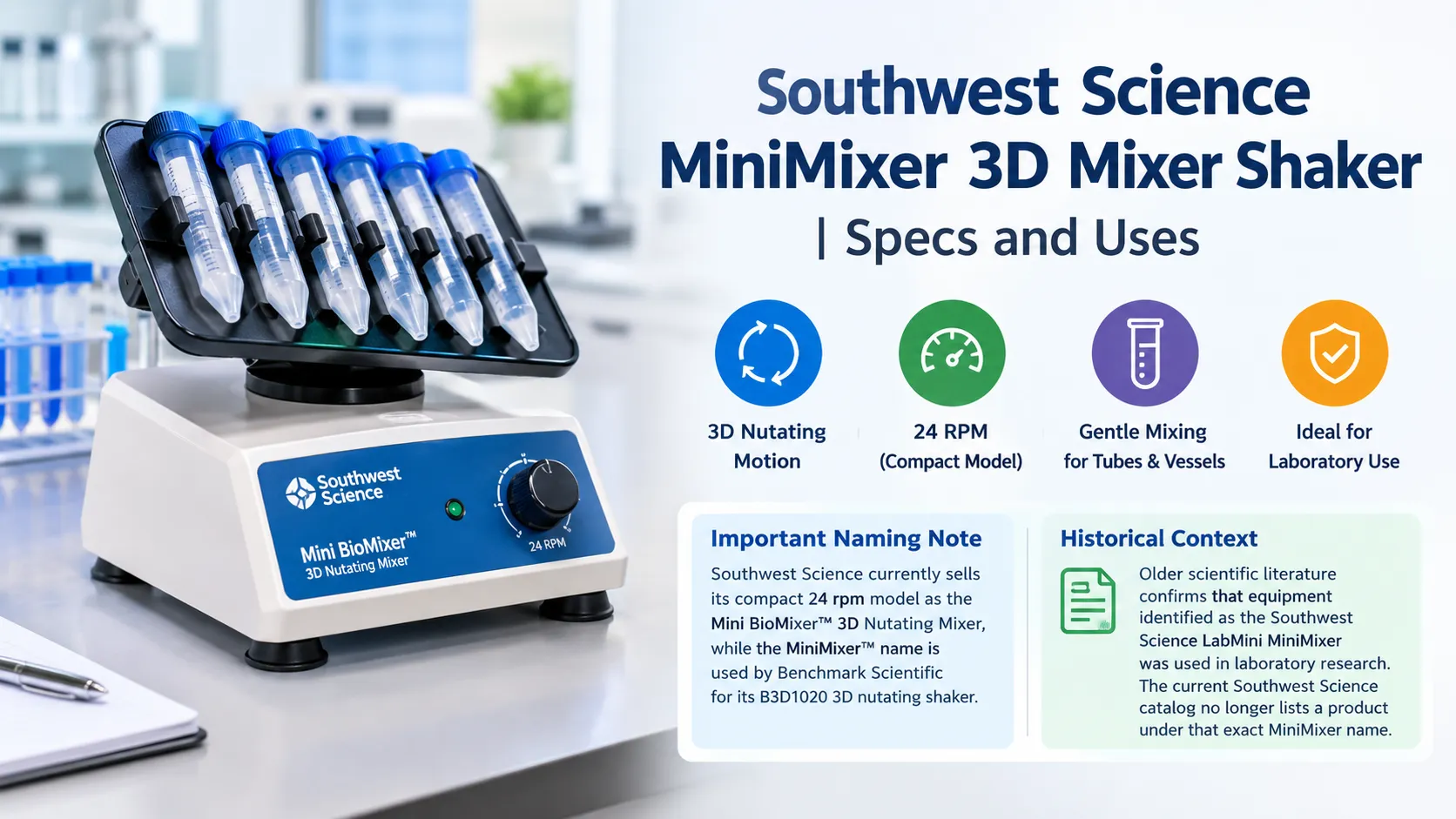
The southwest science minimixer 3d mixer shaker refers to a compact laboratory nutating mixer used for gentle, continuous three-dimensional agitation of tubes and other sample vessels. There is an important naming detail, however: Southwest Science currently sells its compact 24 rpm model as the Mini BioMixer™ 3D Nutating Mixer, while the MiniMixer™ name is currently used by Benchmark Scientific for its B3D1020 3D nutating shaker.
Older scientific literature confirms that equipment identified as the Southwest Science LabMini MiniMixer was used in laboratory research, so searches combining “Southwest Science” and “MiniMixer” have a genuine historical basis. The current Southwest Science catalog no longer lists a product under that exact MiniMixer name.
What Is the Southwest Science MiniMixer 3D Mixer Shaker?
A 3D nutating mixer is a benchtop laboratory shaker that simultaneously rocks and tilts its platform to create a multidirectional mixing pattern. Instead of moving samples rapidly in a flat circular orbit, the platform continually changes orientation, allowing liquid to move through the vessel in a gentler rolling or tumbling pattern.
Southwest Science describes its current nutating mixers as producing a combination of rocking, tilting, and orbital motion. The company says this type of movement is intended to provide even mixing while limiting excessive shear on samples.
For someone specifically searching for a Southwest Science MiniMixer today, the closest compact product in the manufacturer’s current lineup is the Mini BioMixer 3D Nutating Mixer, SKU SB3D1020. It operates at a fixed 24 rpm with a fixed ±20 degree tilt and uses a 10.5 by 7.5 inch platform.
Why the MiniMixer Name Can Be Confusing
The naming deserves clarification because several closely related laboratory mixers appear under similar product descriptions.
A 2015 peer-reviewed paper published in Analytical Methods specifically identifies a Southwest Science LabMini MiniMixer as the shaker used during antibody conjugation and magnetic microbead preparation. This establishes that Southwest Science equipment using the MiniMixer name existed in research settings at that time.
Today, however, Southwest Science lists three products in its Nutating 3D Mixers category:
- Mini BioMixer™ 3D Nutating Mixer
- Mini BlotBoy™ 3D Nutating Mixer
- 3D Variable Speed & Tilt Nutating Shaker
The company’s current Mini BioMixer carries model number SB3D1020.
Benchmark Scientific separately sells the MiniMixer™ B3D1020, and Sigma-Aldrich explicitly identifies MiniMixer as a trademark of Benchmark Scientific. For this reason, specifications from a modern Benchmark MiniMixer should not automatically be attributed to a Southwest Science unit, even though the products share several characteristics.
Southwest Science Mini BioMixer Specifications
The following specifications come directly from Southwest Science’s current product listing for the Mini BioMixer SB3D1020.
| Specification | Southwest Science Mini BioMixer SB3D1020 |
|---|---|
| Mixing type | 3D nutating motion |
| Speed | Fixed 24 rpm |
| Tilt angle | Fixed ±20° |
| Platform size | 10.5 × 7.5 in |
| Load capacity | 2.2 lb |
| Operating environment | 4°C to 50°C |
| Dimensions | 10.5 × 7.5 × 8 in |
| Weight | 4.6 lb |
| Electrical | 115 V, 60 Hz, 0.4 A |
| Platform surface | Custom dimpled mat |
| Warranty | 1 year |
| Current listed price | $399 |
| SKU | SB3D1020 |
The $399 figure is the price displayed by Southwest Science at the time of research and may change.
How the 3D Nutating Motion Works
A nutating mixer moves the sample platform around an angled axis. This means one side of the vessel rises while another falls, and the orientation continually rotates as the platform moves.
The result is different from an orbital shaker. An orbital shaker keeps its platform approximately horizontal and moves it in a circular path. A nutating mixer continuously changes the platform angle as well as its position.
That motion is useful when the goal is continuous liquid circulation rather than aggressive agitation. Southwest Science specifically positions nutating mixers for gentle sample handling, gel staining, sensitive reagent mixing, and laboratory workflows where excessive shear is undesirable.
Why 24 rpm Can Be Enough
Twenty-four revolutions per minute sounds slow compared with vortex mixers and orbital shakers capable of hundreds or thousands of rpm. The comparison is misleading because they perform different jobs.
A nutating mixer relies on gravity and changing vessel orientation to keep liquid moving. It is intended primarily for prolonged, controlled agitation, not rapid sample disruption.
The fixed speed can also simplify repeat procedures. Once a laboratory protocol has been validated at that motion and speed, operators do not need to reproduce a manual speed setting each time.
What the Dimpled Mat Is Used For
Southwest Science supplies the Mini BioMixer with a custom dimpled mat intended to hold blood tubes and microtubes. The molded surface helps prevent round sample containers from freely rolling across the platform while it is moving.
This setup makes more sense for tubes than a completely flat mat. Southwest Science’s related Mini BlotBoy takes the opposite approach and includes a flat rubber mat because that model is designed primarily around blotting, washing, and staining applications using flatter vessels.
Common Laboratory Uses
The southwest science minimixer 3d mixer shaker type is most useful when samples need continuous but relatively gentle agitation rather than high-speed vortexing.
Blood and Centrifuge Tube Mixing
The dimpled platform is suited to tubes that need to remain secure during extended mixing. Similar 3D nutating systems are marketed specifically for blood and centrifuge tubes because the multidirectional motion repeatedly redistributes liquid without requiring high rotational speeds.
Antibody and Magnetic Bead Incubation
There is direct evidence of an older Southwest Science LabMini MiniMixer being used in published scientific research.
In the 2015 Analytical Methods study on cardiac biomarker detection, researchers used a Southwest Science LabMini MiniMixer during a two-hour antibody labeling reaction. They also used it for three-hour incubation of biotinylated antibodies with magnetic particles.
This is useful evidence of practical laboratory use, although the study was not designed to evaluate or compare the shaker itself.
Gel Staining and Washing
Three-dimensional agitation can keep staining or wash solutions moving across a gel or membrane surface. For workflows specifically centered on gel staining, destaining, and blot washing, Southwest Science’s Mini BlotBoy may be better suited because it runs at a slower 12 rpm, uses an ±8 degree tilt, and comes with a flat mat.
Reagent and Sample Mixing
Gentle nutating movement may also be appropriate for suspensions, reagent mixtures, and other samples where continuous circulation is required without the intense localized agitation produced by a vortex mixer.
Whether it is appropriate for a particular biological material depends on the protocol. The manufacturer’s speed, temperature, vessel, and load limits should always be checked before adapting an established procedure.
Can It Be Used in a Cold Room or Incubator?
The current Southwest Science Mini BioMixer is specified for operation from 4°C to 50°C, allowing it to be used in many laboratory cold-room and incubator environments within that range.
This can be important for temperature-sensitive incubations because samples can remain under controlled agitation without repeatedly being moved between the mixer and the controlled-temperature environment.
The environmental specification should not be interpreted as temperature control. The mixer does not heat or cool samples itself. It simply operates within the stated surrounding-temperature range.
Mini BioMixer vs Mini BlotBoy
Southwest Science currently sells both units for $399, but they are configured for different mixing behavior.
| Feature | Mini BioMixer SB3D1020 | Mini BlotBoy SB3D1008 |
|---|---|---|
| Speed | 24 rpm | 12 rpm |
| Tilt | ±20° | ±8° |
| Platform | 10.5 × 7.5 in | 10.5 × 7.5 in |
| Included surface | Dimpled mat | Flat rubber mat |
| Load capacity | 2.2 lb | 2.2 lb |
| Temperature range | 4°C to 50°C | 4°C to 50°C |
| Main emphasis | Tubes and general nutating mixing | Blotting, washing and staining |
| Current listed price | $399 | $399 |
The BioMixer produces a stronger nutating action because of its greater tilt and higher speed. The Mini BlotBoy uses gentler movement suited to flat vessels and blot-related applications.
Southwest Science Mini BioMixer vs Benchmark MiniMixer
The modern Benchmark MiniMixer B3D1020 is particularly relevant because its product name closely matches the target search.
Benchmark currently specifies its MiniMixer at a fixed 24 rpm for the 115 V version, ±20 degree tilt, and a 10.5 by 7.5 inch platform. Benchmark lists a 4 lb load capacity, a 4°C to 50°C operating range, a two-year warranty, and a current price of approximately $484.41 on its official product page.
Southwest Science currently lists its SB3D1020 at $399, 24 rpm, ±20 degrees, and the same platform dimensions, but specifies a 2.2 lb load capacity and one-year warranty.
| Feature | Southwest Science SB3D1020 | Benchmark B3D1020 |
|---|---|---|
| Current product name | Mini BioMixer | MiniMixer |
| Speed | 24 rpm | 24 rpm, 115 V version |
| Tilt | ±20° | ±20° |
| Platform | 10.5 × 7.5 in | 10.5 × 7.5 in |
| Listed load capacity | 2.2 lb | 4 lb |
| Operating temperature | 4°C to 50°C | 4°C to 50°C |
| Warranty | 1 year | 2 years |
| Listed manufacturer price | $399 | $484.41 |
Despite the similar dimensions and motion specifications, buyers should use the specifications supplied for the exact branded model they are purchasing. The differences in rated load and warranty mean the two listings should not be treated as technically identical without manufacturer confirmation.
How It Differs From Other Laboratory Mixers
3D Nutating Mixer vs Vortex Mixer
A vortex mixer normally generates rapid circular motion concentrated around one tube or a small group of tubes. It is useful when fast and intense mixing is required.
A nutating mixer instead provides slower continuous agitation over a larger platform. It makes more sense for lengthy incubations or procedures where tubes need to remain moving for minutes or hours.
3D Nutating Mixer vs Orbital Shaker
An orbital shaker keeps vessels moving in a horizontal circular path. It is widely used for flasks, cultures, microplates, and other applications requiring consistent orbital agitation.
A nutating platform adds changes in angle. This helps liquids repeatedly flow across different parts of the vessel and can be advantageous when gentle surface coverage is more important than high-speed aeration.
3D Nutating Mixer vs Rocking Platform
A conventional rocker generally tips samples from one side to another along a single axis. A 3D nutating mixer adds rotational movement, producing a more complex path through the sample.
Neither design is universally superior. The appropriate mixer depends on the vessel, desired shear level, mixing intensity, protocol, and sample characteristics.
Advantages of a Compact 3D Nutating Mixer
The main practical advantage is its ability to provide continuous multidirectional movement without requiring a large benchtop shaker.
The Southwest Science Mini BioMixer’s 10.5 by 7.5 inch footprint is relatively compact, and the platform itself occupies essentially that same area. Its stated weight of 4.6 lb also makes it considerably easier to position or relocate than many larger laboratory shakers.
The fixed speed and tilt can also be useful for routine protocols because operation is straightforward. There are fewer parameters for users to change accidentally.
Important Limitations
The same simplicity that makes a fixed-speed mixer convenient can be a disadvantage for laboratories that run many different protocols.
The Southwest Science Mini BioMixer does not provide adjustable speed or adjustable tilt. If an experiment requires slower movement, a different angle, timed operation, or protocol-specific optimization, a variable model provides more flexibility.
Its official load rating is also only 2.2 lb. Laboratories should calculate the combined weight of the platform contents rather than estimating based only on the number of tubes present.
Another limitation is the lack of independent comparative performance data. The available peer-reviewed research confirms use of a Southwest Science LabMini MiniMixer in an experimental workflow, but it does not compare mixing uniformity, durability, noise, reliability, or sample performance against competing mixers.
When the Variable-Speed Southwest Science Model Makes More Sense
Southwest Science also sells the SB3D2301 3D Variable Speed & Tilt Nutating Shaker. This larger model offers speeds from 2 to 30 rpm and a tilt range from 0 to 23 degrees. It includes a 12 by 12 inch platform, supports loads up to 8 lb, and provides a timer from one minute to 100 hours or continuous operation.
Its current listed price is $625.
For laboratories developing new protocols or working with several sample types, those adjustable parameters may be more valuable than the lower cost and simpler controls of the compact fixed-speed unit.
Who Should Consider This Type of Mixer?
A compact 3D nutating mixer makes the most sense for laboratories that repeatedly perform gentle mixing at a known speed and angle.
It may be particularly useful for:
- Blood and centrifuge tube mixing
- Magnetic bead incubations
- Antibody and reagent reactions
- General low-speed sample agitation
- Procedures carried out in compatible cold rooms or incubators
- Laboratories with limited bench space
Researchers who need variable speeds, programmable timing, high-capacity loads, intense vortexing, or orbital culture shaking should consider equipment designed specifically for those requirements.
Southwest Science Background
Southwest Science states that it was founded in 2006 by a group with decades of experience in laboratory equipment design, manufacturing, and sales. The company also says previous designs from members of its team have been sold under brands including Fisher, VWR, Cole-Parmer, Benchmark, Labnet, and Boekel.
That history helps explain why searches for older laboratory equipment can produce overlapping product styles and names. It does not, however, prove that a particular Southwest Science product is identical to a model currently sold by another manufacturer.
FAQ
Is the Southwest Science MiniMixer still available?
Southwest Science does not currently list a mixer using the exact product name “MiniMixer.” Its current compact 24 rpm nutating model is the Mini BioMixer 3D Nutating Mixer SB3D1020, listed at $399.
Was there really a Southwest Science MiniMixer?
Yes. A 2015 peer-reviewed scientific paper identifies a Southwest Science LabMini MiniMixer as equipment used during antibody conjugation and magnetic microbead incubation.
What speed does the Southwest Science Mini BioMixer run at?
The SB3D1020 operates at a fixed 24 rpm with a fixed tilt angle of ±20 degrees.
What is a 3D nutating shaker used for?
It provides gentle multidirectional agitation for tubes, vials, flat vessels, staining procedures, reagent mixing, incubations, and other workflows that benefit from continuous movement without very high-speed shaking.
Is the Southwest Science Mini BioMixer the same as the Benchmark MiniMixer?
They have several similar specifications, including 24 rpm operation, ±20 degree tilt, and a 10.5 by 7.5 inch platform, but their official listings differ in load capacity, warranty, electrical details, pricing, and branding. They should therefore not be assumed to be identical products without confirmation from the manufacturers.
Can the mixer operate inside a refrigerator or incubator?
The current Southwest Science Mini BioMixer is specified for environments from 4°C to 50°C. It can therefore operate in compatible cold rooms and incubators within that range, but it does not control temperature itself.
Also Read: Humaniac Safety Outer Pants
