


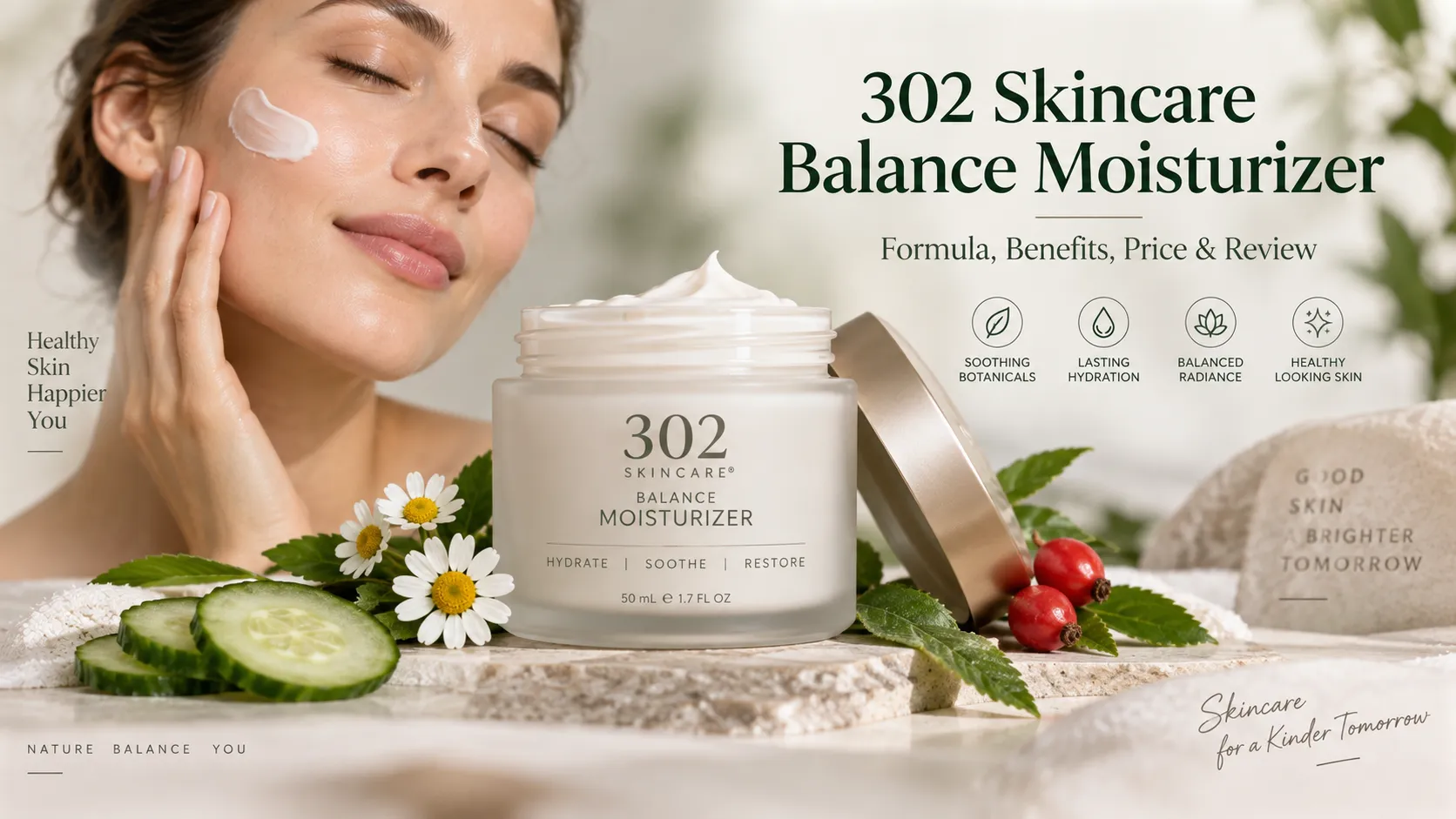
302 Skincare Balance Moisturizer is a medium-weight facial lotion designed to hydrate, soften, and support the skin’s moisture barrier without leaving a heavy or sticky finish. As of September 2026, 302 Professional Skincare sells it in 2 oz and 8 oz sizes, with official U.S. prices of $16.95 and $39.95 respectively.
The product sits between a very light lotion and a richer moisturizer. Its formula combines glycerin, jojoba oil, shea butter, squalane, medium-chain triglycerides, botanical hydrosols, esters, and other conditioning ingredients. That makes it most relevant to people who want more moisture than a gel or lightweight lotion provides but do not want the dense feel of a heavy cream.
This review is based on the current ingredient list, manufacturer information, independent retailer listings, and established dermatology research on moisturizer ingredients. It is not based on personal hands-on testing.
What Is 302 Skincare Balance Moisturizer?
302 Balance Moisturizer is part of the moisturizer range from 302 Professional Skincare, a U.S. skincare company operated by Avoscience LLC. The company currently lists products including 302 Moisturizer, Sensitive Moisturizer, Balance Moisturizer, Intensive Moisturizer, Moisturizing Drops, and several body moisturizers.
The brand describes Balance Moisturizer as an “all day” facial lotion with medium viscosity. Its main selling points are barrier support, a non-tacky finish, and a mixture of organic botanical ingredients with conventional cosmetic moisturizers and texture-enhancing agents.
The current official product comes in:
| Size | Official U.S. price* |
|---|---|
| 2 oz / 60 ml | $16.95 |
| 8 oz / 240 ml | $39.95 |
*Prices checked on the official 302 Professional Skincare website in September 2026 and may change.
302 Skincare Balance Moisturizer Ingredients
The current formula listed by 302 Professional Skincare contains organic green tea; hydrosols of chamomile, cucumber, arnica, yucca, and rose hips; jojoba oil; shea butter; medium-chain coconut triglycerides; methyl glucose esters; glyceryl monostearate; glycerine; C12-15 ammonium alkyl esters; Polyquat 81; olive-derived squalane; cellulose polymer; rose ether; sodium benzoate; camphor; and citrus extracts, among other formulation components.
The formula is useful to understand in groups because the ingredients do different jobs.
| Ingredient or group | Main role in the formula |
|---|---|
| Glycerin | Humectant that helps attract and retain water |
| Jojoba oil | Emollient that helps soften and smooth skin |
| Shea butter | Lipid-rich emollient that reduces a dry, rough feel |
| Squalane | Lightweight emollient and skin-conditioning lipid |
| Medium-chain triglycerides | Emollient and texture-enhancing oils |
| Glyceryl monostearate | Emollient and emulsifying ingredient |
| Botanical hydrosols | Primarily botanical and sensory components |
| Sodium benzoate | Preservative |
| Cellulose polymer and Polyquat 81 | Texture, film-forming, and conditioning functions |
| Rose ether, camphor, citrus extracts | Sensory and aromatic components |
Modern moisturizers usually work through a combination of humectants, emollients, and occlusive or film-forming ingredients. Humectants increase water content in the outer skin layer, while emollients smooth spaces between dry skin cells and occlusive ingredients reduce water evaporation. Glycerin and jojoba oil are established examples of ingredients used in those roles.
Glycerin Provides the Core Hydration
Glycerin is one of the most established humectants used in skincare. It attracts and holds water within the stratum corneum, the skin’s outermost layer, which can make dry skin feel softer and more flexible.
Its inclusion is important because Balance Moisturizer is not relying solely on plant extracts to provide hydration. There is a conventional, well-studied moisturizing ingredient at the center of the formula.
Jojoba Oil, Shea Butter, Triglycerides and Squalane Add Emollience
302 combines glycerin with several oil-soluble conditioning ingredients. Jojoba oil, shea butter, medium-chain triglycerides, and squalane help give the lotion its richer feel and can smooth dry or rough skin.
Dermatology literature classifies jojoba oil among common emollient ingredients, while squalane is widely used as a stable skin-conditioning lipid in moisturizers.
This mixture explains why Balance Moisturizer can feel more substantial than a water-heavy gel moisturizer while remaining lighter than a highly occlusive ointment.
What Does 302 Balance Moisturizer Actually Do?
The strongest evidence-based expectation is straightforward: it moisturizes the skin and temporarily improves softness, smoothness, and water retention.
Moisturizers can support the outer skin barrier by increasing hydration and reducing transepidermal water loss. Research consistently shows that combinations of humectants, emollients, and occlusive agents can improve dry-skin symptoms and barrier function.
302 describes Balance Moisturizer as providing barrier protection and a tack-free finish. Those claims are consistent with the general functions of ingredients such as glycerin, oils, squalane, esters, and film-forming polymers, although the manufacturer does not publish controlled clinical data on the product page demonstrating how much Balance Moisturizer improves skin hydration or transepidermal water loss compared with other moisturizers.
That distinction matters. The formula contains sensible moisturizer ingredients, but consumers should not interpret ordinary barrier-support language as evidence that the product has been clinically proven to treat a skin disease.
Who Is 302 Skincare Balance Moisturizer Best For?
Balance Moisturizer makes the most sense for normal, normal-to-dry, combination, or seasonally dehydrated skin that needs moderate hydration without an extremely rich finish.
Independent 302 retailers similarly describe it as a middle-ground formula, stronger than the brand’s light moisturizer but less intensive than its richest options. Skincare by Alana describes it as a medium-bodied moisturizer intended for normal, combination, or environmentally stressed skin.
It may be especially practical for people whose skin changes throughout the year. Someone who finds lightweight gel moisturizers insufficient during air-conditioned days, colder weather, flights, or dry indoor environments may prefer this type of lotion.
People with very oily skin may find the combination of jojoba oil, shea butter, triglycerides, and squalane more moisturizing than necessary. On the other end, severely dry or compromised skin may need a more occlusive cream or ointment.
Is It Good for Sensitive Skin?
It depends on what the skin is sensitive to.
The moisturizer contains several ingredients that are often well tolerated, including glycerin, squalane, jojoba oil, and common emollient ingredients. However, the current official ingredient list also includes rose ether, camphor, and citrus extracts.
That makes Balance Moisturizer different from a simple fragrance-free moisturizer designed specifically for highly reactive skin. The FDA notes that fragrance components can trigger sensitivity or allergic reactions in some people and advises fragrance-sensitive consumers to examine ingredient lists carefully and consider fragrance-free products.
A person with eczema, known fragrance allergy, active dermatitis, or a history of reacting to botanical skincare may therefore prefer a simpler fragrance-free product or seek guidance from a dermatologist.
Does “Organic” Make the Formula Better?
302 emphasizes organic and naturally sourced ingredients throughout its product range. The company says it sources organic, animal-free, and sustainably farmed ingredients and that many of its products contain more than 90% organic content. It also identifies the range as gluten-free, glycol-free, and cruelty-free.
Those features may matter to consumers who prefer certain sourcing standards, but they do not automatically make a moisturizer more effective or less irritating.
The U.S. Food and Drug Administration specifically warns consumers not to assume that natural or organic cosmetic ingredients are safer. Ingredient safety depends on the substance, concentration, formulation, exposure, and the individual using it, not simply whether it originated from a plant or organic source.
Is 302 Balance Moisturizer Non-Comedogenic?
The current official Balance Moisturizer page does not clearly advertise the product as non-comedogenic, so it would be inaccurate to guarantee that it will not contribute to breakouts.
The formulation contains several commonly used cosmetic oils and emollients, but whether a finished moisturizer causes clogged pores depends on the complete formula and an individual’s skin. Ingredient-by-ingredient “comedogenic ratings” found online are not reliable enough to predict how a finished product will behave on every person.
People who are highly acne-prone should introduce it gradually rather than assuming that a botanical or organic formula is automatically acne-safe.
How to Use 302 Skincare Balance Moisturizer
The manufacturer’s directions are simple: dispense the moisturizer and smooth it onto the skin after cleansing.
For most people, it would fit into a routine after cleansing and any lightweight water-based treatment products. During the daytime, sunscreen should normally be the final skincare layer because Balance Moisturizer itself is not marketed as a sunscreen.
A practical routine could look like cleanser, treatment serum if used, Balance Moisturizer, and broad-spectrum sunscreen in the morning. At night, sunscreen is omitted.
There is no need to apply an unusually large amount. Start with enough to cover the face comfortably, then add more only where the skin still feels dry.
Does 302 Balance Moisturizer Replace Recovery Plus Intensive?
Some third-party 302 retailers state that Balance Moisturizer replaced or is the renamed version of an older product called Recovery Plus Intensive. Blossom Organic Skin Care describes Balance Moisturizer as replacing Recovery Plus: Intensive, while another 302-focused retailer similarly describes the older moisturizer as having been renamed.
Consumers looking for Recovery Plus Intensive may therefore encounter Balance Moisturizer as the current equivalent. However, older product descriptions and ingredient lists should not automatically be assumed to match the current formula exactly. Anyone repurchasing after several years should check the present package ingredient list.
White Label and Gray Label Versions Can Cause Confusion
Search results for 302 Balance Moisturizer can show different ingredient lists. This appears partly related to older or retailer-specific listings of a Gray Label version.
For example, one retailer lists a Gray Label Balance Moisturizer containing chamomile and cucumber hydrosols, jojoba oil, shea butter, triglycerides, glycerin, and mixed silicone, while the current main 302 website lists a formula containing a broader selection of hydrosols, olive-derived squalane, rose ether, camphor, and citrus extracts.
For that reason, the ingredient label on the exact bottle being purchased is more useful than an older online ingredient list. This is particularly important for people avoiding fragrance-related ingredients or known allergens.
302 Balance Moisturizer vs. a Basic Drugstore Moisturizer
Balance Moisturizer is not fundamentally different from other moisturizers in the way it hydrates skin. Like many effective lotions, it combines a water-binding humectant with oils, emollients, and ingredients that help form a protective film.
Its main differences are the botanical-heavy formulation, moderate texture, brand philosophy, and relatively unusual blend of hydrosols and aromatic components.
There is currently no strong clinical evidence showing that 302 Balance Moisturizer hydrates or repairs the skin barrier better than well-formulated conventional moisturizers containing ingredients such as glycerin, petrolatum, dimethicone, ceramides, or similar established moisturizing agents. Reviews of moisturizer science repeatedly note that many products use similar basic mechanisms even when their marketing and ingredient stories differ considerably.
That does not make Balance Moisturizer ineffective. It simply means its value should be judged by how well the texture, formula, ingredient preferences, price, and skin compatibility suit the individual user.
Advantages and Limitations
The strongest points of 302 Skincare Balance Moisturizer are its useful middle-weight texture, glycerin-based hydration, mixture of emollient oils, squalane, larger 8 oz option, and comparatively straightforward positioning as an everyday moisturizer.
The main limitation is that sensitive-skin shoppers may expect an “organic” moisturizer to be extremely minimal, yet the current version contains rose ether, camphor, citrus extracts, and multiple botanical hydrosols. Anyone specifically seeking a fragrance-free or ultra-minimal moisturizer should compare alternatives carefully.
There is also little publicly available product-specific clinical research. Most expectations about hydration and barrier support are therefore based on established knowledge of the formula’s ingredient categories rather than published trials of Balance Moisturizer itself.
Is 302 Skincare Balance Moisturizer Worth Considering?
302 Skincare Balance Moisturizer is a credible option for someone seeking moderate everyday facial hydration with a soft, non-greasy finish, particularly if they enjoy botanical skincare and tolerate fragranced or aromatic ingredients well.
Its formula includes recognized moisturizer components such as glycerin, jojoba oil, shea butter, triglycerides, and squalane. The official 2 oz price of $16.95 also places the entry-size bottle below many premium facial moisturizers, while the 8 oz version provides considerably more product.
It is less compelling for someone who specifically needs an extremely simple, fragrance-free formula, has known sensitivity to botanical extracts, or wants a moisturizer supported by extensive finished-product clinical trials.
Frequently Asked Questions
What is 302 Skincare Balance Moisturizer used for?
It is an everyday facial moisturizer intended to hydrate, soften, smooth, and support the outer skin barrier. The manufacturer describes it as a medium-bodied lotion with a non-tacky finish.
How much does 302 Balance Moisturizer cost?
As of September 2026, the official U.S. website lists the 2 oz / 60 ml size at $16.95 and the 8 oz / 240 ml size at $39.95. Prices at independent retailers can differ.
Is 302 Balance Moisturizer good for dry skin?
It can be suitable for mild to moderate dryness because it combines glycerin with emollients including shea butter, jojoba oil, triglycerides, and squalane. Extremely dry or severely barrier-damaged skin may require a more occlusive moisturizer.
Can acne-prone skin use 302 Balance Moisturizer?
Possibly, but the manufacturer does not clearly make a non-comedogenic claim for the current product. Acne-prone users should introduce it gradually and monitor how their own skin responds rather than relying on ingredient-rating charts.
Is 302 Skincare Balance Moisturizer fragrance-free?
The current official ingredient list includes rose ether, camphor, and citrus extracts, so it should not be treated as a completely fragrance-free, aroma-free formula. People with fragrance allergies or very reactive skin should review the package label carefully.
Did Balance Moisturizer replace 302 Recovery Plus Intensive?
Several established retailers describe Balance Moisturizer as the replacement or renamed version of Recovery Plus Intensive. Because formulations can change over time, the current ingredient label should be used when comparing the older and newer products.
Also Read: Best Cosmetic Procedure for Crowded Teeth Contribute to Our Blog
