


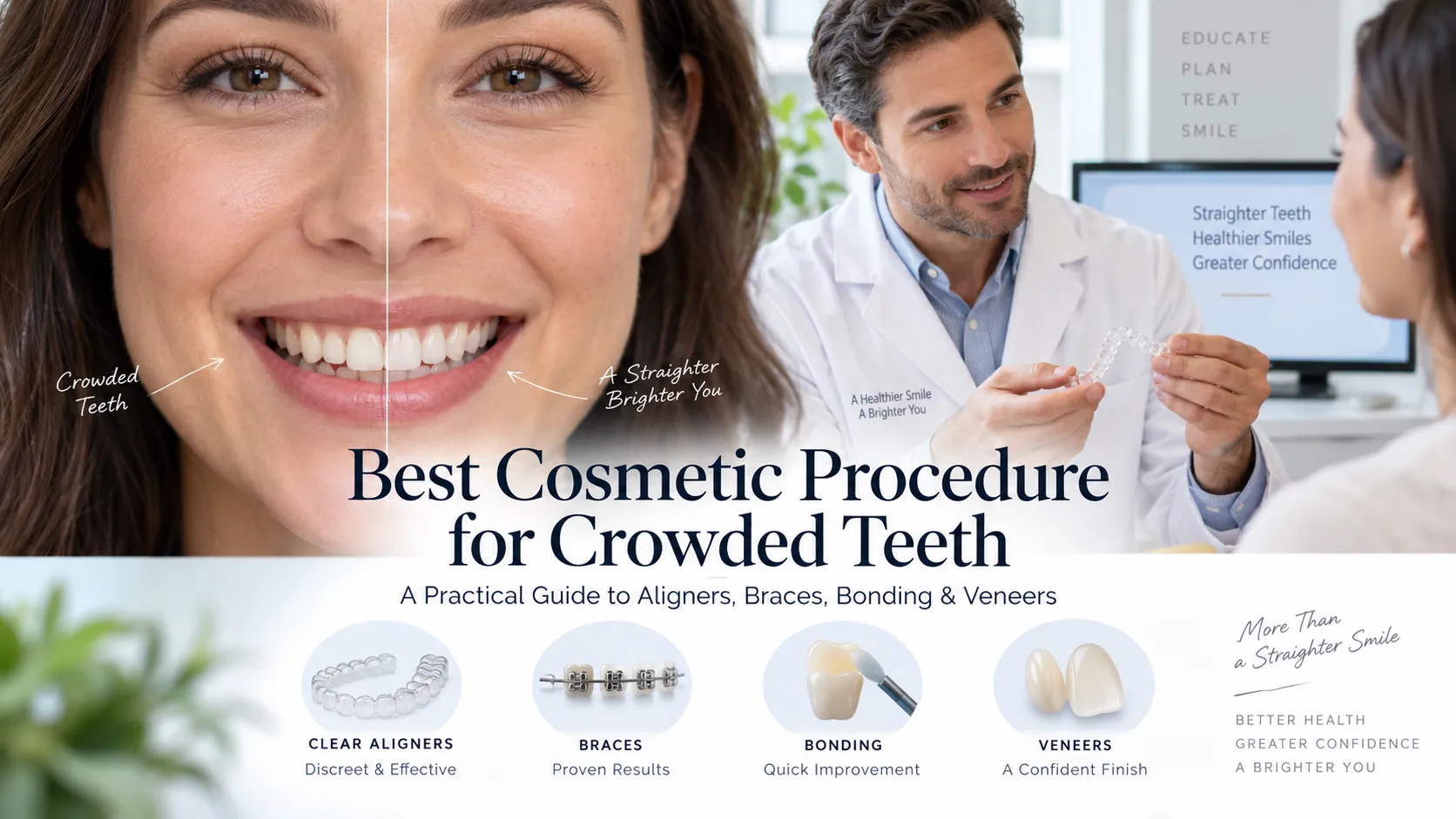
For genuinely crowded teeth, orthodontic treatment is usually the most appropriate way to improve the smile because it moves the teeth rather than simply covering the problem. Clear aligners can be a discreet option for many mild-to-moderate cases, while fixed braces may be more suitable when crowding is severe, extractions are required, or tooth movements are complex.
Crowded teeth occur when there is not enough room in the dental arch for the teeth to sit in proper positions. Teeth may overlap, rotate, tilt, or erupt outside the ideal line of the arch. Although people often seek treatment because of appearance, crowding can also affect the bite and make some areas harder to brush and floss effectively.
That distinction matters when comparing clear aligners, braces, composite bonding, and veneers. Some treatments actually correct tooth position. Others mainly disguise the visible irregularity.
What Is the Best Cosmetic Procedure for Crowded Teeth Contribute to Our Blog Readers Should Know About?
There is no single procedure that is best for every crowded smile. If the goal is to straighten teeth while preserving as much natural tooth structure as possible, orthodontics is generally the first option worth assessing.
For adults concerned about appearance during treatment, clear aligners are often the most cosmetic form of orthodontics because the trays are much less noticeable than conventional braces. The British Orthodontic Society says aligners are commonly used for mild-to-moderate dental irregularity, including crowding that can be managed through modest expansion or interproximal reduction. Severe crowding, extraction cases, complex movements, and major jaw discrepancies may require additional techniques or fixed appliances.
This means the useful question is not simply, “Which treatment looks best?” It is, “Which treatment can safely produce the tooth movements my case requires?”
Why Orthodontics Is Usually Preferred for True Dental Crowding
Orthodontics addresses the underlying position of the teeth. Braces and aligners apply controlled forces that gradually move teeth into planned positions.
The NHS describes orthodontic treatment as a way to correct dental crowding, straighten teeth, and correct bite problems. The American Association of Orthodontists similarly identifies crowded and crooked teeth among the conditions braces are designed to treat.
This is fundamentally different from veneers or bonding. A veneer changes the visible surface and shape of a tooth. Composite bonding adds material to alter appearance. Neither automatically creates the space or tooth movement required to correct significant crowding.
For someone with healthy teeth who mainly dislikes overlapping or rotated teeth, unnecessarily removing enamel just to make the teeth appear straighter may therefore be a very different trade-off from orthodontically moving those teeth.
Clear Aligners for Crowded Teeth
Clear aligners are removable plastic trays created to move teeth gradually through a sequence of planned positions. They have become particularly attractive to adults who want orthodontic treatment without highly visible brackets and wires.
When Clear Aligners Can Work Well
The British Orthodontic Society lists several common aligner indications, including:
- Mild-to-moderate dental irregularity
- Crowding manageable through mild-to-moderate arch expansion
- Crowding manageable with interproximal reduction
- Mild spacing
Aligners generally need to be worn throughout the day and night except during meals, so treatment depends heavily on patient compliance.
Recent clinical evidence also suggests that aligners can be effective when appropriately selected. A 2024 systematic review examining treatment duration in crowding cases found low-certainty evidence that treatment time with clear aligners was similar to fixed appliances for mild-to-moderate crowding.
A systematic review and meta-analysis published in 2025 found that both clear aligners and fixed appliances performed well in simple, non-extraction malocclusions. The authors also emphasized that the overall quality of evidence was limited and that more high-quality research is needed for complex cases.
Where Aligners Become Less Predictable
Not every crowded smile is an uncomplicated aligner case.
A 2026 systematic review comparing anterior tooth movements in adults found mixed results across different types of movement, with fixed appliances showing advantages in rotation and torque control in some studies. The authors noted that the evidence remained limited.
Another recent systematic review found no significant difference in overall treatment quality in non-extraction cases but reported better treatment quality with fixed appliances in extraction cases.
Clear aligners should therefore not be selected simply because they are less visible. The complexity of the tooth movements matters.
Traditional and Ceramic Braces for Crowded Teeth
Fixed braces remain one of the most versatile ways to correct crowding.
Brackets are attached to the teeth and connected by wires that apply controlled pressure. Orthodontists can use additional components when necessary to help manage individual tooth positions or bite relationships.
Fixed appliances can be particularly useful when treatment involves:
- Significant tooth rotations
- Severe crowding
- Complex bite correction
- Extraction spaces
- Tooth movements requiring precise control
The disadvantage for a patient focused primarily on cosmetics is visibility. Ceramic braces can reduce that concern because their brackets are less noticeable than conventional metal brackets, although they remain fixed appliances.
For some complex cases, accepting a more visible treatment for a period may preserve more natural tooth structure than attempting to camouflage crowding with restorative dentistry.
Clear Aligners vs Braces for Crowded Teeth
| Treatment | What it does | Often considered for | Important limitation |
|---|---|---|---|
| Clear aligners | Moves teeth orthodontically | Many mild-to-moderate crowding cases | Requires consistent wear and may be less suitable for certain complex movements |
| Fixed braces | Moves teeth orthodontically | Mild through complex crowding | More visible and requires careful cleaning |
| Composite bonding | Changes tooth shape with resin | Small cosmetic irregularities | Does not correct significant tooth position or bite problems |
| Porcelain veneers | Covers the visible front surface | Selected cosmetic shape, color, or alignment concerns | Usually requires enamel removal and is irreversible |
| Interproximal reduction | Creates small amounts of space between teeth | Selected orthodontic crowding cases | It is an adjunct to orthodontic treatment, not a stand-alone cosmetic fix |
| Extraction | Creates larger amounts of space | Selected severe or structurally complex cases | Only appropriate when justified by the full orthodontic diagnosis |
The right option depends on the amount of crowding, tooth shape, gum health, bite, jaw relationships, and the types of tooth movement required.
Can Composite Bonding Fix Crowded Teeth?
Composite bonding can improve the appearance of very small irregularities, but it should not be confused with orthodontic correction.
During bonding, a dentist applies tooth-colored composite resin and shapes it to change the visible size, contour, or proportions of a tooth. Cleveland Clinic describes bonding as a minimally invasive cosmetic procedure commonly used for changes in tooth shape, gaps, chips, and other minor imperfections. It generally requires much less enamel alteration than porcelain veneers.
For mildly uneven front teeth, carefully selected bonding may improve visual symmetry. It can also be useful after orthodontic treatment when the teeth are properly aligned but their natural shapes are uneven.
The limitation is simple: adding resin does not make a crowded tooth move into a better position.
Trying to disguise substantial overlap by adding material could also make already crowded teeth look bulkier. That is why tooth position should be assessed before bonding is chosen as the main treatment.
Bonding also has practical limitations. Composite can stain and chip over time and generally does not offer the same wear resistance as porcelain.
Are Veneers a Good Choice for Crowded Teeth?
Veneers can make certain crooked or misshapen teeth appear more uniform, but they are generally a cosmetic camouflage treatment rather than a true correction for dental crowding.
The American Dental Association’s MouthHealthy guidance states that veneers can improve the appearance of crooked or misshapen teeth. However, porcelain veneer placement involves removing enamel, making the treatment irreversible. Veneers can also chip, crack, loosen, or wear and may need future repair or replacement.
That trade-off deserves particular attention when the underlying teeth are healthy.
If a person could achieve the desired result through orthodontic movement, an orthodontic consultation may reveal a way to improve alignment without covering several healthy teeth with restorations.
Veneers can still have a legitimate role. For example, after orthodontic treatment, a patient may have unusually shaped, heavily discolored, worn, or damaged teeth that need restorative correction. In such cases, orthodontics and restorative dentistry may be combined rather than treated as competing options.
The ADA also advises that problems such as tooth decay or gum disease should be treated before veneers are placed. A deep overbite or tooth grinding may affect whether veneers are appropriate.
How Dentists Create Space for Crowded Teeth
Straightening crowded teeth is not simply a matter of pushing them apart. The orthodontist first has to determine where the required space will come from.
Arch Development or Expansion
Some treatment plans create space by changing the width or form of the dental arch. The amount that can safely and predictably be achieved depends on the patient’s anatomy and diagnosis.
The British Orthodontic Society notes that mild-to-moderate crowding that can be corrected through modest expansion may be suitable for clear aligners.
Interproximal Reduction
Interproximal reduction, often abbreviated as IPR, removes a very small controlled amount of enamel between selected teeth to create space.
A systematic review evaluating IPR reported that it can be useful in treating crowding, although the quality of available evidence was low to very low and stronger long-term trials were still needed.
IPR should therefore be viewed as an orthodontic technique performed after clinical planning, not as a DIY tooth-filing method.
Tooth Extraction
Some crowded arches require more space than expansion or IPR can reasonably provide. Extraction can therefore form part of selected orthodontic treatment plans.
NHS guidance notes that orthodontic treatment may sometimes involve tooth extraction and, in considerably more complex situations, jaw surgery.
Extraction is not automatically required because teeth look crowded. The decision depends on the full bite, facial and dental relationships, available space, tooth condition, and treatment objectives.
Mild, Moderate, and Severe Crowding Need Different Solutions
The visible amount of overlap does not always reveal how difficult treatment will be.
A seemingly small irregularity may involve a tooth that requires difficult rotation or root movement. In another person, noticeable crowding may respond relatively predictably once adequate space has been created.
As a practical guide:
Mild Crowding
Clear aligners or fixed braces may both be appropriate. Limited IPR or modest space creation may sometimes be incorporated into treatment.
Small residual cosmetic shape differences can occasionally be refined with bonding afterward.
Moderate Crowding
Either aligners or braces may remain possible, but diagnosis becomes more important. The orthodontist needs to determine how much space is required and whether movements such as expansion, rotation, or IPR can produce a stable result.
Severe Crowding
Fixed appliances are often considered when tooth movements are complex, significant space must be created, or extractions are involved. The British Orthodontic Society specifically identifies severe crowding and extraction treatment as situations in which aligners may require additional techniques such as fixed appliances.
Why a Cosmetic Dentist Alone May Not Be Enough
Cosmetic dentistry and orthodontics overlap, but they solve different problems.
An orthodontist specializes in diagnosing and treating irregularities involving tooth and jaw position. A general or cosmetic dentist focuses on dental health and restorative or cosmetic procedures such as bonding, whitening, crowns, and veneers.
When the main problem is actual crowding, an orthodontic assessment can help determine whether the teeth should first be moved.
In more complicated smile makeovers, the most conservative result may come from collaboration. An orthodontist can establish tooth position, while a restorative dentist handles issues such as worn edges, abnormal tooth shapes, discoloration, or damaged enamel afterward.
What Should Be Checked Before Choosing Treatment?
A treatment decision should come after an examination rather than from photographs alone.
Important factors include the amount and location of crowding, tooth rotations, bite relationship, gum condition, cavities, existing restorations, tooth proportions, available space, and the health of supporting structures.
An orthodontic evaluation may also use dental imaging when clinically appropriate. The AAO describes panoramic and cephalometric radiographs as diagnostic tools used by orthodontists to examine the teeth and jaw relationships.
This assessment can change the apparent “best” option significantly.
Two people who both have overlapping front teeth may need completely different treatment plans.
Do Straightened Teeth Stay Straight Permanently?
Not automatically. Retention is an important part of orthodontic treatment because teeth can move after active treatment ends.
The American Association of Orthodontists states that teeth naturally continue to shift throughout life and that retainers help maintain orthodontic results. Long-term retainer use is commonly recommended.
Retainers may be removable or fixed, depending on the treatment plan. A person considering braces or aligners should therefore include retention in the long-term decision rather than thinking treatment ends when the last aligner is removed or the braces come off.
Which Treatment Preserves the Most Natural Tooth Structure?
In a patient with otherwise healthy teeth, orthodontic treatment often has an important conservative advantage: the objective is to reposition the existing teeth rather than cover their visible surfaces with restorations.
Composite bonding generally requires little or no major enamel removal and can also be conservative for small cosmetic changes. Porcelain veneers, however, generally require enamel removal and are considered irreversible.
This does not make veneers inherently inappropriate. It means the benefits of veneers should justify permanently altering healthy teeth, particularly if crowding could instead be corrected orthodontically.
When a Combination Approach Makes More Sense
Some of the best cosmetic outcomes do not come from one treatment.
A patient might first straighten crowded teeth with aligners or braces and then use conservative bonding to correct a chipped edge or improve the proportions of an unusually small tooth.
Another patient might need orthodontic treatment followed by veneers because several teeth already have extensive cosmetic or structural problems.
This sequence can sometimes reduce how much restorative work is necessary because the dentist is no longer trying to use restorations to compensate for poor tooth position.
How to Choose Between Aligners, Braces, Bonding, and Veneers
The decision becomes easier when each treatment is matched to the problem it actually solves.
If the main issue is tooth position, investigate orthodontics first.
If the teeth are already reasonably positioned but one or two teeth have small shape irregularities, bonding may be enough.
If significant color, shape, wear, or structural cosmetic problems remain after alignment, veneers or another restorative approach may become relevant.
If crowding is severe, involves extractions, or requires difficult rotations and root control, fixed braces may offer advantages over an aligner-only strategy. Recent systematic reviews suggest that aligners and braces can produce comparable results in many simpler non-extraction cases, while fixed appliances may provide greater control in some complex movements and extraction cases.
The best plan therefore comes from matching treatment mechanics to the actual diagnosis, not simply choosing the least visible procedure.
FAQ
What is the best cosmetic treatment for mildly crowded teeth?
Clear aligners are often considered when mild-to-moderate crowding can be corrected orthodontically without complex movements or extraction. Fixed braces are another effective option, and the appropriate choice depends on the bite and movements required.
Can veneers straighten crowded teeth without braces?
Veneers can make selected crooked teeth appear straighter by changing their visible shape, but they do not physically move crowded teeth into proper positions. Porcelain veneers generally require enamel removal and are irreversible, so orthodontic options should also be considered when the teeth are otherwise healthy.
Can bonding hide overlapping teeth?
Bonding can improve small shape irregularities, but it is not a reliable substitute for orthodontics when teeth significantly overlap. Adding composite to an already crowded area may not solve the underlying position or bite problem.
Are clear aligners better than braces for crowding?
Neither is universally better. Evidence suggests they can achieve similar outcomes in many simpler non-extraction cases, while fixed appliances may offer advantages for certain complex movements and extraction cases.
Do crowded teeth always require extraction?
No. Depending on the amount and type of crowding, treatment may create space through controlled expansion, interproximal reduction, or other orthodontic strategies. Extractions are used only in selected cases where the diagnosis and treatment plan justify them.
Will crowded teeth become crooked again after treatment?
They can shift after orthodontic treatment, which is why retainers are important. The American Association of Orthodontists recommends continued retainer use to help maintain the corrected positions over time.
Also Read: Does Oil Pulling Really Whiten Teeth Contribute to Our Blog
