


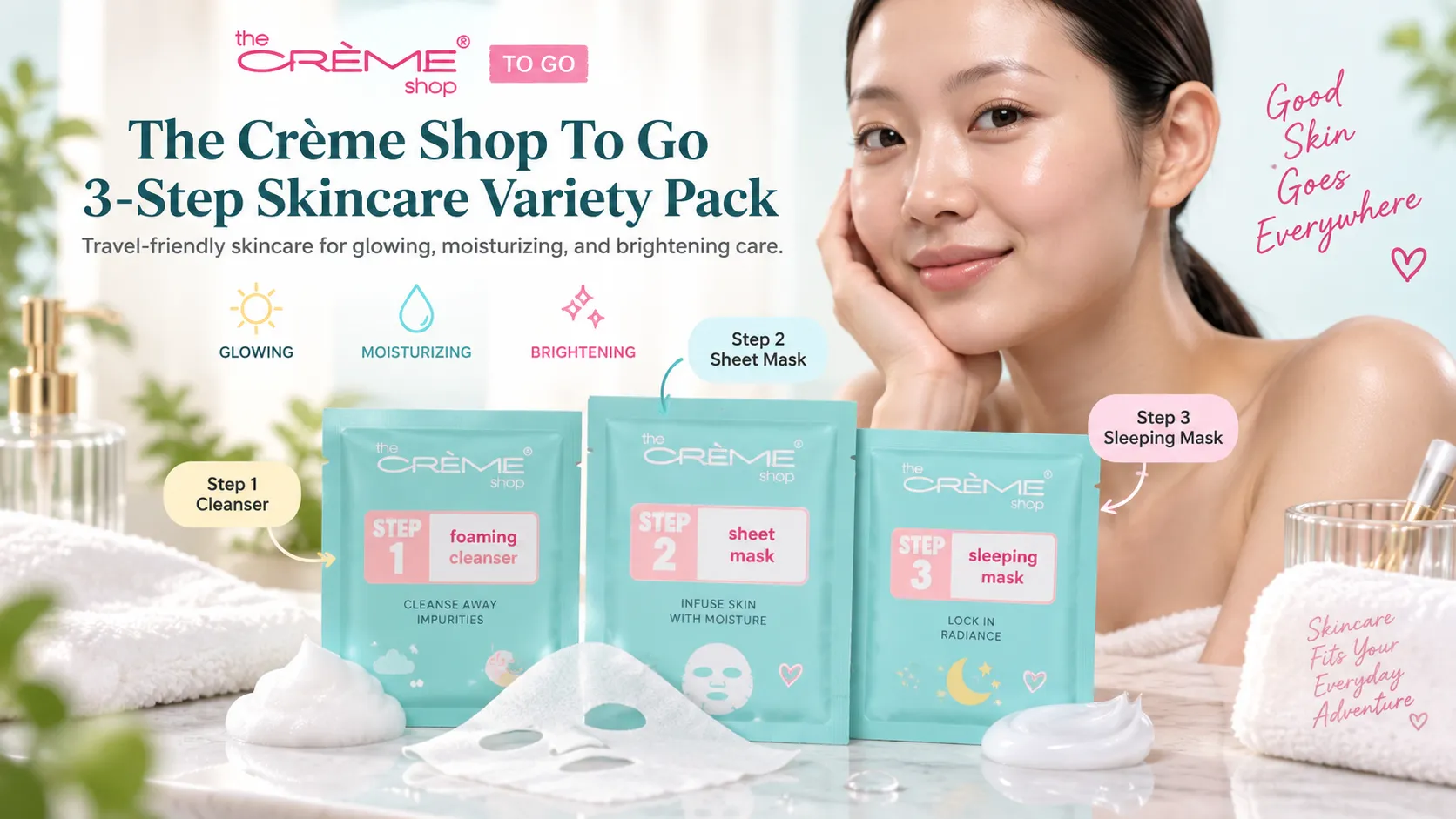
The Crème Shop To Go 3-Step Skincare Variety Pack is a travel-focused skincare kit containing three separate routines: Glowing, Moisturizing, and Brightening. Each pouch includes a cleanser, sheet mask, and sleeping mask or moisturizer, giving buyers three complete three-step routines in compact packaging.
At the time of review on September 17, 2026, Ulta listed the pack online for $13.50 and showed a 4.7 out of 5 rating from 61 reviews. The product is designed more as a convenient travel, trial, or occasional skincare set than as a complete everyday routine.
What Is the Creme Shop To Go 3-Step Skincare Variety Pack?
The the creme shop to go 3-step skincare variety pack combines nine individual skincare steps across three themed pouches. Instead of buying full-size cleansers, masks, and moisturizers separately, the pack lets users try three mini routines built around different cosmetic goals.
According to Ulta, the box contains:
| Pack | Main focus | Highlighted ingredients | Steps included |
|---|---|---|---|
| Glowing | Radiance and hydration | Rice extract, niacinamide | Cleanser, sheet mask, sleeping mask/moisturizer |
| Moisturizing | Hydration and barrier support | Ceramides, mugwort | Cleanser, sheet mask, sleeping mask/moisturizer |
| Brightening | Brighter, plumper-looking skin | Raspberry, peptides, collagen | Cleanser, sheet mask, sleeping mask/moisturizer |
Ulta describes the product as containing one Glowing pack, one Moisturizing pack, and one Brightening pack, with all three following the same cleanse, sheet-mask, overnight-treatment sequence.
That structure makes the set particularly relevant for people searching for portable skincare, beauty gifts, trial-size routines, sleepover products, or skincare that can be packed without carrying several full-size bottles.
How the Three-Step Routine Works
The basic process is simple: cleanse the skin, use a sheet mask, then finish with a sleeping mask.
Step 1: Foaming Cleanser
The cleanser is massaged over the face and neck until it lathers, then rinsed away with warm water. Ulta instructs users to pat the skin dry afterward.
Cleansing removes surface oil, sweat, sunscreen, makeup residue, and environmental debris. For most people, this is the logical first step before applying a sheet mask because it gives the leave-on ingredients direct contact with clean skin.
There is one ingredient worth noticing in the published cleanser formula: sodium C14-16 olefin sulfonate appears immediately after water. It is an effective cleansing surfactant, but people with very dry or easily irritated skin may prefer gentler cleansers if a foaming formula leaves their skin feeling tight.
The American Academy of Dermatology recommends gentle, non-abrasive cleansing, particularly for dry or sensitive skin, because overly harsh cleansing can contribute to irritation.
Step 2: Sheet Mask
The sheet mask is placed over clean, dry skin for 10 to 15 minutes. After removal, the remaining essence should be gently patted into the skin rather than rinsed away.
Sheet masks mainly provide temporary hydration and a concentrated layer of water-based skincare ingredients. Their most noticeable effect is usually softer, more hydrated-looking skin immediately after use rather than a permanent transformation.
The ingredient list published by Ulta for the mask includes glycerin, allantoin, trehalose, niacinamide, rice extract and panthenol. These ingredients are commonly used in hydrating or skin-conditioning formulas.
Step 3: Sleeping Mask
The final product is left on overnight and washed off with lukewarm water the following morning. The instructions specifically say to avoid the eye and lip areas.
Ulta’s published sleeping-mask ingredient list includes glycerin, propanediol, sodium hyaluronate, rice extract, betaine, allantoin and niacinamide. Several of these ingredients function primarily as humectants or skin-conditioning agents that help the skin retain water or feel softer.
The sleeping mask should not be confused with sunscreen or a medical treatment. If the routine is used at night, normal daytime sun protection is still needed the following morning. The American Academy of Dermatology recommends broad-spectrum, water-resistant sunscreen with SPF 30 or higher for exposed skin.
What the Key Ingredients Can Realistically Do
The marketing highlights rice water, niacinamide, ceramides, mugwort, raspberry, peptides and collagen. These ingredients sound impressive, but the usefulness of an ingredient depends on its concentration, formulation, stability, contact time and the product in which it appears.
It is therefore more accurate to examine the ingredients individually rather than assume every advertised benefit will occur after one three-step treatment.
Niacinamide
Niacinamide is one of the better-supported cosmetic ingredients mentioned in the range. It is a form of vitamin B3 used in products targeting skin-barrier function, uneven appearance and pigmentation.
A 2024 scientific review covering topical niacinamide found clinical evidence supporting several cosmetic uses, including barrier support and skin-brightening applications.
However, the product listing does not state the percentage of niacinamide. This matters because simply identifying an ingredient does not tell consumers whether it is present at a concentration comparable with formulas used in clinical research.
Under U.S. cosmetic-labeling rules, ingredients are generally declared in descending order of predominance, although ingredients present at 1% or less may appear in any order after higher-concentration ingredients.
Ceramides
Ceramides are natural lipids that form an important part of the outer skin barrier. Scientific reviews have found that appropriately formulated ceramide-containing moisturizers can help improve hydration and barrier function, particularly in dry or barrier-impaired skin.
That gives the Moisturizing pack a reasonable ingredient concept. Still, the presence of the word “ceramides” in marketing does not by itself reveal the exact ceramide type, concentration or delivery system.
Those formulation details can influence performance.
Rice Extract
Rice extract is highlighted in the Glowing pack alongside niacinamide. Ulta describes rice water extract as a brightening ingredient.
Rice-derived ingredients are common in Korean and Korean-inspired cosmetics, but consumers should interpret “glow” mainly as a cosmetic appearance claim. Hydrated skin can look smoother and more luminous even without a significant change in pigmentation.
The published formula places Oryza sativa (rice) extract relatively late in the ingredient lists shown by Ulta, so it would be inappropriate to assume that rice extract is the main component simply because it is emphasized in the marketing.
Mugwort
Mugwort is promoted in the Moisturizing pack as a calming ingredient.
Botanical extracts such as mugwort are popular in skincare aimed at irritated or stressed-looking skin. However, botanical ingredients can affect different users differently, and evidence for a particular extract does not automatically prove that a specific finished cosmetic will treat inflammation.
People with reactive skin should judge the complete ingredient formula rather than focusing on a single plant extract.
Peptides and Collagen
The Brightening pack emphasizes raspberry, peptides and collagen, with Ulta describing them in connection with brightening, protection, firmness and plumpness.
Peptides are a large group of short amino-acid chains, and their effects differ substantially depending on the specific peptide and formulation. “Peptides” therefore cannot be treated as one universally proven anti-aging ingredient.
Topical collagen also should not be confused with replacing lost collagen deep inside the skin. In cosmetics, collagen-containing formulas can contribute to hydration and surface conditioning, but claims about visibly reversing structural skin aging require much stronger evidence than the presence of collagen on an ingredient label.
One Important Ingredient-List Limitation
There is a transparency issue buyers should understand before treating online ingredient information as complete.
Ulta clearly describes three different skincare packs with different highlighted ingredients. However, the product page reviewed for this article displays only one cleanser ingredient list, one mask ingredient list and one sleeping-mask ingredient list, and those published formulas prominently feature rice extract and niacinamide.
The listing does not clearly separate three complete ingredient sets for the Glowing, Moisturizing and Brightening pouches.
That means consumers with allergies, known sensitivities or ingredients they specifically avoid should check the packaging itself before applying each pouch rather than assuming the online ingredient list represents every formula in the box.
Does It Contain Fragrance?
Yes, fragrance appears in the ingredient lists published by Ulta for the cleanser, sheet mask and sleeping mask. The cleanser also lists fragrance-related compounds including limonene, hexyl cinnamal, benzyl alcohol and linalool, while some of these also appear in the mask and sleeping-mask listings.
For many people, fragranced skincare causes no problem. For highly sensitive users, however, it is an important consideration.
The American Academy of Dermatology notes that fragrance can trigger irritation or allergic skin reactions and commonly recommends fragrance-free products for sensitive skin.
This makes the set less straightforward for people with fragrance allergies, eczema-prone skin, rosacea or a history of contact dermatitis.
Is It Suitable for Sensitive Skin?
It may be tolerated by some people with sensitive skin, but it is not automatically the safest choice for every sensitive-skin user.
The potential benefits include hydrating ingredients such as glycerin, allantoin, panthenol, betaine and sodium hyaluronate in the formulas published by Ulta. On the other hand, fragrance and fragrance-related ingredients are also present.
Anyone who reacts easily to new products should consider testing a small amount first. The American Academy of Dermatology recommends testing new skincare on a small area for seven to ten days when there is concern about a possible reaction.
Because these are single-use or limited-use packets, performing such a lengthy test may not always be practical. People with known allergies or active skin conditions may therefore be better served by products with shorter, fragrance-free formulas they already know they tolerate.
Who Is the Variety Pack Best For?
The strongest reason to buy this set is convenience rather than advanced skin treatment.
It makes the most sense for:
- travelers who do not want to pack full-size skincare
- people who enjoy sheet masks and occasional skincare treatments
- buyers who want to sample several product concepts from The Crème Shop
- sleepovers, vacations and overnight trips
- inexpensive beauty gifts or stocking-stuffer-style purchases
- users who want an easy one-night skincare routine without assembling individual products
It is less compelling for someone looking to build a consistent long-term routine around specific concentrations of active ingredients.
For everyday skincare, consistency usually matters more than the number of steps. The American Academy of Dermatology advises that a simple routine built around gentle cleansing, moisturizing and sun protection can provide a strong foundation for healthy skin.
What Skin Types Could Use It?
Normal and combination skin are probably the easiest fit because the set combines foaming cleansing with hydrating masks.
Dry skin users may enjoy the sheet and sleeping masks but should pay attention to how their skin feels after cleansing. If the face feels unusually tight, rough or uncomfortable after the cleanser, continuing with a gentler cleanser may be preferable.
Oily skin does not automatically need to avoid moisturizers or sleeping masks. Hydration and oil production are separate issues. The bigger consideration is whether an individual formula feels comfortable and does not contribute to unwanted congestion.
Sensitive skin deserves the most caution because the published formulas contain fragrance.
Current Price and Availability
As of September 17, 2026, Ulta listed The Crème Shop To Go 3-Step Skincare Variety Pack at $13.50, marked it as an online-only item and showed it in stock for shipping.
The listing also displayed a temporary subscription price of $12.82 and promotional offers, but promotions can change quickly. Buyers should therefore treat $13.50 as the listed base price at the time of this review rather than a permanent market price.
The Crème Shop’s U.S. TikTok Shop also listed the travel-friendly three-step set, though its displayed price differed from Ulta’s.
This difference is a useful reminder to compare authorized retailers before buying.
Is the Price Reasonable?
At $13.50 for three separate three-step packs, the cost works out to about $4.50 per complete three-step pouch.
That is inexpensive compared with buying three full-size cleansers, masks and moisturizers, but the comparison is not entirely equal because this is primarily a trial or travel format.
Its value depends on what the buyer wants. For occasional use, travel, gifting or experimentation, the format is practical. For daily skincare over several months, full-size basic products usually provide more applications and allow greater control over ingredients.
Advantages and Limitations
The pack succeeds at making skincare compact and straightforward. Three themed routines provide more variety than a single travel kit, and each one follows an intuitive cleanse, mask and moisturize sequence.
Its main strengths are convenience, relatively low initial cost, portability and the opportunity to experiment with different cosmetic themes.
The limitations are equally important. It contains fragranced formulas according to the ingredient information displayed by Ulta, there is no sunscreen step, exact concentrations of highlighted ingredients are not disclosed, and the retailer’s online ingredient section does not clearly provide three separately labeled full ingredient lists for the three variants.
It should therefore be judged as a fun and portable skincare set, not as a substitute for a carefully selected daily routine or dermatologist-directed treatment.
How to Use It Safely
Follow the individual packet instructions first because packaging information may be more specific than retailer listings.
Avoid applying the products to broken, actively irritated or injured skin. Ulta’s stated precautions advise avoiding the eyes and irritated skin, rinsing if eye contact occurs, and stopping use if irritation develops.
If the skin becomes red, swollen, painful, intensely itchy or persistently irritated, discontinue the product. The American Academy of Dermatology recommends stopping a product when a significant reaction occurs and seeking professional care when symptoms are severe or do not settle.
And because none of the three steps is presented as sunscreen, daytime SPF remains a separate requirement.
FAQ
What comes in the creme shop to go 3-step skincare variety pack?
The pack contains three themed sets: Glowing, Moisturizing and Brightening. Each set has a cleanser, sheet mask and sleeping mask or moisturizer, for nine skincare components across three routines.
How much does The Crème Shop To Go 3-Step Skincare Variety Pack cost?
Ulta listed it for $13.50 on September 17, 2026. Prices, subscription discounts and promotional offers can change, so the retailer’s current listing should be checked before purchase.
Do you wash off the sleeping mask?
Yes. Ulta’s directions say to leave the sleeping mask on overnight and wash it off with lukewarm water the following morning.
Is The Crème Shop 3-Step Variety Pack fragrance-free?
No. The cleanser, sheet mask and sleeping mask ingredient lists currently shown by Ulta all include fragrance, and some also list fragrance-related compounds such as limonene, linalool or hexyl cinnamal.
Can sensitive skin use this skincare pack?
Some people with sensitive skin may tolerate it, but fragrance makes it a less predictable choice for highly reactive skin. Dermatologists generally recommend fragrance-free skincare for people who are prone to fragrance irritation or allergic reactions.
Is this a full daily skincare routine?
Not quite. It covers cleansing, masking and overnight moisturizing, but it does not include daytime sunscreen. A basic long-term routine should also include appropriate sun protection, with the American Academy of Dermatology recommending broad-spectrum SPF 30 or higher for exposed skin.
Also Read: 302 Skincare Balance Moisturizer | Formula, Benefits, Price & Review
