


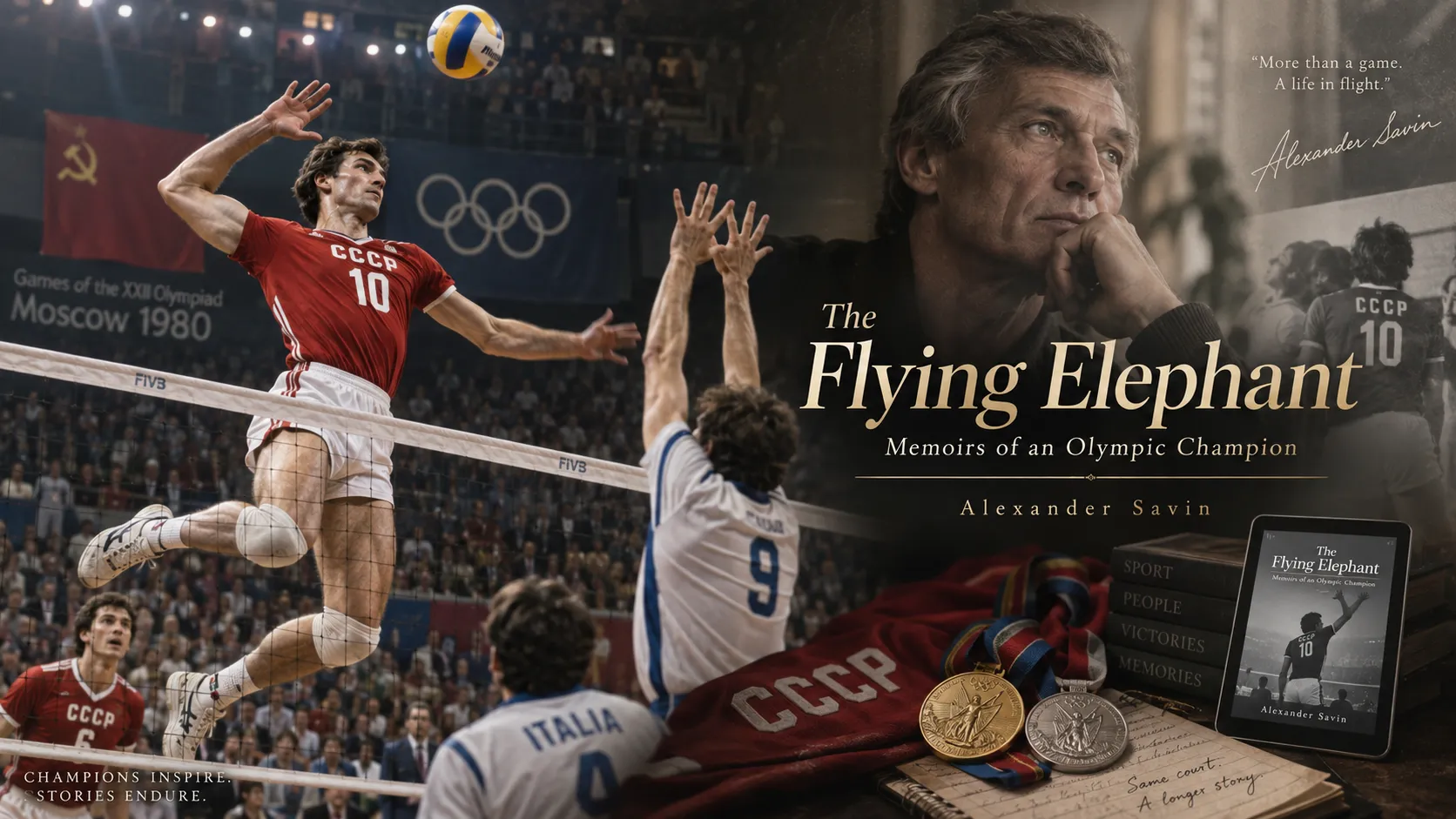
The Flying Elephant: Memoirs of an Olympic Champion is the autobiography of Alexander Savin, the Soviet volleyball great who won Olympic silver in 1976 and gold in 1980. The English Kindle edition brings Savin’s memories of elite volleyball, teammates, coaches, Olympic competition, and Soviet sports culture to English-speaking readers through a family-led translation project.
The book is particularly interesting because Savin was not simply a one-tournament Olympic champion. His career covered one of the strongest periods in Soviet men’s volleyball, with World Championship, World Cup, European Championship, domestic, and Olympic success. His memoir therefore works both as an athlete’s personal story and as a record of an important era in international volleyball.
What Is The Flying Elephant Memoirs of an Olympic Champion Kindle Edition Alexander Savin?
The Flying Elephant: Memoirs of an Olympic Champion is Alexander Savin’s autobiographical account of his life in volleyball. The original Russian book, Летающий слон or Flying Elephant, was publicly presented in late 2023 and early 2024, before an English translation was later released for Kindle. Russian coverage of the launch described the book as containing Savin’s Olympic experiences, memories of coaches and people around him, photographs, and stories connected with his sporting journey.
The English edition was developed through a personal translation effort involving Savin’s half-brother Andrei Savine, Alfredo Cabero, and Ioulia Soudakova. Andrei Savine has said publicly that the work took more than a year and gradually became a broader effort to preserve the memories of Savin’s teammates, coaches, friends, and volleyball generation. He also confirmed that the English book was released through Amazon in Kindle format.
English Kindle Edition Details
| Detail | Current published information |
|---|---|
| Title | The Flying Elephant: Memoirs of an Olympic Champion |
| Author | Alexander Savin |
| Format | Kindle edition |
| Language | English |
| Reported publication date | October 26, 2025 |
| Reported print length | 514 pages |
| Photographs | More than 240 reported |
| Amazon identifier | B0FXVDWW16 |
| Main subject | Olympic and Soviet-era volleyball |
| Editor and translator | Andrei Savine |
| Additional translation involvement | Alfredo Cabero |
| Introduction | Peter Murphy |
Publicly indexed edition information reports a 514-page Kindle print length, more than 240 photographs and an October 26, 2025 publication date. The book’s dedicated website also lists a file size of about 68.8 MB and Kindle features including Page Flip and enhanced typesetting.
Kindle pricing and subscription availability can differ between Amazon marketplaces and can change over time. A reliable universal current price could not be established from the publicly indexed material, so readers should verify the live listing in their own Amazon region before purchasing.
Who Is Alexander Savin?
Alexander Borisovich Savin, also transliterated as Aleksandr Savin in official sporting records, was born on July 1, 1957, in Taganrog. Olympedia lists him at 200 cm tall and 97 kg and records his club affiliation with CSKA Moscow.
He later grew up in Obninsk, where he began organized volleyball in 1967 under coach Vladimir Pitanov. The Russian State University of Physical Education records that early connection with the sport, while CSKA states that Savin represented the club from 1973 until 1988.
His career eventually made him one of the major players of Soviet volleyball. The International Volleyball Hall of Fame inducted Savin in 2010 in its Male Indoor Player category.
Alexander Savin’s Olympic Story
Savin competed in two Olympic Games and won a medal at both.
At Montreal in 1976, the Soviet Union reached the men’s volleyball final after going unbeaten through pool play and defeating Cuba in the semifinal. Poland won the gold-medal match 3-2, leaving Savin and the Soviet team with silver. The International Volleyball Hall of Fame records that Savin appeared in all five Soviet matches at those Games.
Four years later, Moscow provided a different ending. The Soviet team won its group matches, defeated Romania in the semifinal and beat Bulgaria 3-1 in the final to claim Olympic gold. Savin played in all six matches of the 1980 tournament.
That progression from Montreal silver to Moscow gold provides an obvious historical framework for the memoir, but Savin’s achievements extended considerably beyond the Olympics.
Also Read: The Crème Shop To Go 3-Step Skincare Variety Pack
A Career Much Bigger Than One Olympic Gold Medal
Official CSKA records credit Savin with World Championship titles in 1978 and 1982, World Cup victories in 1977 and 1981, and six European Championship titles. CSKA also identifies him as a 13-time Soviet champion and a central blocker for both the club and Soviet national team.
The Great Russian Encyclopedia similarly describes Savin as one of the leading attacking players in world volleyball around the late 1970s and early 1980s. It records his 13 Soviet championships, five European Champions Cup titles, two world championships, two World Cups, six European championships and Olympic medals.
These results help explain why a memoir about Savin can cover much more than the 1980 Olympics. His career crossed domestic club volleyball, European competition, World Championships, World Cups and a long period with the Soviet national team.
Why Is the Book Called The Flying Elephant?
The title The Flying Elephant refers to Savin’s distinctive identity as an unusually large but highly athletic volleyball player. At 200 cm and about 97 kg, his physical presence was substantial, yet his game depended on explosive movement, jumping, attacking and blocking at the net.
Savin himself deliberately avoided giving away the full explanation when the Russian book was presented. In a January 2024 interview about the memoir, he said volleyball players would already understand why it was called Flying Elephant, while other readers would understand after reading the book.
That is important because numerous later websites have supplied their own detailed explanations for the nickname. Some attribute it to particular journalists or publications, but reliable primary evidence for those more specific origin stories is limited. The safest documented interpretation is that the name reflects the memorable contrast between Savin’s imposing build and the athleticism associated with his playing style.
What Does the Memoir Actually Cover?
The available primary material indicates that The Flying Elephant is not simply a chronological list of Savin’s trophies. Contemporary Russian reporting on the original book says Savin wrote about his Olympic experiences, the people who travelled the sporting path with him, his coaches, CSKA teammates, and athletes associated with Obninsk.
The translation team provides further insight. Andrei Savine said that while translating the memoir he came to know the teammates, coaches and friends mentioned throughout Savin’s story. Alfredo Cabero, another participant in the English project, has described the material as including Savin’s sporting life as well as his relationships with his mother, wife and family.
The English edition also places considerable emphasis on visual history. Andrei Savine specifically referred to rare archival photographs, while current edition descriptions report more than 240 images.
That combination makes the memoir useful in two different ways. The text provides Savin’s memories of the people and competitions he experienced, while the photographs help document a period of volleyball history for which English-language first-person material is comparatively limited.
The Russian Book and the English Kindle Edition
The Russian version of Летающий слон was already being presented publicly by December 2023 and early 2024. Volleyball club Belogorie described it as Savin’s autobiographical book when announcing a February 2024 presentation.
A Russian volleyball report from January 2024 said the original publication had about 300 pages and took more than six months to prepare. It contained stories, photographs and responses to questions Savin had received over the years.
The later English Kindle metadata reports 514 pages. That difference should not automatically be interpreted as evidence that hundreds of pages of new material were added. Kindle “print length,” translation, typography, photograph placement and edition formatting can all affect page counts, so the Russian and English numbers are not directly comparable without the physical editions themselves.
How the English Translation Became a Family Project
The translation history is one of the more unusual aspects of the English edition.
Andrei Savine described Alexander as his half-brother and said they had not known each other closely. Their effort to reconnect eventually turned into the translation of The Flying Elephant. What began as a structured project became, in Andrei’s description, a way of discovering the people who had populated Alexander’s volleyball life.
Alfredo Cabero has independently described participating in the translation and editorial work for more than a year. His account also confirms that the completed English edition was released on Amazon Kindle and included historical photographs and contributions associated with prominent volleyball figures.
This background matters because translation is especially important in a memoir. Names, sporting terminology, Soviet cultural references and personal memories can lose meaning if translated mechanically. The direct involvement of people connected to the author gave the English project access to context that a completely detached translation might not have had.
How Historically Reliable Is the Memoir?
A memoir is a primary source for what its author remembers, believes and experienced, but it is not the same thing as an independently verified history book.
Savin’s major sporting achievements can be checked against outside records. Olympedia independently confirms his 1976 Olympic silver and 1980 gold, while the International Volleyball Hall of Fame documents his Olympic participation and 2010 induction. CSKA and the Great Russian Encyclopedia independently support the broader record of World Championships, World Cups, European titles and domestic success.
Personal conversations, private relationships, motivations and behind-the-scenes recollections are different. Those should be read as Savin’s perspective unless separate documentation confirms them. That does not reduce the value of the memoir. It simply distinguishes personal testimony from the independently verifiable competitive record.
Is Alexander Savin Still Involved With Volleyball?
Savin remains publicly connected to the sport.
In February 2026, CSKA reported that he appeared at its Museum of Sporting Glory as part of a “Legends of Sport” event. He spoke with young volleyball players about team play, answered questions, offered advice and showed the Olympic medal he won with the Soviet Union in 1980.
That appearance is useful current evidence of Savin’s continued relationship with volleyball decades after the end of his elite playing career.
Who Is the Kindle Edition Most Relevant For?
The book has an obvious audience among volleyball players, coaches and fans, but its subject is wider than technique or tournament results. Olympic-history readers can use Savin’s recollections alongside official competition records, while readers interested in Soviet sport get a first-person account from someone who spent years inside one of its most successful teams.
The extensive photographic material may be especially valuable to sports historians and longtime volleyball followers. On the other hand, readers looking only for a short biography of Savin may find a 500-plus-page digital edition more detailed than necessary.
It is also worth keeping expectations realistic. The English edition is a translated memoir produced through a relatively personal project, not a neutral academic history of Soviet sport. Its greatest value lies in the combination of firsthand memory, documented athletic achievement and material about people whose stories are often absent from medal tables.
Frequently Asked Questions
Who wrote The Flying Elephant: Memoirs of an Olympic Champion?
Alexander Savin wrote the memoir. Official sporting sources identify him as Aleksandr Borisovich Savin, while the English book uses the spelling Alexander Savin. He was a Soviet volleyball player, Olympic champion and 2010 International Volleyball Hall of Fame inductee.
Is The Flying Elephant available in English on Kindle?
Yes. Andrei Savine, who worked on the English translation, publicly confirmed that the book was released in Kindle format through Amazon. The relevant Amazon identifier reported for the English edition is B0FXVDWW16.
How many pages is The Flying Elephant Kindle edition?
Current English-edition metadata reports a Kindle print length of approximately 514 pages. The original Russian publication was separately described in 2024 as roughly 300 pages, but the figures should not be directly compared because translation and digital formatting can significantly change calculated page length.
How many Olympic medals did Alexander Savin win?
Savin won two Olympic medals in men’s volleyball. He earned silver with the Soviet Union at Montreal in 1976 and gold at Moscow in 1980.
Does The Flying Elephant include photographs?
Yes. The English project is described as containing rare archival photographs, and current edition information reports more than 240 images. Andrei Savine also specifically mentioned the archival photography when announcing the English Kindle edition.
Is Alexander Savin in the International Volleyball Hall of Fame?
Yes. The International Volleyball Hall of Fame inducted Aleksandr Savin in 2010 in the Male Indoor Player category. Its official biography documents both his 1976 Olympic silver and his 1980 Olympic gold.
Also Read: The Flying Elephant Memoirs of an Olympic Champion Kindle Edition Amazon
