


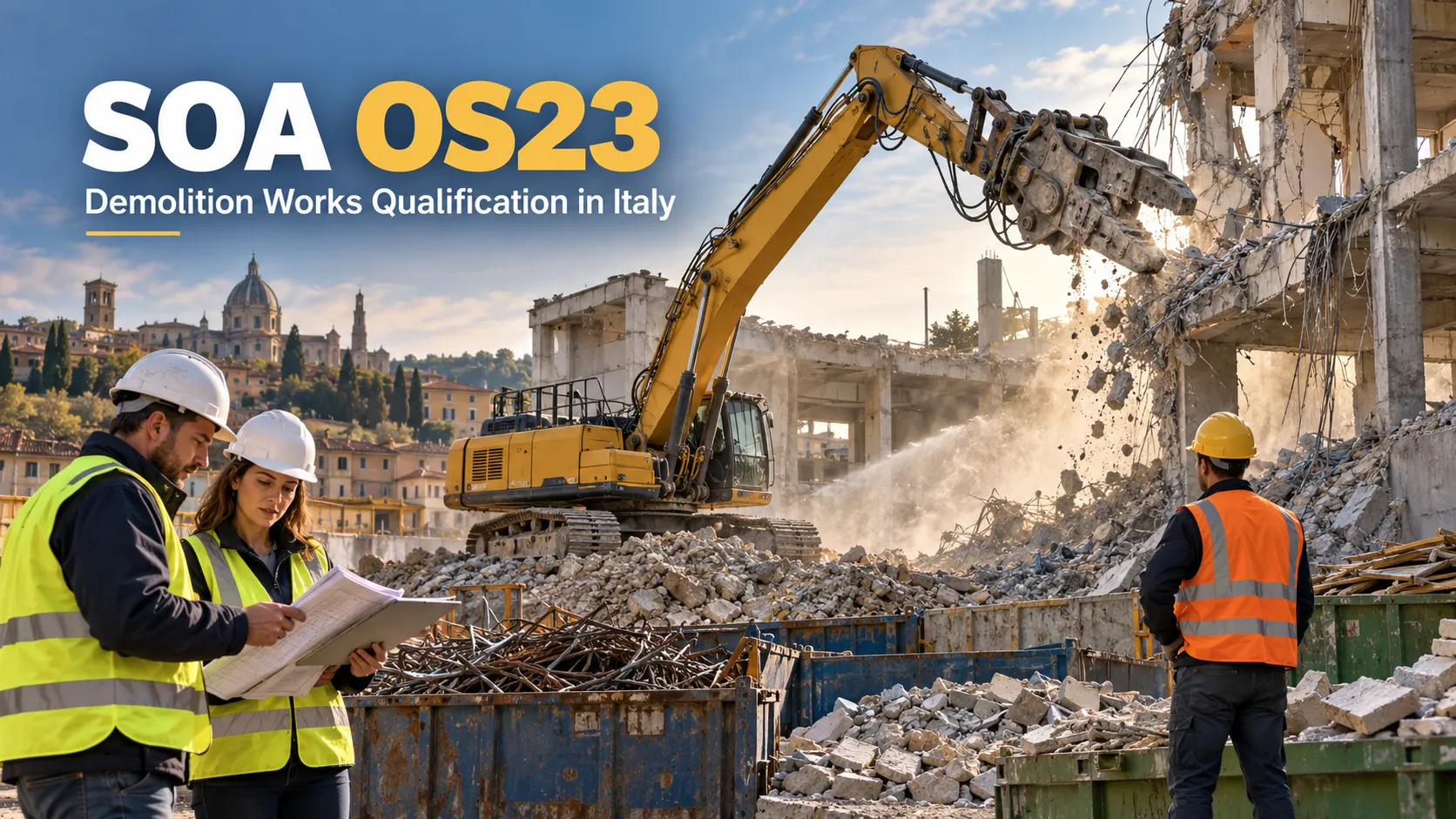
SOA OS23 is most reliably documented as an Italian public-works qualification category for “Demolizione di opere,” or demolition works. It identifies specialized demolition activities within Italy’s SOA contractor-qualification system. Official Italian procurement rules recognize OS23, while claims that “SOA OS23” is an official technology standard called “Service-Oriented Architecture Open Standard 2023” could not be verified through established software standards bodies.
The distinction matters because search results currently mix two very different subjects. Italian legislation, public tenders, and ANAC material provide a clear regulatory basis for the construction meaning. A newer group of technology websites uses the same phrase for a supposed modernization of Service-Oriented Architecture, but that interpretation should not be treated as an established technical standard without further evidence.

What Is SOA OS23?
In Italian public procurement, SOA refers to the qualification system administered through authorized Società Organismi di Attestazione, private certification bodies operating within the framework supervised by Italy’s National Anti-Corruption Authority, ANAC. ANAC describes SOAs as organizations responsible for assessing whether companies meet the requirements needed for qualification to execute public works.
OS23 is one of the specialized work categories in that system. Under Annex II.12 of Italy’s Legislative Decree No. 36 of 31 March 2023, the country’s Public Contracts Code, OS23 is officially titled “Demolizione di opere,” meaning demolition of works or structures.
The official description covers demolition and dismantling activities including:
- dismantling industrial plants
- complete demolition of buildings using specialized equipment
- demolition involving explosives where applicable
- cutting reinforced-concrete structures
- demolition works generally
- collection of demolition debris
- separation of resulting materials
- possible recycling of recovered materials
These activities are expressly included in the statutory OS23 description published in Italy’s Gazzetta Ufficiale.
What Does the SOA Part of SOA OS23 Mean?
An SOA attestation is evidence that an economic operator possesses specified qualifications for Italian public works. It is not simply a general construction certificate or a safety credential.
ANAC’s current qualification framework concerns the execution of public works worth more than €150,000. In October 2025, ANAC issued an updated qualification manual aligned with the current Public Contracts Code and confirmed the €150,000 threshold for this system.
Authorized SOA bodies examine an applicant’s documentation and determine which work categories and monetary classifications it qualifies for. A contractor might therefore hold, for example, OS23 Class I alongside unrelated categories such as OG1 for civil and industrial buildings or OG3 for roads and similar infrastructure.
SOA certificates are generally effective for five years, subject to a verification of continuing requirements at the three-year point. Annex II.12 also provides procedures for renewal and for cases in which the triennial verification is not completed in time.
What Work Falls Under OS23?
OS23 is broader than the ordinary removal of a wall or a minor alteration during building maintenance. Its official scope is aimed at demolition as a specialized construction activity.
Industrial dismantling
The category expressly covers dismantling industrial installations. Depending on the project, this can involve the controlled removal of machinery, plant structures, supporting components, reinforced concrete, steelwork, and associated infrastructure.
Complete building demolition
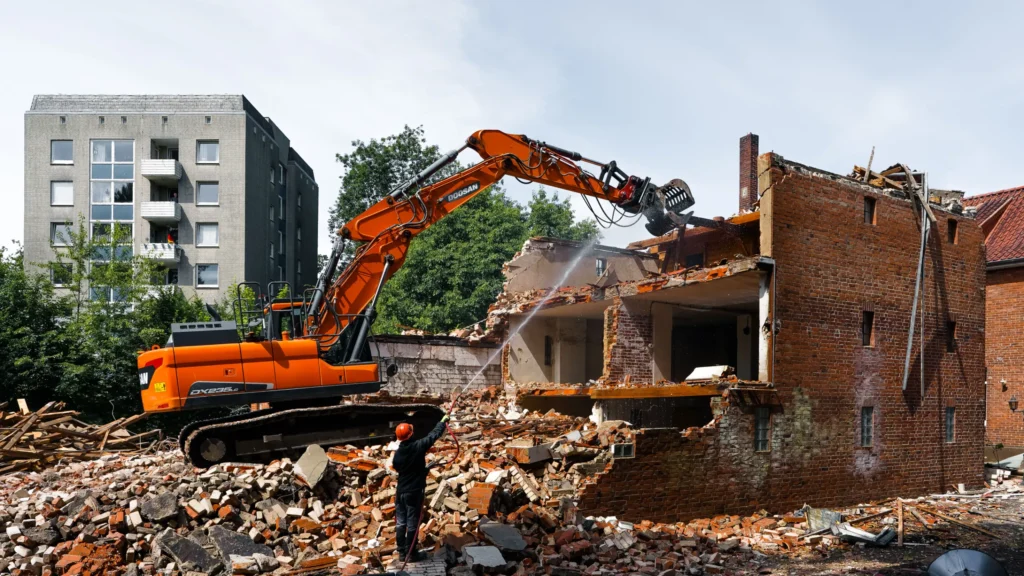
Full demolition of buildings using specialist machinery falls directly within OS23. Large public projects may involve excavators fitted with demolition attachments, high-reach equipment, cranes, cutting systems, or other specialized techniques.
Demolition using explosives
The statutory definition also refers to complete demolition using explosives. This does not mean an OS23 qualification alone authorizes unrestricted explosive work. Separate safety, licensing, environmental, technical, and operational requirements may apply depending on the project.
Cutting reinforced concrete
The category specifically includes the cutting of reinforced-concrete structures. This can be relevant when dismantling bridges, structural sections, large concrete elements, industrial facilities, or parts of existing public infrastructure.
Debris collection and material separation
OS23 does not end when a structure comes down. The official definition also includes collection and separation of the resulting materials and their possible recycling in the components industry.
This connection with material recovery is increasingly important because demolition projects often require carefully planned separation of concrete, metals, timber, glass, equipment, hazardous materials, and other waste streams.
SOA OS23 Classes and Value Limits
SOA qualification is divided into monetary classes. The class held by a contractor indicates the value range for which it is qualified within that category.
The classifications provided under Annex II.12 are:
| SOA class | Qualification amount |
|---|---|
| I | Up to €258,000 |
| II | Up to €516,000 |
| III | Up to €1,033,000 |
| III-bis | Up to €1,500,000 |
| IV | Up to €2,582,000 |
| IV-bis | Up to €3,500,000 |
| V | Up to €5,165,000 |
| VI | Up to €10,329,000 |
| VII | Up to €15,494,000 |
| VIII | Above €15,494,000 |
These classifications apply across SOA categories, including OS23. A current Italian public-procurement platform, for example, lists OS23 from the sub-€150,000 level through Classes I to VIII using these same thresholds.
The Code also provides, subject to its conditions, that qualification in a category may permit participation and execution within the relevant class amount increased by one fifth. For example, a Class I ceiling of €258,000 can correspond to €309,600 when the statutory one-fifth rule applies.
The correct class for a particular tender should always be determined from the tender documentation and current procurement rules rather than from the headline contract value alone.
How OS23 Appears in Real Public Tenders
OS23 is not merely a theoretical category in the legislation. Italian contracting authorities use it in live procurement documents.
For example, official Gazzetta Ufficiale tender notices have separately identified OS23 demolition works and assigned them specific values and SOA classifications. One notice listed OS23 demolition works worth €162,595.51 as Class I, while another listed demolition activities valued at €2.1 million as Class IV.
A procurement record from the Metropolitan City of Reggio Calabria also listed OS23 Class II, up to €516,000, as a separable category in a multimillion-euro building project.
These examples illustrate why contractors must examine how a contracting authority divides a project into its prevailing and separable categories. A contract may have a much larger total value while the portion attributed to OS23 falls into a lower class.
Is OS23 Always a Mandatory Qualification Category?
This point requires care.
Italian procurement notices have frequently described OS23 as a “categoria scorporabile a qualificazione non obbligatoria,” meaning a separable category for which specific qualification was not mandatory under the rules applied to that tender. Examples appear in official notices published in the Gazzetta Ufficiale.
However, qualification, subcontracting, reliance on another operator’s capabilities (avvalimento), and category requirements depend on the governing version of procurement law and the individual tender documents. Historical notices should therefore not be treated as a universal rule for every current OS23 procurement.
A company considering a specific tender should check the current tender notice, disciplinary rules, Annex II.12 of Legislative Decree 36/2023, later amendments, and any applicable ANAC guidance.
What Does a Company Need for SOA Qualification?
Obtaining an SOA qualification is not simply a matter of paying for a certificate. An authorized SOA examines evidence showing that the company meets the applicable legal and technical requirements.
The current ANAC framework evaluates matters such as general eligibility, economic and financial capacity, technical organization, qualifying work previously carried out, technical management, equipment, workforce, and other requirements relevant to the categories and classes requested. ANAC’s October 2025 manual provides its updated guidance for qualification under the current Public Contracts Code.
The company enters into a qualification contract with an authorized SOA, which reviews the supporting documentation. Annex II.12 provides a maximum procedural framework under which the assessment may be suspended for clarification or additional documentation, with an overall limit before the SOA must issue the attestation or a refusal.
Companies should use an SOA authorized under the Italian system. ANAC maintains information and searchable records related to SOA attestations and qualified companies.
How Long Does an SOA OS23 Qualification Last?
An SOA attestation normally has a five-year effectiveness period, provided the contractor successfully completes the required three-year verification.
Under Annex II.12, the operator must undergo a maintenance-of-requirements check around the end of the first three-year period. If the verification is handled late, the operator can lose the ability to participate in tenders during the gap until a positive verification takes effect.
This makes expiry dates important. Contractors should monitor both the triennial verification date and the final five-year expiration rather than treating the certificate as automatically valid for five uninterrupted years.
SOA OS23 and Demolition Safety
An OS23 qualification demonstrates qualification for a category of public works. It should not be confused with every permit or safety requirement needed to execute a demolition project.
Actual demolition can involve structural instability, falling materials, heavy machinery, utilities, dust, noise, contaminated materials, waste handling and, in unusual cases, explosives. The contractor must still comply with the safety, environmental, waste-management and project-specific obligations that apply to the work.
The SOA category therefore answers one important procurement question: is the contractor appropriately qualified for this category and class of public work? It does not replace the rest of the regulatory framework governing the execution of the demolition.
Also Read: Laaster: What It Is and How the Platform Works
Is SOA OS23 a Software Architecture Standard?
This is where online information becomes confusing.
A growing number of websites describe SOA OS23 as “Service-Oriented Architecture Open Standard 2023” or as a modern software framework combining traditional SOA with APIs, microservices, containers, Kubernetes, AI, automation and zero-trust security. Some pages even describe it as a formal 2023 standard.
The underlying technologies are real, but the claimed standard is difficult to substantiate.
OASIS, a recognized developer of open technology standards, publishes an official Reference Model for Service Oriented Architecture (SOA-RM) v1.0, approved in October 2006. It describes the fundamental concepts and relationships of service-oriented systems.
The Open Group likewise maintains recognized SOA standards, including its SOA Reference Architecture, SOA Governance Framework, SOA Ontology and Service Integration Maturity Model. Its catalog does not identify a standard named “SOA OS23” or “Service-Oriented Architecture Open Standard 2023.”
No authoritative standards-body publication located during verification established “SOA OS23” as that formal technology standard. Consequently, claims about mandatory OS23 software layers, security requirements, AI functionality, compliance rules or a 2023 technical specification should be treated as unverified unless the publisher identifies an actual issuing organization and specification.
SOA OS23 vs Traditional Service-Oriented Architecture
The two uses of the term should not be mixed.
| Term | Documented meaning | Field |
|---|---|---|
| SOA OS23 | SOA qualification category OS23, Demolizione di opere | Italian construction and public procurement |
| SOA | Service-Oriented Architecture | Software architecture |
| OASIS SOA-RM | Official SOA Reference Model v1.0 | Software standards |
| “Service-Oriented Architecture Open Standard 2023” | Used by some websites, but no recognized primary standard located | Unverified online terminology |
Traditional Service-Oriented Architecture itself is well established. The Open Group defines SOA as an architectural style supporting service orientation, in which software capabilities are expressed as services representing repeatable activities and defined outcomes.
Modern API-first systems, microservices, event-driven communication, containers and cloud-native deployment can certainly incorporate SOA principles. Calling those practices “SOA OS23,” however, does not by itself turn the label into an official standard.
How to Tell Which Meaning of SOA OS23 Is Intended
Context usually makes the answer clear.
If the surrounding content mentions Italian tenders, construction firms, demolition, appalti pubblici, attestazione SOA, classifica I–VIII, ANAC, OG categories or OS categories, SOA OS23 almost certainly refers to the Italian demolition qualification.
If the discussion contains APIs, microservices, Kubernetes, cloud platforms or software services, the author is using the newer technology interpretation. Readers should check whether that author provides a primary specification from a recognized standards organization before treating the term as a formal standard.
This simple distinction prevents an especially serious SEO and research problem: repeating a confident definition merely because many secondary websites have copied it.
Frequently Asked Questions
What does SOA OS23 stand for?
In the best-documented regulatory context, it refers to the SOA qualification for OS23, “Demolizione di opere,” an Italian specialized public-works category covering demolition and industrial dismantling.
What work is included in OS23?
OS23 includes industrial-plant dismantling, complete building demolition with specialized equipment or explosives, reinforced-concrete cutting, general demolition, debris collection and separation, and possible recycling of recovered materials.
Is SOA OS23 required for public demolition contracts in Italy?
SOA qualification forms part of Italy’s system for qualifying contractors for public works above €150,000, but the precise category and qualification requirements depend on the individual procurement. Contractors should follow the current tender documentation and applicable provisions of Legislative Decree 36/2023.
How much work can an OS23 Class I company perform?
Class I corresponds to qualification up to €258,000. The Public Contracts Code contains a one-fifth increase rule that can raise the effective limit to €309,600 when its requirements are satisfied.
How long is an SOA OS23 certificate valid?
An SOA attestation is generally effective for five years, with a required verification of continuing eligibility after three years. Failure to complete the triennial verification correctly can interrupt the effectiveness of the qualification.
Is “Service-Oriented Architecture Open Standard 2023” an official SOA OS23 standard?
No primary record from a recognized standards body was found confirming a formal software standard under that name. OASIS and The Open Group publish established SOA reference models and standards, but their recognized SOA materials identify different specifications.
Also Read: InSnoop: What It Is, How It Works, and Is It Safe?
