


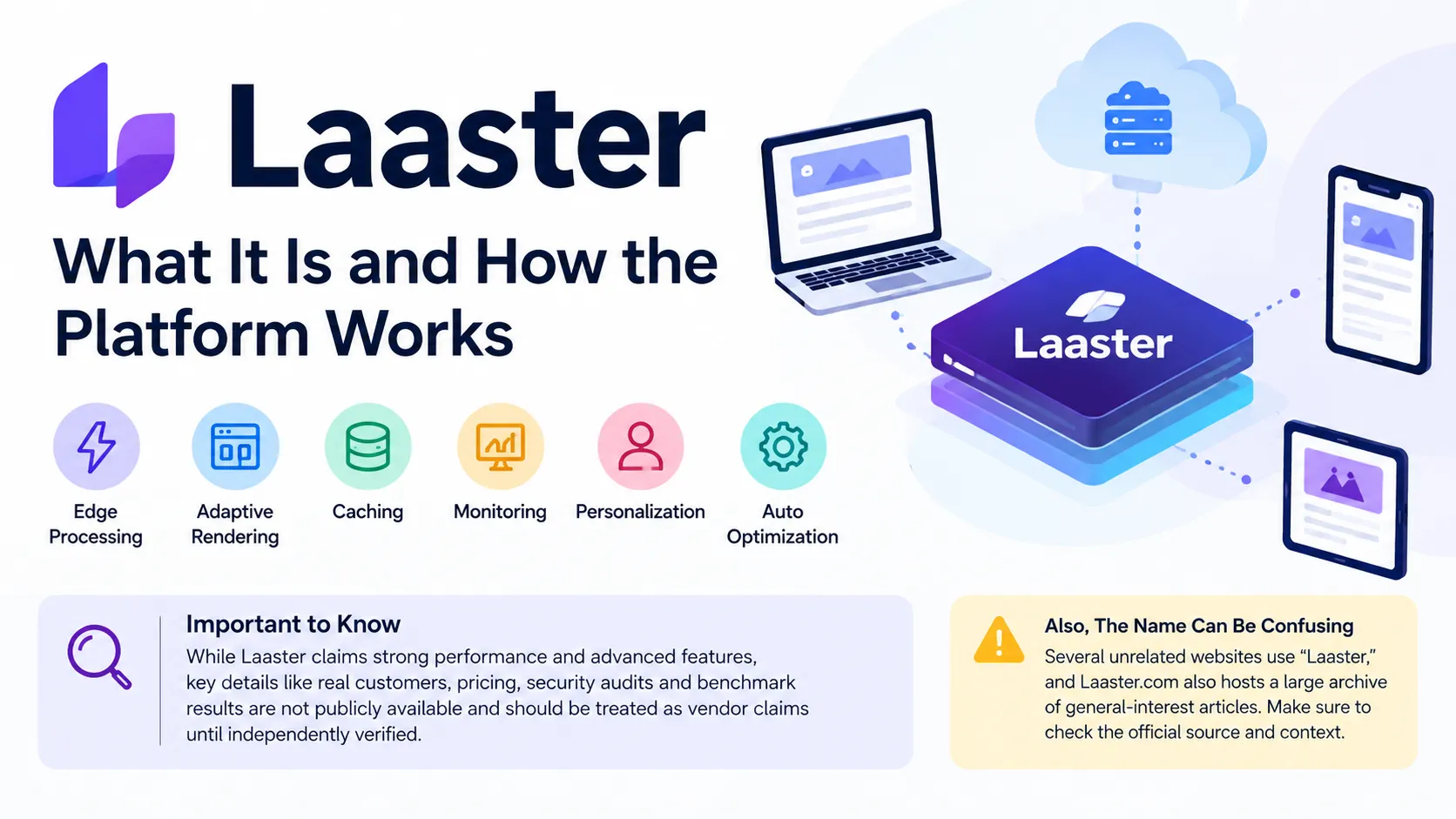
Laaster currently presents itself as a real-time system design platform for web and mobile applications, with features centered on edge processing, adaptive interface rendering, caching, monitoring, personalization, and automated performance optimization. However, publicly available evidence about its infrastructure, customers, pricing, security audits, and benchmark methodology remains limited, so its headline performance figures should be treated as vendor claims rather than independently verified results.
The name can be confusing because several unrelated websites use “Laaster,” while Laaster.com itself also contains a large archive of general-interest articles. For someone researching the technology, the safest approach is to distinguish what Laaster officially says it does from what can actually be confirmed through public documentation.

What Is Laaster?
Laaster.com describes Laaster as a real-time system design platform intended to make modern websites and mobile applications faster and more adaptive. According to the platform, requests can be processed through nearby edge nodes, after which factors such as device type, connection speed, and user context influence what content or interface is delivered.
Its stated purpose is broader than ordinary static-content delivery. The website promotes a combination of edge optimization, adaptive UI rendering, automated performance tuning, live personalization, caching, and a real-time monitoring dashboard.
These underlying ideas are legitimate areas of web engineering. Edge servers can reduce latency by bringing processing or cached content closer to users, while properly configured HTTP caching can reduce both origin-server workload and repeated data transfers.
What is less clear is how much of this technology Laaster currently operates as a mature commercial service and how much remains an emerging product proposition. Detailed public developer documentation, independently published benchmarks, named production customers, and extensive technical architecture documentation were not readily identifiable during research.
How Laaster Says Its System Works
Laaster presents a four-stage request-processing model. A user’s request is first directed toward a nearby edge node rather than being handled entirely by the application’s main origin server. The platform then says it evaluates the request context, chooses an appropriate version of the interface or resource, and continuously learns from subsequent performance information.
1. Edge-based request handling
The platform says incoming traffic is routed to a nearby edge node.
This is an established performance technique rather than a technology unique to Laaster. A content delivery network typically operates distributed servers in multiple locations so users can retrieve cached resources from infrastructure geographically or topologically closer to them. MDN notes that CDNs can reduce origin workload and latency, while Cloudflare describes edge servers as infrastructure designed to process or deliver content closer to requesting users.
2. Real-time context detection
Laaster says it can examine conditions such as the user’s device, network performance, and previous behavior before deciding what to serve.
In practical terms, context-aware delivery could mean sending a lighter interface to a slow mobile connection, prioritizing important resources, or using previously cached content when it is appropriate. The important distinction is that these capabilities depend heavily on implementation. Simply detecting a mobile connection does not guarantee a faster application.
3. Adaptive UI rendering
According to Laaster, the platform can choose between a full interface, a lighter version, or cached content depending on current conditions.
That concept fits established web-performance practices. MDN recommends minimizing unnecessary JavaScript, understanding the browser’s critical rendering path, using caching correctly, and delivering resources efficiently. A system that adjusts payload size or rendering behavior can therefore improve performance when implemented carefully.
4. Automated optimization
Laaster also says its system monitors performance continuously and automatically detects and corrects slow areas. The homepage describes this as “smart automation” and says performance improvements can occur without manual intervention.
This is one area where more technical documentation would be particularly valuable. Automated optimization can refer to many different processes, including cache-policy changes, routing, autoscaling, resource prioritization, image optimization, code delivery, or predictive loading. Laaster’s public marketing pages do not currently explain these mechanisms in enough detail to independently evaluate the full scope of the automation.
Main Laaster Features
Based on the current Laaster.com website, its advertised feature set can be summarized as follows.
| Feature | What Laaster says it does | Why it could matter |
|---|---|---|
| Edge optimization | Processes requests close to users | Can reduce network latency |
| Adaptive UI rendering | Changes the delivered interface according to conditions | May improve performance on slower devices or networks |
| Smart automation | Detects and addresses performance problems | Could reduce manual tuning |
| Live personalization | Adjusts content or layouts by session behavior | May create more relevant user experiences |
| Performance dashboard | Displays latency, caching and user-flow information | Helps teams monitor application behavior |
| Caching | Reuses appropriate resources instead of repeatedly querying the origin | Can lower server load and response times |
| Edge and cloud integration | Combines distributed processing with central infrastructure | Can support globally distributed applications |
The principles behind several of these features are technically well established. HTTP caching, for example, allows a stored response to be reused instead of requesting and processing the same resource at the origin every time.

Laaster vs a Traditional CDN
Laaster specifically positions itself as doing more than a traditional content delivery network.
A conventional CDN primarily stores and delivers content through geographically distributed servers. MDN defines a CDN as a network of servers across multiple locations that can satisfy requests using servers closer to users, while caching reduces repeated work at the application’s origin.
Laaster says its model adds adaptive rendering, personalization, automated optimization, and context-aware decisions on top of that edge-delivery layer.
The conceptual difference can be summarized this way:
Traditional CDN: “Where should this content be delivered from?”
Laaster’s proposed approach: “Where should it be delivered from, what version should this particular user receive, and can the system adapt automatically?”
That distinction is meaningful in theory. Whether Laaster delivers those capabilities more effectively than established edge-computing, CDN, application-performance and personalization stacks would require direct technical testing.
What Performance Does Laaster Claim?
The Laaster website displays several prominent metrics, including approximately 11 milliseconds of average edge latency, a 94.2% cache-hit rate, three-times-faster page loading, roughly 40% higher engagement and a 99.9% uptime commitment or SLA-related claim.
The homepage describes some of these numbers as real results from applications using its network. It also promotes figures such as 28% higher conversions for online stores and under-20-millisecond responses for global users.
These figures should not be interpreted as guaranteed results for every website.
Publicly available information does not clearly disclose important benchmarking details such as:
- the number and identity of tested applications
- geographic locations
- network conditions
- baseline infrastructure
- test duration
- traffic volumes
- p50, p75, p95 and p99 latency
- whether figures represent synthetic or real-user monitoring
- independent third-party verification
An independent review of the available information similarly noted the absence of sufficiently detailed public methodology and advised treating the numbers as vendor assertions until supporting evidence is provided.
Performance results naturally vary by application architecture, traffic patterns, database design, user location, cacheability and network quality. Edge infrastructure can reduce network distance, but it cannot automatically eliminate every bottleneck elsewhere in an application.
Who Owns Laaster?
Some indexed articles published directly on Laaster.com identify Yaqoub Gurmani as the person who founded Laaster.com in 2025 and describe the site as a platform focused on innovation, technology and digital growth.
That information comes from Laaster’s own website rather than an independently verified corporate record. Public details about the company’s legal entity, corporate registration, executive structure, investors or financing are not prominently disclosed on the main platform page.
The site’s contact page provides a Gmail address and a Pakistan telephone/WhatsApp number, while also describing Laaster as being open to business, media and collaboration inquiries. Interestingly, the same page discusses editorial support and articles alongside the real-time system-design positioning.
This suggests that Laaster.com has operated as more than a narrowly focused software-product website.
Also Read: InSnoop: What It Is, How It Works, and Is It Safe?
Why Laaster.com Can Be Confusing
One of the most important facts about Laaster is that its current platform identity does not perfectly match all of its existing website content.
Search-indexed Laaster.com pages include articles on celebrities, investing, flooring, cybersecurity, AI, proxies, marketing, healthcare technology and numerous other subjects. Many of these pages identify the site as a broader innovation or digital-growth platform rather than specifically as an application-performance company.
That does not prove anything improper about the current product. Websites can change direction or rebrand.
It does mean researchers should distinguish between:
- Laaster.com as an editorial website and publishing domain
- Laaster as the real-time system design product now promoted on its homepage
Several completely different domains also use the Laaster name. Laaster.net, for example, describes a communication platform involving messaging, AI collaboration and encryption, while Laasterblog.com presents itself as an English-language and grammar resource.
Those should not automatically be assumed to represent the same company or technology.
Is Laaster Safe to Use?
There is not enough independently published evidence to make a blanket claim that Laaster is either unsafe or fully enterprise-validated.
The homepage displays references to SOC 2, GDPR Ready, a 99.9% uptime figure and global-edge capabilities. Laaster However, publicly accessible audit reports, SOC 2 documentation, penetration-test reports, data-processing documentation or detailed certification evidence were not clearly available in the sources reviewed.
For an experimental or non-critical project, teams could evaluate Laaster through controlled testing. For production systems processing customer accounts, payments, healthcare information, confidential documents or other sensitive data, stronger due diligence would be appropriate.
OWASP specifically recommends evaluating third-party SaaS providers for security, reliability, compatibility and suitability before integrating them into important systems.
Before using Laaster in such an environment, an organization should request documentation covering security architecture, encryption, data locations, subprocessors, retention, deletion procedures, incident response, access controls, penetration testing, backups, service availability and contractual SLA terms.
Does Laaster Have Public Pricing?
The current homepage promotes a “Start for free” option and asks visitors to submit a work email for early access. A conventional public pricing table with clearly defined paid plans, usage allowances and enterprise rates was not visible in the material reviewed.
That makes the exact commercial model unclear.
Potential users should ask how pricing changes with requests, bandwidth, edge executions, data storage, geographic distribution, team seats, monitoring volume and support requirements. These details matter because infrastructure platforms can become considerably more expensive as traffic scales.
Who Might Benefit From Laaster?
If its advertised capabilities operate as described, Laaster could be relevant to developers building applications where responsiveness and changing user conditions matter.
Potential use cases include e-commerce platforms, mobile applications, interactive SaaS dashboards, globally distributed web services and applications serving users across widely different connection speeds. Laaster itself highlights online stores, mobile applications, SaaS products and international audiences as target scenarios.
A content-heavy static website with modest traffic may not need such an extensive optimization layer. Standard caching, image optimization, lightweight code and a conventional CDN can already solve many common performance problems. MDN recommends these fundamentals before introducing unnecessary architectural complexity.

What to Verify Before Choosing Laaster
The most sensible way to evaluate Laaster is through measurable testing rather than its headline numbers.
Start with a staging application and establish an existing baseline using real-user and synthetic performance measurements. Then test Laaster under the same locations, devices, traffic levels and network conditions.
Pay particular attention to latency percentiles, cache-hit ratios, Time to First Byte, Core Web Vitals, origin-server load, API response times and failure behavior. It is also worth testing what happens if Laaster itself becomes unavailable, because adding any third-party performance layer introduces another dependency into the system. MDN specifically notes that CDN dependencies can create availability and security considerations of their own.
Teams should also request customer references or production case studies where the before-and-after architecture can be independently understood.
Is Laaster a Real Technology or Just a Concept?
The underlying technologies associated with Laaster are real. Edge computing, distributed caching, adaptive delivery, real-time monitoring and automated scaling are established parts of modern internet infrastructure.
The unanswered question is not whether those techniques work. It is how extensively Laaster itself currently implements them and how its implementation compares with mature alternatives.
Laaster.com is a live website describing an identifiable platform, publishing features, use cases, metrics and contact details. At the same time, the relatively limited public documentation and independent verification mean it is more accurate to describe Laaster as an emerging platform with ambitious performance claims rather than assume the maturity implied by every marketing statistic.
Frequently Asked Questions
What is Laaster?
Laaster is currently presented on Laaster.com as a real-time system design and application-performance platform. It says it combines edge processing, caching, adaptive UI rendering, personalization, monitoring and automated optimization for web and mobile applications.
Is Laaster a CDN?
Not exactly, according to its own description. Laaster uses ideas associated with CDNs and edge computing but says it also adapts interfaces, personalizes sessions and automatically optimizes application performance.
Is Laaster free?
The website currently advertises that users can “Start for free” and also offers early-access registration. A detailed public pricing structure was not clearly available in the sources reviewed.
Are Laaster’s performance numbers verified?
Laaster publishes figures such as roughly 11 ms average edge latency, 94.2% cache hits, three-times-faster loading and 40% increased engagement. These are claims displayed by the platform itself, and sufficient independent benchmarking methodology was not located to confirm that the results apply generally.
Who founded Laaster?
Articles published on Laaster.com identify Yaqoub Gurmani as the founder and say Laaster.com was established in 2025. That is a self-published attribution from the site, and independent corporate confirmation was not clearly available in the reviewed sources.
Is Laaster.com the same as Laaster.net or other Laaster websites?
There is no clear evidence that all websites using the Laaster name belong to the same organization. Laaster.com currently promotes real-time system design, while Laaster.net describes a communications platform and Laasterblog.com focuses on English grammar and communication.
Also Read: Geometry Learn V3: What It Is, Games, Safety and Current Status
