


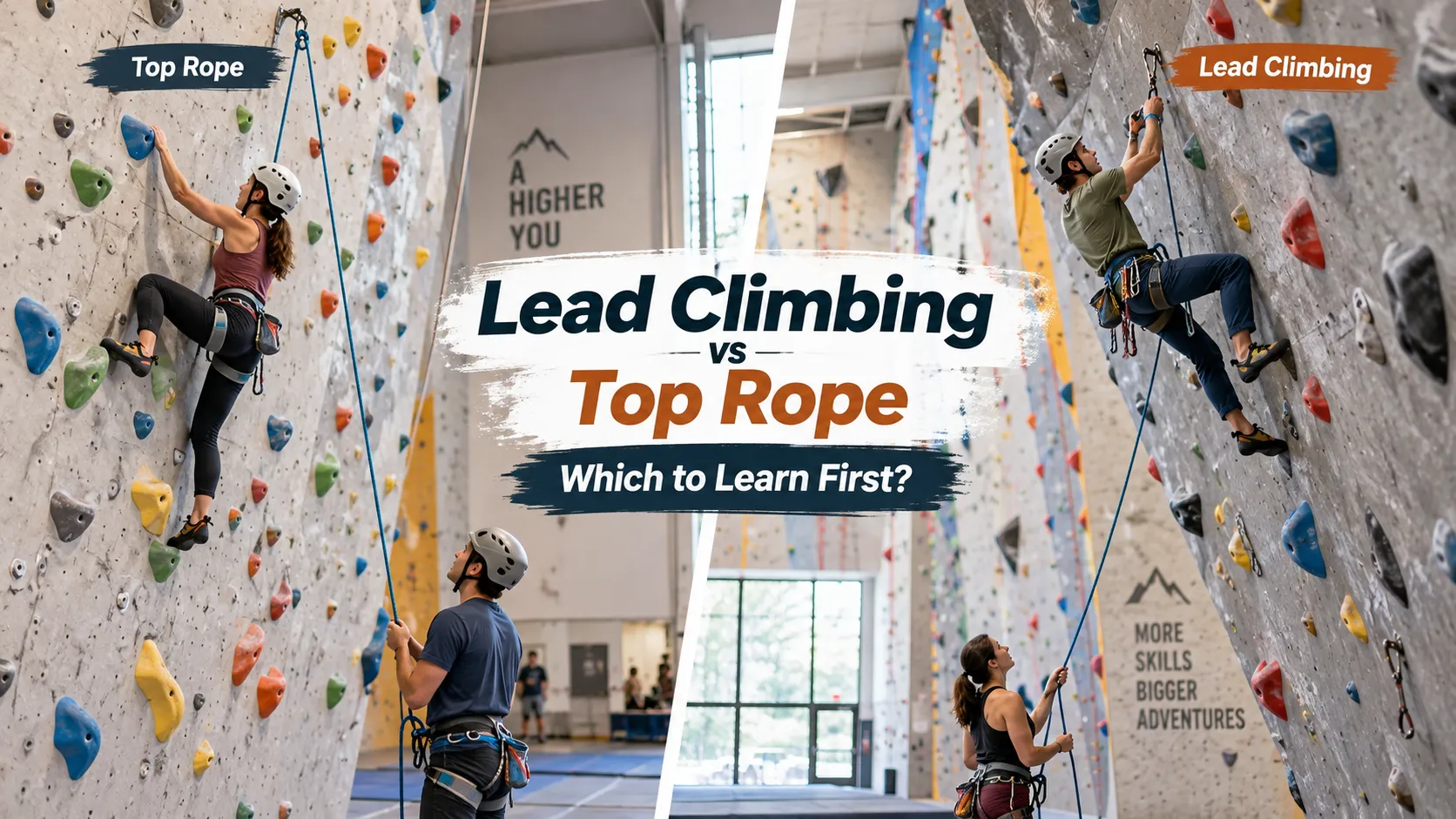
For most new climbers, top-rope climbing should come before lead climbing. It lets you learn movement, knots, communication, belaying, and basic rope systems while keeping potential falls much shorter than they are on lead.
Lead climbing is usually the next step once those fundamentals feel routine. It adds clipping, rope management, larger falls, more complex belaying, and additional judgment that are easier to learn when basic climbing skills no longer demand all of your attention. This progression is consistent with guidance from major climbing education organizations, including the British Mountaineering Council (BMC), REI, Petzl, and the American Mountain Guides Association (AMGA).
Lead Climbing vs Top Rope: Which to Learn First?
Learn top rope first in most cases, then progress to lead climbing with qualified instruction. There is no universal rule requiring a certain number of weeks or climbing sessions before leading, but a climber should already be comfortable with basic climbing movement, tying in, partner checks, communication, and belaying.
REI describes top-rope belaying as a foundational skill taught early in climbing instruction and says that a proficient top-rope belayer is in a suitable position to begin learning lead belaying. Its sport-climbing progression similarly describes lead climbing as the logical next step after mastering the basics as a top-rope climber.
That does not mean you need to become an advanced top-rope climber. The goal is competence, not reaching a particular climbing grade.
What Is Top-Rope Climbing?
In top-rope climbing, the rope travels from the climber up through an anchor at or near the top of the route and back down to the belayer. As the climber moves upward, the belayer takes in excess rope.
Because the rope is already anchored above the climber, a properly managed top-rope fall is generally short. The climber may drop slightly as slack is removed and the rope stretches, but they normally do not fall past multiple protection points as they could while leading.
This simpler rope arrangement is one reason top roping is widely used for learning fundamental climbing and belaying skills.
A beginner can concentrate on:
- foot placement and balance
- efficient movement
- handholds and body positioning
- tying into the rope
- standard climbing commands
- belay technique
- partner checks
- trusting the climbing system
REI specifically describes belaying as a foundational climbing skill and recommends qualified hands-on instruction rather than relying only on written guidance.
What Is Lead Climbing?
In lead climbing, the rope does not start above the climber. Instead, it runs from the belayer directly to the climber, who clips the rope into protection while ascending.
On a typical indoor or outdoor sport route, the climber clips the rope into quickdraws attached to fixed bolts. In traditional, or trad, climbing, the leader normally places removable protection such as cams and nuts while climbing.
The major difference appears when the leader falls.
A leader who climbs above the most recent protection point must fall back toward that point before the rope can begin catching the fall. REI notes that a climber three feet above the last protection point could initially fall roughly six feet before accounting for factors such as rope stretch and system movement.
The BMC consequently describes leading as inherently riskier than top roping and emphasizes the importance of an attentive, skilled belayer.
Top Rope vs Lead Climbing at a Glance
| Factor | Top Rope | Lead Climbing |
|---|---|---|
| Rope position | Runs through an anchor above the climber | Runs from belayer to climber |
| Protection | Already established overhead | Climber clips or places protection while ascending |
| Typical fall | Usually short when properly belayed | Can be significantly longer |
| Belayer’s main rope task | Taking in rope | Constantly giving and taking appropriate slack |
| Clipping required | No | Yes |
| Mental demand | Generally lower | Generally higher |
| Beginner suitability | Usually the better starting point | Better after basic skills are established |
| Additional skills | Fundamental climbing and belaying | Clipping, lead belaying, fall management, rope positioning and greater risk assessment |
The exact level of risk depends on the route, equipment, belayer, climber, environment, and quality of instruction. Neither system makes climbing risk-free.
Why Top Rope Is Usually Better for Beginners
You Can Learn Movement Without Managing Clips
New climbers already have several things to think about at once. They are learning how hard to grip, where to place their feet, how to shift their weight, when to rest, and how to interpret the route.
Lead climbing introduces another task: clipping the rope while maintaining a secure body position.
A climber may need to recognize the correct clipping position, identify which side of the rope should enter the carabiner, pull up enough rope, make the clip efficiently, and continue climbing without creating an unsafe configuration.
Learning those tasks after basic movement becomes more natural reduces unnecessary cognitive overload.
Falls Are Easier to Become Comfortable With
Fear of falling is common in climbing.
Top roping provides a relatively controlled environment in which beginners can learn what it feels like to weight the rope and trust their harness, rope, belayer, and climbing system.
Lead falls are different. They can be longer, and the experience of falling below your previous position can initially be intimidating.
REI recommends controlled fall practice as part of developing lead-climbing confidence, but such practice should occur in an appropriate setting with competent instruction and a capable belayer.
Top-Rope Belaying Builds Skills Needed for Lead Belaying
The belayer’s job changes significantly when a climber moves from top rope to lead.
During top-rope climbing, the belayer generally removes slack as the climber ascends. During lead climbing, the belayer frequently needs to feed rope quickly so the climber can clip while maintaining an appropriate amount of slack.
Too little slack can interfere with movement or pull the climber during a clip. Too much slack can unnecessarily increase fall distance.
REI specifically recommends becoming proficient in top-rope belaying before learning lead belaying.
There Are Fewer Technical Tasks
Top roping lets beginners establish several habits before introducing more complex systems.
Those include tying in correctly, checking harness buckles, confirming the belay-device setup, communicating clearly, keeping a brake hand on the rope, lowering correctly, and performing a partner check.
Petzl emphasizes the partner check before climbing and recommends specific training before climbers use belay techniques independently.
Why Is Lead Climbing More Difficult?
Lead climbing combines climbing ability with rope management and decision-making.
A leader must continue climbing while understanding where the rope is, where the next protection point is, how a potential fall could develop, and whether the current position is suitable for clipping.
Sport leaders also need to understand errors such as back-clipping and Z-clipping.
A lead belayer simultaneously has to monitor the climber’s position and manage rope slack. REI notes that catching lead falls requires additional skills and quick reactions compared with ordinary top-rope belaying.
The BMC likewise stresses that lead belayers must remain attentive and consider both the distance and direction of a possible fall.
How Long Should You Top Rope Before Learning to Lead?
There is no reliable universal number of sessions, weeks, or climbing grades that makes someone ready to lead.
Some people become comfortable with the necessary fundamentals relatively quickly. Others top rope for months before they want to lead. Progress should depend on actual skills rather than an arbitrary timetable.
Professional climbing standards also illustrate that top-rope and lead instruction are treated as distinct skill levels. The AMGA’s Climbing Wall Instructor program has separate Top Rope and Lead certification standards, with the lead level requiring additional climbing and lead-belaying competence.
For recreational climbers, a more useful question is not “How long have I been climbing?” but “Can I perform my basic skills consistently without needing constant reminders?”
Signs You May Be Ready to Learn Lead Climbing
You may be ready to begin a supervised lead-climbing course when you can comfortably climb straightforward top-rope routes and perform the fundamental rope procedures expected by your gym or instructor.
Useful indicators include being able to tie in correctly, conduct a partner check, communicate clearly, belay confidently, lower a climber under control, and remain composed while climbing.
You should also have enough climbing movement skill that an easy route does not consume all of your attention.
That last point matters. Your first lead route should generally be comfortably below your maximum climbing difficulty so you can concentrate on clipping, rope management, and fall awareness rather than struggling through every move.
REI similarly recommends starting on very easy routes when learning to lead instead of immediately attempting the same grades you can climb on top rope.
Should You Learn Lead Climbing Indoors First?
For many climbers, an indoor climbing gym is a practical environment for learning sport lead climbing because the routes, bolts, quickdraws, landing areas, and teaching environment are controlled compared with many outdoor situations.
A gym course can introduce:
- clipping technique
- correct rope orientation
- lead belaying
- slack management
- partner checks
- communication
- lead-fall technique
- common clipping errors
Many climbing facilities also have their own competency tests or certification requirements before customers may independently lead or lead belay. Requirements vary between facilities, so climbers should follow the rules of the specific gym they use.
Indoor competence should not automatically be treated as complete preparation for outdoor climbing. Outdoor environments introduce hazards and technical considerations that may not exist in a gym.
Indoor Lead Climbing and Outdoor Lead Climbing Are Not the Same
A climber who learns to lead in a gym has learned valuable skills, but moving outdoors requires additional knowledge.
Outdoor sport climbing may involve route finding, evaluating bolts and anchors, checking rope length, managing uneven terrain, cleaning routes, identifying rockfall hazards, understanding lowering or rappel procedures, and dealing with environmental conditions.
Petzl specifically advises checking whether the rope length is appropriate before climbing. REI also warns that rope length must be sufficient to lower the climber safely from the route.
Outdoor trad climbing adds another major layer because the leader normally places their own protection.
The BMC advises aspiring trad climbers to gain experience following, or “seconding,” routes led by experienced climbers or instructors, allowing them to observe protection placements before attempting to lead themselves.
Sport Lead vs Trad Lead: An Important Difference
When people ask about progressing from top rope to lead, they often mean sport lead climbing.
Sport routes typically have fixed bolts. The leader clips quickdraws into those bolts, or uses quickdraws already installed in some gyms.
Traditional climbing requires the leader to identify appropriate placements and install removable protection while climbing. That substantially increases the technical knowledge and judgment required.
The BMC notes that trad climbing requires more skills than indoor or sport leading and recommends learning protection placement and belay construction before attempting independent trad leads.
For this reason, a normal progression might be:
Top rope → indoor sport lead → outdoor sport lead with instruction → trad climbing skills and supervised trad leading
It is not the only possible progression, but each stage builds skills useful for the next.
What Is a Mock Lead?
A mock lead is a useful bridge between top roping and true lead climbing.
The climber remains protected by a top rope while simultaneously practicing lead-climbing tasks using another rope. This can allow the climber to practice clipping, rope management, or, in appropriate outdoor instruction, protection placement without relying solely on the lead system to catch a fall.
REI specifically recommends mock leading as an option for people preparing for their first leads.
The BMC also describes top-rope-protected mock leading as a way to practice technical leading skills before committing to an actual lead.
Because mock-leading setups can involve multiple ropes and belayers, they should still be arranged by someone who understands the system.
Do You Need to Be a Strong Climber Before Leading?
You do not need to climb extremely difficult grades before beginning lead instruction.
Technical reliability matters more than impressive grades.
In fact, attempting your first lead on a route close to your physical limit can make learning harder. You may be tired, rushed, or poorly positioned exactly when you need to clip correctly or evaluate a fall.
REI advises new leaders to begin on routes where they feel stable and in control rather than assuming that a grade they can top rope is automatically an appropriate grade to lead.
A climber who comfortably top ropes moderate routes with sound technique may therefore be better prepared for lead instruction than someone climbing harder routes but still struggling with basic rope skills.
What Beginners Should Learn Before Their First Lead
The exact curriculum varies between gyms and instructors, but several abilities form the foundation of safe lead climbing.
A beginner should understand their harness and belay device, know how to tie into the rope correctly, conduct systematic partner checks, use clear climbing commands, and belay competently.
Lead instruction should then cover clipping, rope position, appropriate slack, lead-belayer positioning, fall dynamics, common clipping mistakes, controlled lowering, and situation-specific hazards.
Petzl’s technical guidance stresses that mastering belay techniques requires specific training and recommends confirming competency with a professional before attempting them independently.
Written articles and videos are useful for reviewing skills, but they cannot evaluate whether someone is performing a safety-critical technique correctly in real time.
Is Top Roping Completely Safe?
No form of climbing is completely safe.
Top roping reduces some of the consequences associated with leading, particularly the longer falls created by climbing above protection. However, accidents can still occur because of incorrect knots, improper belay-device use, excessive slack, poor communication, inadequate anchors, lowering errors, equipment misuse, or inattentive belaying.
Outdoor top roping can introduce additional hazards during anchor setup. REI notes that assessing and mitigating risk while establishing top-rope anchors is itself an important technical skill.
A beginner using an established gym top rope under qualified supervision faces a very different situation from someone attempting to construct an outdoor anchor without proper training.
The Most Practical Learning Progression
For someone starting roped climbing from scratch, a sensible progression is to first learn top-rope climbing and belaying with qualified instruction.
Spend enough time top roping that tying in, partner checks, commands, belaying, lowering, and basic climbing movement feel consistent rather than confusing.
Then take a lead-climbing course or work with a competent instructor. Practice clipping and lead belaying in a controlled environment, use mock leading where appropriate, and begin actual leads on routes well within your ability.
From there, gradually progress to more demanding leads rather than treating the first successful lead as proof that every lead situation is now within your skill set.
This approach reflects a central theme across REI, Petzl, BMC, and professional climbing instruction: advanced rope systems work best when they are built on reliable fundamental skills.
FAQ
Should I learn top rope or lead climbing first?
For most beginners, learn top rope first. It provides a simpler environment for developing climbing movement, belaying, communication, knots, and trust in the rope system before adding the extra demands of leading.
Can a beginner start directly with lead climbing?
It is possible for lead skills to be introduced relatively early under qualified supervision, but someone with no roped-climbing foundation normally benefits from learning top-rope fundamentals first. The BMC notes that people sometimes begin leading after relatively little experience, but stresses that both partners need confidence in rope handling and adequate belay practice.
Is lead climbing more dangerous than top roping?
Yes, lead climbing introduces additional hazards, most notably longer falls because the climber moves above the last protection point. The BMC describes leading as inherently riskier than top roping, although good technique, appropriate equipment, competent belaying, and proper instruction can manage many of those risks.
How good should I be at top rope before learning to lead?
There is no universal climbing grade you must reach. You should be comfortable on easy routes and reliable with tying in, partner checks, communication, basic rope handling, and belaying before adding lead-specific skills.
Is lead belaying harder than top-rope belaying?
Yes. Instead of mostly taking in rope, a lead belayer must dynamically manage slack, feed rope for clips, monitor the climber’s position, and be prepared to catch longer falls. REI recommends being proficient at top-rope belaying before learning lead belaying.
Should I learn sport climbing or trad climbing after top rope?
Sport leading is generally the simpler next progression because protection points are already fixed. Trad leading requires the climber to place protection and involves additional skills and judgment, so organizations such as the BMC recommend gaining experience following experienced leaders and receiving proper instruction before taking on independent trad leads.
Also Read: Hyzer vs Anhyzer Disc Golf Throws Explained
