


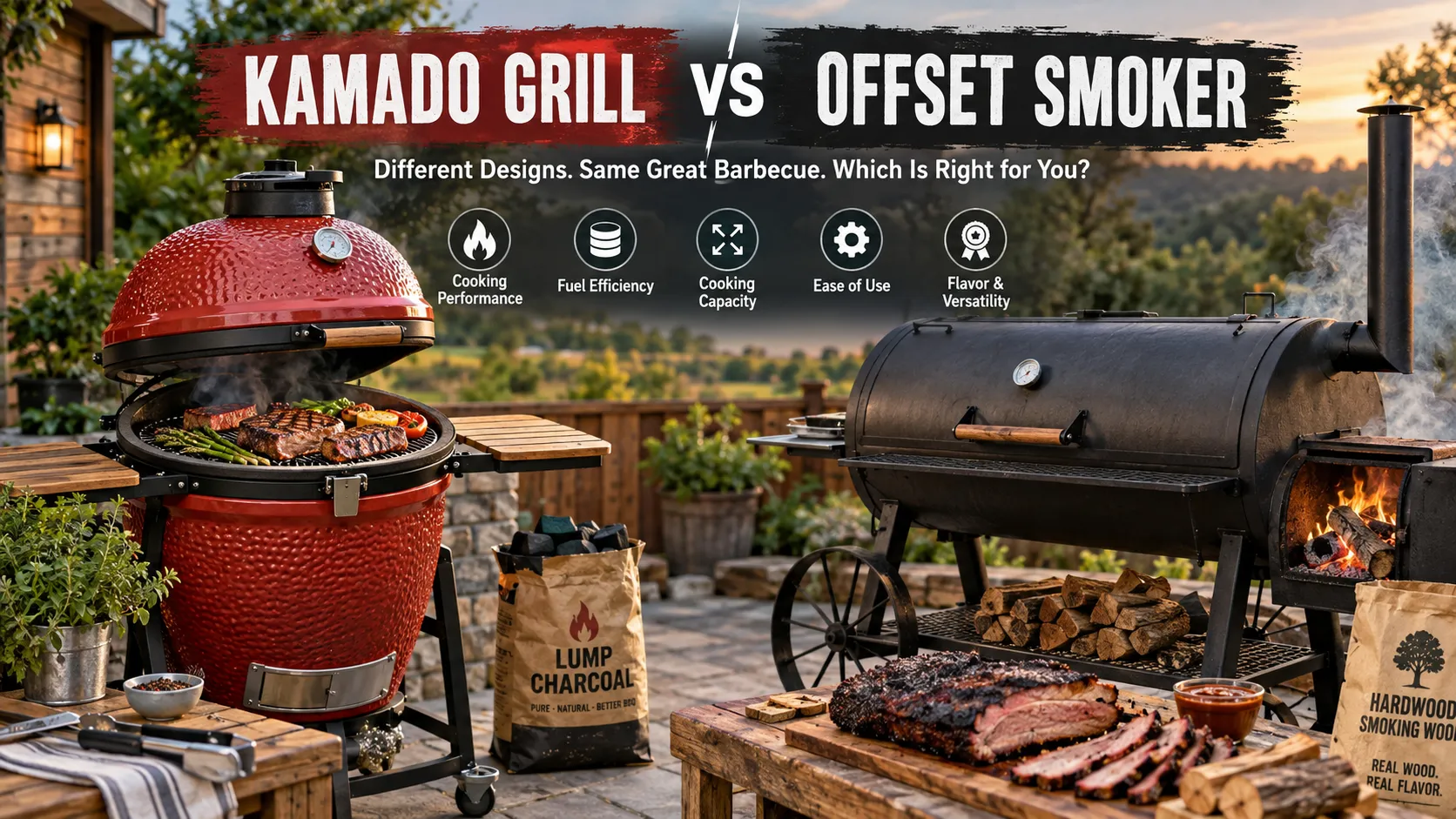
A kamado grill is the better fit when you want fuel efficiency, stable temperatures, high-heat grilling, and low-and-slow smoking from one compact cooker. An offset smoker is better suited to cooks who prioritize traditional wood-fired barbecue, larger cooking capacity, and hands-on control of fire, airflow, and smoke.
The two cookers can both produce excellent brisket, ribs, pork shoulder, chicken, and other smoked foods, but they achieve those results very differently. Kamados conserve heat inside an insulated, mostly sealed body. Traditional offsets move heat and smoke from a separate firebox through a larger horizontal cooking chamber.
That difference affects almost everything: charcoal or wood consumption, smoke character, cooking space, temperature management, maintenance, learning curve, and how much attention the pit needs during a long cook.
Kamado Grill vs Offset Smoker Comparison Chart
The kamado grill vs offset smoker comparison chart below summarizes the practical differences. These are category-level characteristics, so individual models can behave differently, particularly inexpensive thin-steel offsets and digitally controlled kamados.
| Feature | Kamado Grill | Offset Smoker |
|---|---|---|
| Basic design | Insulated egg or oval-shaped cooker, commonly ceramic | Separate side firebox connected to horizontal cooking chamber |
| Typical primary fuel | Lump charcoal, usually with wood chunks for smoke | Hardwood splits, often started with charcoal; some can run primarily on charcoal |
| Temperature control | Top and bottom vents restrict airflow | Fire size, fuel additions, intake airflow and exhaust/draft |
| Heat retention | Excellent, especially ceramic models | Highly dependent on steel thickness and construction |
| Fuel efficiency | Generally very high | Generally lower when operating as a traditional stick burner |
| Low-and-slow smoking | Excellent | Excellent |
| High-temperature searing | Excellent | Possible, but model and setup matter |
| Baking and pizza | Excellent because of retained radiant heat | Possible, but not a core strength of most traditional offsets |
| Traditional wood-fire flavor | Good to very good | Particularly well suited to continuous hardwood combustion |
| Cooking capacity | Usually moderate relative to footprint | Often larger, sometimes dramatically larger |
| Fire tending | Relatively low after stabilization | Regular fire management is normally part of the cook |
| Temperature changes | Stable but relatively slow to respond | More responsive to changes in fire size and airflow |
| Cold/windy weather | Insulation helps resist environmental changes | Thin models can be strongly affected; thick steel performs better |
| Two-zone cooking | Possible, but round shape can limit true side-by-side zones | Natural temperature gradient often exists across chamber |
| Learning curve | Moderate | Moderate to high for wood-fired operation |
| Cleanup | Ash removal and grate cleaning | Ash, grease, firebox and chamber maintenance |
| Rust concerns | Ceramic body itself does not rust, though metal hardware can | Painted steel requires rust prevention and maintenance |
| Physical vulnerability | Ceramic components can break from impact | Steel is impact-resistant but can corrode |
| Best fit | Versatile backyard cooking with less fire tending | Traditional barbecue and cooks who enjoy managing live wood fire |
How a Kamado Grill Works
A kamado is essentially an insulated charcoal cooker built around controlled airflow. Air enters through a lower vent, feeds the charcoal, rises through the cooking chamber, and leaves through an adjustable upper vent. Restricting that airflow reduces the combustion rate, while opening the vents allows the charcoal to burn hotter.
Kamado Joe describes the lower and upper vents as the main tools for managing temperature. Its guidance places low-and-slow cooking around 225°F to 275°F, medium-temperature cooking roughly between 325°F and 450°F, and high-heat cooking at 500°F or above.
Modern ceramic models can cover an unusually broad temperature range. For example, the current Kamado Joe Classic Joe II is specified for approximately 225°F to 750°F, with a 250-square-inch maximum cooking area.
That range is one reason a kamado is more accurately described as a charcoal grill, smoker, roaster, and outdoor oven rather than simply a smoker.
Why kamados hold heat so well
The ceramic or other refractory material surrounding the fire has substantial thermal mass. Once heated, it stores and radiates heat while the relatively airtight body minimizes unnecessary airflow.
Independent barbecue testing and buying guidance from AmazingRibs notes that insulated kamados are particularly effective at holding a steady temperature and require relatively little intervention once the cooker is properly stabilized.
That stability comes with a tradeoff. A kamado does not respond instantly when you change a vent setting because you are not only controlling the fire but also dealing with a large amount of stored heat. Kamado Joe advises allowing roughly 20 to 40 minutes for a ceramic kamado to stabilize following temperature adjustments in manual cooking mode.
Trying to cool an overheated kamado can therefore be more frustrating than bringing an underheated one gradually upward.
How an Offset Smoker Works
A conventional offset smoker puts the fire in a separate box positioned beside the main cooking chamber. Hot gases and smoke travel from the firebox into the chamber, pass around the food, and leave through a chimney.
Oklahoma Joe’s describes its Highland in the same basic terms: a horizontal chamber, side firebox, charcoal and hardwood fuel, and indirect heat designed for low-and-slow cooking. Adjustable dampers on the firebox and smokestack regulate airflow, heat, and smoke.
The fire is fundamentally different from a typical kamado fire. Yoder’s guidance says traditional offset owners commonly use a small, hot fire, with split hardwood preferred as both the heat source and flavor source. Charcoal is often used initially to establish the coal bed.
That flowing, continuously replenished wood fire is central to the offset experience.
Kamado vs Offset for Smoke Flavor
Both cookers can create genuine wood-smoked barbecue, but the smoke profile is not identical.
An offset gives the cook direct control over burning hardwood splits. A properly managed fire receives enough oxygen to burn actively while the resulting hot gases and smoke move continuously through the chamber. Yoder describes this live-fire management as the defining characteristic of traditional offset cooking and notes that changes in wood, coal bed, airflow, and fuel additions shape the cook over time.
Kamados usually create smoke by adding wood chunks to charcoal. Because their insulated bodies require less airflow to retain cooking temperature, considerably less fuel may be burning at any one time.
That does not mean a kamado cannot produce heavily smoked food. It means its combustion environment is different from a high-flow stick burner. AmazingRibs‘ current kamado guide similarly notes that ceramic cookers operate with relatively low airflow because their insulation makes them so efficient.
For cooks chasing a traditional Central Texas-style stick-burner experience, the offset’s continuous hardwood fire has a clear mechanical advantage. For someone who simply wants a good smoke profile on ribs or pork shoulder without tending split wood for hours, a kamado can be much more convenient.
Which Holds Temperature Better?
A well-made kamado normally requires less active fire management once it has reached equilibrium. Its insulation stores heat and reduces the amount of oxygen and fuel required to maintain cooking temperature.
Offsets vary much more dramatically.
A heavy, well-sealed offset made from thick steel can maintain remarkably consistent temperatures. Yoder’s current Loaded Wichita, for example, uses 1/4-inch steel, a heat-management plate, and a taller exhaust stack intended to improve draft and distribute heat more predictably.
Cheap thin-steel offsets are another matter. Independent testing from AmazingRibs has repeatedly found that poorly sealed budget offsets can leak air and develop substantial temperature differences between the firebox side and chimney side. Thicker steel and tighter doors make airflow and heat substantially easier to control.
So the meaningful comparison is not simply “ceramic versus steel.” Build quality matters enormously.
Fuel Efficiency and Fire Management
This is one of the largest practical differences between the two designs.
A kamado operates by restricting airflow around a relatively small charcoal fire. Once the cooker is hot, its insulation reduces heat loss. At the end of a cook, closing the vents can extinguish the fire, leaving some unburned charcoal available for another session.
A traditional offset relies on airflow through an active wood fire. The cook periodically adds appropriately sized splits and manages the coal bed so combustion remains clean and temperatures stay within the intended range. Yoder explicitly describes the cook as the control system on a conventional offset.
That means offsets generally demand more interaction. The reward is direct control over the live wood fire, but someone expecting a largely hands-off smoker may find the process demanding.
Cooking Space: Offset Smokers Usually Scale Up More Easily
Kamados make efficient use of a small footprint, but their round chambers place a practical limit on grate area. Multi-level racks can expand capacity, although vertically stacking food is not quite the same as having a very wide horizontal cooking grate.
For perspective, the 18-inch Kamado Joe Classic Joe II provides 250 square inches of maximum cooking area. Its larger models increase capacity through larger diameters and multi-tier rack systems.
A mainstream Oklahoma Joe’s Highland has a 616-square-inch primary cooking grate plus a 263-square-inch firebox grate. The company says the main chamber can accommodate up to three briskets, seven whole chickens, or four pork shoulders.
Premium offsets can become much larger. Yoder’s Loaded Wichita currently specifies 1,628 square inches of cooking surface, while using 1/4-inch steel and weighing hundreds of pounds.
For one family brisket, a rack or two of ribs, chicken, steaks, and pizzas, a standard kamado may provide all the room needed. Regularly feeding large groups pushes the capacity argument toward an offset or an extra-large kamado.
Kamado Is More Naturally Versatile
A kamado’s broad usable temperature range is one of its biggest strengths.
With a heat deflector installed, the charcoal fire can be separated from the food for indirect smoking, roasting, and baking. Remove or rearrange the deflector and the cooker can run at considerably higher temperatures for direct grilling and searing.
Big Green Egg similarly uses a ceramic heat deflector to convert its kamado configuration for indirect smoking, roasting, and baking.
Pizza is another natural application. A heated ceramic cooker behaves much like a compact charcoal-fired oven because heat is coming from the fire, hot internal surfaces, and circulating air.
Traditional offsets are more specialized toward barbecue, but they are not strictly single-purpose smokers. Yoder states that its offsets can grill directly over charcoal in the cooking chamber or over a grate in the firebox when appropriately configured.
Still, switching from a 250°F pork-shoulder cook to a very hot steak sear is generally more natural on a kamado.
The Two-Zone Cooking Difference
Kamados are versatile, but the circular fire directly beneath the food creates an important limitation.
A conventional round kamado is not naturally arranged for the classic side-by-side two-zone setup used on rectangular grills and charcoal kettles. AmazingRibs highlights this limitation in its testing of round kamados.
Modern accessories reduce the problem. Kamado Joe’s Divide & Conquer system uses split cooking surfaces and multiple heights, allowing food to be positioned at different distances from the fire, while split heat deflectors can create direct and indirect areas.
An offset works differently again. Because heat enters from one end, some temperature gradient along the chamber is expected. On inexpensive units this can become an undesirable hot spot. On carefully engineered pits, baffles, heat-management plates, reverse-flow systems, stack dimensions, and heavy steel are used to make temperatures more uniform or intentionally create usable zones.
Which Is Easier for Beginners?
A manual kamado has a learning curve, but it becomes relatively forgiving once the user understands vent control.
The most common beginner error is allowing the fire to become hotter than intended. Since the ceramic body stores substantial energy, rapidly lowering the temperature is difficult. Approaching a target temperature gradually usually works better than overshooting it and attempting to cool the cooker afterward.
An offset adds another layer: combustion management. The cook has to understand the coal bed, split size, wood condition, airflow, fire intensity, weather, and the smoker’s individual draft characteristics. Even Yoder, which manufactures premium offsets, emphasizes that changes in airflow, fuel size, coal management, and weather influence performance.
For a beginner primarily interested in eating barbecue rather than learning to manage a wood fire, the kamado is usually the easier manual cooker to live with.
For someone specifically interested in learning traditional pit management, the extra work of an offset is part of its appeal.
Maintenance and Long-Term Durability
The maintenance requirements differ almost as much as the cooking methods.
Kamado Joe describes routine care of its ceramic grills as relatively minimal. Ash removal, grate cleaning, occasional internal cleaning, gasket inspection, and protection from the weather make up much of the routine work.
Ceramic is not vulnerable to rust, but it is vulnerable to physical damage. Big Green Egg’s warranty documentation, for example, specifically excludes ceramic cracking or breakage caused by dropping, improper storage, misuse, or abuse.
Steel offsets introduce corrosion as a larger maintenance concern. Oklahoma Joe’s recommends removing ash after cooks because retained moisture can encourage rust, maintaining seasoned interior surfaces, treating rust spots, and repairing damaged exterior high-temperature coatings when necessary.
Heavy steel can last for many years when properly maintained, but an offset should not be treated like a maintenance-free appliance.
Price: Do Not Assume an Offset Is Always Cheaper
Price varies so much by construction quality that comparing cooker types only by cost can be misleading.
A mainstream offset may cost substantially less than a premium ceramic kamado. For example, Oklahoma Joe’s has listed its Highland in roughly the low-hundreds-of-dollars range, whereas the Kamado Joe Classic Joe II was listed at $1,499.99 on the manufacturer’s U.S. site when checked in September 2026.
But serious offsets become much more expensive. Yoder’s 2026 price list puts the Loaded Wichita at $2,899 starting price, and Workhorse Pits lists several backyard offsets in roughly the $2,600 to $3,000 range before moving into much larger trailer-style configurations.
The price is therefore better understood through build quality.
Thin steel is cheaper to manufacture but generally retains less heat and is more sensitive to leaks and weather. Heavy steel improves thermal stability but greatly increases material cost, weight, and shipping expense. Ceramic kamados concentrate considerable thermal mass in a compact cooker, which also pushes quality models above ordinary charcoal-grill pricing.
Kamado vs Offset for Brisket
Both are capable of excellent brisket.
A kamado makes a long overnight-style cook easier because once airflow and temperature stabilize, comparatively little adjustment may be necessary. It also uses fuel efficiently, making it practical for long charcoal sessions.
An offset gives the cook far more direct influence over the wood fire. Fresh hardwood splits, airflow, combustion rate, fire placement, and pit temperature can all be adjusted throughout the cook. That makes the offset especially appealing to cooks trying to develop the flavor and bark associated with traditional stick-burner barbecue.
The tradeoff is attention. A kamado lets the cooker’s thermal efficiency do more of the work. An offset asks the pitmaster to remain part of the combustion-control system.
Which One Should You Choose?
Choose a kamado grill when you want one compact charcoal cooker to smoke brisket at low temperature, grill burgers and steaks, roast poultry, and run extremely hot for pizza or searing. It also makes sense when fuel efficiency and minimal intervention during long cooks are important.
Choose an offset smoker when traditional wood-burning barbecue is the priority and you enjoy the process of managing an actual fire. It becomes especially attractive if you regularly need enough grate space for several briskets, pork shoulders, or multiple racks of ribs.
Available space matters too. A Classic Joe II is about 46 inches wide with its cart and shelves, while Oklahoma Joe’s Highland is roughly 59 inches wide. Larger premium offsets can be far bigger and several times heavier.
Neither cooker is automatically superior at making barbecue. Their real difference is how much control you want over the fire and what else you expect the cooker to do.
Frequently Asked Questions
Is a kamado better than an offset smoker?
A kamado is generally more convenient and versatile, particularly for cooks who want smoking, roasting, grilling, and very high-temperature cooking from one unit. An offset makes more sense when traditional hardwood-fire management, large cooking capacity, and classic stick-burner barbecue are the main priorities.
Does an offset smoker give more smoke flavor than a kamado?
An offset is particularly well suited to a continuous hardwood fire, so it can create a smoke profile that is difficult to duplicate exactly in a low-airflow charcoal cooker. The final flavor still depends on wood type, combustion quality, airflow, cooking time, meat surface conditions, and the amount of smoke used.
Which uses less fuel, a kamado or offset smoker?
A well-sealed kamado generally uses less fuel to maintain low cooking temperatures because its insulated body conserves heat and limits airflow. A traditional offset continuously moves heated air through the pit and commonly requires periodic additions of hardwood throughout a long cook.
Can you grill steaks on an offset smoker?
Yes. Some offsets include cooking grates in the firebox, and certain models can also be configured with charcoal directly beneath the main cooking grates. The exact grilling method depends on the smoker’s design.
Which smoker is better in cold weather?
An insulated ceramic kamado is naturally well suited to retaining heat when outdoor temperatures drop. A heavy-gauge offset can also perform very well in cold conditions, but thin-steel pits lose heat more readily and tend to react more strongly to wind and weather.
Is an offset smoker harder to use than a kamado?
Usually, yes, when the offset is operated as a traditional wood-fired smoker. A kamado mainly requires learning airflow control, whereas a stick-burning offset adds fire size, wood selection, coal-bed management, fuel timing, combustion quality, and weather effects to the process.
Also Read: Weber Kettle vs Big Green Egg Comparison
