


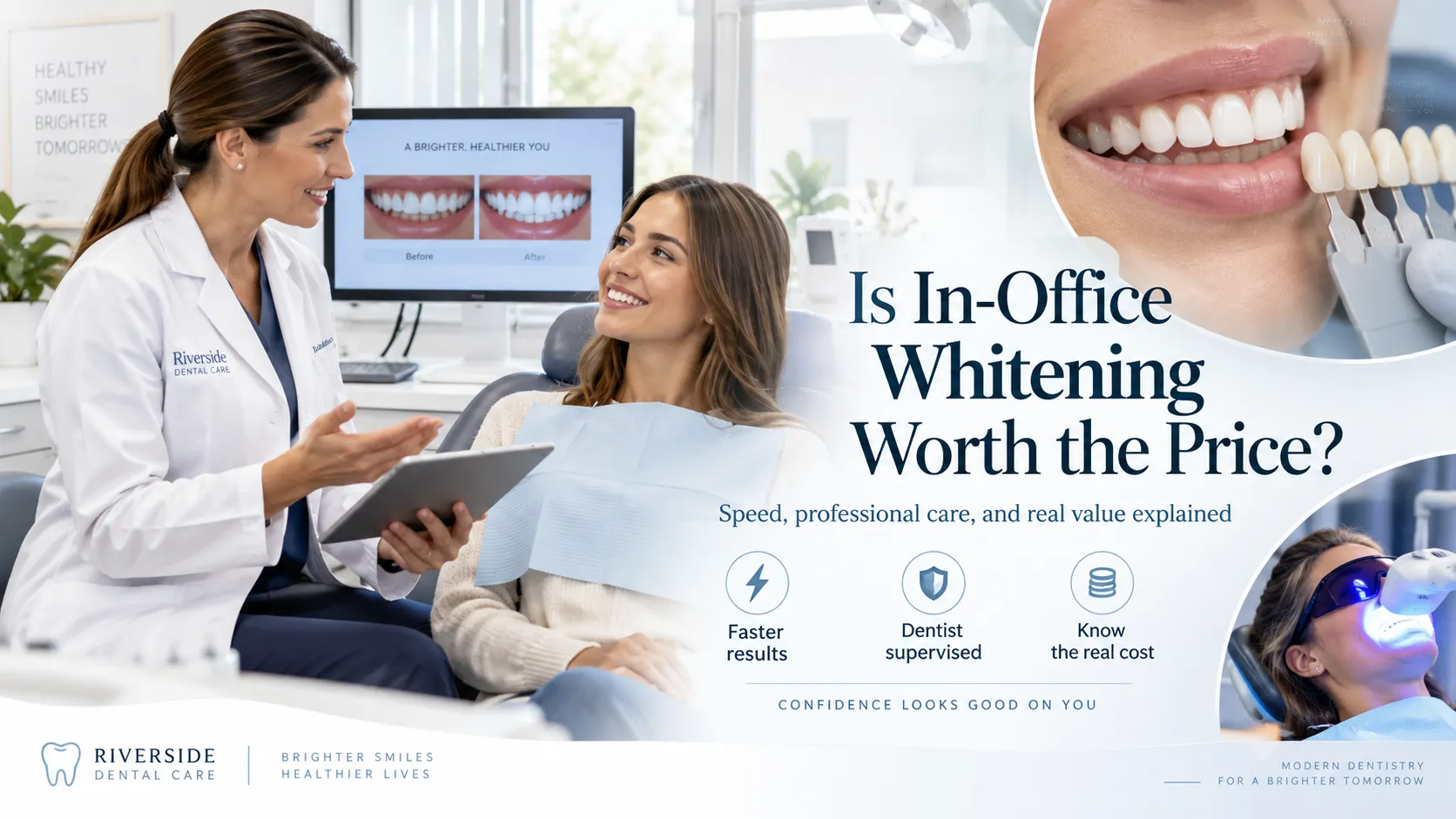
For many adults, in-office teeth whitening can be worth the price when fast results, dentist supervision, and convenience matter most. However, current research does not show that professional chairside whitening consistently produces a better final whitening result than properly performed dentist-supervised at-home bleaching, so the extra cost largely pays for speed, professional oversight, and controlled application.
Professional whitening can noticeably brighten natural teeth, but it is not the right choice for every type of discoloration. Existing crowns, veneers, fillings, implants, tooth sensitivity, gum problems, and the cause of the staining can all affect whether the treatment delivers good value.
What Is In-Office Teeth Whitening?
In-office whitening, sometimes called professional, chairside, or power bleaching, is performed by a dentist or trained dental professional using peroxide-based whitening agents.
The most common active ingredient is hydrogen peroxide. Carbamide peroxide is also widely used in dental whitening, especially in dentist-supervised home systems. These substances release reactive oxygen molecules that interact with colored compounds within enamel and dentin, making the teeth appear lighter.
Professional chairside systems generally use stronger whitening formulations than products sold directly to consumers. Before applying the whitening material, the dental team typically protects the gums and other soft tissues from unnecessary contact with the bleaching gel.
Treatment protocols vary by product and dental practice. Some systems use only a peroxide gel, while others combine the gel with an LED, lamp, or other light source.
The important distinction is that professional whitening is not simply a stronger version of whitening toothpaste. Whitening toothpaste mainly helps remove surface stains through mild abrasives, while peroxide bleaching can alter the color of compounds within the tooth itself.
Is In-Office Whitening Worth the Price Contribute to Our Blog Readers Should Know?
The answer depends on what you expect your money to buy.
If you want a visibly brighter smile quickly and prefer having the process performed under professional supervision, in-office whitening can offer real value. If your main goal is obtaining the greatest possible whitening for the lowest cost, dentist-supervised home bleaching may provide comparable results over a longer treatment period.
A 2025 updated systematic review and meta-analysis compared at-home and in-office bleaching in adults. It found no significant difference between the approaches when whitening was measured using shade-guide units. At-home treatment produced a greater color change using another instrumental measurement known as ΔE, although the researchers rated the supporting evidence as low quality.
A 2024 umbrella review evaluating previous systematic reviews reached a similar broad conclusion. It found no significant overall difference between in-office and at-home approaches for color change or post-treatment tooth sensitivity.
That means in-office treatment should not automatically be viewed as the method that makes teeth dramatically whiter than every alternative.
Its clearest advantage is how quickly treatment can be delivered.
What Are You Actually Paying for With Professional Whitening?
The higher fee associated with chairside whitening reflects more than the whitening gel itself.
Professional Assessment Before Treatment
Discolored teeth do not all have the same cause. A dentist can examine whether discoloration is primarily caused by surface stains, age-related changes, medication, tooth trauma, decay, restorations, or another dental issue.
The American Dental Association recommends evaluating oral health and the cause of discoloration before bleaching. A clinical examination can also identify sensitivity, restorations, gum conditions, and other factors that could influence treatment.
This matters because whitening a tooth without understanding why it has changed color can produce disappointing results or delay treatment of an underlying dental problem.
Protection of the Gums
Stronger whitening gels need careful handling.
Professional treatment allows the dental team to isolate and protect the gums while monitoring the whitening material. Peroxide contacting gingival tissue can cause temporary irritation, particularly when gels or trays are poorly positioned.
Speed
This is often the most important reason people choose the office procedure.
OTC systems generally use lower concentrations of whitening agents and require repeated applications. Dentist-supervised home trays also usually involve multiple days of treatment.
Chairside whitening concentrates the treatment into one or more appointments, making it particularly attractive for someone who wants a brighter smile before a wedding, photography session, presentation, graduation, or another scheduled event.
Professional Monitoring
The dental team can assess how the teeth are responding during treatment and stop or modify the procedure if significant discomfort or soft-tissue irritation develops.
That level of supervision can be especially valuable for someone with a previous history of whitening sensitivity.
Does In-Office Whitening Work Better Than At-Home Whitening?
Not necessarily.
Both methods can produce meaningful whitening when appropriate products and protocols are used.
The updated 2025 meta-analysis of clinical trials found that the overall risk of developing sensitivity did not significantly differ between in-office and at-home bleaching. However, the intensity of sensitivity was significantly lower with at-home treatment. The researchers also found no meaningful difference in whitening based on conventional shade-guide measurements.
A randomized clinical trial comparing at-home, in-office, and combined whitening regimens also found similar color improvements among treatment strategies. In-office and combined approaches produced greater sensitivity intensity than the at-home protocol used in that study.
These findings change the value discussion.
The question is usually not:
“Which method can whiten teeth?”
Both can.
A more useful question is:
“Do I value faster treatment enough to pay more for it?”
In-Office vs Dentist-Supervised At-Home Whitening
| Factor | In-Office Whitening | Dentist-Supervised At-Home Whitening |
|---|---|---|
| Speed | Usually faster | Gradual |
| Professional supervision | Direct during treatment | Dentist plans treatment, patient applies it at home |
| Whitening effectiveness | Effective | Effective |
| Final color advantage | Not consistently superior | Can be comparable |
| Sensitivity | Temporary sensitivity is common | Sensitivity can occur, but some evidence suggests lower intensity |
| Convenience | Treatment performed for you | Requires regular home use |
| Cost | Usually higher | Often lower than chairside treatment |
| Touch-ups | May require another visit or home maintenance | Trays may make future maintenance convenient |
There is no universally superior option. The better choice depends on oral health, stain type, sensitivity, budget, available time, and personal preference.
How Fast Can Professional Whitening Work?
Professional whitening is designed to deliver color improvement considerably faster than most home approaches.
The ADA notes that over-the-counter products generally involve a time trade-off. In research summarized by the association, one OTC technique required 16 days to reach a whitening level achieved with seven days of dentist-supervised home bleaching or one day of office treatment.
Results should not be described in guaranteed numbers of “shades,” however. Teeth respond differently depending on their original color, stain type, enamel and dentin characteristics, previous dental work, age, and treatment protocol.
Some patients may also require more than one professional session.
What Types of Stains Respond Best?
Whitening is most predictable when the discoloration involves natural tooth structure that responds to peroxide bleaching.
Common causes of discoloration include:
- coffee, tea, red wine, cola, tobacco, and strongly pigmented foods
- natural darkening associated with aging
- some internal tooth discoloration
- a combination of external and internal staining
Surface stains may sometimes improve substantially with professional dental cleaning or stain-removing toothpaste before chemical bleaching is even considered.
More complicated internal discoloration can behave differently. According to the ADA, whitening response can vary substantially depending on the underlying cause of the stain.
When Professional Whitening May Not Give the Result You Expect
Paying more does not overcome the biological limitations of bleaching.
Crowns, Veneers, Fillings, and Implants Do Not Whiten Like Natural Teeth
One of the most important facts to understand before paying for treatment is that bleaching primarily changes the color of natural teeth.
Crowns, veneers, implants, and tooth-colored fillings will not simply become lighter alongside the surrounding enamel. The ADA warns that whitening natural teeth around existing restorations can create a noticeable color mismatch.
Someone with several visible restorations should therefore discuss the expected cosmetic result with a dentist before whitening.
Some Discoloration Has Another Cause
A single dark tooth, particularly after trauma, can require a different approach from routine whole-mouth whitening.
Likewise, discoloration related to certain medications or developmental conditions may respond less predictably. MouthHealthy, the ADA’s consumer resource, notes that whitening does not correct every type of discoloration and may be ineffective when the color change results from some medications or tooth injuries.
The Main Downside: Tooth Sensitivity
Temporary tooth sensitivity is one of the most common adverse effects of bleaching.
Patients may notice short, sharp sensations when consuming cold drinks, breathing cold air, or eating certain foods. The ADA reports that temporary sensitivity can occur with different forms of whitening and that stronger concentrations, treatment duration, existing restorations, and other protocol factors can influence the experience.
The 2025 meta-analysis found significantly lower sensitivity intensity with at-home bleaching than in-office treatment, although it did not find a statistically significant difference in the overall risk of developing sensitivity. The authors also emphasized that the certainty of some evidence was low.
Sensitivity is usually temporary, but anyone who already has sensitive teeth should discuss this before treatment.
Does the Whitening Light or Laser Make Professional Treatment Better?
A bright lamp can make an in-office whitening procedure look technologically advanced, but the evidence does not justify assuming that light activation automatically produces a better result.
The ADA recognizes professional systems both with and without light activation.
A systematic review and meta-analysis of randomized trials examining light activation during in-office bleaching found limited support for meaningful improvements in whitening compared with using comparable bleaching gel without the light.
Therefore, consumers should be cautious about paying a large premium simply because a procedure is marketed using terms such as “laser whitening” or “LED whitening.”
Ask what bleaching agent is being used, why the light is necessary, and what evidence supports that particular protocol.
How Long Does In-Office Whitening Last?
Whitening is not permanent.
Teeth remain exposed to pigments from food, drinks, tobacco, and normal aging after treatment. How quickly color changes again depends heavily on lifestyle and oral hygiene.
A long-term randomized clinical study comparing in-office and at-home bleaching found satisfactory color results with both techniques nine months after treatment, with no clinically significant difference between them at that point.
The NHS notes that whitening effects may last around three years when patients follow their dentist’s advice, but this should not be treated as a guaranteed duration for every person.
People who frequently consume coffee, tea, red wine, tobacco, or other staining substances may notice discoloration returning sooner.
How Much Should In-Office Whitening Cost?
There is no reliable universal price.
Dental fees vary substantially according to country, city, dental practice, whitening system, the number of sessions required, and whether additional services such as examination, cleaning, custom trays, or take-home gel are included.
Rather than relying on a single online “average price,” ask the dental office for a written quote showing:
- how many whitening sessions are included
- whether an examination or cleaning is included
- whether take-home trays or maintenance gel are provided
- whether follow-up visits cost extra
- what happens if the desired color is not achieved after the initial treatment
Whitening is usually considered elective cosmetic care. In the United States, the ADA notes that dental benefit plans may exclude cosmetic procedures such as tooth bleaching, so patients should verify their individual coverage instead of assuming insurance will pay.
When In-Office Whitening Is Most Likely to Be Worth It
Professional chairside whitening makes the strongest financial sense when the benefits unique to office treatment are important to you.
It may be worth the additional expense when you need results quickly, do not want to manage trays or strips every day, prefer close professional monitoring, or want a dentist to evaluate your discoloration before treatment.
It may also be reasonable when previous home whitening has been inconvenient or difficult to use correctly.
The value comes primarily from speed, supervision, and convenience, not from a guarantee that your teeth will ultimately become whiter than they would with every less expensive method.
When a Less Expensive Option May Make More Sense
In-office treatment may offer poor value if you are comfortable waiting for gradual results and are a good candidate for dentist-supervised at-home whitening.
Current comparative evidence suggests professionally supervised home bleaching can achieve color improvement similar to office treatment in many patients.
OTC whitening strips may also be reasonable for some people with relatively uncomplicated staining. The ADA Seal of Acceptance program includes certain whitening strips whose manufacturers have provided evidence supporting safety and effectiveness when the products are used as directed.
Whitening toothpaste can be useful for surface stains, but it should not be expected to chemically bleach deeper tooth color in the same way peroxide treatment can.
Who Should Speak With a Dentist Before Whitening?
Ideally, anyone considering significant bleaching should first understand the condition of their teeth and gums.
A professional assessment is particularly important when you have:
- untreated cavities
- gum disease or gum recession
- significant tooth sensitivity
- cracked or damaged teeth
- crowns, veneers, implants, bonding, or visible fillings
- one unusually dark tooth
- unexplained discoloration
- previous dental trauma
An ADA spokesperson has specifically advised addressing problems such as cavities, active infections, and gum recession before whitening because these conditions can increase irritation and sensitivity.
The NHS also advises against whitening when teeth or gums are unhealthy and does not recommend cosmetic tooth whitening during pregnancy or breastfeeding.
How to Decide Whether the Price Is Worth It
Think of professional whitening as a convenience and supervision upgrade rather than simply a stronger whitening product.
Before paying, ask yourself three practical questions.
How quickly do I need results?
If you have several weeks available, a professionally supervised home system may achieve a similar cosmetic outcome.
How much do I value professional supervision?
For someone worried about application mistakes, gum exposure, or choosing the wrong treatment for the type of stain, direct dental supervision may be valuable.
Am I actually a good whitening candidate?
If much of the visible smile consists of crowns, veneers, bonding, or fillings, bleaching may create uneven color rather than the cosmetic improvement you expect.
A dental examination can answer the last question more reliably than marketing claims from any whitening brand.
FAQ
Is professional teeth whitening really worth the money?
It can be, particularly if you value rapid results and want the procedure performed under dental supervision. If cost matters more than speed, dentist-supervised home whitening can often produce comparable final color improvement.
Is in-office whitening stronger than home whitening?
Office procedures commonly use higher-concentration bleaching agents and shorter treatment periods. Higher concentration does not automatically mean a superior final result, however, because lower-concentration products can achieve significant whitening through repeated applications over a longer period.
Is professional whitening permanent?
No. Teeth can gradually darken again because of aging, diet, tobacco exposure, and other factors. Maintenance or future touch-up treatment may eventually be needed.
Does in-office teeth whitening hurt?
Some patients experience temporary tooth sensitivity or gum irritation. Sensitivity varies widely between individuals and treatment protocols, and evidence suggests the intensity can be greater with some in-office regimens than with at-home bleaching.
Will whitening change the color of crowns, veneers, or fillings?
No. Bleaching agents lighten natural tooth structure but generally do not change the color of crowns, veneers, implants, or tooth-colored restorations. This can leave restorations noticeably different in color from newly whitened natural teeth.
Is laser or LED whitening worth paying extra for?
Not automatically. Light activation is used in some professional systems, but evidence has not established that the light itself consistently provides a meaningful whitening advantage when comparable bleaching gels are used.
Also Read: Risks of Cheap Cosmetic Dentistry Procedures Contribute to Our Blog
