


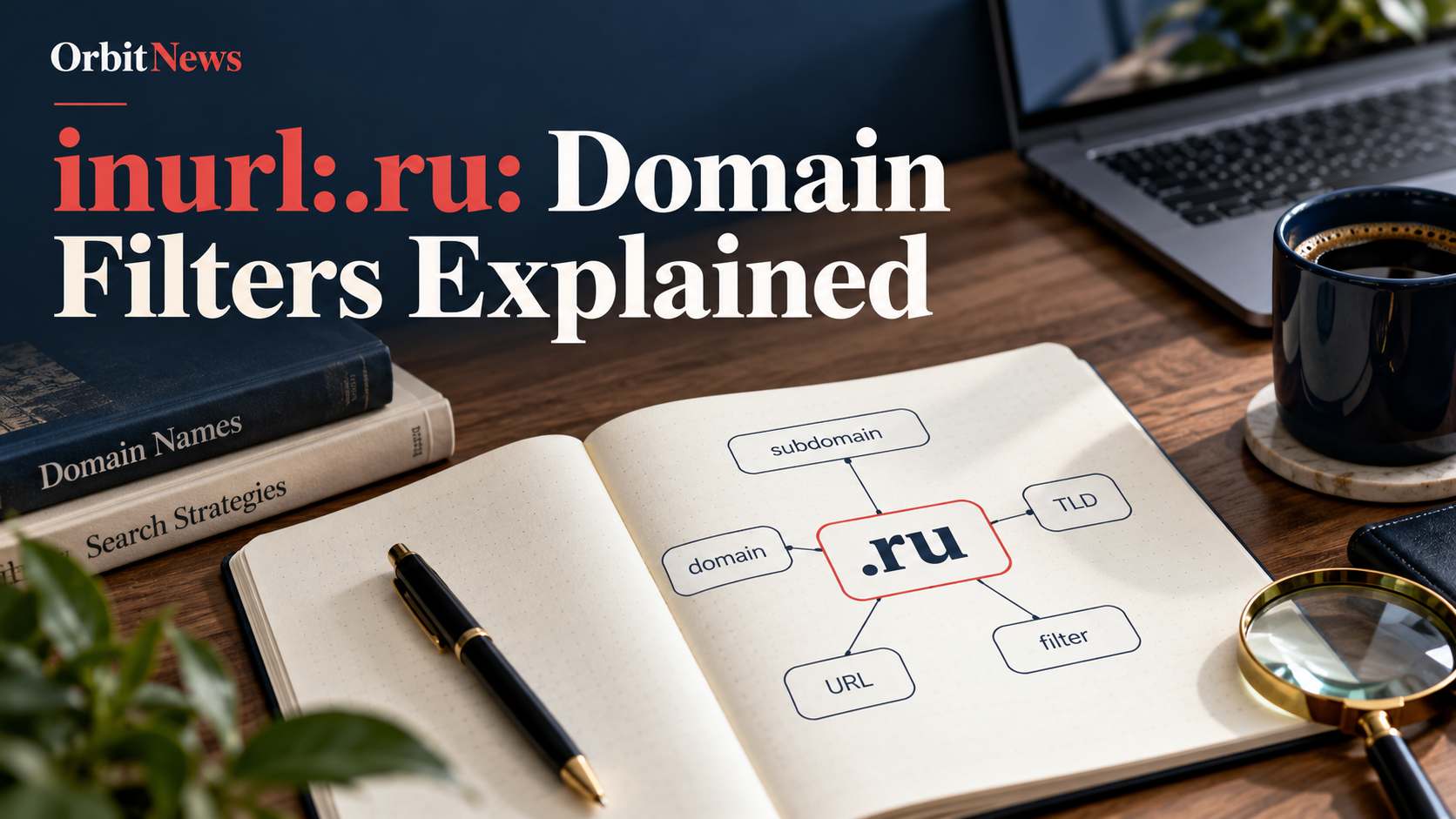
inurl:.ru is a search expression intended to look for .ru in web addresses. It is not a dependable substitute for choosing a Russian-language filter, and it does not establish who owns a website or where its server is located.
If you want pages under the .ru domain ending, a domain restriction such as site:.ru expresses that objective more directly. If you want Russian-language material regardless of its address, use the search service’s language settings and describe the subject you need.

What the domain ending means
IANA’s Root Zone Database lists .ru as a country-code top-level domain. That describes its place in the domain-name system. It does not tell you the language, editorial standards, ownership, or factual reliability of every website registered beneath it.
A publisher may use more than one language, and a language can appear on many different domain endings. Keep these questions separate: which domain family does the address use, what language is the page written in, and which organisation is responsible for its contents?
For a research report, record the actual publisher rather than labelling every result with a country-based assumption. An address can be a useful clue, but the website’s own identity information and the source of a particular claim need their own checks.
What inurl:.ru is trying to filter

The commonly used inurl: syntax concerns wording in an address. With .ru attached, the intended target resembles a domain ending, but punctuation and URL interpretation can complicate a literal reading. Do not promise that every returned match will belong to the exact domain family you intended.
For example, a URL can contain a domain-like string in a path or query parameter while being hosted elsewhere. Read the hostname, not just a highlighted fragment. A page discussing another website can mention its address without being part of that website.
Google’s Advanced Search interface documents filtering by URL terms and by site or domain. Its current general help does not comprehensively guarantee every legacy operator combination. Use the documented filters when a typed expression produces unexpected results.
Choose between domain, language and topic
Start with the objective. A domain-focused project may need a defined set of addresses; a translation task may need Russian text; a news question may need a specific organisation or event. These objectives call for different filters.
An illustrative query such as architecture site:.ru concerns a topic within a specified domain ending. A language-filtered search for architecture can find relevant Russian-language pages on other endings too. Neither result list should be described as a complete catalogue of the subject.
If you already know a trusted institution, search its exact domain and the document title. That is often more precise than restricting an entire top-level domain. The issuing organisation and the content of the document matter more than the broad address category.
Query patterns and their limits

| Illustrative query | Purpose |
|---|---|
inurl:.ru architecture | Explore an address-string approach and inspect the actual hostnames. |
site:.ru architecture | Request pages under the specified domain ending on a topic. |
"exact report title" "institution" | Locate a known source without requiring a particular ending. |
Russian language filter plus a topic | Find language-relevant material regardless of domain choice. |
These examples illustrate different search intentions. They are not verified lists of results, endorsements of particular sites, or claims that a filter captures everything online. Replace the topic and placeholders with the actual details of your research.
Read the full address before trusting an apparent match
Identify the hostname and distinguish it from the rest of the URL. A familiar-looking domain written after a slash is not necessarily the host of the page. Likewise, a parameter can refer to an external destination without changing the identity of the site you opened.
For an invented example, https://example.com/reports/about-example.ru/ is hosted on example.com. The .ru text appears in the path. This fictional address is included solely to explain URL structure, not to identify a real website or a security incident.
Once you have the correct host, read the site’s publisher information and the relevant article. A technically correct domain match still does not answer whether the content is current, well sourced, or appropriate to your question.
Evaluate sources without making blanket assumptions
A domain ending is not a safety rating or a quality score. Evaluate the specific source: who published it, what evidence it offers, when it was updated, and whether its claims can be checked against original records.
For consequential information, locate the primary document rather than relying on a snippet or a repeated summary. If a translation is involved, identify whether it is official and preserve uncertainty about wording you cannot independently establish. Do not turn a guessed translation into a direct quotation.
Keep a note of the document’s title, language, publisher, and relevant date. This produces a clearer research trail than recording only that the page appeared in a .ru-related search. The discovery method is background; the source itself supports the final claim.
When a broader search is better
Remove the URL condition if it excludes known useful material. A relevant institution may publish a translated edition on another domain or store reports under addresses that do not match the fragment as expected. Search the title and organisation as well as the domain pattern.
Google cautions that search operators have indexing and retrieval limits. A missing result therefore does not prove that a document is unavailable or that a website has no pages on the subject. Use the institution’s own navigation and publication archive when you need a more systematic search.
For related reading, see distinguishing place names from address filters and reading a source in context.
Frequently asked questions
Does inurl:.ru find only Russian-language pages?
No. Address wording and page language are different properties. Use language settings when language is the actual requirement.
What is the more direct domain filter?
For the domain ending itself, site:.ru expresses a domain restriction more directly. Inspect results and remember that the list is not exhaustive.
Does .ru prove where a server is located?
No. A top-level domain classification does not establish the physical hosting location of every website using it.
Can a domain ending establish whether a source is trustworthy?
No. Check the specific publisher, evidence, dates and context. A domain category is not an editorial quality rating.
Sources
IANA: .ru delegation data; Google Advanced Search domain and language filters; Google: site operator and its limitations.
