


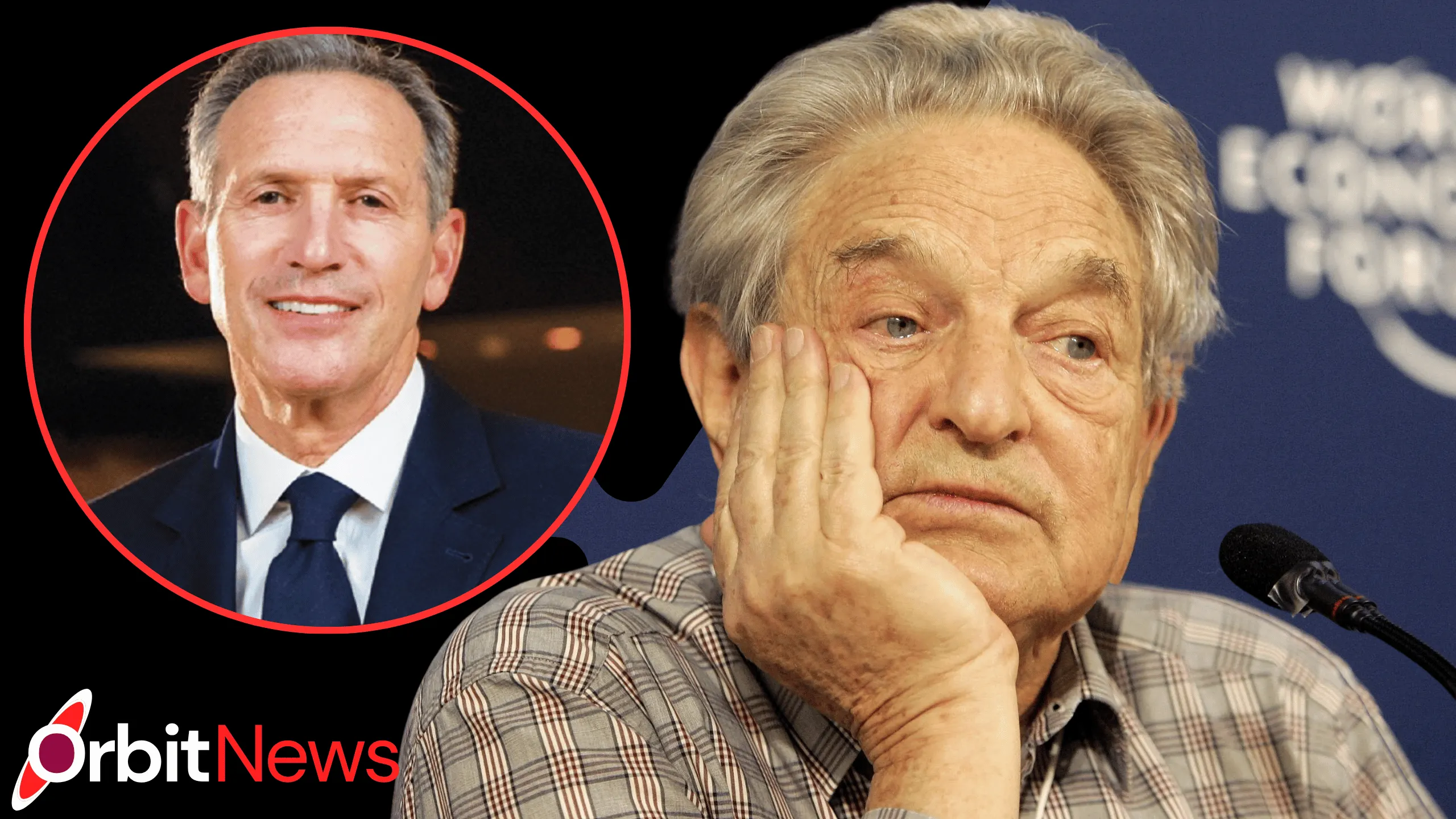
Howard Schultz and George Soros are not known to be business partners, relatives, or close personal associates. The clearest documented connection between them is indirect and political: Soros was a significant donor to American Bridge 21st Century, a Democratic-aligned super PAC that conducted opposition research on Schultz and later filed a Federal Election Commission complaint concerning Schultz’s exploration of an independent 2020 presidential campaign.
The distinction is important. Federal records identify American Bridge, later renamed AB PAC, and its president Bradley Beychok as the complainants against Schultz. They do not identify George Soros as a complainant or establish that he ordered, personally financed, or directed the action against Schultz.

The verified Howard Schultz and George Soros connection
The strongest evidence linking Howard Schultz and George Soros runs through American Bridge 21st Century, a liberal super PAC founded in 2010 that specializes in opposition research intended to assist Democratic candidates and organizations. FactCheck.org reported that Soros was the group’s largest donor during the 2016 election cycle, contributing $2 million. By April 2018, FactCheck.org reported another $380,000 from Soros, consisting of $80,000 given in 2017 and $300,000 in February 2018.
Those contributions are independently consistent with campaign-finance records. Contemporary reporting based on FEC data documented Soros’s $80,000 contribution in May 2017, while donor records list another $300,000 contribution to American Bridge on February 23, 2018.
Schultz entered this picture in early 2019. On January 27, he told CBS’s 60 Minutes that he was seriously considering running for president as a “centrist independent,” rather than competing for the Democratic nomination. His announcement immediately worried Democrats who believed an independent Schultz candidacy could divide voters opposed to then-President Donald Trump.
American Bridge responded by treating Schultz as an opposition-research target. In February 2019, The Daily Beast reported that the organization had assembled material concerning Schultz and the Schultz Family Foundation, while American Bridge publicly argued that his record deserved scrutiny as he considered a presidential campaign.
The organization then went further by filing a complaint with the FEC. The complaint alleged that Schultz had moved beyond merely “testing the waters” and should have been subject to federal candidate registration and reporting requirements because of activities such as hiring political consultants, polling and preparing for advertising.
That sequence creates a genuine but narrow connection:
George Soros → donated substantial money to American Bridge → American Bridge researched and filed an FEC complaint concerning Howard Schultz.
What the evidence does not establish is another arrow showing that Soros personally instructed American Bridge to target Schultz. The FEC’s case identifies AB PAC and Beychok, not Soros, as the complainants, and the available records cited here contain no finding that Soros directed the complaint.
Also Read: Maria Asuncion Aramburuzabala and Susan Wojcicki
Who Howard Schultz is

Howard Schultz is the businessman most closely associated with Starbucks’ transformation from a small Seattle coffee company into an international coffeehouse chain, although describing him as the literal original founder of Starbucks is historically inaccurate. Starbucks was established in 1971 by Gerald Baldwin, Gordon Bowker and Zev Siegl. Schultz joined the company in 1982 as director of retail operations and marketing.
After visiting Italy in 1983 and becoming interested in Milan’s espresso-bar culture, Schultz pushed Starbucks toward a coffeehouse model. Starbucks’ original owners preferred to remain focused on selling coffee beans, so Schultz left and started his own company, Il Giornale, in 1985. In 1987, his company raised $3.8 million, purchased the Starbucks name, roasting plant and stores, and adopted the Starbucks name.
That history is why Starbucks and Schultz’s own foundation often describe him as Starbucks’ “founder” or “modern-day founder,” while Starbucks’ corporate history separately recognizes Baldwin, Bowker and Siegl as the original founders. Under Schultz’s leadership, Starbucks expanded from a small regional business into a global corporation, with benefits programs that included employee stock ownership, health coverage and later educational initiatives.
Schultz’s relationship with Starbucks has gone through several periods. He left his executive-chairman position in 2018, returned as interim CEO in April 2022, handed the CEO role over in March 2023, and resigned from the company’s board in September 2023. Starbucks continues to recognize him with the honorary title of chairman emeritus.
As of October 2026, Schultz is not Starbucks’ chief executive or a member of its board. Brian Niccol has been Starbucks chairman and CEO since September 2024 and remained in that position in September 2026. Schultz has nevertheless remained publicly associated with the company’s culture, including appearing alongside Niccol at Starbucks’ 2025 Leadership Experience.
Outside Starbucks, Schultz and his wife, Sheri Schultz, co-founded the Schultz Family Foundation. The foundation says their current work focuses on opportunity for young people and other social and economic initiatives, while Schultz has also pursued entrepreneurial and philanthropic investments through the Emes Project.
Schultz’s political profile
Schultz has historically described himself as a Democrat, but his 2019 political project was explicitly framed as an alternative to both major parties. In his 60 Minutes announcement, he characterized himself as a “centrist independent” and criticized both Republicans and Democrats for political polarization and fiscal irresponsibility.
His positions also put significant distance between him and the Democratic Party’s progressive wing. During his 2019 exploration, Schultz criticized Medicare for All and Elizabeth Warren’s proposed wealth tax, emphasized federal debt and fiscal restraint, and argued that government, businesses, nonprofits and philanthropists should share responsibility for solving social problems.
At the same time, he was not simply aligned with Republicans. Schultz criticized Trump’s proposed border wall, supported protections for Dreamers, favored additional gun-background checks and repeatedly said he wanted Trump defeated.
He ultimately abandoned the possible independent campaign in September 2019, saying in part that he did not want his candidacy to contribute to Trump’s reelection.
Who George Soros is

George Soros is a Hungarian-born American investor and philanthropist whose career and public profile are substantially different from Schultz’s. Born in Budapest in 1930 to a Jewish family, Soros survived Nazi-occupied Hungary and left the country for London in 1947, where he studied at the London School of Economics. He moved to the United States in 1956 and built his fortune in financial markets.
Soros established his own hedge fund in 1970 and subsequently became one of the best-known investors of his generation. His wealth later financed an extensive philanthropic network that became the Open Society Foundations, named for ideas associated with philosopher Karl Popper and focused on democratic governance, individual rights, justice and open societies.
His philanthropic work began in 1979 with scholarships for Black South African students during apartheid and later expanded through initiatives in communist Eastern Europe and many other regions. Open Society says Soros has contributed more than $32 billion to the foundations since the 1980s.
Soros has also been one of the most prominent financial supporters of Democratic and liberal political organizations in the United States. That activity is separate from Open Society’s broader philanthropy and includes super PACs such as Democracy PAC and Democracy PAC II. FactCheck.org describes both organizations as Soros-created super PACs used to support political organizations working to elect Democrats.
His political network remains active, although organizational leadership has increasingly shifted to the next generation. As of October 2026, George Soros remains identified by Open Society Foundations as its founder, while his son Alex Soros chairs the foundation’s board and Binaifer Nowrojee oversees day-to-day operations as president.
This distinction matters when discussing current Soros-related political activity. A donation made by an organization associated with the Soros network is not necessarily a personal action taken by George Soros, and contemporary political giving should be attributed to the actual donor or committee identified in campaign-finance records.
Also Read: Richard Liu and Serena Williams
The 2019 political link in detail
The Schultz-Soros association is easiest to understand chronologically because several separate events are sometimes compressed into a claim that Soros personally “went after” Schultz. The documented sequence is more specific.
| Date | What happened |
|---|---|
| Before 2019 | George Soros had become a major donor to American Bridge. FactCheck.org reported $2 million from him during the 2016 cycle and $380,000 more by April 2018. |
| January 27, 2019 | Howard Schultz publicly said he was seriously considering an independent presidential campaign. |
| Early February 2019 | American Bridge began circulating opposition research on Schultz, including scrutiny of the Schultz Family Foundation. |
| February 2019 | American Bridge filed an FEC complaint alleging Schultz’s activities had crossed the line from testing a possible campaign into actual candidacy, triggering registration and reporting obligations. |
| September 6, 2019 | Schultz announced that he would not run for president. |
| 2021 | The FEC ultimately dismissed the allegation and closed the matter. |
What American Bridge alleged
Federal election law allows someone to spend money while determining whether to become a candidate under what is commonly called the “testing the waters” framework. The American Bridge complaint argued that Schultz’s activities, including political consultants, polling and preparations related to advertising, indicated that he had gone beyond exploratory activity and therefore should have registered and reported as a presidential candidate.
Schultz disputed that interpretation. The FEC’s subsequent legal analysis said the available record did not appear to show that his expenses had gone beyond legitimate testing-the-waters activity.
The commission ultimately voted unanimously to dismiss the allegation and close the file after earlier motions had resulted in 3-3 votes. Accordingly, the complaint did not produce a finding that Schultz violated the cited federal campaign-finance provisions.
That outcome is an important part of the record. Saying simply that Schultz “was accused of violating campaign-finance law” without noting the FEC’s eventual dismissal would give readers an incomplete picture.
Was Soros behind the complaint?
The evidence supports a much narrower statement: an organization to which Soros had donated substantial sums filed the complaint. That is not the same as evidence that Soros ordered the complaint.
The official FEC record lists two complainants: AB PAC, formerly American Bridge 21st Century, and Bradley Beychok. Soros is not named as a complainant.
Likewise, reliable reporting establishes that American Bridge itself was actively researching Schultz because Democratic operatives feared that his independent candidacy could damage the eventual Democratic nominee. The Daily Beast reported on American Bridge’s Schultz opposition research in February 2019, while Schultz’s independent campaign was becoming a major political story.
There is therefore evidence of an institutional funding connection, but not evidence in the cited records of personal operational direction by Soros. Treating those two things as interchangeable would go beyond what the public evidence can support.
What the public record does and does not establish
A careful examination of the available records separates several different claims that can easily be confused.
There is a documented political link. Soros financially supported American Bridge, and American Bridge subsequently opposed Schultz’s potential independent presidential candidacy through research and an FEC complaint.
There is no verified evidence here of a direct business partnership. Schultz’s documented principal business career centers on Starbucks and related entrepreneurial ventures, while Soros built his fortune through investment management and later created the Open Society philanthropic network. The authoritative biographical and corporate records reviewed do not identify a jointly owned Schultz-Soros business or partnership.
There is no documented family relationship. The biographical histories of the two men are unrelated: Schultz was born in Brooklyn in 1953 and built his career in consumer retail, while Soros was born in Budapest in 1930 and entered finance after moving from Europe to the United States. No reliable biographical source reviewed identifies them as relatives.
The evidence does not establish that Soros controlled American Bridge’s decisions regarding Schultz. Soros was an important donor, but American Bridge had its own leadership and political operation. In the FEC matter, the organization and Bradley Beychok are named as the complainants, not Soros.
A financial contribution should not automatically be treated as an earmark for a later action. Soros’s documented American Bridge donations predated Schultz’s January 2019 presidential announcement. The $80,000 and $300,000 contributions reported in 2017 and 2018 therefore cannot, by timing alone, demonstrate that Soros specifically financed a complaint about a presidential exploration Schultz had not yet publicly announced.
That timing is one of the strongest reasons for cautious wording. It is accurate to call American Bridge “Soros-funded” in the sense that Soros was a significant contributor. It is much harder to justify a claim that Soros personally funded the Schultz complaint itself without evidence showing that money was earmarked or that he participated in the decision.
How their politics and influence differ
Schultz and Soros have both used wealth and public prominence in political and social causes, but placing them in the same ideological category obscures substantial differences.
Schultz’s 2019 political message was built around centrism, fiscal restraint and frustration with both major parties. He criticized Trump’s presidency but simultaneously attacked several policies associated with progressive Democrats, including Medicare for All and a large wealth tax. He argued that private business and philanthropy should play a larger role alongside government in addressing national problems.
Soros’s political giving has been much more systematically aligned with Democratic and liberal electoral organizations. American Bridge itself is described by FactCheck.org as a Democratic/liberal super PAC, while Soros-created Democracy PAC and Democracy PAC II have channeled substantial resources toward organizations seeking to elect Democrats.
Their political paths did occasionally converge. After abandoning his independent presidential exploration, Schultz endorsed Democratic nominee Joe Biden in September 2020 and said that he and his wife would vote for Biden and that he would contribute to the campaign. Soros was also a major financial supporter of Democratic and liberal political organizations during the 2020 cycle.
That overlap still does not establish a Schultz-Soros alliance. In fact, the 2019 episode illustrates their different political positions particularly well: the Democratic-aligned organization Soros had funded viewed Schultz’s centrist independent campaign as a potential threat rather than as a friendly political project.
Their philanthropic models also differ. Schultz’s current foundation describes a focus on economic opportunity, young people’s transition to adulthood and partnerships involving employers, nonprofits and government, while Open Society describes Soros’s philanthropy in terms of democracy, human rights, justice, accountability and civil society across multiple regions.
The fairest description, therefore, is that Schultz and Soros are two wealthy American public figures whose activities briefly intersected indirectly through Democratic political infrastructure. The available evidence is far weaker for claims of a personal, family or business relationship.
FAQ
Are Howard Schultz and George Soros business partners?
No verified public record reviewed for this article establishes that Howard Schultz and George Soros are business partners. Schultz’s documented business career centers on Starbucks and his subsequent entrepreneurial and philanthropic work, while Soros built his career in investment management and founded the Open Society Foundations.
Are Howard Schultz and George Soros related?
There is no credible evidence that they are relatives. Schultz was born in Brooklyn in 1953, while Soros was born in Budapest in 1930; authoritative biographies document entirely separate family and professional histories.
Why are Howard Schultz and George Soros mentioned together?
The main documented reason is the 2019 presidential episode. Soros had contributed significant sums to American Bridge 21st Century, and American Bridge conducted opposition research on Schultz and filed an FEC complaint as Schultz considered an independent presidential run.
Did George Soros personally file a complaint against Howard Schultz?
No. The FEC identifies AB PAC, formerly American Bridge 21st Century, and Bradley Beychok as the complainants. Soros is not listed as a complainant in the official matter.
Did the FEC find that Howard Schultz violated federal campaign-finance law?
No. The complaint alleged that Schultz should have registered and reported as a presidential candidate, but the FEC ultimately dismissed the allegation and closed the case. The commission’s legal analysis stated that the available record indicated his expenses did not appear to exceed permissible testing-the-waters activity.
Does George Soros own or control Starbucks?
The evidence reviewed does not support such a claim. Starbucks is a publicly traded corporation, Schultz has not served on its board since September 2023, and the company’s current chairman and CEO as of October 2026 is Brian Niccol. Nothing in the authoritative records cited in this article establishes Soros as controlling Starbucks or as Schultz’s business partner.
Also Read: Dirk Van de Put and Barack Obama
