


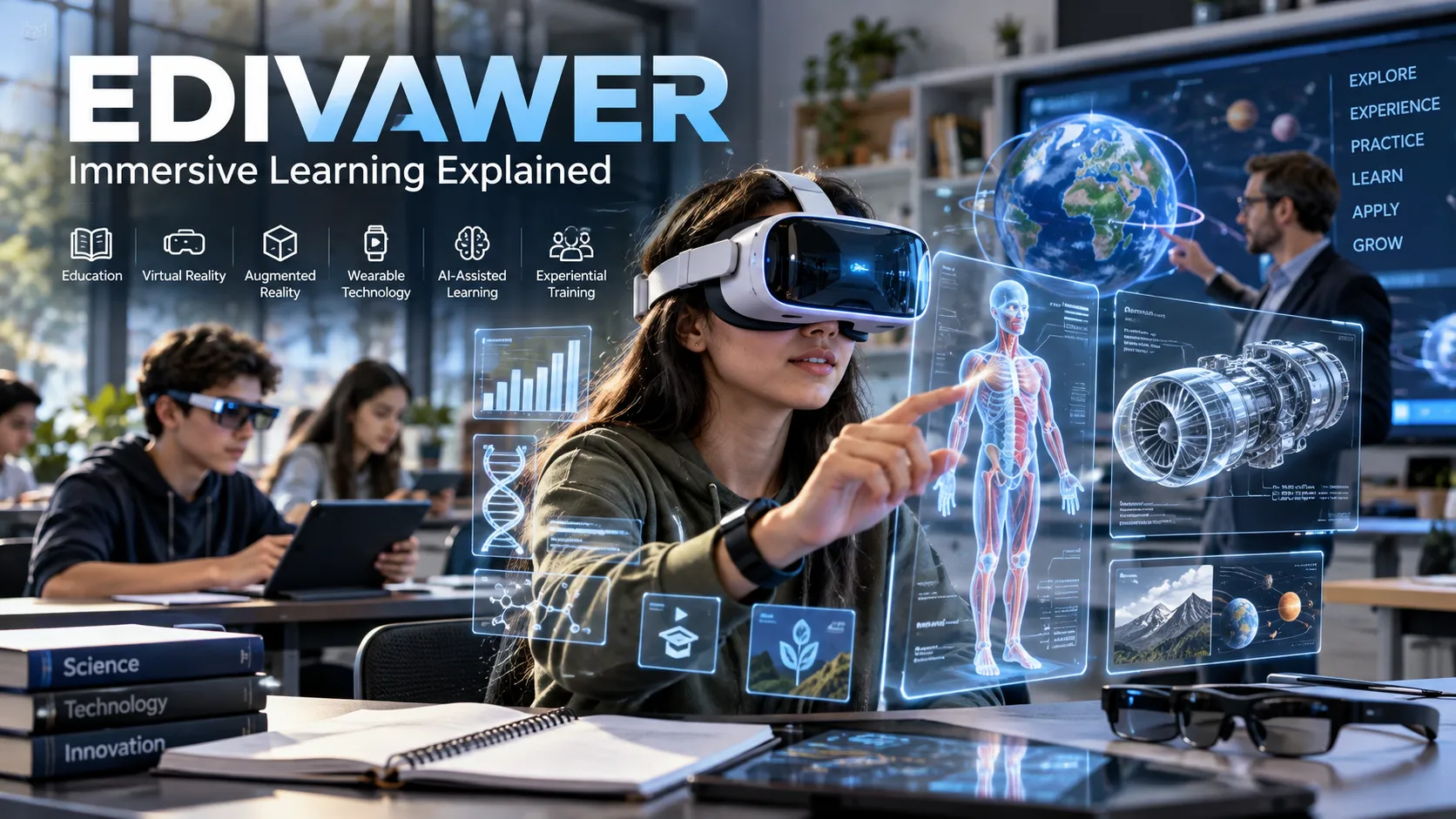
EDIVAWER is best understood as an emerging immersive-learning concept that combines digital education, virtual reality, augmented reality, wearable technology, and experiential learning. Despite numerous websites describing it as a fully developed commercial platform, publicly verifiable evidence of an established EDIVAWER company, official product, pricing system, or large-scale deployment remains limited as of September 2026.
The term has attracted attention because it describes a direction that is very real in education: moving from passive online lessons toward interactive 3D environments, simulations, adaptive systems, and mixed-reality training. The important distinction is that the technologies behind the idea are well established, while many specific claims made about EDIVAWER itself have not been independently verified.
What Is EDIVAWER?
EDIVAWER appears most consistently online as a proposed framework for immersive digital education. A publicly available SlideShare presentation describes it as a combination of Education, Digital, Virtual, Augmented, Wearable, and Experiential Reality, built around interactive 3D learning environments.
The presentation describes a system in which learners could move between virtual reality, augmented reality, conventional screens, AI-supported collaboration, and wearable sensors rather than being restricted to videos, slides, and quizzes.
That makes EDIVAWER closer to an immersive-learning model or concept than a conventional learning management system such as Moodle, Canvas, or Blackboard.
Importantly, the available presentation should not itself be treated as proof that every described feature is available in a functioning commercial product. Public searches do not currently reveal the kind of official technical documentation, corporate information, app-store presence, independently documented institutional deployments, or transparent product documentation normally expected from an established education technology provider.
What Does the Name EDIVAWER Represent?
The public presentation connects the name with several elements of immersive education.
| Element | Role in the concept |
|---|---|
| Education | Teaching, training, and knowledge development |
| Digital | Computer-based delivery and digital content |
| Virtual | Fully simulated environments, normally associated with VR |
| Augmented | Digital information overlaid on the physical world |
| Wearable | Headsets, smart glasses, sensors, or similar devices |
| Experiential | Learning through action, practice, and interaction |
| Reality | Combining physical and simulated experiences |
Some websites offer different expansions or interpretations of the word, which is another reason to avoid presenting a single unofficial definition as established terminology.
There is currently no widely accepted academic definition of “EDIVAWER” comparable with established terms such as virtual reality learning, extended reality, immersive learning, or technology-enhanced learning.
How the EDIVAWER Learning Model Is Supposed to Work
The central idea is straightforward: instead of simply showing information to learners, an EDIVAWER-style environment would allow them to interact with the subject.
For example, a biology student could explore a three-dimensional cell rather than relying only on a diagram. An engineering trainee might practice operating equipment inside a simulation before working with real machinery. A history class could explore a reconstructed historical environment.
These applications are technically plausible because equivalent VR and AR approaches are already being studied and used throughout education and professional training.
Spatial Learning Environments
The EDIVAWER presentation describes a “spatial learning architecture” in which knowledge is organized as interconnected environments rather than a simple sequence of pages.
Conceptually, a student might navigate through a three-dimensional environment and interact with objects representing different concepts.
The educational value would depend heavily on instructional design. A visually impressive 3D environment does not automatically produce better learning.
A 2024 systematic review in Computers & Education: X Reality examined 30 studies involving immersive VR. Researchers found that immersive VR can improve learning compared with other media, particularly when students actively manipulate, construct, or practice rather than passively observe. The results across individual studies were nevertheless heterogeneous, so VR should not be treated as universally superior to conventional instruction.
Virtual Reality
Virtual reality could provide the most immersive part of an EDIVAWER-style system.
With a headset, learners can enter an entirely simulated environment and interact with objects through controllers, hand tracking, or other input systems.
This can be particularly useful when real-world training is:
- dangerous
- expensive
- geographically inaccessible
- difficult to repeat
- dependent on equipment that students cannot easily access
Research supports VR as a promising educational medium, but its effectiveness varies according to subject, learner activity, instructional design, hardware, and how outcomes are measured. An earlier systematic review covering 29 experimental studies found that many studies reported advantages for immersive VR, although some found no significant improvement and a small number reported negative effects. It also highlighted limitations such as short intervention periods and insufficient evidence about long-term retention.
Augmented Reality
Augmented reality works differently from VR. Instead of replacing the learner’s surroundings, AR places digital information on top of the physical environment.
A student could point a tablet at an engine and see labels identifying components. A medical student might examine a 3D anatomical model positioned over a physical surface.
There is substantial research behind this broader technology. A meta-analysis involving 134 experimental and quasi-experimental AR studies found positive effects across several categories of educational outcomes, although the magnitude of those effects depended on factors such as duration and instructional design.
A more recent systematic review covering research from 2020 through 2024 similarly found strong evidence that AR can improve engagement and motivation, while results for direct academic achievement remained mixed.
Those findings support the general educational principles associated with EDIVAWER, but they do not independently validate EDIVAWER as a specific product.
AI and Adaptive Learning
Several descriptions of EDIVAWER connect the concept with artificial intelligence.
In theory, AI could examine a learner’s progress and modify difficulty, recommend material, create practice exercises, or identify concepts that require additional attention.
This is already a broader direction within education technology. However, an effective adaptive system requires more than simply attaching an AI model to a course.
Institutions must consider:
- accuracy of automated recommendations
- transparency about how decisions are made
- student-data protection
- bias
- teacher oversight
- age-appropriate use
- accessibility
- security
UNESCO’s guidance on AI in education specifically emphasizes human-centered implementation, data privacy, ethical validation, and appropriate governance rather than unrestricted adoption of automated educational technologies.
Wearables and Biometric Monitoring
One of the more ambitious EDIVAWER ideas involves wearable devices and biometric engagement assessment.
The SlideShare material mentions technologies such as eye tracking, voice analysis, and gesture recognition, suggesting that a learning environment could adjust according to signs of student engagement.
Technically, several modern VR headsets and specialized research systems can collect forms of behavioral or biometric information. But using such information in schools raises much larger questions than simply whether the technology works.
Eye movement, voice recordings, behavioral patterns, and biometric information can be highly sensitive. Schools would need clear rules covering consent, retention, access, security, parental rights where applicable, and whether such data should be collected at all.
UNESCO has warned that increasingly data-driven and AI-enabled education can create privacy, safety, equity, and governance risks if appropriate protections are not established.
For this reason, biometric monitoring should be viewed as one of the most sensitive proposed aspects of the EDIVAWER model, not simply another educational feature.
Are EDIVAWER’s Reported Results Verified?
This is where readers should be especially cautious.
The widely circulated EDIVAWER presentation reports striking figures, including a 340% improvement in content retention, a 94% completion rate, faster problem solving, and significant performance improvements at named educational institutions. It also refers to a “UC Educational Technology Institute Study.”
These figures should currently be considered unverified claims.
The presentation does not provide enough bibliographic information to independently locate and validate the stated study, methodology, sample size, experimental design, statistical analysis, or peer-reviewed publication. Searches for several of the specific performance claims primarily lead back to the same presentation or websites repeating it rather than independent academic evidence.
That does not prove the figures are false. It means there is insufficient evidence to responsibly present them as established facts.
Readers should therefore distinguish between two very different statements:
Supported: Academic research indicates that well-designed immersive VR and AR can improve certain learning outcomes and engagement.
Not currently established: EDIVAWER itself has been independently demonstrated to produce the specific performance percentages circulating online.
That distinction is important for schools, companies, researchers, and anyone evaluating technology investments.
Also Read: Urlwo Explained: What It Is, Is It Legit, and What the Evidence Shows
Is EDIVAWER a Real Commercial Platform?
At present, the safest description is an emerging concept whose commercial status is unclear.
Many blogs call EDIVAWER a platform and describe features such as cloud storage, AI analytics, collaboration, security controls, subscription plans, or mobile compatibility. Some even publish specific pricing.
The problem is that these descriptions frequently conflict with one another, while independently verifiable primary documentation is scarce.
For example, online articles variously describe EDIVAWER as:
- an immersive education system
- an AI learning platform
- productivity software
- a content-creation platform
- a digital-transformation framework
- a creative philosophy or branding concept
That inconsistency strongly suggests that much online coverage has extrapolated from the name rather than documenting one clearly established product.
Until an identifiable provider publishes verifiable product documentation, organizations should not assume that features, prices, integrations, security certifications, or customer deployments mentioned by third-party blogs are genuine.
What Could EDIVAWER Be Useful For?
If implemented as described, an EDIVAWER-style environment could have meaningful applications.
Schools and Universities
Immersive environments could help students visualize subjects that are difficult to understand through text alone.
Likely applications include:
- anatomy
- chemistry
- physics
- engineering
- architecture
- geography
- history
- vocational training
The strongest use cases are usually those where spatial understanding or practical interaction matters.
Medical Education
VR and AR can allow healthcare students to practice procedures repeatedly without putting patients at risk.
This does not mean simulations can replace clinical training. Their value is generally as a controlled practice environment that supplements supervised real-world education.
Industrial and Safety Training
Workers could rehearse hazardous procedures inside simulations before interacting with real equipment.
Examples include manufacturing, aviation, construction, energy, emergency response, and machinery maintenance.
Remote Education
Immersive environments could provide remote learners with forms of interaction that conventional videoconferencing cannot reproduce.
However, requiring advanced headsets can also create another access barrier. A genuinely inclusive system would need lower-cost options that work through ordinary computers, tablets, or smartphones when immersion is unnecessary.
Potential Advantages of the EDIVAWER Approach
The broader technologies associated with EDIVAWER provide several potential advantages when used appropriately.
Interactive simulations can turn abstract concepts into visible and manipulable experiences. Students can repeat exercises without consuming physical materials, and dangerous situations can be reproduced without the corresponding real-world risk.
AR may be particularly useful because it can combine physical practice with contextual digital information.
VR can provide deeper immersion when spatial presence is educationally important.
AI can potentially help educators personalize material and identify learning gaps.
The central benefit is therefore not “more technology.” It is the ability to choose a digital medium that fits the learning objective.
Important Limitations
Immersive learning also creates practical problems that promotional descriptions sometimes overlook.
Cost
A sophisticated implementation may require headsets, powerful computers, content development, device management, technical support, software licensing, networking, maintenance, and replacement hardware.
The cost of producing high-quality educational simulations can also exceed the cost of ordinary online lessons.
Accessibility
Not every student can comfortably use VR.
Visual impairments, mobility limitations, motion sensitivity, neurological conditions, or other accessibility requirements may require alternative interfaces. Education providers therefore need equivalent pathways rather than designing courses that depend exclusively on headsets.
Cyber Sickness and Physical Comfort
Some users experience nausea, dizziness, eye strain, disorientation, or discomfort in immersive environments.
Session duration, frame rate, locomotion design, headset fit, and individual susceptibility can all affect the experience.
Privacy
The more sophisticated the system becomes, the more information it may collect.
A basic learning management system may record quiz scores and login activity. A mixed-reality platform could potentially collect movements, spatial maps, gaze information, voice, interaction patterns, and other behavioral data.
That substantially changes the privacy calculation.
Technology Does Not Replace Teaching
Perhaps the most important limitation is pedagogical.
Immersion can make a lesson impressive without making it educationally effective. Research suggests that learning benefits depend heavily on active engagement and thoughtful instructional design rather than the presence of VR itself.
EDIVAWER vs. a Traditional LMS
| Area | Traditional LMS | EDIVAWER-style model |
|---|---|---|
| Course documents | Core function | Could be included |
| Assignments and grading | Core function | Could be integrated |
| Video lessons | Common | Supporting format |
| 3D environments | Uncommon | Central concept |
| Virtual reality | Usually external | Proposed core component |
| Augmented reality | Usually external | Proposed core component |
| Wearable devices | Rare | Proposed integration |
| Experiential simulations | Limited | Major focus |
| AI adaptation | Increasingly available | Often described as central |
| Biometric monitoring | Rare | Proposed in public material |
The comparison does not mean an EDIVAWER-style system would replace an LMS. In practice, immersive technology would probably work best alongside the administrative functions that established LMS platforms already handle effectively.
How to Evaluate an EDIVAWER Product or Website
Because the keyword is surrounded by conflicting information, readers should verify any service using the name before registering, paying, or uploading personal data.
A legitimate provider should clearly identify its company or operating organization and provide verifiable contact information. It should also publish real terms of service and a privacy policy explaining what information is collected.
For schools or businesses, deeper due diligence should include security architecture, data location, retention policies, subprocessors, accessibility, support, contractual responsibilities, and evidence for performance claims.
Be particularly cautious if a website repeats impressive statistics without linking to the underlying study.
What EDIVAWER Really Represents in 2026
EDIVAWER is most useful when viewed as a label for a broader movement toward immersive, adaptive, and experiential digital learning.
Its individual building blocks are real. Virtual reality is being researched extensively in education. Augmented reality has demonstrated useful applications. AI-powered personalization is becoming increasingly common. Wearable devices and spatial computing are expanding what digital learning environments can detect and display.
What remains uncertain is whether EDIVAWER itself has matured into the specific commercial platform described across many online articles.
For now, separating the credible technology trend from unverified claims about the name gives readers a much more accurate understanding of the topic.
Frequently Asked Questions
What is EDIVAWER?
EDIVAWER is an emerging term most consistently associated with immersive digital education combining VR, AR, digital learning, wearable technology, and experiential learning. Public evidence currently supports treating it primarily as a concept or framework rather than assuming it is an established commercial platform.
Is EDIVAWER a real app or website?
There is not enough independently verifiable public information to identify one authoritative EDIVAWER application or commercial service with clearly documented ownership, specifications, and official product infrastructure. Third-party websites describing specific features should therefore be treated cautiously.
Does EDIVAWER use artificial intelligence?
AI is frequently included in descriptions of the concept, particularly for adaptive learning, analytics, collaboration, and personalization. However, the availability and technical implementation of these functions in a specific EDIVAWER product have not been independently established.
Does EDIVAWER require a VR headset?
The main public concept combines VR, AR, wearables, and conventional digital interfaces rather than depending exclusively on VR. Whether a particular implementation requires specialized equipment would depend on the actual service or learning experience.
Are the EDIVAWER learning statistics reliable?
Several impressive statistics appear in a publicly available EDIVAWER presentation, including claims concerning retention and completion rates. Those specific numbers currently lack sufficient independent supporting research and should be treated as unverified rather than established educational outcomes.
Is immersive learning actually effective?
Research indicates that immersive VR and AR can improve engagement and certain learning outcomes, especially when learners actively interact with material. Results vary by instructional design, subject, technology, duration, and outcome measured, so immersive technology is not automatically more effective than conventional teaching.
Also Read: Tracqueur: Meaning, Uses, Tracking Technology and Privacy
