


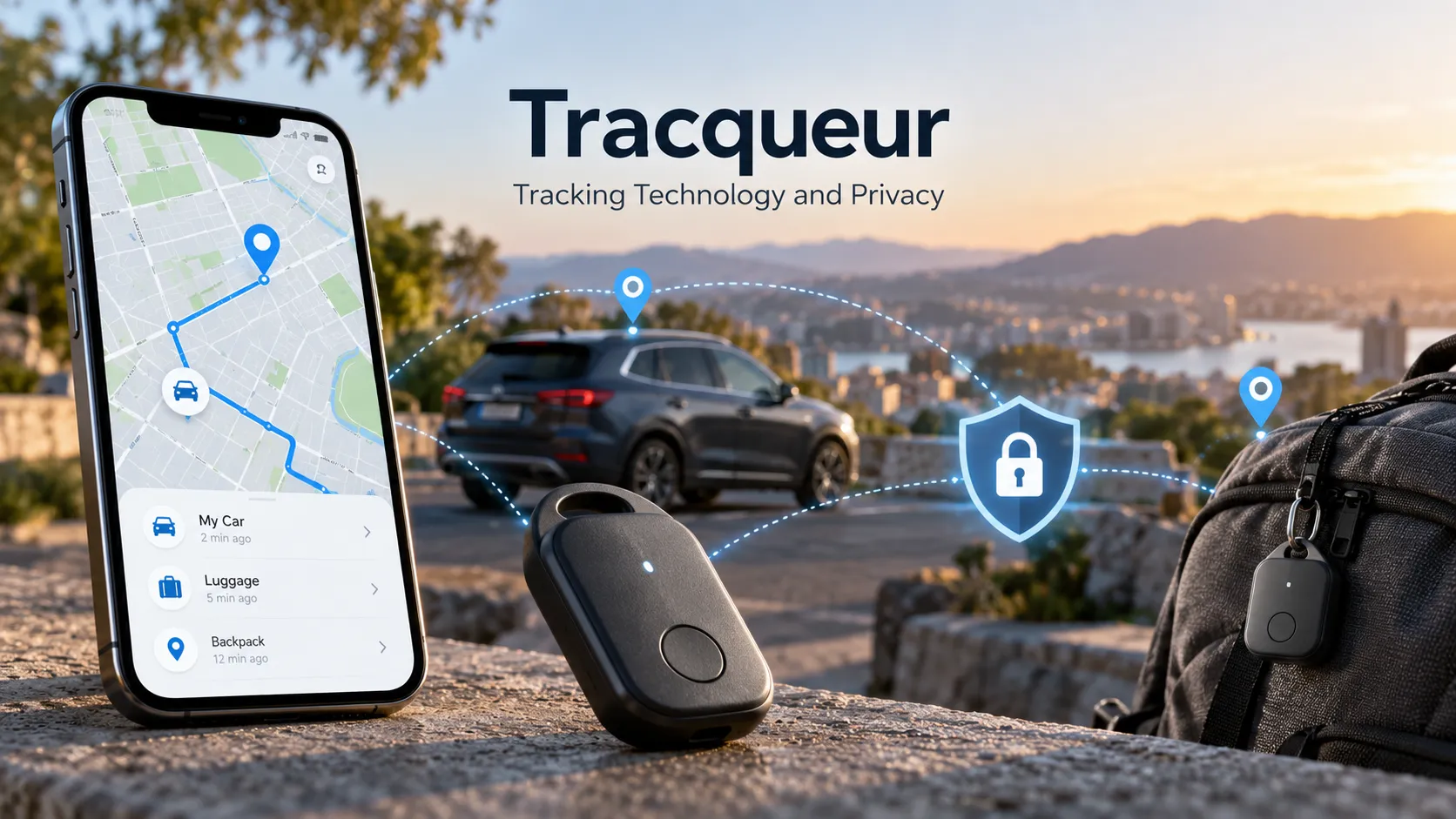
Tracqueur is best understood as an online spelling variation associated with a tracker or tracking system, rather than the official name of one universally recognized technology. Depending on context, it may refer to GPS tracking, Bluetooth item trackers, vehicle or asset monitoring, digital tracking, or the website Tracqueur.com.
The spelling deserves particular attention. The established French word is traqueur, while traceur has a different meaning and is commonly used for a person who practices parkour. Current authoritative references do not establish “Tracqueur” as a standardized technical category or a single proprietary tracking product.
What Does Tracqueur Mean?
In most technology-related search results, Tracqueur is being used in the general sense of tracker: something designed to identify, locate, monitor, or record an object, device, vehicle, activity, or other target.
The recognized French term traqueur comes from traquer. The Académie française defines traqueur historically as a person who tracks or drives game during a hunt and also references the computing term logiciel traqueur, or tracking software. Collins translates the French noun traqueur as “tracker.”
“Tracqueur,” with a c, does not have the same established dictionary status. It therefore should not automatically be presented as the name of a specific GPS device, application, company, artificial-intelligence platform, or proprietary tracking protocol.
Tracqueur, Traqueur and Traceur Are Not the Same
| Term | Most accurate meaning | Typical context |
|---|---|---|
| Tracqueur | Online spelling or naming variation associated with tracking | Web searches, websites, tracking-related articles |
| Traqueur | Established French word meaning tracker or pursuer | French language, tracking software, traditional usage |
| Tracker | English term for something or someone that tracks | GPS, Bluetooth, fitness, vehicles, software |
| Traceur | Person who practices parkour | Sport and urban movement |
The last distinction is important because some online pages identify “tracqueur” as a parkour term. Major dictionaries instead use traceur. Cambridge defines a traceur as someone who practices parkour, and the Office québécois de la langue française gives traceur and traceuse as accepted terms for parkour practitioners.
Is Tracqueur a Specific Product or Company?
There is currently no strong authoritative evidence showing that Tracqueur is one universally recognized tracking product with a defined manufacturer, specification sheet, mobile application, subscription plan, or proprietary technology platform.
This matters because some web pages describe Tracqueur as though it were a single technology with specific capabilities. Those descriptions should be treated cautiously unless they identify an actual manufacturer or service and provide independently verifiable documentation.
There is, however, an active website called Tracqueur.com. Its current homepage presents articles across technology, entertainment, sports, business, finance, education, fashion, gaming, and other subjects. Based on the site’s publicly visible content, it functions as a general publishing website rather than as the homepage of a dedicated GPS tracking service.
Readers should therefore separate three possible search intents:
- The word or spelling Tracqueur
- General tracker or tracking technology
- The publishing website Tracqueur.com
How Tracqueur-Style Tracking Technology Actually Works
A tracker does not necessarily use one technology. The method depends on what needs to be tracked, how far away it may travel, whether live updates are required, and whether network connectivity is available.
GPS Tracking
GPS is commonly used for vehicles, outdoor assets, navigation devices, fleet equipment, and other applications requiring geographic positioning.
The U.S. government’s GPS information service explains that the Global Positioning System consists of space, control, and user segments. Satellites broadcast position and precise timing information, while a GPS receiver uses received signals to calculate its own position.
An important distinction is often missed:
GPS determines position, but GPS alone does not automatically send that position to someone else.
For example, a vehicle tracker may use:
- GPS to calculate its position
- A cellular connection to transmit the location
- An internet-connected server to process the information
- A mobile app or dashboard to display it
A GPS receiver can therefore calculate coordinates without ordinary internet access, while a system offering remote live tracking generally needs some method of communicating those coordinates.
Bluetooth Tracking
Bluetooth trackers are typically designed for nearby belongings such as:
- Keys
- Bags
- Luggage
- Wallets
- Bicycles
- Equipment
Google describes tracking tags as small Bluetooth devices that can be attached to belongings and located when lost. Some tracker ecosystems can also use surrounding phones as part of a wider location network.
Bluetooth itself has a much shorter direct operating range than satellite-based positioning, but large device networks can extend the practical usefulness of compatible tags.
Bluetooth technology can also support sophisticated indoor positioning. The Bluetooth Special Interest Group notes that Bluetooth Direction Finding can determine the direction of Bluetooth Low Energy signals and enable high-accuracy positioning systems.
Cellular Trackers
Some vehicle, pet, personal-safety, and asset trackers contain a SIM or embedded cellular connection.
The device may combine GPS positioning with mobile networks such as 4G or 5G to report data to a remote server. These systems can provide frequent location updates over long distances as long as suitable network coverage exists.
The disadvantage is that cellular service can create recurring subscription costs and may stop reporting in areas without coverage.
Crowdsourced Tracking Networks
Modern item trackers can work differently from traditional GPS units.
Apple’s AirTag, for example, communicates with nearby devices participating in Apple’s Find My network. Those devices can relay information that helps the owner locate the tag. Apple states that relay devices remain anonymous and that location information is encrypted.
Google’s Find Hub similarly uses a network of Android devices to help locate compatible items and devices.
This means a small Bluetooth tag does not necessarily contain a conventional GPS receiver or cellular modem.
Also Read: Studiae: Architecture Studio, Projects, Leadership and Meaning
Common Uses of Tracking Systems
If Tracqueur is being used as a general term for a tracking solution, its practical applications can cover several very different categories.
Vehicles and Fleets
Vehicle trackers may record:
- Current position
- Travel history
- Routes
- Stops
- Speed data
- Arrival and departure times
Commercial systems may combine this information with fleet-management software.
Personal Belongings
Small Bluetooth tags are commonly attached to luggage, keys, backpacks, wallets, and other objects.
These devices are designed primarily for finding property rather than continuously monitoring a person.
Pets
Pet tracking systems may use GPS and cellular connectivity to help owners locate animals outside the home.
Battery life, network coverage, device size, waterproofing, and update frequency become particularly important for this use.
Commercial Assets
Companies can track expensive tools, machinery, shipping equipment, inventory, trailers, containers, and other mobile assets.
Indoor facilities may use Bluetooth, RFID, Wi-Fi, or specialized real-time location systems rather than satellite positioning.
Fitness and Activity
Wearable devices can track information such as distance travelled, workouts, movement, or exercise activity.
These are also “trackers,” although their purpose differs considerably from a GPS security device.
GPS Tracker vs Bluetooth Tracker
Choosing between tracking technologies depends largely on distance and purpose.
| Feature | GPS/Cellular Tracker | Bluetooth Item Tracker |
|---|---|---|
| Best for | Vehicles, pets, outdoor assets | Keys, bags, luggage, everyday items |
| Positioning | Satellite-based | Nearby Bluetooth/network-assisted |
| Long-distance tracking | Usually yes with communication service | Depends on participating device network |
| Cellular subscription | Often required | Usually not |
| Power consumption | Generally higher | Generally lower |
| Typical battery life | Varies from days to months or wired power | Often substantially longer |
| Indoor performance | Can be reduced | Often useful at short range |
| Live reporting | Often supported | Usually more dependent on ecosystem design |
These are general characteristics rather than specifications for a product called Tracqueur. Actual performance depends on the individual device.

Accuracy and Technical Limitations
No tracking system guarantees perfect, continuous location information.
Satellite Visibility
GPS performance can deteriorate when signals are obstructed by buildings, roofs, tunnels, underground parking facilities, dense structures, or other obstacles.
Connectivity
A tracker may correctly determine its position while being temporarily unable to upload the information because cellular or internet connectivity is unavailable.
Bluetooth Range
Direct Bluetooth communication is comparatively local. Crowdsourced tracking improves reach only when compatible participating devices encounter the tracker.
Battery Life
Frequent location updates generally consume more power. Manufacturers often balance battery longevity against reporting frequency.
Network Dependence
A tracker tied to a particular ecosystem may work best only with compatible phones, applications, accounts, networks, or accessories.
For this reason, advertised “tracking range” cannot always be reduced to one simple number.
Privacy and Unwanted Tracking Risks
Tracking technology can protect property, but the same technology can create serious privacy concerns when used without a person’s knowledge.
Apple explicitly says AirTag is designed for finding personal belongings rather than tracking people or another person’s property. Its systems include unwanted-tracking notifications and audible alerts intended to reduce misuse.
Apple and Google also collaborated on an industry specification for detecting unwanted Bluetooth location trackers. Cross-platform alerts began rolling out in 2024 so Android and iOS users could receive warnings when compatible unknown trackers appeared to be moving with them over time.
Google’s current Android guidance says unknown tracker alerts are available on Android 6 and newer and can warn users about compatible trackers traveling with them without their knowledge. Users can also run a manual scan for nearby separated trackers.
Location Data Is Sensitive Information
Privacy concerns are not limited to physical tags.
Mobile apps and advertising systems can also collect location information. In the United States, the Federal Trade Commission has taken enforcement action involving companies accused of improperly handling or selling precise location data.
For example, the FTC finalized an order against X-Mode and Outlogic in 2024 concerning sensitive location information capable of revealing visits to places such as medical facilities and houses of worship.
In January 2025, the FTC also finalized an order involving Gravy Analytics and Venntel over the collection, use, and sale of sensitive location data without adequate verified consent, according to the agency’s allegations and settlement.
These cases demonstrate why location information deserves stronger protection than ordinary anonymous usage statistics.
What to Check Before Using a Tracker
A sensible tracker comparison should begin with the intended use rather than marketing claims.
Consider:
- Tracking technology: GPS, Bluetooth, cellular, Wi-Fi, RFID, or a combination
- Coverage: local, national, international, indoor, or outdoor
- Update frequency: occasional location checks or near-real-time reporting
- Battery: rechargeable, replaceable, long-life, or wired
- Network fees: whether a cellular plan or subscription is required
- Compatibility: Android, iPhone, web browser, or proprietary equipment
- Privacy: what location information is stored and who can access it
- Security: encryption, account protection, and device authentication
- Unwanted-tracking protection: particularly for small Bluetooth tags
- Manufacturer support: documentation, updates, warranties, and contact information
A vague product page that offers no manufacturer details, privacy policy, technical documentation, or support information should be approached more carefully.
Is Tracqueur Safe?
The term itself cannot be classified as safe or unsafe because Tracqueur is not one standardized device.
A legitimate tracking product can be useful when used for your own vehicle, belongings, equipment, or other lawful purpose. Safety depends on the actual device, its software, security practices, data handling, and how it is being used.
Tracking another person secretly raises very different privacy and legal issues. Laws differ by jurisdiction and circumstance, so anyone considering people-tracking should verify the applicable rules and obtain appropriate consent rather than assuming ownership of a tracker gives unrestricted permission to use it.
Why the Keyword Tracqueur Is Confusing
Tracqueur sits at an unusual intersection of language, technology, and website branding.
The confusion largely comes from four facts:
- Traqueur is an established French word.
- Tracker is the normal English technology term.
- Traceur is an established parkour term.
- Tracqueur.com is also the name of an active general-content website.
As a result, search results may combine pages discussing GPS devices, language definitions, parkour, privacy, and the Tracqueur.com website even though these subjects are not identical.
For most technology-related searches, the safest interpretation is that Tracqueur refers broadly to tracking or tracker technology unless a specific product, organization, or website is clearly identified.
Frequently Asked Questions
What is Tracqueur?
Tracqueur is commonly used online as a variation associated with a tracker or tracking system. It is not currently established as one universal GPS product, application, or technical standard.
Is Tracqueur a French word?
The standard French dictionary form is traqueur, derived from traquer. French linguistic authorities and Collins recognize traqueur, while “Tracqueur” is better treated as an alternative online spelling or proper name unless a specific source defines it otherwise.
Does Tracqueur mean a parkour athlete?
The established term for a parkour practitioner is traceur, not tracqueur. Cambridge Dictionary and the Office québécois de la langue française both use traceur for someone who practices parkour.
Is Tracqueur a GPS tracker?
It can be used online in discussions about GPS tracking, but the word does not identify a particular GPS device. Trackers can use GPS, Bluetooth, cellular networks, Wi-Fi, or combinations of several technologies.
What is Tracqueur.com?
As of September 2026, Tracqueur.com is an active general-content publishing website carrying articles across categories including technology, entertainment, sports, business, finance, education, and fashion. Its public homepage does not identify the site as a dedicated GPS tracking service.
Can a GPS tracker work without the internet?
GPS positioning itself does not require an ordinary internet connection. A receiver determines its position from satellite signals, but remotely sending that position to an app or online dashboard normally requires another communication method such as cellular or internet connectivity.
Also Read: Babeltee | Meaning, Uses, and What Is Actually Verified
