


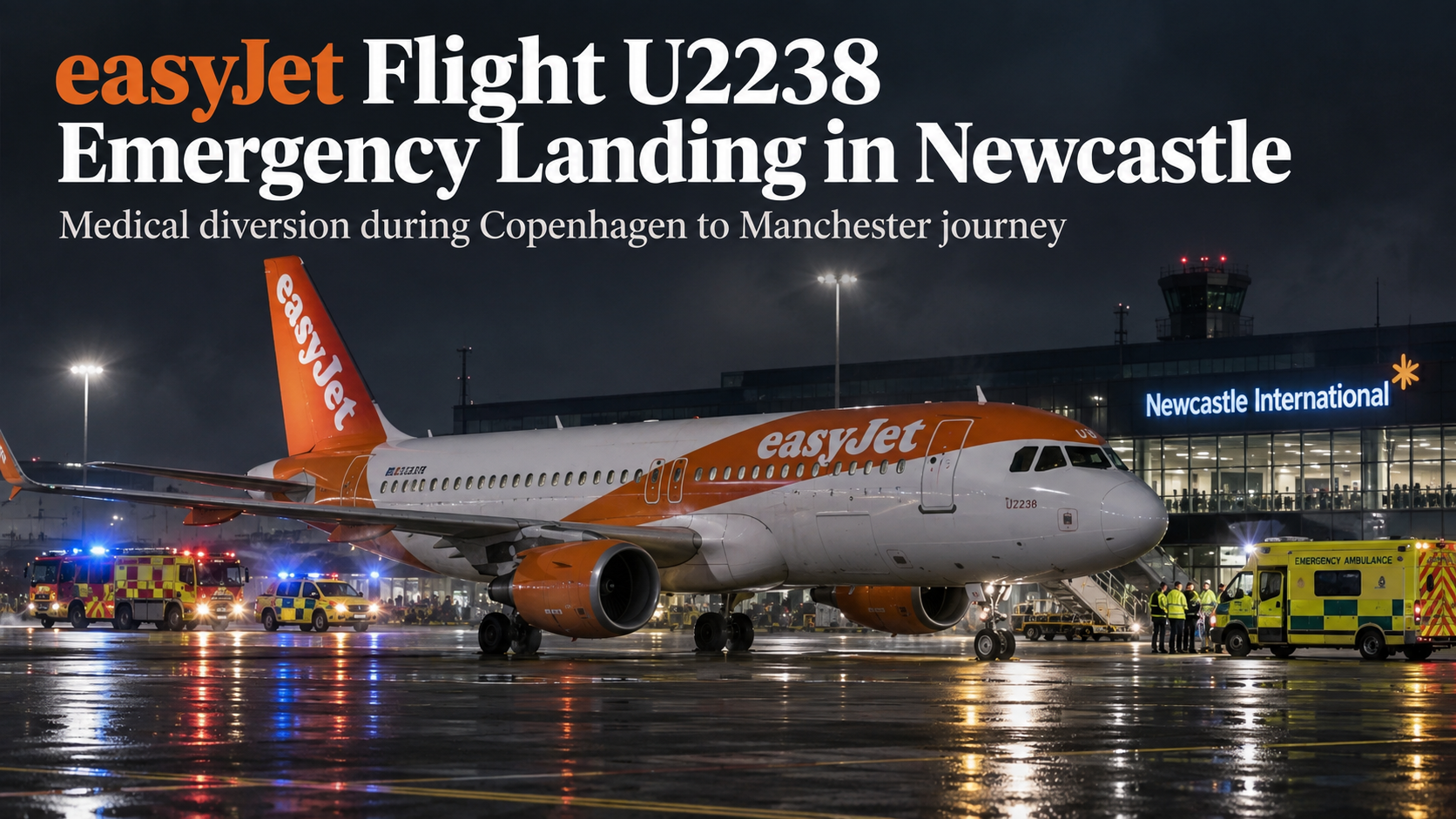
The incident widely searched as easyjet flight u2238 emergency landing newcastle happened on 27 October 2025, when an easyJet flight from Copenhagen to Manchester diverted to Newcastle because a passenger required urgent medical attention. The aircraft landed safely, medical services met the passenger, and the flight later continued to Manchester.
There is one important correction to many versions of the story. The flight involved was U2 2238, commonly displayed as U22238, and identified in contemporary reporting as EZY2238. U2238, properly read as U2 238, is a different easyJet service between Newcastle and Bristol. Current flight records continue to show the two as separate routes.
EasyJet Flight U2238 Emergency Landing Newcastle: Key Facts
| Detail | Verified information |
|---|---|
| Airline | easyJet |
| Date | 27 October 2025 |
| Correct commercial flight | U2 2238 / U22238 |
| Identifier reported by easyJet | EZY2238 |
| Planned route | Copenhagen, Denmark to Manchester, UK |
| Diversion airport | Newcastle International Airport |
| Aircraft | Airbus A320-214 |
| Reported registration | G-EZPB |
| Reason for diversion | Passenger requiring urgent medical attention |
| Emergency transponder code | 7700 |
| Newcastle landing | Approximately 22:52 GMT |
| Final outcome | Safe landing, passenger met by medical services, flight continued to Manchester |
The airline itself confirmed the central facts. In a statement reported by multiple news outlets, easyJet said flight EZY2238 from Copenhagen to Manchester diverted to Newcastle because a customer needed urgent medical attention. The airline said medical personnel met the passenger after arrival and the aircraft then continued to Manchester.
What Happened on the Copenhagen to Manchester Flight?
The flight departed Copenhagen on the evening of Monday, 27 October 2025, for its scheduled journey across the North Sea to Manchester.
Aviation reporting based on flight-tracking information identifies the aircraft as Airbus A320-214 G-EZPB. AIRLIVE reported that it departed Copenhagen at about 22:13 CET, after a scheduled departure of 21:45, and climbed to approximately 38,000 feet.
While the aircraft was over the North Sea, a medical situation involving a passenger became serious enough for the crew to change the flight plan. The aircraft transmitted transponder code 7700 and diverted toward Newcastle rather than continuing directly to Manchester.
According to the same aviation tracking report, G-EZPB landed on Newcastle’s Runway 25 at approximately 22:52 GMT. Medical personnel then took responsibility for the affected passenger.
EasyJet subsequently confirmed that the flight continued to Manchester. Aviation tracking reporting places the final Manchester arrival at approximately 00:28 GMT on 28 October, after the unexpected Newcastle stop.
Why Did the EasyJet Flight Divert to Newcastle?
The publicly confirmed reason was a passenger medical emergency, not a reported aircraft malfunction.
EasyJet said the customer required “urgent medical attention.” Contemporary reporting also stated that medical personnel were ready when the flight reached Newcastle. The airline did not publicly disclose the passenger’s diagnosis or subsequent medical condition.
No reliable contemporary account cited an engine failure, fire, depressurisation or structural problem as the reason for the diversion. Calling the incident an “emergency landing” is therefore technically less informative than describing it as an emergency medical diversion followed by a safe landing.
That distinction matters. Aircraft can receive emergency priority because somebody on board urgently needs medical assistance even when the aircraft itself is operating normally.
What Does Squawk 7700 Mean?
Squawk 7700 means an aircraft is indicating an emergency situation to air traffic services. It does not reveal what type of emergency is occurring.
UK Civil Aviation Authority rules state that a pilot may select transponder code 7700 to indicate a state of emergency. Separate codes exist for radio communication failure and unlawful interference.
This means seeing “7700” on a flight-tracking service does not prove that an engine has failed or that an aircraft is in immediate danger of crashing. The emergency may involve the aircraft, weather, fuel, crew, security or, as in this case, a passenger who needs rapid medical treatment.
For EZY2238, contemporary reporting connected the emergency declaration directly to the passenger welfare situation.
Why Newcastle Instead of Continuing to Manchester?
EasyJet has not published a detailed explanation of why the crew selected Newcastle specifically.
The aircraft was reported to be over the North Sea when the situation developed, making Newcastle a geographically practical airport on England’s northeast side. In a serious medical event, reducing the time before a passenger can reach professional medical care can be more important than reaching the originally booked destination.
The exact choice of diversion airport can depend on aircraft position, airport suitability, runway availability, weather, medical support, air traffic conditions and other operational considerations. It would therefore be speculative to claim that any single factor determined the crew’s decision unless easyJet or the flight crew confirms it.
Was It Really Flight U2238?
This is the most significant factual problem surrounding the story.
The emergency flight was the Copenhagen to Manchester service numbered U2 2238. When the airline’s two-character code and the four-digit flight number are written together, that becomes:
U2 + 2238 = U22238
Flight-tracking databases currently list U22238 as the Copenhagen to Manchester service.
EasyJet’s ICAO designator for its UK operation is EZY, according to the International Civil Aviation Organization. This explains why the flight was identified in easyJet’s statement and media coverage as EZY2238.
By contrast:
U2 + 238 = U2238
Current Flightradar24 records identify U2238 as a Newcastle to Bristol service, not the Copenhagen to Manchester flight involved in the October 2025 medical diversion.
The three identifiers should not be confused
U22238 refers to U2 flight 2238, Copenhagen to Manchester.
EZY2238 is the EZY-format identifier associated with flight 2238 and is the form used by easyJet in its reported statement.
U2238 means U2 flight 238 and refers to a separate flight number.
As of September 2026, current flight records still show U22238 operating on the Copenhagen to Manchester pairing and U2238 on Newcastle to Bristol, reinforcing that these are different services.
What Aircraft Was Involved?
Aviation reporting identified the diverted aircraft as G-EZPB, an Airbus A320-214 operated by easyJet.
Independent aircraft records also identify G-EZPB as an Airbus A320-214 operated by easyJet. Flightradar24’s current aircraft record shows the aircraft continuing to operate easyJet services in September 2026.
That later operational activity should not be interpreted as an official technical investigation finding. It does, however, confirm that G-EZPB remains an active easyJet aircraft rather than an aircraft permanently removed from service following the Newcastle event.
Was the Plane in Danger?
There is no verified evidence that the aircraft itself was suffering a major technical failure.
What can be established is that the crew treated the situation as an emergency, selected the emergency transponder code and diverted so that medical assistance could reach the passenger. The aircraft then landed safely and was able to continue to Manchester.
The use of squawk 7700 understandably attracts attention on public flight trackers, but the UK CAA definition only establishes that the aircraft is indicating an emergency. It does not identify the underlying cause or severity.
There is therefore no factual basis for descriptions claiming that the Airbus was “about to crash,” suffered an engine failure, or experienced another catastrophic aircraft malfunction.
What Happened to the Passenger?
EasyJet confirmed only that a customer required urgent medical attention and was met by medical services after the Newcastle landing.
The airline did not publicly disclose the person’s identity, diagnosis or later condition in the reliable contemporary reports available about the incident. GB News specifically reported that easyJet had not released further details about the passenger’s condition.
Claims on later websites that provide precise hospital treatment details or a specific medical diagnosis should therefore be treated cautiously unless they can be traced to the passenger, emergency services, a hospital or another authoritative source.
Protecting those details is also normal. Airlines generally have little reason to release private medical information about an individual passenger beyond what is necessary to explain a diversion.
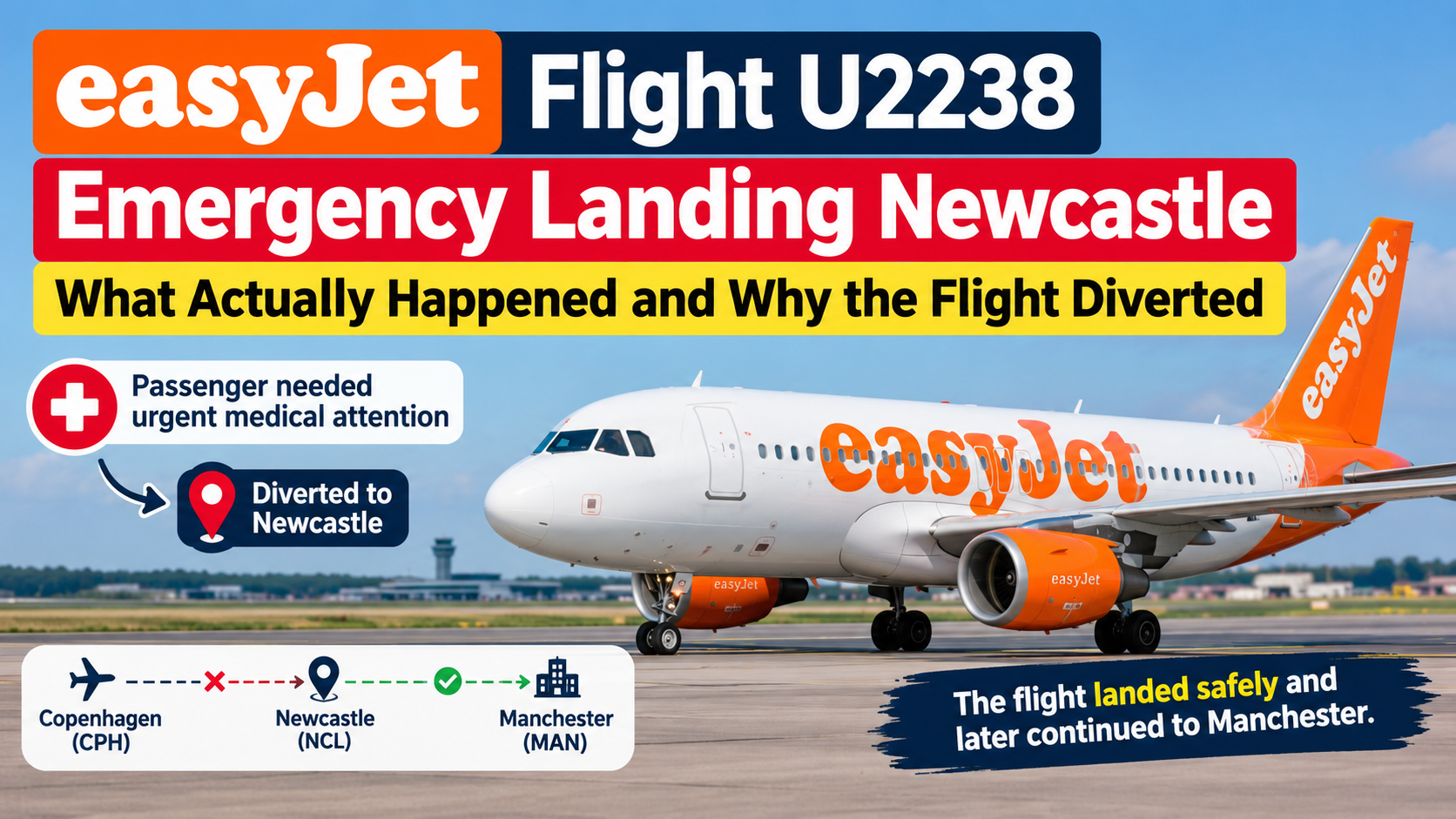
Did the Flight Eventually Reach Manchester?
Yes. The flight did not terminate permanently in Newcastle.
EasyJet confirmed that after the customer was handed to medical services, the aircraft continued its journey to Manchester.
AIRLIVE’s tracking-based account records the aircraft reaching Manchester at approximately 00:28 GMT on 28 October.
This is an important detail because some headlines describing an “emergency landing” can create the impression that the aircraft was disabled or unable to fly afterward. The available evidence shows that this was not the outcome of the incident.
Did the Emergency Cause Problems for Other Flights?
Contemporary reporting indicated that the diversion required Newcastle to accommodate an aircraft receiving emergency priority, but claims about wider airport disruption should be treated separately from the confirmed easyJet statement.
An emergency aircraft can be given priority by air traffic control. That is one of the reasons declaring an emergency and using the appropriate transponder code is important. It allows controllers and airport teams to prepare for the aircraft’s arrival and coordinate the response.
In this case, the key confirmed operational outcome is straightforward: Newcastle accepted the diversion, medical personnel met the passenger, and EZY2238 subsequently departed for Manchester.
Could Passengers Claim Compensation?
A medical diversion does not automatically create a right to fixed cash compensation.
Because the journey departed Copenhagen, European air passenger protection rules are relevant. European Commission guidance on Regulation EC 261/2004 specifically states that removing a passenger from an aircraft because of a medical emergency can qualify as an extraordinary circumstance.
Extraordinary circumstances can exempt an airline from fixed compensation when the disruption was outside its control and the required legal conditions are met. Passenger rights can still depend on the individual booking, length of the delay, assistance provided and applicable law.
Anyone seeking reimbursement or compensation for this particular flight should therefore rely on their booking records and the airline’s formal response rather than assuming that the words “emergency landing” automatically create a compensation entitlement.
Why the U2238 Story Became Confusing Online
The confusion appears to come primarily from the unusually similar flight-number formats.
A reader seeing U22238 can easily interpret it as a string of numbers rather than “U2” followed by “2238.” Removing one of the repeated twos produces U2238, which unfortunately is itself a valid easyJet flight number. Current flight databases demonstrate the distinction clearly.
Another layer of confusion comes from the use of EZY2238 in easyJet’s statement and media coverage. ICAO records confirm EZY as the designator for easyJet UK.
That explains why search results may contain U2238, U22238 and EZY2238 even though only two distinct flight numbers are actually involved.
For identifying the October 2025 event accurately, the safest reference is:
easyJet U2 2238 / U22238, Copenhagen to Manchester, diverted to Newcastle on 27 October 2025.
FAQ
Did EasyJet flight U2238 make an emergency landing in Newcastle?
The widely searched story refers to easyJet U2 2238, written U22238, rather than the separate U2 238 service written U2238. U22238 diverted from its Copenhagen to Manchester route to Newcastle on 27 October 2025 because a passenger required urgent medical attention.
Why did the easyJet flight make an emergency landing?
The confirmed reason was an urgent medical issue involving a passenger. EasyJet said medical services met the customer at Newcastle before the flight continued to Manchester.
Was there an engine failure on easyJet U22238?
No reliable contemporary report identified an engine failure as the cause. The airline explicitly attributed the diversion to a passenger needing urgent medical attention.
What does squawk 7700 mean?
Code 7700 indicates a state of emergency. UK CAA regulations confirm its emergency use, but the code itself does not specify whether the problem is medical, mechanical or related to another type of emergency.
What aircraft operated the flight?
Aviation reporting identifies the aircraft as Airbus A320-214 G-EZPB. Current Flightradar24 information also lists G-EZPB as an easyJet Airbus A320-214 and shows it continuing to operate flights in 2026.
Did the flight continue from Newcastle to Manchester?
Yes. EasyJet confirmed the flight continued after the passenger was met by medical services. Tracking-based reporting places its final Manchester arrival at approximately 00:28 GMT on 28 October 2025.

1 Comment
Pingback: Ohio Champion Trees Delaware County USD Lewis Center