


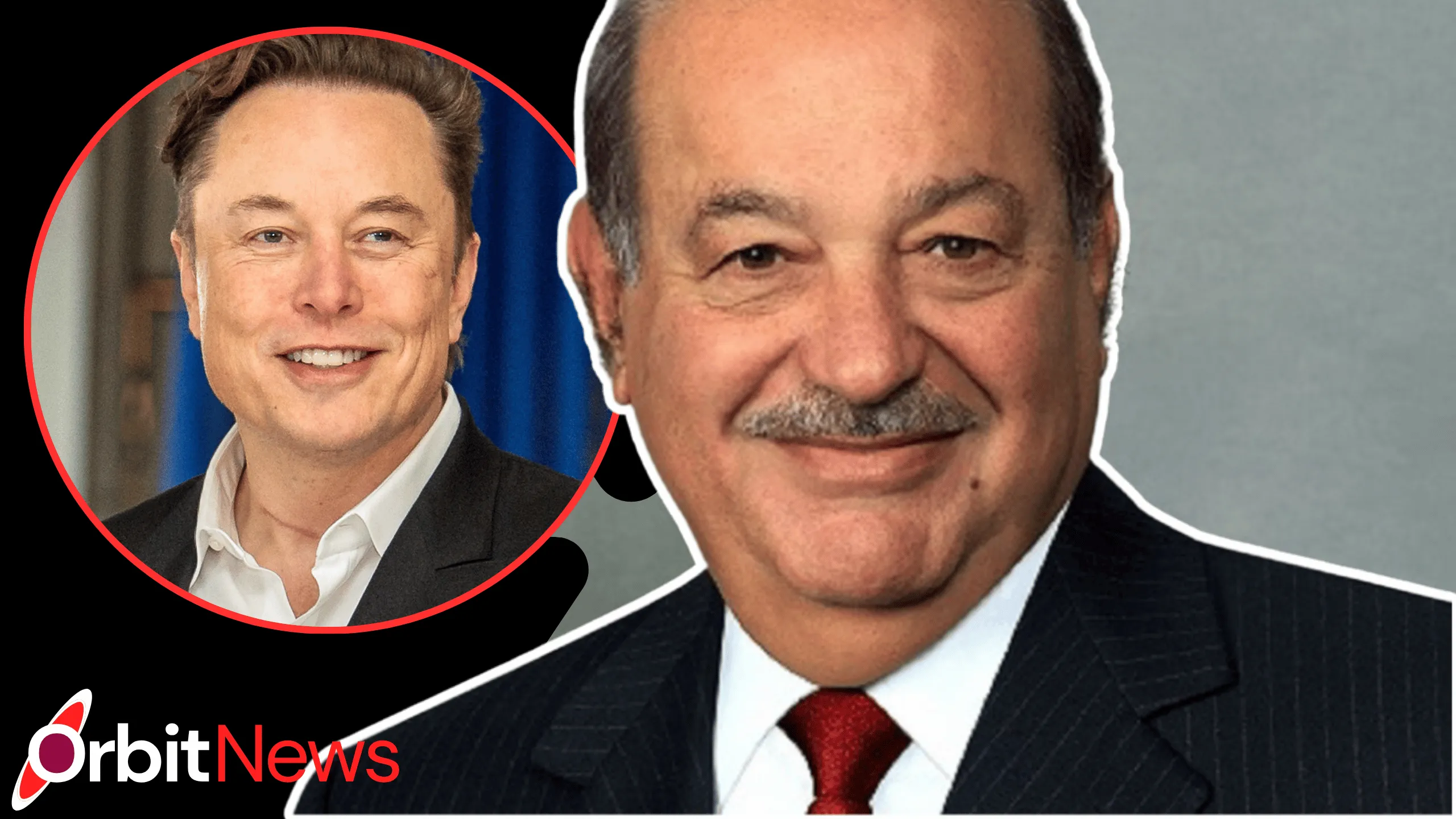
Carlos Slim and Elon Musk are not known to be personal friends or direct business partners. Their documented connection is mainly commercial, through Slim-controlled América Móvil and Musk’s SpaceX and Starlink businesses, where cooperation, competition and negotiations have overlapped since at least 2024. Slim himself said in February 2025 that he did not know Musk personally.
The relationship is more complicated than headlines describing a simple billionaire rivalry. América Móvil has used Starlink-related services, explored deeper cooperation, pulled back from some plans, and then reopened discussions with Starlink in 2026 about satellite-to-phone connectivity. At the same time, Starlink competes with parts of Slim’s telecom empire by offering internet in places traditionally served by terrestrial broadband and mobile networks.
Who Are Carlos Slim and Elon Musk?
Carlos Slim Helú is a Mexican businessman whose fortune is closely associated with telecommunications. His family controls América Móvil, whose major brands include Telcel and Claro, while Telmex is also part of the broader telecom group. Slim has interests in construction, retail, real estate, mining and other businesses through Grupo Carso and related companies. Forbes lists him as honorary chairman of América Móvil.
Elon Musk built his business profile around technology, automobiles, space and artificial intelligence. His major companies include Tesla and SpaceX, whose Starlink division operates a large low-Earth-orbit satellite internet network.
Their overlap therefore comes primarily from telecommunications. Slim has spent decades building terrestrial mobile and fixed-line networks across Latin America, while Musk is trying to extend connectivity through satellites.
What Is the Connection Between Carlos Slim and Elon Musk?
The clearest verified connection between Carlos Slim and Elon Musk is América Móvil’s commercial relationship and negotiations with SpaceX and Starlink.
During América Móvil’s third-quarter 2024 earnings call, company executives confirmed that they already had a Starlink resale agreement. They were also considering a broader arrangement that could use SpaceX technology for mobile backhaul, the infrastructure that connects cell sites to the rest of a telecommunications network. América Móvil said Starlink was already being used for mobile backhaul in Chile.
That is important because it means the relationship was not merely speculative. There was a real corporate arrangement involving companies associated with Slim and Musk, although that should not be confused with a personal partnership between the two men.
The 2024 cooperation
América Móvil executives explained in October 2024 that satellite services could help connect rural cell sites where installing fiber or other terrestrial infrastructure was difficult or expensive.
The company was working with more than one satellite provider rather than becoming dependent on Starlink alone. Executives referred to Starlink, SpaceX and AST-related technology while discussing satellite connectivity options.
This gives the relationship an important distinction. Starlink could be both a supplier to América Móvil and a potential competitor.
Why América Móvil Was Interested in Starlink
Traditional mobile networks depend heavily on towers, fiber, microwave links and other ground infrastructure. Extending those networks into mountains, forests, sparsely populated communities or isolated highways can be costly.
Starlink approaches the problem differently. Its satellites orbit much closer to Earth than traditional geostationary telecommunications satellites. The network can therefore deliver broadband without requiring fiber to reach every individual location.
For América Móvil, satellite technology can potentially fill gaps rather than replace its entire terrestrial network.
This is particularly relevant because of América Móvil’s scale. The company reported 334.3 million wireless subscribers at the end of June 2026, including about 84.5 million in Mexico.
Connecting even a small percentage of customers or cell sites in hard-to-reach areas can therefore represent a substantial technical and commercial opportunity.
Why the Carlos Slim and Elon Musk Relationship Cooled in 2025
By February 2025, Slim was publicly less enthusiastic about expanding the Starlink relationship.
During his February 10 press conference, a journalist specifically asked Slim how contracts involving Elon Musk’s Starlink were progressing. Slim answered that they were going “backwards” and said it made more sense to deploy América Móvil’s own towers, facilities and fiber-optic connections.
That statement is stronger evidence than many subsequent reports describing a dramatic feud because it comes directly from Slim.
Slim was also asked during the same event whether he knew Elon Musk. He answered simply: “I don’t know him.”
The exchange makes clear that their relationship should primarily be understood as one between their companies rather than as a close personal relationship between two billionaires.
Did Musk’s social-media post cause the breakdown?
This part of the story requires caution.
In January 2025, Musk amplified an unsubstantiated social-media allegation concerning Slim and organized crime. The allegation was publicly disputed, and no credible evidence establishing the claim was presented in the material reviewed.
Some later reports connected that episode directly with América Móvil’s decision to reduce its reliance on Starlink. However, Slim’s own February explanation focused on economics and infrastructure. He argued that building the company’s own towers and fiber was preferable.
It is therefore safer to say that the public controversy occurred during the same period that cooperation cooled, rather than presenting Musk’s post as a proven cause of the business decision.
Was There Really a $7 Billion Carlos Slim-Starlink Deal?
Claims about a failed $7 billion or $7.5 billion Starlink deal have circulated widely, but the primary corporate evidence does not support treating that figure as the confirmed value of a contract between América Móvil and Starlink.
América Móvil’s October 2024 earnings discussion described an existing Starlink resale agreement and additional negotiations involving backhaul. During the same period, the company also discussed roughly $7 billion in annual capital expenditure. Reuters separately reported that América Móvil expected approximately $7 billion of capital spending for 2024.
Those are different things.
The publicly disclosed material reviewed does not establish that América Móvil had agreed to pay SpaceX $7 billion for Starlink services. Describing the entire amount as a cancelled Musk-Slim contract therefore goes beyond what the primary company disclosures verify.
Later figures reinforce the distinction. Reuters reported that América Móvil spent about $7.1 billion on capital expenditures in 2024 and planned approximately $6.7 billion for 2025. Those amounts cover its broader telecom network investments rather than a single Starlink contract.
Carlos Slim and Elon Musk Reopened the Door in 2026
The most important recent development is that the commercial relationship did not remain frozen.
In April 2026, América Móvil CEO Daniel Hajj confirmed during the company’s first-quarter earnings call that the company was again talking with Starlink about possible opportunities involving direct-to-cell satellite technology.
Hajj said América Móvil was open to working with Starlink if an arrangement made commercial sense and described satellite connectivity as potentially complementary to the company’s existing mobile services.
This substantially changes the simple “Slim versus Musk” narrative.
The better description as of 2026 is that América Móvil and Starlink are companies whose interests sometimes compete and sometimes align.
Also Read: Alberto Baillères and Elon Musk
What Is Starlink Direct to Cell?
Starlink Direct to Cell is designed to allow ordinary LTE-compatible mobile phones to communicate directly with suitably equipped satellites when terrestrial mobile coverage is unavailable.
Starlink describes its Direct to Cell satellites as effectively carrying a cellular base-station system in orbit. The technology is intended to support services including messaging, data, voice and Internet of Things connectivity as its network develops.
For a company such as América Móvil, the appeal is straightforward. A satellite layer could potentially extend Telcel or Claro connectivity beyond existing towers without requiring terrestrial infrastructure everywhere.
Hajj nevertheless stressed in April 2026 that spectrum and technical arrangements matter. He also distinguished currently available satellite capabilities from the larger next-generation system he expected to become more significant around 2027.
Why this could benefit both companies
Starlink has satellites but does not automatically possess everything required to operate as a conventional mobile network in every country.
América Móvil has millions of mobile subscribers, spectrum holdings, billing relationships, terrestrial infrastructure and established telecom operations throughout Latin America.
A partnership could therefore combine Starlink’s satellite coverage with América Móvil’s mobile network.
That is why the two companies do not fit neatly into the traditional definition of competitors.
Are Starlink and Carlos Slim’s Companies Competitors?
Yes, in some areas. In others, they are complementary.
Starlink’s residential broadband service can compete with fixed broadband offered by companies connected to Slim, particularly in locations where consumers can choose between satellite and terrestrial internet.
Direct-to-cell technology creates another potential area of overlap because it allows satellite networks to provide functions traditionally delivered through mobile towers.
However, Starlink can also strengthen an operator such as América Móvil. The 2024 earnings call showed that América Móvil had already used satellite connections for mobile backhaul in Chile.
The practical relationship therefore looks like this:
| Area | América Móvil | Starlink | Relationship |
|---|---|---|---|
| Urban mobile service | Telcel, Claro and other terrestrial networks | Limited direct overlap | Mostly different infrastructure |
| Rural mobile coverage | Towers and terrestrial backhaul | Satellite-to-phone technology | Potential partnership or competition |
| Fixed broadband | Fiber, cable and fixed telecom networks | Satellite broadband | More directly competitive |
| Mobile backhaul | Fiber, microwave and satellites | Starlink satellite links | Potential supplier relationship |
| Remote connectivity | Expensive terrestrial expansion | Core Starlink use case | Strong overlap and partnership potential |
This mixture explains why cooperation can resume even after periods of public tension.
Slim Later Said He Had No Feud With Musk
Another development complicates the idea that Carlos Slim and Elon Musk are locked in a personal battle.
During a September 2025 appearance on the Cracks Podcast, Slim was asked about his supposed dispute with Musk. Slim said there was no feud and separately indicated interest in making an investment in Tesla.
That did not amount to an announcement that Slim had purchased Tesla shares. It showed interest, not a confirmed transaction.
Combined with the renewed América Móvil-Starlink discussions in 2026, the comments suggest that business considerations remain more important than the personal-rivalry framing sometimes used in headlines.
How Their Business Empires Differ
Carlos Slim’s core strength remains telecommunications and infrastructure. América Móvil operates large cellular and fixed networks, while the broader Slim business portfolio extends into construction, finance, retail, mining and real estate.
Musk’s major businesses are more heavily concentrated in technology, transportation, space and artificial intelligence. SpaceX is particularly relevant to Slim because Starlink is gradually pushing satellite communications deeper into markets historically controlled by terrestrial telecommunications companies.
Their strategies are also fundamentally different.
Slim’s telecom businesses largely own or operate substantial ground infrastructure. Musk’s Starlink model attempts to make space-based infrastructure another major layer of the global telecommunications network.
Neither approach necessarily eliminates the other. Modern communications networks increasingly combine fiber, towers, microwave systems and satellites.
Carlos Slim vs Elon Musk Net Worth
Both men rank among the world’s wealthiest people, but Musk’s estimated fortune has become substantially larger.
Forbes estimated Carlos Slim Helú and his family at approximately $120.8 billion in mid-September 2026, with telecommunications remaining his principal source of wealth.
Forbes estimated Musk at roughly $886 billion on September 15, 2026, although Musk’s figure has been exceptionally volatile because much of his wealth is tied to equity valuations in companies including Tesla and SpaceX.
These numbers are snapshots rather than cash holdings. Billionaire net-worth estimates can move dramatically as publicly traded shares and private-company valuations change.
Where the Relationship Stands Now
As of September 2026, the strongest publicly verified evidence points to an open but unresolved corporate relationship.
América Móvil had previously worked with Starlink, stepped back from expanding the relationship in early 2025, and then confirmed new discussions in April 2026 concerning direct-to-cell technology. No later public disclosure reviewed for this article established that those 2026 talks had resulted in a finalized large-scale Direct to Cell agreement.
At the same time, América Móvil continues investing heavily in its own network. Reuters reported in May 2026 that the company was targeting roughly $7 billion of annual capital expenditure from 2026 through 2028, illustrating that satellite connectivity is being considered as an addition to, rather than a wholesale replacement for, terrestrial infrastructure.
The best-supported picture is therefore neither a close alliance nor an all-out rivalry. Slim’s América Móvil and Musk’s Starlink operate in overlapping markets where cooperation can make economic sense even while their technologies compete for customers.
FAQ
Are Carlos Slim and Elon Musk business partners?
Not personally, based on publicly available evidence. Their companies have had commercial dealings and negotiations, particularly involving América Móvil, SpaceX and Starlink. Slim said in February 2025 that he did not personally know Musk.
Does Carlos Slim use Starlink?
América Móvil executives confirmed in October 2024 that the company had a Starlink resale agreement and was already using Starlink-related satellite connectivity for mobile backhaul in Chile. The relationship later cooled before new discussions emerged in 2026.
Are Carlos Slim and Elon Musk rivals?
Their businesses compete in parts of the telecommunications market, particularly broadband and remote connectivity. However, Starlink can also provide satellite infrastructure that complements América Móvil’s terrestrial network, so describing them only as rivals is misleading.
Did Carlos Slim cancel a $7 billion deal with Elon Musk?
A confirmed $7 billion Starlink contract is not established by the primary corporate disclosures reviewed. América Móvil did discuss roughly $7 billion in annual capital expenditure during the same period, which appears to have contributed to confusion in some secondary reporting.
Could Telcel work with Starlink?
Yes. América Móvil CEO Daniel Hajj confirmed in April 2026 that the company was talking with Starlink and was open to cooperation involving direct-to-cell technology if it made commercial sense.
Has Carlos Slim invested in Tesla?
Slim publicly expressed interest in a Tesla investment during a 2025 podcast interview, but that statement should not be interpreted as confirmation that he subsequently bought Tesla shares.
Also Read: Tom Brady and Elon Musk
