


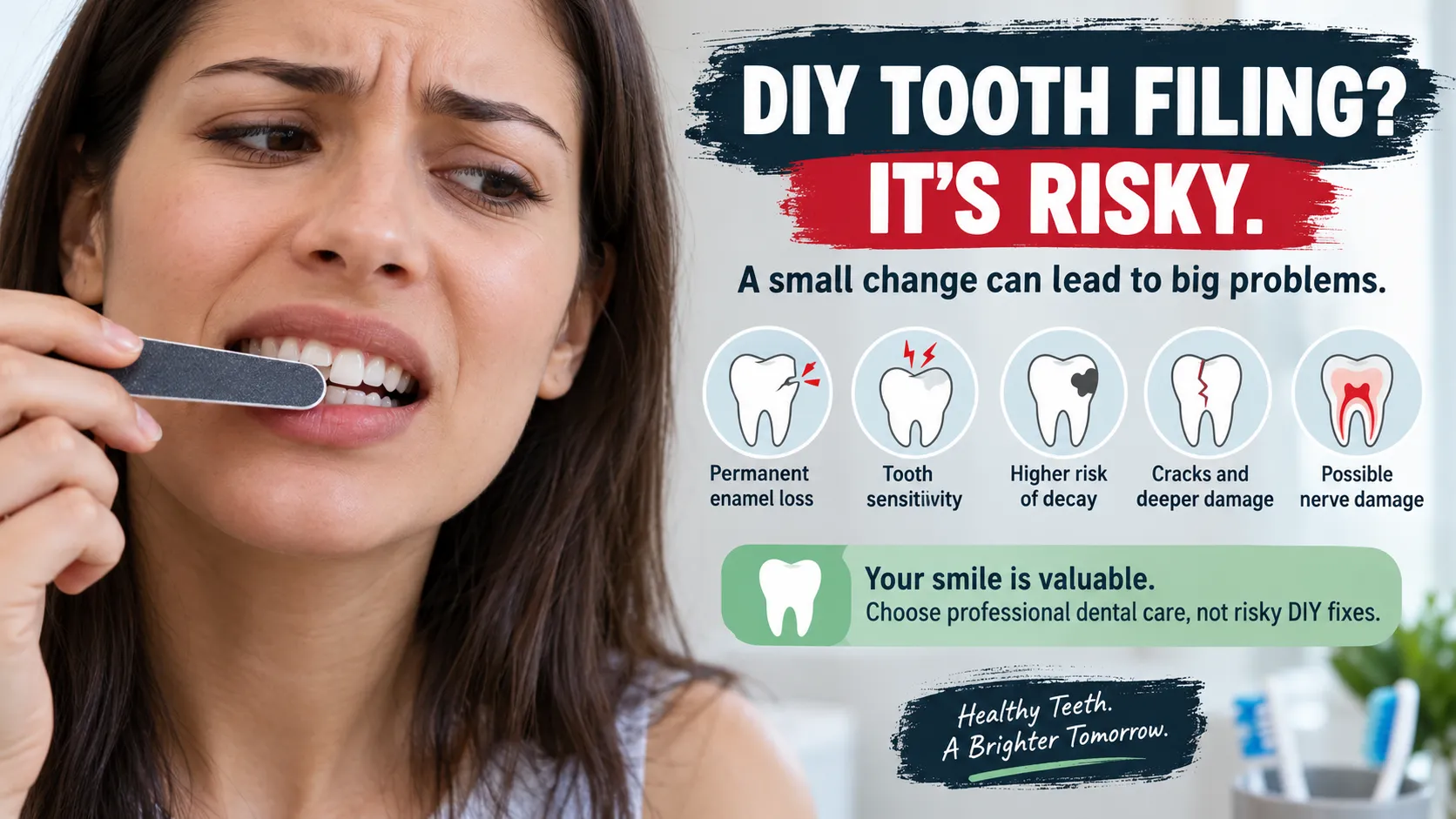
DIY tooth filing is not a safe way to fix uneven, chipped, pointed, or long-looking teeth. Removing enamel without a dental examination can permanently weaken a tooth and may lead to sensitivity, cracks, decay, bite problems, nerve damage, or infection.
If you searched for risks of diy tooth filing contribute to our blog, the most important point is simple: reshaping a natural tooth is an irreversible dental procedure, even when only a small amount appears to be removed. Professional tooth contouring can be appropriate in selected cases, but it requires careful assessment and controlled removal of enamel.
What Is DIY Tooth Filing?
DIY tooth filing means deliberately grinding, sanding, or shaving part of a tooth at home, often to shorten a tooth, smooth a chip, reduce a pointed edge, or make several teeth look more even.
Social media has helped popularize the practice, sometimes using household tools such as nail files. The problem is that the visible white surface of a tooth is not simply material that can be trimmed without consequence.
Professional tooth reshaping is known as enameloplasty, odontoplasty, dental contouring, or teeth reshaping. During professional enameloplasty, a dentist removes only a small amount of enamel after evaluating the health and structure of the tooth. Cleveland Clinic specifically advises against attempting teeth filing yourself because excessive enamel removal can cause irreversible damage.
Risks of DIY Tooth Filing Contribute to Our Blog: The Main Concern
The central risk is loss of healthy tooth structure that your body cannot simply replace.
Enamel is the hard outer covering that protects the more sensitive dentin and pulp inside the tooth. The National Institute of Dental and Craniofacial Research describes enamel as the hardest material in the human body, but notes that once it is physically damaged, it cannot heal itself in the way bone or skin can.
Early mineral loss caused by tooth decay can sometimes be remineralized with saliva and fluoride before a cavity forms. That is very different from mechanically grinding enamel away. Once enamel has actually been filed off, it does not grow back.
1. Permanent Loss of Enamel
The first and most immediate consequence of tooth filing is permanent enamel removal.
A person filing their own tooth has no reliable way to judge enamel thickness or determine how much can safely be removed. Different areas of the same tooth can also have different amounts of enamel.
Professional dentists deliberately take a conservative approach. Before enameloplasty, they may examine the teeth and use dental X-rays to assess the roots, bone, existing restorations, cavities, and general tooth health. Only small amounts of enamel are then removed.
Removing too much enamel can leave a tooth structurally weaker and more vulnerable to future damage.
2. Tooth Sensitivity Can Develop
Underneath the enamel is dentin, which is more closely connected to the tooth’s nerve-containing pulp.
When protective tooth structure becomes thinner or dentin becomes exposed, hot drinks, cold food, sweets, or even cold air may trigger sensitivity. The National Institute of Dental and Craniofacial Research lists worn enamel and exposed inner tooth layers among causes associated with tooth pain and sensitivity.
Sensitivity after improper filing may be temporary in some cases, but persistent or severe sensitivity can indicate deeper damage that needs professional assessment.
Cleveland Clinic lists permanent tooth sensitivity as one potential complication when excessive enamel is removed during tooth contouring.
3. The Tooth May Become More Vulnerable to Cracks
A tooth is designed to withstand considerable biting pressure, but its structure matters.
Removing too much enamel can weaken that structure. Cleveland Clinic identifies cracked teeth as one of the possible complications of excessive enamel removal.
Cracks are particularly important because they do not heal like broken bones. According to the American Association of Endodontists, cracked teeth may produce pain while chewing or sensitivity to hot and cold temperatures. Cracks can also spread deeper toward the pulp and, in severe cases, extend far enough that the tooth cannot be saved.
A tiny cosmetic change is therefore not necessarily a minor biological change.
4. Filing Can Increase the Risk of Decay and Infection
Enamel forms an important protective barrier around the tooth.
If excessive filing compromises that protection, the tooth may become more susceptible to damage and decay. Cleveland Clinic lists cavities and infection among possible complications when too much enamel is removed.
Decay becomes increasingly serious as it progresses inward. NIDCR explains that untreated tooth decay can eventually produce pain, infection, and even tooth loss.
The American Dental Association has also warned about unsupervised procedures that physically alter teeth. In its guidance concerning unlicensed veneer services, the ADA specifically identifies improperly trimming or filing teeth as a potential cause of nerve damage and warns that unsupervised alteration of tooth structure may cause irreversible harm.
5. DIY Filing Can Damage the Dental Pulp
The pulp is the soft tissue in the center of a tooth containing nerves and blood vessels.
Enamel itself does not contain nerves, which is one reason professionally controlled enameloplasty can often be performed without anesthesia. But deeper removal changes the situation. Beneath the enamel is dentin, followed by the pulp chamber.
If damage extends sufficiently deep, the pulp may become irritated or injured. Symptoms can include prolonged temperature sensitivity, spontaneous pain, pain while biting, or worsening toothache.
The American Association of Endodontists notes that cracks and other damage reaching the pulp can eventually require root canal treatment.
6. Your Bite Can Be Changed
Teeth are not isolated cosmetic objects. Upper and lower teeth are designed to meet in particular patterns when you bite and chew.
The ADA defines occlusal adjustment as reshaping the biting surfaces of teeth to create appropriate contact between the upper and lower teeth. That definition shows why removing tooth structure from a biting surface is more complicated than simply making a tooth look shorter.
During professional enameloplasty, the dentist checks the patient’s bite after reshaping the tooth.
At home, it is easy to remove more material from one side than another or change a contact point without realizing it. A tooth may then feel different when the mouth closes or when chewing.
If your bite feels unusual after filing a tooth, a dentist should assess it rather than attempting further adjustments yourself.
7. A Small Chip May Be Made Worse
One common reason people consider filing a tooth is a small chip or rough edge.
Sometimes a dentist really can smooth a very minor chip. The ADA’s MouthHealthy resource notes that small chips may be suitable for professional smoothing, while larger defects may need bonding, a veneer, or a crown.
The important difference is diagnosis.
What looks like a harmless rough edge could be associated with a deeper fracture, weakened filling, decay, tooth grinding, or another dental problem. Continuing to grind the area before determining why it chipped can remove healthy material while leaving the underlying problem untreated.
The NHS advises people with chipped, broken, or cracked teeth to see a dentist. Depending on the damage, treatment may include bonding the broken fragment, a filling, a crown, or root canal treatment.
8. DIY Filing Can Hide the Real Cause of Uneven Teeth
An uneven tooth is not always simply a cosmetic problem.
Differences in tooth length or shape can result from:
- A previous chip or dental injury
- Teeth grinding or clenching
- Natural tooth anatomy
- Dental erosion
- An abnormal bite
- Existing restorations
- Developmental enamel problems
For example, NIDCR lists flattened, chipped, cracked, or loose teeth and worn enamel among possible signs of bruxism, which is persistent grinding or clenching.
Filing the visible difference may therefore change the appearance while doing nothing to address what caused the tooth to wear or break.
Why Professional Tooth Contouring Is Different
Professional enameloplasty is not simply a dentist using a more sophisticated file.
A dentist first decides whether removing enamel is appropriate at all. Cavities, gum disease, weak enamel, significant fractures, thin enamel, or other dental conditions may make contouring unsuitable.
When enameloplasty is appropriate, Cleveland Clinic describes a controlled process in which the dentist removes tiny amounts of enamel with specialized instruments, smooths the area, checks the bite, and polishes the tooth.
The goal is to preserve as much healthy tooth structure as possible.
| DIY Tooth Filing | Professional Enameloplasty |
|---|---|
| No clinical examination | Tooth health is assessed first |
| No reliable measurement of enamel thickness | Removal is deliberately conservative |
| Household or non-dental tools may be used | Specialized dental instruments are used |
| Bite may not be evaluated | Bite is checked after reshaping |
| Underlying cracks or decay may be missed | Existing dental problems can be identified |
| Damage may be irreversible | Treatment is planned to minimize structural risk |
Is It Safe to File Just a Tiny Amount?
There is no universal amount of enamel that is safe for a person to remove at home.
Enamel thickness, tooth shape, existing wear, dental restorations, previous injuries, and bite relationships vary from one person to another. This is why even professional enameloplasty begins with an evaluation rather than a standard amount being removed from every patient.
The safest approach is therefore not to test how little you can file. It is to have the tooth assessed first.
What Should You Do If You Already Filed Your Teeth?
Stop filing the tooth, even if the result looks uneven. Trying to correct one side by removing more enamel can compound the damage.
Arrange a dental examination, particularly if the tooth has become sensitive, painful, rough, cracked, discolored, or uncomfortable when biting. A dentist can determine whether only enamel was affected or whether the tooth needs bonding or another form of protection.
While waiting for an appointment, continue normal gentle oral hygiene with a soft-bristled toothbrush and fluoride toothpaste. Avoid deliberately testing the tooth with very hot, very cold, or hard foods if they trigger pain.
Do not attempt to seal, grind, drill, or reshape the tooth further yourself.
When Does a Filed or Damaged Tooth Need Urgent Care?
Persistent pain, significant swelling, or signs of infection deserve prompt dental assessment.
The American Association of Endodontists advises professional evaluation for ongoing tooth pain and symptoms associated with cracked teeth.
Seek urgent dental care if you develop severe or worsening pain, facial or jaw swelling, fever, or other symptoms suggesting infection. A dental abscess needs professional treatment and does not resolve by itself.
Severe swelling accompanied by difficulty breathing, speaking, or swallowing requires emergency medical attention.
Safer Ways to Fix Uneven or Chipped Teeth
The best treatment depends on why the tooth looks uneven.
A dentist may recommend simple professional contouring when only a very small adjustment is needed. For a chipped or misshapen tooth, dental bonding can sometimes add tooth-colored composite instead of removing additional natural enamel.
Larger defects may require a veneer, filling, or crown. A cracked tooth may need a different treatment entirely, particularly if the crack reaches deeper structures.
This distinction matters because sometimes the safest cosmetic treatment is to add material rather than grind healthy tooth structure away.
Frequently Asked Questions
Can I file my own teeth with a nail file?
No. Dental authorities and medical experts advise against DIY tooth filing. A nail file cannot tell you how thick the enamel is or whether the tooth has an underlying crack, cavity, or structural weakness, and enamel that is mechanically removed does not grow back.
Does tooth enamel grow back after filing?
No. Mechanically removed enamel does not regenerate. Early mineral loss from the decay process can sometimes be remineralized before the enamel structure breaks down, but that should not be confused with regrowing enamel that has been physically filed away.
Can a dentist safely file an uneven tooth?
Sometimes. Professional enameloplasty can correct minor irregularities, small chips, rough edges, or slightly uneven tooth shapes when the tooth is healthy and enough enamel is present. A dentist must first determine whether contouring is appropriate.
What happens if I file too much enamel off?
Excessive enamel removal can weaken the tooth and increase the risk of sensitivity, cracks, cavities, infection, and permanent structural damage. Depending on the amount lost, treatment could involve bonding or another dental restoration.
Should I see a dentist after filing my tooth if it does not hurt?
A dental check is still sensible because enamel loss and small structural changes may not cause immediate pain. An examination can determine whether the tooth remains adequately protected and whether its bite or surface needs professional correction.
What if I only want to smooth a sharp chipped edge?
A small chip may sometimes be professionally smoothed, but a dentist should first confirm that the damage is superficial. Larger chips or cracks may need bonding, a filling, a crown, or other treatment instead of additional tooth removal.
