


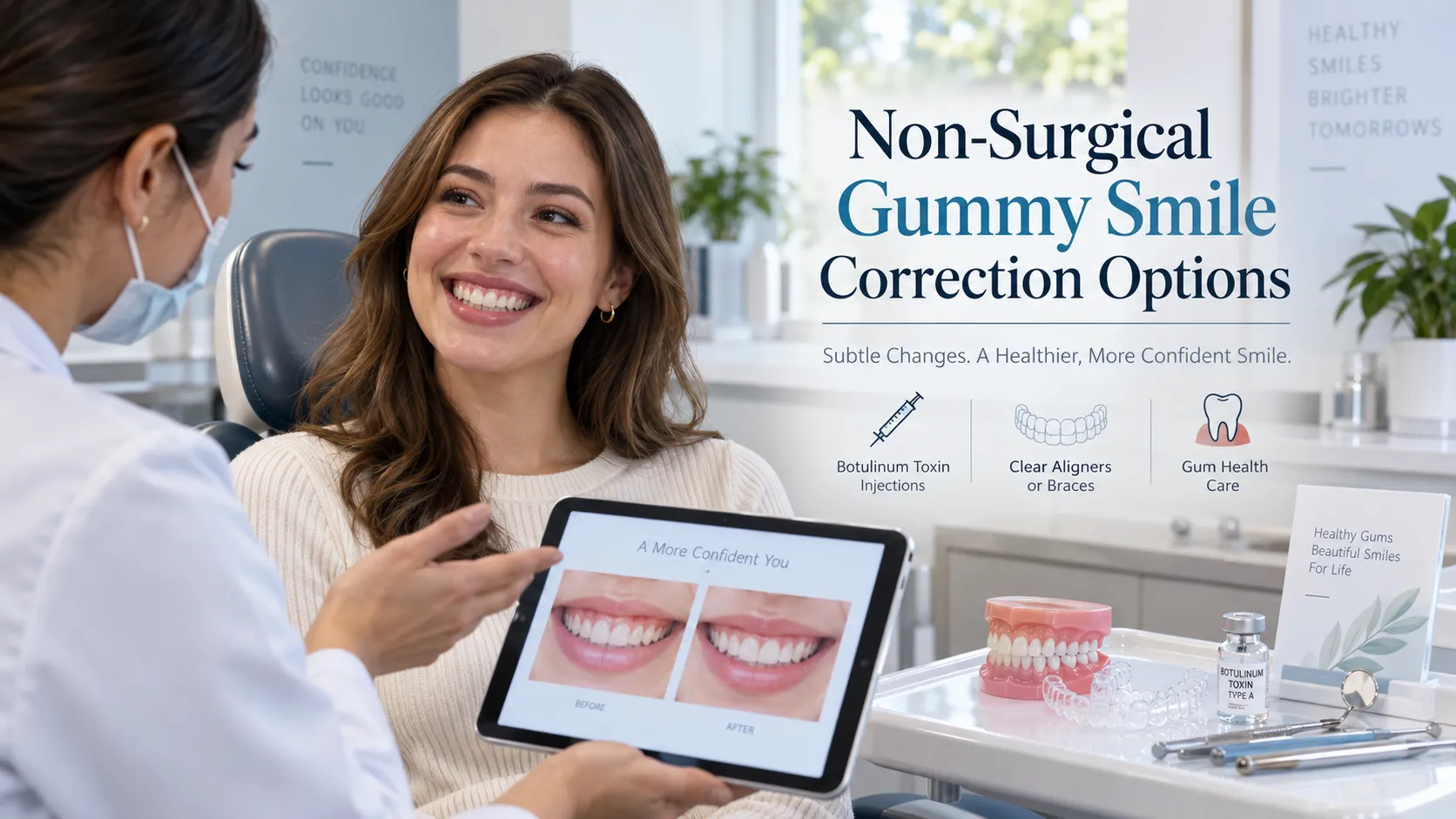
Non-surgical gummy smile correction can include botulinum toxin injections, orthodontic tooth movement, treatment of reversible gum enlargement, and in selected cases hyaluronic acid filler. The right option depends on why too much gum shows when a person smiles, because a hypermobile lip, tooth position, gum anatomy, and jaw proportions require very different treatment.
A “gummy smile,” clinically called excessive gingival display, simply means that more upper gum tissue is visible during a full smile than a person would like. There is no universally accepted cut-off. Dental literature commonly uses thresholds between about 2 and 4 mm, but the amount considered attractive varies between individuals and populations. Excessive gingival display is primarily an aesthetic description and does not automatically mean something is wrong with the teeth or gums.
For people searching non-surgical gummy smile correction options contribute to our blog, the most important point is that treatment should begin with diagnosis, not with choosing Botox, filler, braces, or another procedure from a social-media example.
Why the Cause of a Gummy Smile Matters
A gummy smile can result from one factor or several acting together. Recognized causes include a hypermobile upper lip, a naturally short upper lip, altered passive eruption of the teeth, overeruption of the upper incisors, excessive vertical growth of the upper jaw, gingival enlargement, and dentoalveolar positioning problems.
This distinction changes the treatment completely. Botulinum toxin may reduce gum display when excessive lip elevation is an important cause, but it cannot remove excess gum tissue covering a tooth or physically shorten an excessively long upper jaw. Likewise, orthodontics can reposition teeth but cannot directly correct every problem involving the lip or gingival anatomy.
The issue can also be multifactorial. A 2026 clinical study of 160 Egyptian women with excessive gingival display found that both single and combined causes occurred, reinforcing why a one-treatment-fits-all approach is unreliable. The population was specific, however, so its percentages should not be assumed to represent everyone with a gummy smile.
How a Gummy Smile Is Properly Assessed
A useful evaluation looks at the smile as a relationship between the teeth, gingiva, upper lip, facial proportions, and upper jaw.
A dentist or specialist may examine how much of the upper incisors shows when the lips are relaxed and during a full smile, how far the upper lip moves, whether the teeth appear unusually short, the position of the gingival margins, bite relationships, and whether gum swelling or enlargement is present. In selected cases, periodontal measurements, dental radiographs, photographs, or cephalometric analysis may be required.
This diagnostic step helps distinguish a genuinely lip-related gummy smile from one caused mainly by altered tooth eruption or skeletal anatomy.
Non-Surgical Gummy Smile Correction Options Contribute to Our Blog Readers Should Know
The main non-surgical approaches do not all provide the same degree or duration of correction. Some temporarily change muscle activity, while others physically reposition teeth over several months.
| Option | Most relevant when | Typical commitment or duration | Main limitation |
|---|---|---|---|
| Botulinum toxin type A | Upper lip elevates excessively during smiling | Maximum effect often develops within weeks; commonly fades over several months | Temporary and off-label for gummy-smile correction in the U.S. |
| Orthodontic intrusion | Upper teeth or dentoalveolar position contributes to gum display | Usually months of orthodontic treatment | Not suitable for every skeletal or periodontal cause |
| Gum-disease or enlargement management | Inflammation or reversible enlargement makes gums appear fuller | Depends on underlying cause | Does not correct a hypermobile lip or jaw proportions |
| Hyaluronic acid filler | Selected soft-tissue or lip-dynamic cases | Temporary | Evidence is limited and gummy-smile correction is not an FDA-approved filler indication |
Botulinum Toxin for a Hypermobile Upper Lip
Botulinum toxin type A is currently one of the most studied minimally invasive treatments for a gummy smile caused largely by overactivity of the muscles that lift the upper lip.
The toxin temporarily reduces muscular contraction. When carefully placed in selected upper-lip elevator muscles, the lip does not rise as far during a full smile, which can expose less gingiva.
A 2024 systematic review included 13 prospective controlled clinical trials. Maximum improvement was generally seen about two to four weeks after injection, with reported effects lasting approximately 12 to 24 weeks.
Another meta-analysis involving 17 studies calculated an average reduction in gingival exposure of about 3.42 mm two weeks after treatment. The effect progressively declined and approached baseline by around 24 weeks.
That makes botulinum toxin better understood as a temporary modification of lip movement, not a permanent correction of the underlying anatomy.
Who May Benefit Most From Botulinum Toxin?
It is most logically suited to patients whose examination shows that excessive upward movement of the upper lip is an important contributor to the gummy smile. It may also be considered when someone wants a temporary option before deciding whether to pursue a more permanent procedure.
Results are less predictable when the primary problem is altered passive eruption, major vertical maxillary excess, or another structural condition that muscle relaxation does not correct.
Botox for a Gummy Smile Is an Off-Label Use in the United States
This point is often missed in cosmetic marketing.
The current U.S. prescribing information for BOTOX Cosmetic (onabotulinumtoxinA) lists glabellar lines, lateral canthal lines, forehead lines, and platysma bands among its cosmetic indications. Gummy-smile correction is not a listed indication, so using it for this purpose is considered off-label in the United States.
Off-label does not automatically mean inappropriate. The FDA explains that licensed clinicians can use approved drugs for unapproved indications when they judge that use medically appropriate. It does mean, however, that the FDA has not specifically approved the product as safe and effective for gummy-smile correction.
There is also no single universal gummy-smile injection protocol. Systematic reviews have found variation in injection points, dose, toxin preparation, and patient selection. Botulinum toxin units from different products should not simply be treated as interchangeable.
Possible Risks of Botulinum Toxin
Most adverse effects reported specifically in gummy-smile studies have been mild and temporary, but incorrect placement can potentially create an uneven smile, excessive weakening of the lip, or unwanted changes in facial expression.
Botulinum toxin products also carry more serious general warnings. The FDA prescribing information warns that toxin effects can, rarely, spread beyond the injection site and cause symptoms including generalized weakness and difficulty swallowing or breathing.
For that reason, gummy-smile injections should be treated as a medical procedure performed by an appropriately qualified professional who understands perioral anatomy.
Orthodontic Correction Without Jaw Surgery
Some gummy smiles originate partly from overerupted upper incisors, a deep bite, dentoalveolar extrusion, or the vertical position of the upper teeth. In these situations, orthodontics may address the cause instead of simply hiding the gum display.
Treatment can involve fixed braces or other orthodontic appliances. In selected patients, temporary anchorage devices, commonly called TADs or orthodontic mini-screws, provide a stable anchor that allows the orthodontist to move selected teeth upward, a movement known as intrusion.
A 2024 randomized clinical trial involving 43 adults with gummy smiles and deep bites demonstrated measurable maxillary-incisor intrusion using anterior orthodontic mini-screws. The amount of intrusion differed according to the anchorage configuration, and root resorption was among the factors evaluated during treatment.
A systematic review specifically examining gummy-smile correction with temporary skeletal anchorage concluded that TADs can facilitate reduction of excessive gingival display. However, only four qualifying prospective studies were identified and all were considered at high risk of bias, so stronger long-term evidence remains necessary.
Are TADs Really Non-Surgical?
Orthodontic literature often describes TAD-assisted correction as a non-surgical alternative because it can sometimes avoid orthognathic jaw surgery. That description requires context.
A TAD is still a small device placed through the gum and anchored in bone. It is therefore more invasive than ordinary braces or clear aligners even though it is very different from major jaw surgery.
Patients considering this approach should discuss expected tooth movement, root and bone health, treatment duration, retention, and the risks associated with mini-screw placement with an orthodontist.
Can Clear Aligners Correct a Gummy Smile?
Clear aligners can participate in orthodontic treatment when tooth position contributes to excessive gingival display, but the phrase “aligners fix gummy smiles” is too broad.
The treatment has to produce the specific tooth movements needed for that patient. Significant intrusion can be biomechanically difficult, and some cases require attachments, elastics, TADs, or other anchorage rather than aligners alone.
A 2026 systematic review of TADs used with clear-aligner therapy found the combination technically feasible for several orthodontic movements but judged the overall certainty of evidence to remain low.
A proper orthodontic diagnosis is therefore more important than the choice between clear trays and visible braces.
Treating Gingival Inflammation or Enlargement
Sometimes gum tissue looks more prominent because it is swollen or enlarged, rather than because the person has a purely anatomical gummy smile.
Plaque-related gingivitis can cause swollen and bleeding gum tissue. The American Dental Association notes that plaque and tartar accumulation can contribute to gingivitis and that cleaning between the teeth forms an important part of plaque control. Hardened tartar requires professional removal.
When inflammation contributes to the appearance, improving periodontal health may reduce swelling. The purpose in that situation is primarily to treat the gum disease, not to perform a cosmetic gummy-smile procedure.
If excessive gingival display remains once the gums are healthy, an anatomical cause should be investigated.
Hyaluronic Acid Filler Is an Emerging Option, but Evidence Is Limited
Hyaluronic acid filler has also been investigated as a way of reducing gingival display. It should currently be viewed as an emerging and less established approach, rather than an equivalent alternative to botulinum toxin or well-planned orthodontic treatment.
A cohort study involving 50 patients reported an average 2.5 mm reduction in gingival exposure following a specific hyaluronic acid injection technique. The effect gradually diminished, with complete recovery toward the original gingival display reported at 12 months. Because the study lacked the strength of multiple large randomized controlled trials, these findings need further confirmation.
In the United States, the FDA lists specific approved filler uses such as treatment of certain facial wrinkles and folds and augmentation of areas including the lips, cheeks, and chin. Gummy-smile correction is not among the listed FDA-approved indications.
Filler injections also have important risks. The FDA warns that accidental injection into a blood vessel can cause tissue necrosis and, although uncommon, severe complications including vision loss or stroke.
This is another reason not to regard filler as a simple beauty treatment or a DIY procedure.
Procedures Commonly Mistaken for Non-Surgical Treatment
Several effective gummy-smile treatments are sometimes advertised as “non-surgical” because they are relatively quick or performed with a laser. Clinically, that wording can be misleading.
Gingivectomy and aesthetic crown lengthening remove or reshape gingival tissue. Lip repositioning alters the tissues controlling the position of the upper lip. Orthognathic surgery changes the position of the jaw. These are procedures rather than genuinely non-surgical corrections.
Laser gum contouring still involves deliberate removal or reshaping of tissue. Using a laser instead of a scalpel does not turn tissue surgery into a non-surgical treatment.
This distinction is particularly important in altered passive eruption, where excess gum coverage makes the clinical crowns of the teeth look short. A contemporary review identifies aesthetic crown lengthening as the established surgical treatment for appropriate altered-passive-eruption cases.
When Non-Surgical Treatment May Not Be Enough
The greatest limitation of conservative gummy-smile treatments is that they cannot change anatomy they were never designed to change.
Significant vertical maxillary excess, for example, originates from skeletal proportions. Orthodontic intrusion can provide useful camouflage in carefully selected patients, but it cannot be assumed to produce the same correction as repositioning the maxilla.
Similarly, botulinum toxin can temporarily decrease lip elevation but does not uncover a tooth hidden beneath excessive gingival tissue. Filler does not correct tooth eruption, and orthodontics does not remove excess periodontal tissue.
This is why impressive before-and-after photographs do not establish which treatment will work for another person.
How to Choose Between the Options
The most useful first question is not “Should I get Botox?” but “What is causing my gingival display?”
If the main finding is excessive lip elevation, a clinician may discuss botulinum toxin and its temporary nature. If tooth position or a deep bite is responsible, an orthodontic assessment becomes more relevant. Short-looking teeth and abnormal gum-to-tooth relationships may point toward altered passive eruption, while major facial vertical proportions can raise concern for a skeletal component.
Combination treatment is sometimes appropriate because more than one cause can exist at the same time.
A treatment plan should also account for oral health, previous dental work, bite stability, facial anatomy, medications and medical conditions, expectations, and how temporary or permanent the patient wants the result to be.
Frequently Asked Questions
Can a gummy smile be corrected without surgery?
Yes, in selected cases. Botulinum toxin can temporarily reduce excessive upper-lip elevation, while orthodontics can correct certain tooth-position and dentoalveolar causes. The ability to avoid surgery depends on the underlying anatomy.
How long does Botox for a gummy smile last?
Clinical studies generally show the strongest effect within the first few weeks, followed by gradual weakening. Reviews report meaningful effects for roughly 12 to 24 weeks, with results often approaching baseline by around six months.
Is gummy-smile Botox permanent?
No. Botulinum toxin temporarily weakens selected lip-elevator muscles. Repeat treatment is usually required if someone wants to maintain the effect.
Can braces permanently fix a gummy smile?
Orthodontics can provide a longer-lasting structural improvement when excessive gingival display is caused partly by tooth position or dentoalveolar extrusion. Results still depend on the diagnosis, the movement achieved, periodontal health, retention, and long-term stability.
Is laser gum contouring a non-surgical gummy-smile treatment?
Not in the strict clinical sense. Laser contouring removes or reshapes gingival tissue, so it remains a procedural form of gum surgery even though it may be less invasive than some conventional techniques.
What is the safest way to start gummy-smile treatment?
Begin with a dental examination that identifies whether the main cause is periodontal, dental, muscular, skeletal, or a combination. Injectable treatments should be performed only by appropriately licensed and trained clinicians familiar with facial anatomy and the management of complications.
