


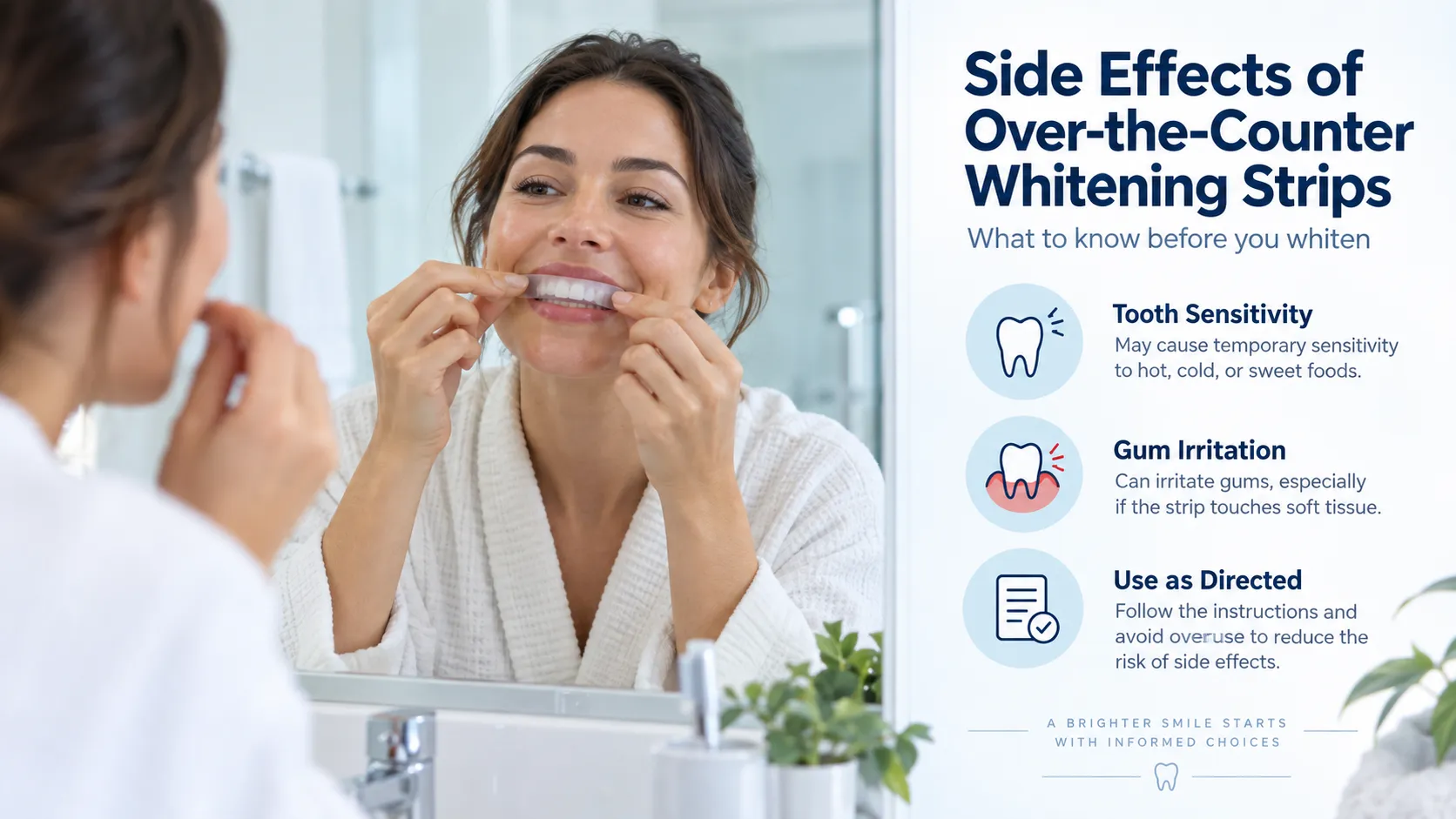
The most common side effects of over-the-counter whitening strips are temporary tooth sensitivity and gum irritation. When peroxide-based strips are used exactly as directed, these effects are usually mild and short-lived, but excessive use, prolonged contact with the gums, or whitening unhealthy teeth can increase the risk of problems.
If you searched for side effects of over-the-counter whitening strips contribute to our blog, the key point is that whitening strips are not automatically harmful. Their safety depends heavily on the peroxide concentration, length and frequency of exposure, the condition of the teeth and gums, and whether the manufacturer’s instructions are followed.
Whitening strips are among the better-studied over-the-counter whitening products. A 2024 scoping review covering 88 studies found that clinical research generally supports their ability to improve tooth color, while tooth sensitivity and gingival, or gum, irritation were the main adverse effects reported with OTC bleaching products.
How Over-the-Counter Whitening Strips Work
Most whitening strips contain a peroxide-based bleaching agent, commonly hydrogen peroxide. The flexible strip keeps the bleaching material in contact with the front surfaces of the teeth for a specified period.
Peroxide does more than polish away surface stains. It penetrates dental hard tissues and reacts with colored compounds within the tooth, helping make them appear lighter. The American Dental Association notes that hydrogen peroxide and carbamide peroxide are the two principal bleaching agents used in tooth-whitening treatments.
That penetration is also why whitening can sometimes cause sensitivity. Peroxide can travel through enamel into dentin, the layer beneath enamel, where it can temporarily irritate tissues associated with the tooth’s nerve.
The Most Common Side Effects of Over-the-Counter Whitening Strips
1. Tooth Sensitivity
Tooth sensitivity is the best-established side effect of peroxide whitening.
A person may notice a short, sharp sensation when drinking cold water, breathing cold air, eating sweet foods, or consuming something hot. Some people describe the teeth as feeling generally tender or unusually reactive rather than experiencing a single sharp pain.
According to the ADA, mild to moderate sensitivity may occur early during bleaching treatment. With strip or tray-based whitening, it can begin after the first few days and usually resolves after treatment is stopped or completed.
Sensitivity occurs because peroxide can pass through enamel and dentin and temporarily affect the pulp, the living tissue in the center of the tooth. It does not necessarily mean the enamel has been permanently damaged.
The likelihood and severity of sensitivity can be affected by factors such as:
- the concentration of peroxide
- how long the product remains on the teeth
- how frequently whitening is performed
- existing tooth sensitivity
- exposed dentin or tooth roots
- cavities, cracks or worn restorations
- the overall condition of the teeth and gums
A recent systematic review of OTC bleaching protocols found relatively limited effects on dentin hypersensitivity overall, although the authors emphasized that the certainty of the available evidence was low.
2. Gum Irritation
Gum irritation is another common problem, particularly when the whitening gel extends beyond the teeth and repeatedly contacts the gingiva.
Symptoms can include tenderness, redness, soreness or a temporary burning sensation. In some cases, peroxide exposure can produce temporary pale or white areas on the gum tissue.
The ADA identifies gingival irritation as one of the principal adverse effects of tooth bleaching and notes that direct contact between peroxide-based gel and soft tissue can cause irritation.
This is one reason whitening strips should be positioned according to their instructions rather than deliberately pushed high onto the gums.
If gum irritation repeatedly appears whenever strips are used, continuing the same whitening routine is unlikely to be a good strategy. Allowing the tissue to recover and discussing the reaction with a dentist is safer than simply tolerating worsening irritation.
3. Temporary Changes in Tooth Sensation
Not every whitening-related sensation fits the traditional description of cold sensitivity.
Some users experience intermittent “zingers,” which are sudden brief shooting sensations in one or more teeth. Others notice a dull sensitivity for several hours after removing the strips.
These sensations are generally associated with the same temporary pulpal response responsible for conventional whitening sensitivity. Mild symptoms usually improve after whitening exposure ends.
Persistent pain, particularly if it is concentrated in a single tooth, should not automatically be blamed on whitening. Tooth decay, cracks, failing fillings, gum disease and exposed roots are also established causes of sensitive teeth.
Can Whitening Strips Damage Enamel?
The answer is more nuanced than claims that whitening strips either “destroy enamel” or are completely incapable of affecting it.
Laboratory studies have found changes in enamel properties after exposure to bleaching agents, particularly under certain concentrations and exposure conditions. However, laboratory changes do not necessarily translate into clinically significant permanent damage in a person’s mouth.
A 2026 systematic review and meta-analysis examining peroxide bleaching and enamel microhardness found a statistically detectable but relatively small decrease in enamel hardness. The researchers concluded that the available evidence did not show clear clinically meaningful enamel harm when peroxide bleaching was used according to recommended protocols. They also noted substantial variability between studies.
This distinction matters. Correctly using a tested whitening strip for the recommended treatment course is not the same as repeatedly bleaching teeth for excessive periods.
The ADA’s consumer guidance warns that overusing whitening products can damage enamel or gums and advises following product directions carefully.
So the practical concern is not simply whether peroxide touches enamel. Exposure time, frequency, concentration and misuse all matter.
Does Whitening Permanently Weaken Teeth?
Current evidence does not support the claim that normal, properly directed peroxide whitening inevitably causes permanent weakening of healthy teeth.
The newer enamel evidence suggests that peroxide bleaching can produce measurable microscopic changes under experimental conditions, but these changes have generally not been shown to translate into major clinically meaningful enamel damage when established protocols are followed.
That does not make unlimited whitening safe.
Repeated bleaching beyond product directions increases total chemical exposure. The ADA advises consumers not to overuse whitening products because excessive whitening can affect the enamel and gums.
Why Some People Have Worse Side Effects Than Others
Two people can use the same whitening strip and have very different experiences.
A major reason is that their teeth may not be starting from the same condition. Someone with healthy enamel and gums may tolerate whitening comfortably, while another person with exposed dentin, gum recession or untreated decay may experience considerable pain.
ADA guidance notes that people with cavities, active oral infections or areas of gum recession may experience greater irritation and sensitivity during whitening. A dental examination can identify these problems before bleaching begins.
Pre-existing sensitivity is particularly important. Sensitive teeth may already have exposed dentin because of enamel wear, gum recession, fractured teeth, decay or other dental conditions.
Applying peroxide does not correct these underlying problems and may make the symptoms more noticeable.
Side Effects of Over-the-Counter Whitening Strips Contribute to Our Blog: What Increases the Risk?
Most whitening-strip complications relate to either excessive chemical exposure or whitening teeth that already have an untreated dental problem.
Leaving the Strips on Longer Than Directed
More exposure does not necessarily mean proportionally whiter teeth.
A whitening product is developed around a particular concentration and exposure period. Keeping strips on longer than instructed increases peroxide contact with the teeth and soft tissues, potentially increasing sensitivity and irritation without guaranteeing a meaningful cosmetic benefit.
Using Whitening Strips Too Frequently
Repeating whitening courses more frequently than the manufacturer recommends increases cumulative exposure.
The ADA specifically warns against overuse of whiteners because excessive use may harm enamel or gums.
Whitening Teeth With Cavities or Cracks
Pain during whitening can sometimes reveal an existing dental problem rather than a direct injury caused by the strip itself.
Cavities, fractured teeth, worn fillings, gum disease, enamel wear and exposed tooth roots can all cause sensitivity.
A dentist can determine whether sensitivity is simply a temporary response to peroxide or a symptom of something requiring treatment.
Allowing Gel to Sit on the Gums
Whitening gel is meant primarily for the teeth. Frequent peroxide contact with soft tissue increases the chance of gum irritation.
Proper placement matters, particularly for users whose strips extend beyond the tooth surfaces.
Combining Several Whitening Methods
Using strips while simultaneously adding other bleaching products can increase total peroxide exposure.
Consumers should follow each product’s directions rather than assuming that combining whitening systems will safely speed up the process. Anyone considering an unusually intensive whitening routine should discuss it with a dentist first.
Whitening Strips and Dental Restorations
Whitening strips work on natural tooth structure, but they do not whiten crowns, veneers, implants or tooth-colored fillings in the same way.
The ADA explains that bleaching affects natural teeth while tooth-colored restorations generally retain their existing shade.
This can create an uneven appearance after whitening. For example, natural front teeth may become lighter while an existing composite filling or crown remains unchanged.
This is not technically a harmful side effect, but it is an important cosmetic limitation that should be considered before whitening.
What to Do if Whitening Strips Make Your Teeth Sensitive
Mild whitening sensitivity often settles after exposure stops.
The ADA advises that people experiencing sensitivity can delay treatment before trying again. Products designed for sensitive teeth may also help some users, although persistent symptoms deserve professional evaluation.
Practical steps include stopping the whitening course temporarily, avoiding additional bleaching products and following the product instructions rather than increasing the treatment frequency.
A dentist should evaluate sensitivity that is severe, continues after whitening has stopped, repeatedly affects the same tooth, or occurs alongside other dental symptoms.
What to Do About Irritated Gums
Stop exposing irritated gum tissue to the whitening agent and allow it to recover.
Short-lived irritation usually improves after peroxide contact ends. The NHS similarly lists temporary gum and throat soreness and white patches on the gums among possible effects of tooth whitening and advises seeking dental advice if side effects are troublesome.
Persistent sores, significant swelling, bleeding or worsening pain warrant professional assessment rather than another whitening application.
Who Should Talk to a Dentist Before Using Whitening Strips?
Professional advice is particularly useful for people who already have sensitive teeth, gum recession, cavities, cracked teeth, dental restorations or ongoing gum problems.
A dentist can also determine why the teeth are discolored. Not every type of discoloration responds equally well to peroxide bleaching.
The ADA recommends a dental examination before bleaching when appropriate because discoloration can have different causes, and existing restorations or oral-health problems can affect both safety and the cosmetic result.
Age and pregnancy also deserve consideration. Guidance varies by jurisdiction and product. For example, current NHS guidance states that tooth whitening is not performed for people aged 17 or younger and is not recommended during pregnancy or breastfeeding.
Consumers should follow local professional guidance and the age restrictions printed on the specific whitening product they plan to use.
How to Reduce the Risk of Whitening-Strip Side Effects
Whitening strips are safest when treated as a chemical dental product rather than something that can be used indefinitely until the desired shade appears.
A sensible approach is to:
- follow the exact application time and treatment schedule on the package
- avoid extending the treatment simply to obtain faster results
- stop temporarily if significant sensitivity develops
- prevent unnecessary gel contact with the gums
- avoid whitening over untreated cavities or active gum problems
- ask a dentist about persistent sensitivity
- choose products from reputable manufacturers
- consider products carrying the ADA Seal of Acceptance where available
The ADA Seal is voluntary. A whitening product carrying it has submitted evidence demonstrating that it meets ADA requirements for safety and effectiveness for its intended whitening claim. The absence of a Seal does not automatically prove that another product is unsafe, since participation in the program is voluntary.
Are Over-the-Counter Whitening Strips Safe Overall?
For adults with healthy teeth and gums, reputable peroxide whitening strips are generally considered a reasonable at-home whitening option when used as directed.
Research does not show that every user will develop sensitivity or irritation. A 2024 systematic review and network meta-analysis involving 37 studies and 1,932 participants found satisfactory short-term whitening effects from OTC products and generally limited effects on dentin hypersensitivity and gum irritation, although the researchers rated the overall certainty of evidence as low.
A separate 2024 review of 88 studies similarly identified tooth sensitivity and gingival irritation as the main adverse effects of OTC bleaching products.
The evidence therefore supports a balanced interpretation. Whitening strips can work, and most reported side effects are temporary, but “over the counter” does not mean there are no precautions.
When to Stop Whitening and See a Dentist
Whitening should not simply be continued through significant pain.
Dental evaluation is appropriate when sensitivity becomes intense, does not improve after stopping the product, repeatedly occurs in only one tooth, or is accompanied by signs of another dental problem.
Persistent gum irritation also deserves assessment. Existing decay, cracked teeth, exposed roots and gum disease can produce symptoms that might otherwise be mistaken for an ordinary whitening reaction.
A dentist can determine whether it is reasonable to resume bleaching, use a different method or address another oral-health problem first.
Frequently Asked Questions
Do whitening strips permanently damage enamel?
Properly used peroxide whitening strips have not been shown to routinely cause clinically meaningful permanent enamel damage. A 2026 systematic review found small laboratory changes in enamel microhardness but concluded that clinically meaningful harm was unlikely when bleaching was used according to recommended protocols.
Overuse remains a concern, so application time and frequency should not exceed the product instructions.
Why do my teeth hurt after whitening strips?
Peroxide can move through enamel into dentin and temporarily irritate tissues associated with the tooth nerve. This can make teeth unusually sensitive to cold, heat or sweet foods.
If the pain is severe, persistent or isolated to one tooth, a dentist should rule out decay, a crack or another dental condition.
Can whitening strips burn your gums?
Peroxide can irritate gum tissue if the whitening material remains in direct contact with it. The irritation is usually temporary, but repeated exposure can worsen the problem.
Stop using the product if significant gum soreness develops and seek dental advice if the tissue does not recover.
How long does whitening-strip sensitivity last?
Whitening-related sensitivity is usually temporary. ADA guidance notes that with strip or tray treatments it may appear within the first few days and generally resolves after bleaching exposure ends.
Persistent symptoms should be assessed instead of repeatedly treated as a normal side effect.
Are whitening strips safe for people with fillings or crowns?
The strips may bleach the surrounding natural teeth, but crowns, implants, veneers and tooth-colored restorations generally do not change shade. This can leave visible color differences.
A dentist can help determine whether whitening is likely to produce an even cosmetic result.
Should you use whitening strips if you already have sensitive teeth?
People with existing sensitivity should be more cautious because whitening may temporarily intensify the problem. ADA guidance recommends discussing whitening with a dentist when sensitivity or underlying dental problems are already present.
Also Read: Internal Bleaching Procedure Explained Contribute to Our Blog
