


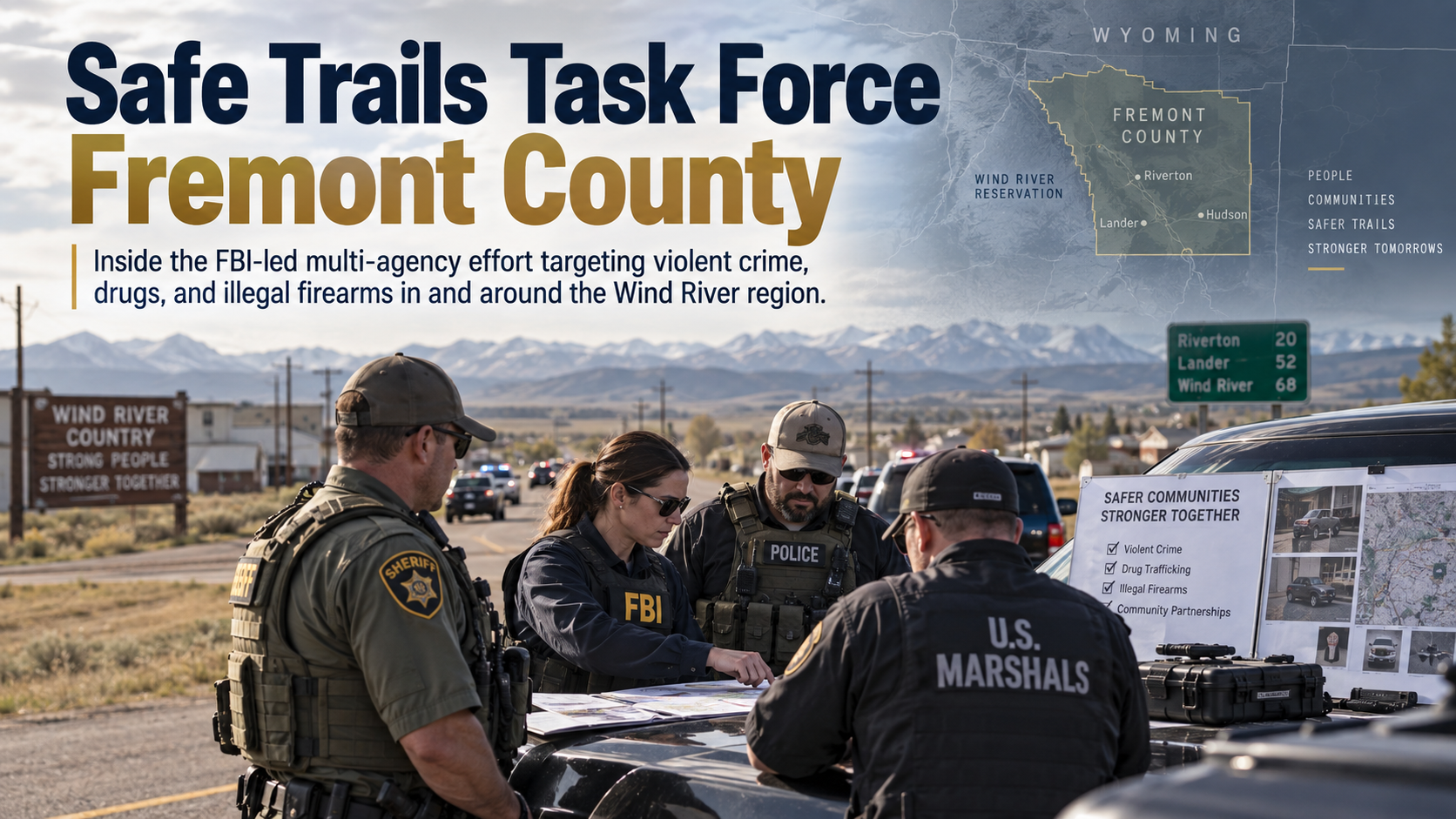
The safe trails task force fremont county search refers to the FBI-led Rocky Mountain Safe Trails Task Force operating in and around the Wind River Indian Reservation and Fremont County, Wyoming. It is a law-enforcement partnership focused mainly on violent crime, drug trafficking, illegal firearms, and related criminal activity, not an organization responsible for hiking trails or outdoor recreation safety.
That distinction matters because several unofficial articles online have interpreted the words “Safe Trails” literally and described a Fremont County group concerned with trail maintenance, hiking accidents, signage, or public-land recreation. Official FBI, Department of Justice, Bureau of Indian Affairs, and City of Riverton records tell a very different story.
What Is the Safe Trails Task Force Fremont County?
There does not appear to be a federal organization formally titled “Safe Trails Task Force Fremont County.” The official name used repeatedly in federal records is the Rocky Mountain Safe Trails Task Force, sometimes shortened simply to Safe Trails Task Force or STTF.
In Wyoming, the task force brings the FBI together with state, local, federal, and Tribal law-enforcement partners to investigate serious criminal activity connected with the Wind River Indian Reservation and surrounding communities. The U.S. Attorney’s Office has specifically described its work as targeting violent crime and drug trafficking affecting the Northern Arapaho and Eastern Shoshone communities.
Fremont County is central to that work because much of the Wind River Indian Reservation lies within the county. The Bureau of Indian Affairs says the reservation covers more than one-third of Fremont County and extends into neighboring Hot Springs County. It is shared by the Eastern Shoshone and Northern Arapaho tribes.
So when people search for the “Safe Trails Task Force Fremont County,” they are generally looking for information about this regional FBI-led law-enforcement partnership.
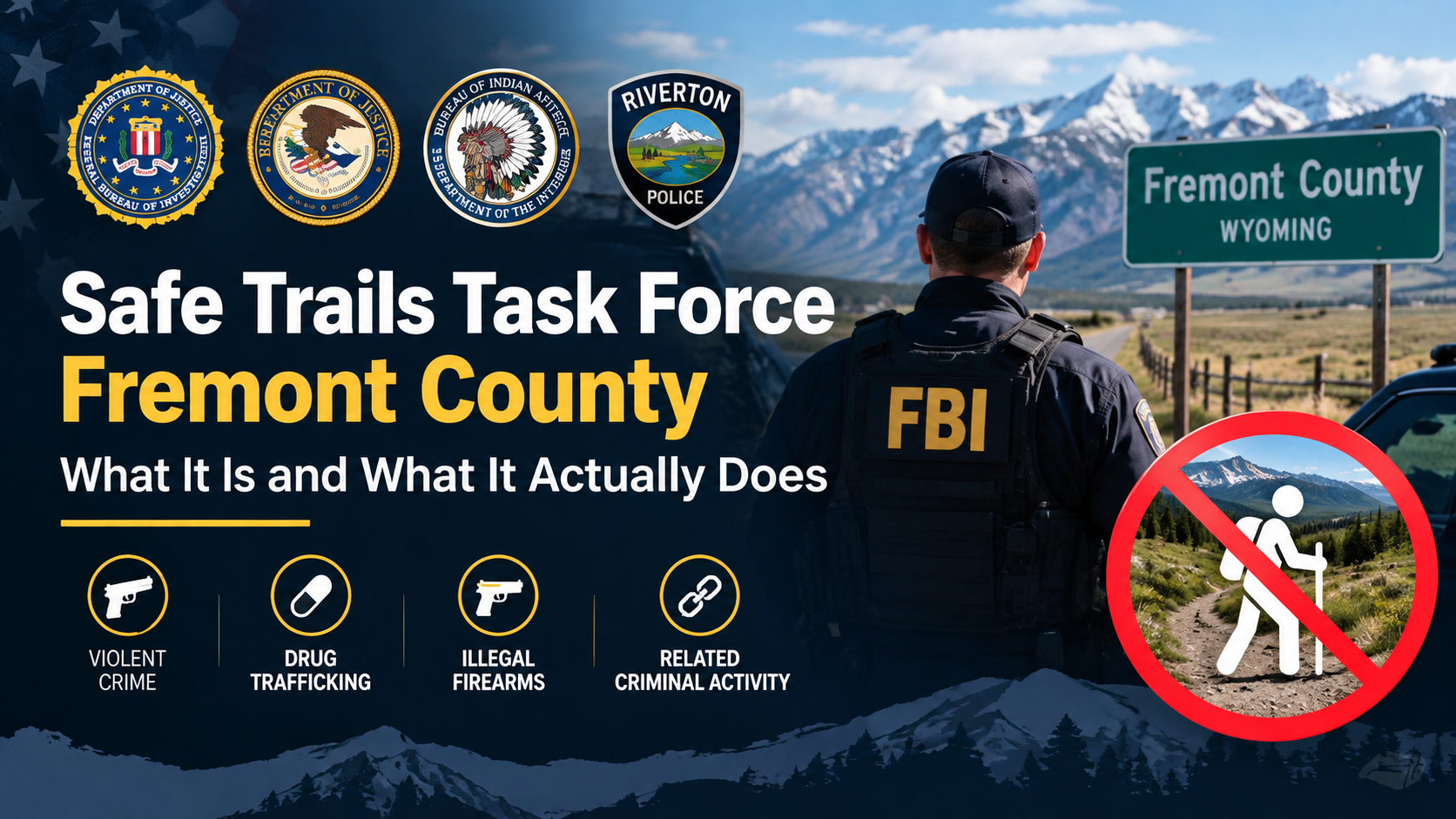
It Is Not a Hiking Trail Safety Organization
The word “Trails” in the program’s name can easily cause confusion. Safe Trails Task Forces are part of an FBI Indian Country crime-fighting program, not a system for maintaining recreational trails.
The FBI says Safe Trails Task Forces evolved from Operation Safe Trails, launched in 1994 through a partnership with the Navajo Department of Law Enforcement in Flagstaff, Arizona. The program now includes 30 Safe Trails Task Forces using federal, Tribal, state, and local partnerships to reduce violent crime and drug trafficking in Indian Country.
This means claims that the Fremont County Safe Trails effort was primarily established to deal with hiking accidents, damaged trails, wayfinding signs, environmental stewardship, or outdoor recreation are not supported by the authoritative records reviewed for this article.
In Fremont County, official documentation connects Safe Trails to matters such as:
- methamphetamine and fentanyl distribution
- illegal firearms
- violent crime
- drug trafficking networks
- investigations crossing reservation and non-reservation jurisdictions
- certain serious cases involving Indigenous victims
The task force should also not be confused with Fremont County Search and Rescue, parks departments, land-management agencies, or organizations responsible for recreational trail conditions.
Why Fremont County Is Important to the Task Force
The Wind River Indian Reservation occupies a geographically significant part of central-western Wyoming. According to the Bureau of Indian Affairs, the reservation covers roughly 3,500 square miles and includes land in both Fremont and Hot Springs counties.
Communities associated with the reservation include Fort Washakie, Ethete, St. Stephens and other areas close to Riverton and Lander. The size of the reservation and the overlap between Tribal lands, municipalities, county jurisdiction, state agencies and federal jurisdiction make interagency cooperation particularly important.
Federal Indian Country criminal jurisdiction can also be more complicated than ordinary city or county policing. The FBI explains that its authority on Tribal lands comes principally from federal statutes including the General Crimes Act and Major Crimes Act. Depending on the crime, its location, and the Tribal status of the people involved, responsibility can involve federal investigators, Tribal law enforcement, the Bureau of Indian Affairs, local police, county deputies, or state investigators.
A task-force structure allows those agencies to combine personnel, intelligence and investigative authorities rather than treating every case as an isolated jurisdictional problem.
Which Agencies Participate?
The exact participating agencies can vary by period and investigation.
A May 2024 Department of Justice description identified the FBI as the lead agency and listed the following partners:
| Agency | Role or level |
|---|---|
| Federal Bureau of Investigation | Federal lead |
| Drug Enforcement Administration | Federal drug enforcement |
| Wyoming Division of Criminal Investigation | State investigations |
| Wyoming Highway Patrol | State law enforcement |
| Fremont County Sheriff’s Office | County law enforcement |
| Riverton Police Department | Local law enforcement |
| Lander Police Department | Local law enforcement |
Later federal descriptions have included an even broader group. During an August 2025 operation, the U.S. Attorney’s Office referred to participation or cooperation involving the FBI, Bureau of Indian Affairs, Wyoming DCI, Wyoming Highway Patrol, Fremont County Sheriff’s Department and Riverton Police Department. It also described the wider Safe Trails partnership as involving Tribal police, the DEA, Homeland Security Investigations and Immigration and Customs Enforcement.
A City of Riverton budget document from 2022 also described a local Safe Trails partnership involving Riverton Police, DCI, the FBI, U.S. Marshals Service and BIA.
These differences should not be read as contradictions. Multi-agency task forces commonly use different combinations of participating agencies depending on the investigation, staffing agreements and operational needs.
How the Wyoming Safe Trails Partnership Developed
The national Safe Trails program dates to 1994, but the Wyoming partnership has its own more recent development history.
Federal records show the Rocky Mountain Safe Trails Task Force was active in Wyoming by at least 2020. An October 2020 U.S. Attorney’s Office release credited the task force with helping an investigation involving oxycodone, cocaine and methamphetamine distribution affecting Fremont County and the Wind River Indian Reservation.
The Wyoming Division of Criminal Investigation later stated that it became a member of the Safe Trails Task Force in 2020 and began working alongside the FBI on narcotics investigations with a connection to the Wind River Indian Reservation.
Riverton Police records provide another piece of the timeline. In its fiscal year 2022-2023 budget material, the department said it had experienced an increase in serious violence involving shootings and stabbings and had worked with DCI to establish Safe Trails cooperation involving several federal agencies.
That 2022 document should not be interpreted as the creation date of the entire Rocky Mountain Safe Trails Task Force. Federal records prove the task force was operating earlier. It is better understood as evidence of growing local participation and coordination in the Fremont County area.
What Crimes Does the Task Force Investigate?
Fentanyl and methamphetamine trafficking
Drug trafficking has become one of the most visible parts of the task force’s Wyoming workload.
The Justice Department stated in 2024 that the FBI-led Safe Trails Task Force investigates trafficking on the Wind River Indian Reservation and in surrounding communities, with particular attention to fentanyl. Methamphetamine also appears repeatedly in federal prosecutions connected with the task force.
These investigations can involve confidential information, controlled drug purchases, surveillance, traffic stops, search warrants and cooperation between several law-enforcement agencies.
Illegal firearms
Firearms frequently appear alongside drug investigations.
Federal cases linked to the task force have involved prohibited persons possessing guns and firearms allegedly connected with drug trafficking. In August 2025, federal officials specifically described a major Safe Trails operation as an effort to reduce both drug trafficking and illegal guns on the Wind River Indian Reservation.
Violent crime
The Safe Trails program has a broader national mission than drug enforcement alone. The FBI identifies violent crime and drug trafficking as core purposes of its Safe Trails Task Forces.
The Wyoming U.S. Attorney’s Office similarly describes the Rocky Mountain task force as focused on violent crime and trafficking, particularly where Native American communities are affected.
Major Cases Show How the Task Force Operates
Public court and Justice Department records provide a clearer picture of the task force than general descriptions alone.
Statewide methamphetamine conspiracy
A federal investigation beginning in 2020 examined a trafficking operation involving Cheyenne, Casper, Riverton, the Wind River Reservation and Green River.
The FBI and Wyoming DCI worked through the Safe Trails Task Force on the case. Four defendants were eventually sentenced in connection with the methamphetamine conspiracy. DCI said at the time that its Safe Trails membership allowed it to work closely with the FBI on cases having a nexus to the Wind River Reservation.
Beatrice Willis methamphetamine case
In another investigation, the task force received information in October 2023 that Beatrice Irene Willis of Ethete was distributing controlled substances.
Federal authorities conducted a controlled purchase of two ounces of methamphetamine in January 2024. Willis later pleaded guilty and was sentenced in December 2024 to 65 months in prison followed by three years of supervised release.
The case illustrates how information supplied to investigators can develop into controlled purchases, federal prosecution and eventual sentencing.
Jason Trimmer drug and firearm investigation
The task force also investigated Jason Trimmer of Lander.
Federal authorities said investigators executing a search warrant recovered more than 500 grams of methamphetamine, more than 32 grams of fentanyl and multiple firearms. Trimmer was subsequently sentenced in 2025 to a total of 180 months in federal prison for drug trafficking and firearm offenses.
Tristan Larsen fentanyl and carfentanil case
A particularly significant 2024 investigation involved Tristan Brynn Larsen of Hudson.
According to the U.S. Attorney’s Office, the Rocky Mountain Safe Trails Task Force identified Larsen as a local source of drugs during an investigation into distribution affecting the Wind River Indian Reservation. Authorities purchased fentanyl during the investigation, and firearms were later found in Larsen’s vehicle.
Federal records say Larsen admitted purchasing substantial quantities of fentanyl tablets and powder in Denver and redistributing them in Fremont County. Larsen received a 120-month federal prison sentence in June 2025 for offenses involving fentanyl, the fentanyl analogue carfentanil and firearms.
This case is also important because the Justice Department explicitly described the Rocky Mountain Safe Trails Task Force as a joint undertaking involving the FBI, Wyoming DCI and local law enforcement, tasked with disrupting controlled-substance distribution around the Wind River Reservation.
The August 2025 Wind River Operation
One of the most visible Safe Trails operations occurred on August 29, 2025.
The U.S. Attorney’s Office for the District of Wyoming and the FBI announced that nearly 100 FBI personnel had converged on the Wind River Indian Reservation in connection with arrest warrants targeting suspected drug traffickers and people accused of illegal firearm possession.
Federal officials presented the operation as part of a continuing effort against drugs and firearms affecting the Eastern Shoshone and Northern Arapaho communities.
The operation is significant for another reason. It demonstrates that the Fremont County Safe Trails activity is not simply a small local police program. It can draw federal personnel and resources into coordinated operations alongside Tribal, state, county and municipal agencies.
Evidence the Task Force Remained Active in 2026
Public federal records continue to reference the Rocky Mountain Safe Trails Task Force in 2026.
In February 2026, the U.S. Attorney’s Office credited Wyoming DCI and the FBI Rocky Mountain Safe Trails Task Force with investigations leading to federal firearm and drug-related sentences. One case involved approximately 57 firearms seized during a March 2025 search in Pavillion. Another involved firearms, methamphetamine and cash recovered during an investigation connected with drug trafficking on the Wind River Reservation.
A March 12, 2026 Justice Department release also credited DCI and the FBI Rocky Mountain Safe Trails Task Force with investigating Cathy Lynn Mink of Lander. Federal records state that investigators conducted a controlled purchase of 150 fentanyl tablets in April 2025 and that more than 180 additional tablets were later found when Mink was booked into the Wind River Detention Center. She received a 32-month federal prison sentence in February 2026.
Those records provide documented evidence that Safe Trails investigations continued to produce federal prosecutions and sentences into 2026.
Public releases, however, represent only cases authorities choose or are able to disclose. They should not be treated as a complete measurement of the task force’s arrests, active investigations, staffing or overall performance.
Why a Multi-Agency Task Force Is Useful in the Wind River Region
A case may begin in Riverton, involve a suspect living elsewhere in Fremont County, involve alleged drug distribution on reservation land and connect to a supplier in another Wyoming city or another state.
No single local agency necessarily has the personnel, geographic coverage or jurisdiction best suited to every stage of such an investigation.
Safe Trails allows agencies to combine different strengths. Local police have detailed community knowledge. County and state investigators can follow activity beyond municipal boundaries. Tribal and BIA officers understand reservation communities and Tribal jurisdiction. Federal agencies can provide federal investigative authority, resources and access to federal prosecution where applicable.
The FBI describes exactly this type of cooperation as the purpose of the national Safe Trails program.
Does the Task Force Investigate Missing and Murdered Indigenous Persons?
Safe Trails Task Forces can support investigations involving missing or murdered Indigenous people, but it would be inaccurate to describe the Fremont County task force solely as an MMIP unit.
The FBI’s wider Indian Country mission includes Missing or Murdered Indigenous Persons investigations, serious assaults, homicide, kidnapping, sex offenses and drug trafficking. Safe Trails officers can become involved when a case falls within their investigative responsibilities or when partner agencies request assistance.
A 2022 Fremont County election guide also recorded then-Sheriff Ryan Lee describing a federally deputized county deputy assigned to Safe Trails who had worked on Indigenous missing-person cases and homicide investigations involving Indigenous victims.
MMIP therefore overlaps with the broader interagency law-enforcement environment, but Safe Trails should not be confused with a dedicated missing-person program.
What the Public Should Know About Information Online
Readers researching safe trails task force fremont county should give greater weight to FBI, Department of Justice, Bureau of Indian Affairs, court and local government records than to generic articles built around the phrase itself.
Several signs suggest an explanation may be unreliable:
- It describes Safe Trails primarily as a hiking or recreation program.
- It talks about trail maintenance or outdoor signage without naming law-enforcement agencies.
- It provides no FBI, DOJ, BIA or government documentation.
- It invents a local organizational structure, membership list or founding date without evidence.
- It discusses Fremont County without identifying Wyoming or the Wind River Indian Reservation.
The official record consistently connects the term with criminal investigations and interagency law enforcement.
FAQ
What is the Safe Trails Task Force Fremont County?
It generally refers to the Rocky Mountain Safe Trails Task Force operating around Fremont County, Wyoming, and the Wind River Indian Reservation. The FBI-led partnership investigates violent crime, drug trafficking, illegal firearms and related offenses with Tribal, federal, state and local law-enforcement partners.
Is the Safe Trails Task Force responsible for hiking trails?
No. Despite its name, the FBI Safe Trails program is a law-enforcement initiative for Indian Country. It is not responsible for maintaining hiking trails, improving trail signs or managing outdoor recreation.
Who leads the Safe Trails Task Force in Wyoming?
Official Department of Justice records identify the FBI as the lead agency. Wyoming DCI, the Fremont County Sheriff’s Office, Riverton Police, Lander Police, Wyoming Highway Patrol, DEA, BIA and other partners have participated at different times.
Does the task force operate only inside the Wind River Indian Reservation?
No. Federal descriptions state that investigators work on the Wind River Indian Reservation and in surrounding communities. Cases have also followed drug trafficking activity across other Wyoming communities when it has a connection to the reservation or the task force’s investigation.
Is the Safe Trails Task Force still active?
Available federal records show continuing Rocky Mountain Safe Trails investigations and prosecutions into 2026. February and March 2026 Justice Department releases specifically credited the task force in Fremont County-area firearm and fentanyl cases.
When did Safe Trails begin in Fremont County?
There is no single verified Fremont County founding date in the records reviewed. The nationwide FBI Safe Trails program began in 1994, the Rocky Mountain task force was involved in Wyoming cases by at least 2020, Wyoming DCI says it joined the task force in 2020, and Riverton city records document expanded local Safe Trails cooperation by 2022.
Also Read: Alhambra Night Tour Attendance Revenue | What Official 2025 Data Actually Shows

3 Comments
Pingback: R6 Marketplace in 2026 | Current Status, How Trading Works, Fees and Safety
Pingback: Randall County DWI Sergeant Landrum | Arrest, Guilty Plea and Current Status
Pingback: Business Information Extraction Firearms Website Analysis | A Practical Research Framework