


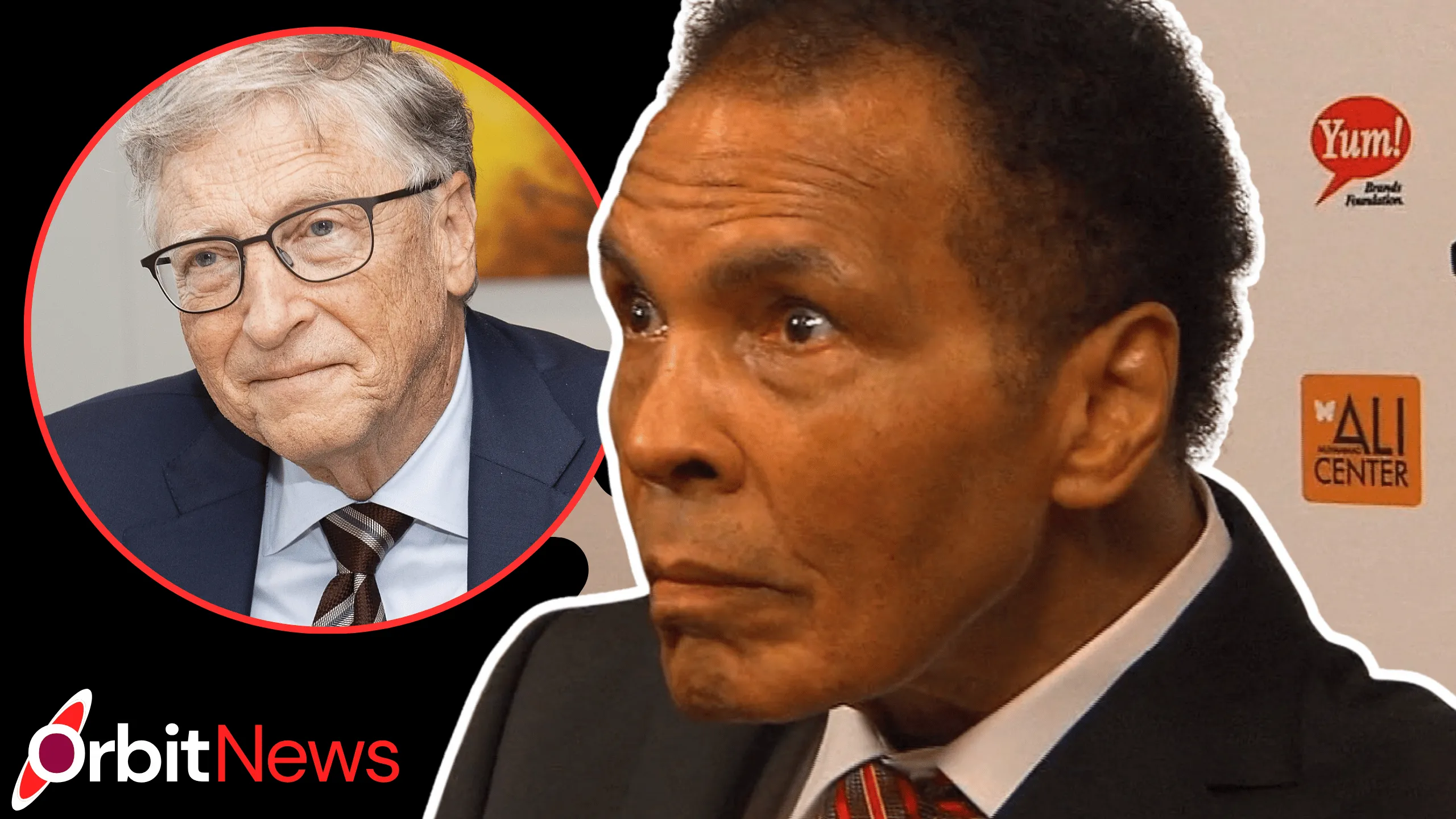
Muhammad Ali and Bill Gates were not known to be personal friends, business partners, or members of a long-running joint organization. Their clearest documented connection was humanitarian: both publicly supported UNICEF’s “Say Yes for Children” campaign, and the Bill & Melinda Gates Foundation helped finance the campaign’s launch.
The connection is easy to miss because Ali came from boxing, civil-rights advocacy, and humanitarian diplomacy, while Gates became famous through Microsoft before shifting much of his attention to global health and philanthropy. Their paths nevertheless overlapped through international efforts focused on children, health, poverty, and human welfare.
What Is the Connection Between Muhammad Ali and Bill Gates?
The strongest verified link between Muhammad Ali and Bill Gates comes from UNICEF’s global child-rights campaign in the early 2000s.
UNICEF’s 2002 Annual Report, covering activities in 2001, placed Bill Gates and Muhammad Ali together in its “Say Yes for Children” coverage. The report explicitly identified both men as supporters of the campaign. It also stated that the Bill & Melinda Gates Foundation and the United Nations Foundation contributed funds to help get the campaign started.
This is more substantial than merely saying both men happened to support charitable causes. They were publicly associated with the same international campaign at the same period, although the available evidence does not establish that they personally worked together or met during it.
| Fact | Muhammad Ali | Bill Gates |
|---|---|---|
| Best known for | Boxing, activism and humanitarian work | Microsoft, technology and philanthropy |
| “Say Yes for Children” supporter | Yes | Yes |
| Connection to UNICEF | Advocacy and humanitarian activities | Foundation funding and global-health partnerships |
| UN-related work | UN Messenger of Peace | Global development and health initiatives involving UN agencies |
| Presidential Medal of Freedom | 2005 | 2016 |
| Current status | Died June 3, 2016 | Chair of the Gates Foundation |
The “Say Yes for Children” Campaign Was Their Clearest Overlap
“Say Yes for Children” was part of the broader Global Movement for Children and was created ahead of the United Nations General Assembly Special Session on Children.
The campaign asked people around the world to support 10 priorities for children, including education, health, protection from exploitation, action against HIV/AIDS, protection from war, and giving children a greater voice in decisions affecting their lives.
UNICEF reported that by May 2002, nearly 100 million people in 194 countries had joined the campaign. Participants could pledge in person, on paper, or electronically and identify the issues they believed deserved the greatest attention.
Muhammad Ali’s role
UNICEF presented Muhammad Ali as one of the prominent personalities who said “YES for Children.” His involvement fit naturally with humanitarian work he had already been doing for years.
Ali was not simply lending the reputation of a famous boxer to an unrelated campaign. By this period, he had developed an extensive public record of charitable and international humanitarian activity.
Bill Gates’s role
Gates also appeared as a public supporter of “Say Yes for Children.” His connection went further financially because UNICEF recorded that the Bill & Melinda Gates Foundation helped fund the campaign’s launch.
That distinction is important. Ali principally brought advocacy, visibility, and his humanitarian reputation, while the Gates Foundation was able to provide institutional and financial support.
Did Muhammad Ali and Bill Gates Ever Meet?
There is no reliable evidence in the authoritative records reviewed for this article confirming a personal meeting between Muhammad Ali and Bill Gates.
UNICEF clearly documents their participation in the same child-rights initiative, but that does not prove they appeared together at an event, developed a friendship, or personally coordinated their work. The United Nations record of Ali’s humanitarian activities and the Gates Foundation’s own history similarly document extensive charitable work without establishing a personal relationship between the two men.
It remains possible that two globally prominent figures with overlapping humanitarian networks encountered each other privately or at a large international gathering. Without a credible photograph, contemporary report, interview, organizational record, or statement confirming such a meeting, however, it should not be presented as fact.
Also Read: Roger Federer and Bill Gates
Muhammad Ali’s Humanitarian Work Went Far Beyond Boxing
Muhammad Ali was born Cassius Marcellus Clay Jr. in Louisville, Kentucky, on January 17, 1942. He won the light-heavyweight gold medal at the 1960 Rome Olympics and later became a three-time world heavyweight champion.
His public influence eventually extended well beyond sport.
The United Nations designated Ali a Messenger of Peace in 1998. According to the UN, he traveled internationally to support people affected by conflict and promoted reconciliation across religious, racial, and national boundaries. He also delivered food and medical assistance and supported hospitals, orphanages, and vulnerable children in Africa and Asia.
His humanitarian involvement was not merely ceremonial. The Muhammad Ali Center documents charitable activity stretching back decades, including donating proceeds from his first professional fight to a children’s hospital and participating in relief, civil-rights, anti-poverty, and international goodwill initiatives.
Ali’s work with UNICEF and the United Nations
Ali’s association with child-focused international organizations continued after the “Say Yes for Children” campaign.
In November 2002, he traveled to Afghanistan on a humanitarian mission sponsored by UNICEF and the World Food Programme. The UN said the trip was intended to highlight humanitarian needs in Afghanistan. His itinerary included a UNICEF-rehabilitated girls’ school and projects assisting vulnerable communities.
That work helps explain why UNICEF featured Ali prominently in its global campaign for children. He already had credibility as an international humanitarian advocate.
Bill Gates’s Shift From Technology to Global Philanthropy
Bill Gates co-founded Microsoft with Paul Allen in 1975 and helped turn the company into one of the most influential businesses in personal computing. His later career increasingly focused on philanthropy.
The foundation created by Bill and Melinda Gates in 2000 concentrated heavily on global health, education and poverty reduction. Gates moved to full-time foundation work in 2008. As of 2026, he serves as chair and a board member of the Gates Foundation, shaping its overall strategy and philanthropic priorities.
The organization, formerly named the Bill & Melinda Gates Foundation, became the Gates Foundation after Melinda French Gates left in 2024. The foundation says its work focuses on reducing disease and poverty and improving health and economic opportunity.
Its connection with UNICEF also predates the “Say Yes” campaign. UNICEF USA says the Gates Foundation selected the U.S. Fund for UNICEF as an early grantee around 2000, beginning a long partnership in areas such as vaccination, nutrition, and maternal and child health.
Their Humanitarian Approaches Were Similar in Purpose but Different in Method
Ali and Gates came from dramatically different professional backgrounds, so their humanitarian influence operated differently.
Muhammad Ali used celebrity, symbolism, personal travel and advocacy. His reputation allowed him to draw attention to war victims, poverty, racial injustice, hunger, children, religious understanding and peace.
Bill Gates has primarily used institutional philanthropy, research funding and large-scale partnerships. The Gates Foundation finances vaccines, disease-control programs, health systems, agriculture, nutrition, education and other development initiatives through governments, nonprofit organizations, researchers and international institutions.
Their shared appearance in UNICEF’s campaign therefore represented two complementary forms of influence: Ali contributed one of the world’s most recognizable public voices, while Gates and his foundation contributed both advocacy and financial resources.
Both Men Also Received the Presidential Medal of Freedom
Another similarity, although not a direct relationship between them, is that both eventually received the Presidential Medal of Freedom, the United States’ highest civilian honor.
President George W. Bush awarded Muhammad Ali the medal in 2005, citing his athletic achievements as well as his commitment to equal justice, peace and service to humanity.
Bill Gates received the Presidential Medal of Freedom in 2016, along with Melinda Gates, during Barack Obama’s presidency. Records from the Obama Presidential Library document Gates’s participation in the November 22, 2016 Medal of Freedom ceremony.
Again, this is a shared distinction rather than evidence of collaboration.
Do Not Confuse Muhammad Ali With Muhammad Ali Pate
Searches for “Muhammad Ali and Bill Gates” can produce a misleading result because another prominent person named Muhammad Ali Pate has extensive, direct connections with Gates and the Gates Foundation.
Muhammad Ali Pate is a Nigerian physician, global-health expert and government official. He has worked closely with global-health organizations and has repeatedly appeared at events involving the Gates Foundation.
For example, the foundation’s 2024 Goalkeepers event listed Bill Gates and Muhammad Ali Pate among its special guests.
That is Muhammad Ali Pate, not boxer Muhammad Ali.
This distinction matters because modern search engines can combine pages containing “Muhammad Ali” and “Bill Gates” even when the Muhammad Ali being discussed is Pate. Articles that fail to distinguish the two can incorrectly create the impression that the boxer had a relationship with Gates that actually belongs to a different person.
What the Evidence Actually Establishes
The available primary and institutional records support several specific conclusions about Muhammad Ali and Bill Gates.
They were both internationally prominent figures who became heavily involved in philanthropy and humanitarian causes. Both publicly supported UNICEF’s “Say Yes for Children” campaign, and the Gates Foundation supplied funding that helped launch it. UNICEF even featured Ali and Gates together in its annual report documenting the campaign.
Ali separately maintained a substantial relationship with United Nations humanitarian activities, including his role as a UN Messenger of Peace and a UNICEF-supported mission to Afghanistan. Gates and his foundation developed long-term partnerships with UNICEF and other global-health organizations.
What reliable evidence does not currently establish is equally important: there is no confirmed basis for describing Muhammad Ali and Bill Gates as close friends, business associates, relatives, or regular collaborators.
Frequently Asked Questions
Were Muhammad Ali and Bill Gates friends?
There is no authoritative public evidence confirming that Muhammad Ali and Bill Gates were personal friends. Their strongest documented connection is their shared support for UNICEF’s “Say Yes for Children” campaign.
Did Muhammad Ali and Bill Gates work together?
They participated in the same international child-rights campaign, but available records do not establish a personal joint project between the two. The Gates Foundation helped finance the campaign while UNICEF publicly identified both men as supporters.
What campaign connected Muhammad Ali and Bill Gates?
Both were associated with UNICEF’s “Say Yes for Children” campaign launched in 2001 as part of the Global Movement for Children. By May 2002, UNICEF reported nearly 100 million participants across 194 countries.
Did Bill Gates’s foundation donate to Muhammad Ali?
No reliable source reviewed for this article documents the Gates Foundation making a donation directly to Muhammad Ali or his personal foundation. Their confirmed overlap concerns broader humanitarian initiatives, particularly UNICEF’s campaign for children.
Was Muhammad Ali involved with UNICEF?
Yes. UNICEF featured Ali in the “Say Yes for Children” campaign, and his 2002 humanitarian mission to Afghanistan was sponsored by UNICEF and the World Food Programme.
Is Muhammad Ali Pate the same Muhammad Ali connected with Bill Gates today?
No. Muhammad Ali Pate is a Nigerian physician and global-health leader who has substantial contemporary ties to the Gates Foundation. He should not be confused with Muhammad Ali, the American heavyweight boxing champion who died in 2016.
Also Read: Ellen DeGeneres and Bill Gates
