


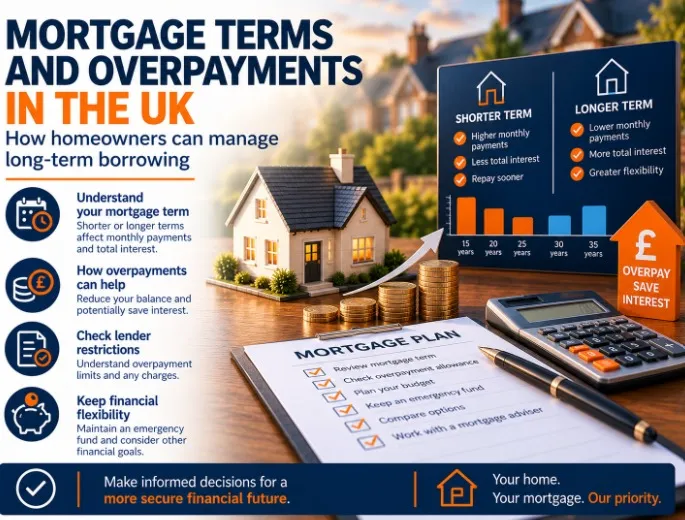
A mortgage is often the largest financial commitment a household will make. Although many borrowers focus on securing an affordable interest rate, the mortgage term and the option to make overpayments can also have a major impact on long-term costs.
Choosing the right mortgage term can help balance monthly affordability against the total interest paid. Meanwhile, making additional payments towards the mortgage may help borrowers reduce their balance more quickly and potentially become mortgage-free sooner.
However, overpayments are not always the right choice for every household. Understanding how mortgage terms, interest calculations, and lender restrictions work can help homeowners make informed decisions.

What Is a Mortgage Term?
The mortgage term is the period over which you agree to repay the amount borrowed. In the UK, repayment mortgages commonly have terms of 20 to 35 years, although shorter or longer terms may be available depending on the lender and borrower.
A longer mortgage term generally spreads the borrowing over more monthly payments. This usually reduces the required monthly repayment compared with a shorter term, assuming the same loan amount and interest rate.
However, a longer term also means interest may be charged for a longer period. As a result, the total amount repaid can be significantly higher.
For example, a borrower may choose a 30-year term rather than a 20-year term to make monthly payments more manageable. The trade-off is that, if the interest rate and other conditions remain comparable, the borrower will generally pay more interest over the full term.
The appropriate term depends on income, household expenditure, age, future plans, and the lender’s affordability assessment.
Shorter Terms Versus Longer Terms
A shorter mortgage term can help borrowers repay their debt sooner and reduce the total interest paid. However, the monthly repayments will generally be higher.
This may suit borrowers with stable income and enough disposable income to manage larger payments without putting other financial goals at risk.
A longer term may be appropriate for borrowers who need more manageable monthly payments. It can provide additional flexibility in the household budget, especially when other costs are high.
Nevertheless, choosing the longest available term simply to reduce monthly payments may not be ideal. It is important to understand the long-term financial consequences and whether you could comfortably make higher payments.
Some borrowers choose a longer contractual term while making voluntary overpayments when their finances allow. This can offer flexibility, provided the mortgage permits overpayments on acceptable terms.
How Mortgage Overpayments Work
An overpayment is an additional payment made towards your mortgage balance beyond the amount required under the agreed repayment schedule.
For a standard repayment mortgage, regular payments cover both interest and some of the capital borrowed. An additional payment usually reduces the outstanding capital, subject to how the lender processes it.
Because interest is generally calculated using the outstanding balance, reducing that balance can reduce future interest charges. The effect depends on the mortgage’s interest calculation method, payment timing, and terms.
There are two common approaches:
Regular overpayments: You pay an additional amount each month, such as £50 or £100, on top of your normal repayment.
Lump-sum overpayments: You make a larger one-off payment, perhaps after receiving a bonus, inheritance, or proceeds from another investment.
Both approaches can help reduce the mortgage balance. Regular overpayments may be easier to incorporate into a budget, while lump-sum payments can make a noticeable reduction when spare funds become available.
Understand Overpayment Limits
Before making extra payments, check the terms of your mortgage.
Some fixed-rate mortgages allow overpayments up to a specified percentage of the outstanding balance each year without an early repayment charge. If you exceed the allowance, you may have to pay a charge on the excess amount.
The allowance and calculation method differ between lenders and products. Some mortgages have more flexible arrangements, while others impose stricter limits.
Do not assume that an overpayment is automatically penalty-free. Ask your lender how much you can repay, when the allowance resets, and whether unused allowances can be carried forward.
Also confirm how the lender will treat the payment. Some lenders reduce the mortgage term, while others may recalculate future monthly repayments. If you want a particular outcome, clarify it before making the payment.
How Overpayments Can Reduce Interest
Imagine you have a repayment mortgage and make an additional payment that reduces the outstanding capital. Future interest will generally be calculated on a lower balance, potentially reducing the total interest paid over the remaining term.
The earlier you reduce the capital, the longer the potential benefit may continue. However, the precise savings depend on the interest rate, mortgage balance, remaining term, overpayment amount, and lender rules.
Online mortgage calculators can provide estimates, but they may not reproduce every lender’s calculation method. Use your lender’s figures or a suitable mortgage illustration for a more accurate assessment.
It is also worth comparing the expected mortgage savings with the return you might receive by keeping the money in savings or using it for another financial priority.
Build an Emergency Fund First
Using all available savings to reduce your mortgage can leave you financially vulnerable.
Homeowners may face unexpected expenses, including boiler repairs, vehicle costs, temporary loss of income, or urgent household maintenance. If all your spare money is tied up in property equity, accessing it may require additional borrowing or a future property transaction.
Before making substantial overpayments, consider keeping an accessible emergency fund appropriate to your circumstances.
You should also account for high-interest debts, essential expenses, insurance, and near-term financial commitments. Paying off expensive unsecured debt may sometimes be more beneficial than making additional mortgage payments, although individual circumstances matter.
Mortgage Overpayments Versus Savings
The decision to overpay a mortgage or save the money depends on several factors.
Mortgage overpayments may provide an effective return through the interest avoided, but the money generally becomes less accessible. Savings accounts provide liquidity, and some may offer attractive interest rates, but interest earned may be subject to tax depending on the account and your circumstances.
Compare the effective mortgage interest saved with the return available from savings after considering tax, access restrictions, and risk.
There is no universal answer. A household that values flexibility may prefer to retain cash, while another with sufficient reserves may prefer to reduce mortgage debt.
Review Your Mortgage Regularly
Your mortgage needs may change over time. A new job, higher income, family changes, or approaching retirement could affect the term and repayment strategy that suits you.
Review your mortgage when your current deal approaches its end, when your financial circumstances change, or when you are considering a significant overpayment.
Prestige Mortgage Solutions Ltd can be considered by borrowers seeking guidance on mortgage options and repayment planning. Before proceeding, verify the firm’s relevant permissions, fees, and the scope of its services.
Final Thoughts
Mortgage terms and overpayments can influence both monthly affordability and the overall cost of borrowing. A shorter term may reduce total interest but require larger payments, while overpayments may help reduce the balance faster if the mortgage terms allow them.
The key is to balance debt reduction with financial security. Understand the conditions, retain sufficient accessible savings, and compare the benefits of overpayments with your other priorities.
This article provides general information only and does not constitute personalised financial or mortgage advice. Check your mortgage terms and seek suitable advice before making significant repayment decisions.
