


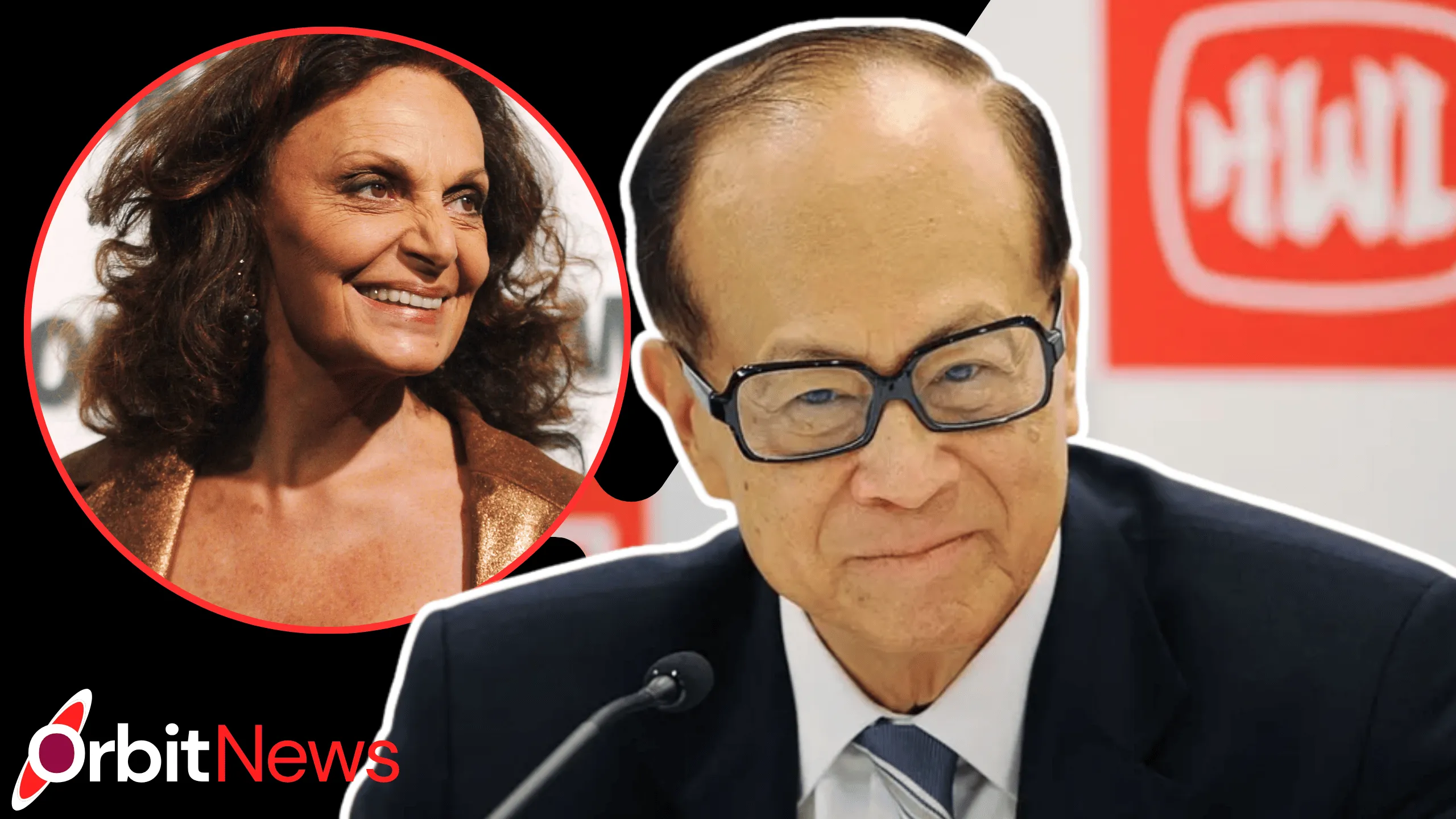
Li Ka-shing and Diane von Furstenberg are not known to be relatives, business partners, or members of the same company. The strongest verified links between them are their status as internationally recognized entrepreneurs, their inclusion in Forbes’ 2017 collection of major living business minds, and an indirect philanthropic overlap in which foundations associated with both names supported the same humanitarian organization.
Their careers developed in very different industries. Li built one of Asia’s most extensive business empires through manufacturing, property, infrastructure, telecommunications, retail and investment. Von Furstenberg built an internationally recognized fashion business around the DVF name and the wrap dress. What makes the pairing interesting is not a hidden corporate relationship, but the similarities and contrasts in how two founders turned personal brands and business judgment into long-lasting institutions.
Are Li Ka-shing and Diane von Furstenberg Connected?
There is no credible evidence of a direct personal or commercial partnership between Li Ka-shing and Diane von Furstenberg in the official biographies, corporate records, foundation materials and reputable profiles reviewed for this article.
No reliable source was found showing that Li invested in DVF, that von Furstenberg participated in Li’s companies, or that the two have a family relationship. Claims implying such a direct connection should therefore be treated cautiously unless supported by documentary evidence.
There are, however, several legitimate points of overlap.
They Were Both Recognized by Forbes in 2017
Forbes marked its 100th anniversary in 2017 by assembling ideas from what it described as 100 of the world’s greatest living business minds. Both Li Ka-shing and Diane von Furstenberg were included.
Forbes separately profiled Li as part of the project, describing his diversified business interests across sectors including ports, utilities, telecommunications, property and retail. In the broader centennial collection, von Furstenberg appeared among the entrepreneurs and business figures contributing lessons from their careers.
That recognition is one of the clearest reasons their names can legitimately appear together in discussions of influential entrepreneurs.
Their Foundations Appeared in the Same Humanitarian Funding Record
A more concrete, although indirect, connection appears in the 2018 trustees’ report of CanDo International, a UK-registered humanitarian organization that operated projects connected with Syria and Turkey.
The report listed the Diller-von Furstenberg Foundation and the Li Ka Shing Foundation among a group of foundations that collectively donated £711,244 to support projects carried out by local humanitarian organizations. One major recipient project was Hope Hospital, a pediatric healthcare initiative in Jarablus in northern Syria.
This should not be exaggerated into a partnership between Li and von Furstenberg. The document establishes that foundations associated with them supported the same humanitarian organization or funding pool. It does not show that Li and von Furstenberg personally collaborated, jointly planned the grants, or operated a shared foundation.
Li Ka-shing and Diane von Furstenberg at a Glance
| Detail | Li Ka-shing | Diane von Furstenberg |
|---|---|---|
| Primary field | Diversified business and investment | Fashion and design |
| Born | 1928, Chaozhou, China | 1946, Brussels, Belgium |
| Major business | Cheung Kong and the businesses that became part of CK Group | Diane von Furstenberg, or DVF |
| Major career breakthrough | Founded Cheung Kong Industries in 1950 | Created the wrap dress in 1974 |
| Current connection to business | Senior adviser to CK Hutchison Holdings and CK Asset Holdings | Founder of DVF and active fashion-industry figure |
| Main philanthropic vehicle | Li Ka Shing Foundation | Diller-von Furstenberg Family Foundation |
| Major philanthropic themes | Education, healthcare, medical research and community initiatives | Women’s leadership, culture, public spaces and other charitable causes |
| Shared distinction | Included in Forbes’ 2017 centennial business-minds project | Included in the same Forbes project |
Sources: CK Hutchison, Li Ka Shing Foundation, DVF, CFDA and Forbes.
Who Is Li Ka-shing?
Li Ka-shing is a Hong Kong entrepreneur, investor and philanthropist whose career stretches back more than seven decades. Born in Chaozhou in 1928, he moved with his family to Hong Kong during wartime and left school at a young age after his father’s illness and death placed financial pressure on the family.
He established Cheung Kong Industries in 1950, initially building a business around plastic products. He later moved into property development, listing Cheung Kong Holdings in 1972, and ultimately expanded through major acquisitions and investments into infrastructure, telecommunications, ports, energy, retail and other industries.
Li formally retired as chairman of the Cheung Kong Group in 2018. CK Hutchison states that he has served as a senior adviser to CK Hutchison Holdings and CK Asset Holdings since May 10, 2018.
How Wealthy Is Li Ka-shing?
Li remains one of the world’s wealthiest individuals, although billionaire fortunes fluctuate with market prices and asset valuations.
Forbes listed his real-time net worth at approximately $49.9 billion as of September 10, 2026. The figure should be understood as an external estimate rather than cash personally held by Li, since billionaire rankings value company stakes and other assets using available market information.
His wealth comes from diversified holdings rather than one consumer product. This is one of the biggest differences between his business story and von Furstenberg’s.
Who Is Diane von Furstenberg?
Diane von Furstenberg is a Belgian-born fashion designer, entrepreneur, author and philanthropist. She established the DVF brand in 1972, and her defining commercial breakthrough came with the wrap dress in 1974.
The wrap dress combined a simple construction with practicality and a distinctive silhouette. According to DVF’s official history, more than one million had been sold by 1976. The product became so closely identified with its creator that the designer’s initials, DVF, developed into an enduring fashion brand in their own right.
Von Furstenberg remained active well beyond the original 1970s success. As of 2026, DVF continues to operate and sell new collections. The company announced Henry Zankov as artistic director in May 2026, while von Furstenberg remains the central historical and public figure associated with the house.
She also continues to serve on the CFDA board. The Council of Fashion Designers of America’s 2025 annual report, covering membership information through March 2026, lists Diane von Furstenberg among its directors.
Her Role in American Fashion
Von Furstenberg’s influence extends beyond her own clothing company.
She became president of the Council of Fashion Designers of America in 2006 and subsequently served as chairwoman, remaining in leadership until 2019. During that period, the organization expanded its membership and developed programs intended to support American designers and strengthen the industry’s institutional structure.
Her significance therefore comes from two related achievements: building a recognizable commercial fashion brand and becoming an influential institution-builder within the American fashion industry.
Two Very Different Entrepreneurial Models
The comparison between Li Ka-shing and Diane von Furstenberg becomes more useful when their businesses are examined as different models of entrepreneurship.
Li Built Through Diversification
Li’s business development was based heavily on expansion across industries and geographic markets.
His early manufacturing operation evolved into property, followed by increasingly diversified interests. CK Hutchison describes the development of the group under Li as a process involving organic expansion, mergers, acquisitions and strategic reorganizations.
The resulting model is large, asset-intensive and geographically diversified.
Von Furstenberg Built Around Identity and Intellectual Property
DVF developed differently. Its greatest asset was not infrastructure or property, but a combination of design, brand identity, licensing and consumer recognition.
The wrap dress provided an instantly identifiable product that could anchor a broader fashion company. DVF subsequently expanded the name into additional categories while maintaining its association with color, print and women’s fashion.
Li’s empire demonstrates the potential of diversification. DVF demonstrates the economic power a founder can create from distinctive design and a recognizable personal brand.
Also Read: Mariah Carey and Diane von Furstenberg
Their Approaches to Philanthropy
Philanthropy is another genuine point of comparison.
Li Ka-shing’s Focus on Education and Healthcare
Li established the Li Ka Shing Foundation in 1980. Its major priorities are education, healthcare, medical research and social initiatives.
The foundation says Li has invested more than HK$30 billion in philanthropic projects, with more than 80 percent directed toward mainland China and Hong Kong. Its activities have included universities, medical research, hospitals, hospice care, scholarships, disaster relief and community programs.
Li has described the foundation as his “third son,” reflecting his intention for philanthropy to function as a major long-term destination for his wealth.
Von Furstenberg’s Focus on Women and Civic Projects
Diane von Furstenberg’s philanthropy is closely associated with the Diller-von Furstenberg Family Foundation, connected with von Furstenberg and her husband, Barry Diller.
The DVF Awards were established in 2010 to recognize women involved in leadership and work benefiting other women. Grants are provided to support the nonprofit work of honorees.
The family’s philanthropy has also been associated with major New York civic projects. DVF’s official biography highlights support for the High Line, Little Island, and fundraising connected with the Statue of Liberty Museum.
Barry Diller and Diane von Furstenberg are also listed by the Giving Pledge as signatories, having joined the initiative in 2010.
What Their 2018 Humanitarian Overlap Actually Means
The CanDo record is important because it gives the keyword Li Ka-shing and Diane von Furstenberg a documented connection beyond appearing on the same business lists.
CanDo International’s 2018 report states that several foundations, including the Diller-von Furstenberg Foundation and Li Ka Shing Foundation, provided funding supporting projects run by local humanitarian organizations. CanDo awarded £491,870 to the Hope Hospital project to provide primary and secondary pediatric healthcare services to conflict-affected children in northern Syria.
There are two important limitations.
First, the £711,244 figure represented combined donations from multiple foundations, not an amount attributable individually to either Li’s or von Furstenberg’s foundation in the cited passage.
Second, shared support for the same organization does not prove that the donors worked together. The responsible interpretation is that their philanthropic networks intersected through a common humanitarian recipient.
Do Li Ka-shing and Diane von Furstenberg Have Similar Business Philosophies?
There are some broad similarities, although they emerged in completely different sectors.
Both built enterprises around strong founder identities. Both retained public influence long after reaching the stage when many founders would have disappeared from day-to-day visibility. Both also extended their legacies beyond their original commercial activities through philanthropy.
Their operating philosophies, however, reflect their industries.
Li’s public business record emphasizes cash flow, prudence, long-term investment and diversification. In Forbes’ centennial project, he discussed the importance of prudence and financial discipline when evaluating opportunities.
Von Furstenberg’s entrepreneurial narrative places more emphasis on independence, authenticity and confidence. Her contribution to the same Forbes project centered on surviving in business by believing in what she was doing and remaining true to it.
Those approaches are not contradictory. They demonstrate how entrepreneurial longevity can come from different foundations: disciplined capital allocation in one case and persistent creative identity in the other.
Is There a Financial Relationship Between Li Ka-shing and DVF?
No verified financial relationship was found.
There is no reliable evidence in the reviewed corporate, foundation or reputable media sources showing that Li Ka-shing owns DVF, financed Diane von Furstenberg’s fashion company, invested personally in her business, or acquired an interest in the brand.
Likewise, no evidence was found that von Furstenberg or the Diller-von Furstenberg Family Foundation owns an interest in Li’s CK-related businesses.
Their names appearing together online should therefore not automatically be interpreted as evidence of an investment relationship.
Are Their Net Worths Comparable?
Li Ka-shing’s wealth can be estimated more systematically because substantial portions of his business interests are linked with major corporate holdings and publicly valued assets. Forbes estimated his fortune at $49.9 billion on September 10, 2026.
For Diane von Furstenberg, various websites publish personal net-worth estimates, but reliable public documentation does not provide the same degree of transparency. Her family circumstances also involve Barry Diller’s separate wealth and family philanthropic structures.
For that reason, presenting a precise personal net-worth figure for von Furstenberg as an established fact would create false certainty. Her documented commercial significance is better measured through DVF’s longevity, the historic reach of the wrap dress, her fashion leadership and her philanthropic activities.
Why Are Li Ka-shing and Diane von Furstenberg Sometimes Discussed Together?
The available evidence points to three defensible reasons:
- Both are internationally recognized founder-entrepreneurs whose careers span several decades.
- Both were included in Forbes’ 2017 centennial project featuring 100 major living business thinkers.
- Foundations associated with their names appeared together among donors supporting CanDo International’s humanitarian work in 2018.
None of these connections establishes a close personal relationship or shared business venture.
FAQ
Are Li Ka-shing and Diane von Furstenberg related?
No verified source indicates that Li Ka-shing and Diane von Furstenberg are related. They come from different families, countries and business backgrounds.
Did Li Ka-shing invest in Diane von Furstenberg’s company?
No credible evidence was found showing that Li Ka-shing invested in or owned part of the DVF fashion company. Their documented overlap is primarily in entrepreneurship, recognition and philanthropy.
Have Li Ka-shing and Diane von Furstenberg worked together?
No direct business collaboration has been verified. Foundations associated with both appeared among donors to CanDo International in its 2018 reporting, but the record does not establish that Li and von Furstenberg personally coordinated their donations.
What do Li Ka-shing and Diane von Furstenberg have in common?
Both are founder-entrepreneurs who built internationally recognized businesses and later developed substantial philanthropic activities. Forbes also included both in its 2017 centennial collection of leading living business minds.
What is Li Ka-shing doing now?
Li retired as chairman of the CK Group in 2018 and remains senior adviser to CK Hutchison Holdings and CK Asset Holdings. His foundation continues funding education, healthcare and community projects.
Is Diane von Furstenberg still involved in fashion?
Yes. DVF remains an operating fashion brand, and Diane von Furstenberg remains closely associated with it and with the wider fashion industry. In May 2026, the company appointed Henry Zankov as artistic director, while von Furstenberg remains a CFDA board member.
Also Read: Peter Woo and Diane von Furstenberg
