


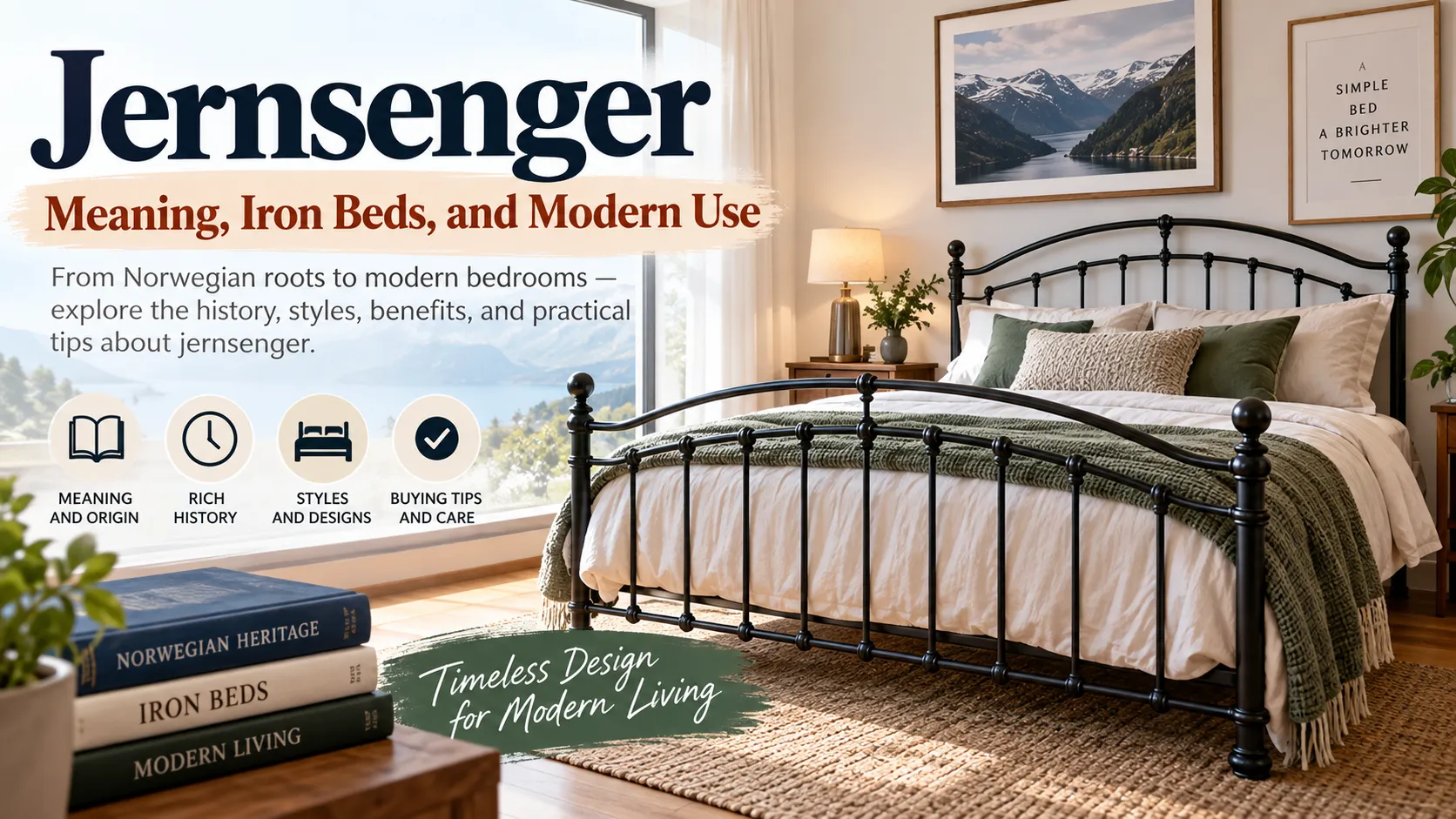
Jernsenger is the Norwegian plural of jernseng, meaning iron beds. The Norwegian Academy Dictionary defines jernseng simply as a bed made of iron, making the furniture meaning far better documented than newer online claims that Jernsenger is a technology, philosophy, or communication framework.
The word has recently become more visible in English-language searches, partly because Jernsenger.com uses the name and because numerous websites have published explanations of it. That has created confusion between the established Norwegian word, the broader category of metal beds, and a website currently operating under the Jernsenger name.
What Does Jernsenger Mean?
In Norwegian, jernseng means an iron bed, while jernsenger is the indefinite plural form, meaning iron beds. A Norwegian word reference gives the forms jernseng, jernsengen, jernsenger, and jernsengene, while Det Norske Akademis ordbok defines the base noun as “seng av jern,” literally a bed of iron.
The terminology is easier to understand when broken down:
| Term | Meaning |
|---|---|
| Jern | Iron |
| Seng | Bed |
| Jernseng | Iron bed |
| Jernsenger | Iron beds |
| Jernsengene | The iron beds |
Although closely related forms also exist in Danish, there is an important linguistic distinction. The authoritative Den Danske Ordbog defines Danish jernseng as a bed with an iron frame but lists its plural inflection as jernsenge, not jernsenger.
For that reason, describing jernsenger specifically as the Norwegian plural form is more accurate than simply calling it a generic Scandinavian plural.
Is Jernsenger a Brand, Product, or General Term?
Jernsenger is primarily a normal Norwegian furniture word, not the established name of a particular technology or internationally standardized product category.
Context, however, matters. Someone searching for “Jernsenger” in 2026 may be looking for one of several things:
- the Norwegian meaning of the word
- traditional or modern iron beds
- Scandinavian-inspired metal bedroom furniture
- Jernsenger.com
- explanations prompted by recent online articles using the term
This distinction is important because several recent webpages assign much broader meanings to Jernsenger. Some describe it as a philosophy, thinking style, communication concept, or digital framework. The authoritative Norwegian dictionary evidence reviewed for this article does not establish those meanings. The documented linguistic definition remains an iron bed.
That does not prevent an individual writer or business from adopting Jernsenger as a brand name or metaphor. It simply means such uses should not be confused with the word’s established dictionary meaning.
What Is a Jernsenger Iron Bed?
A jernseng is traditionally a bed whose structural frame is made predominantly from iron. In contemporary furniture, however, shoppers may see “iron bed” used alongside broader terms such as metal bed frame, even when modern steel tubing or other metal components are involved.
Typical components include a headboard, footboard, side rails, legs, connecting hardware and some form of mattress-support system. The visual design can vary dramatically.
One iron bed may have curved bars, decorative finials and vintage detailing. Another can consist almost entirely of straight lines and a restrained black metal frame. The material category therefore does not dictate a single decorating style.
Traditional Iron Beds
Traditional designs tend to emphasize visible craftsmanship. Curved rails, arches, scrollwork, decorative castings and brass-colored details are common visual references.
These beds work naturally in classic, cottage, farmhouse and vintage-inspired bedrooms, although the surrounding room does not need to follow a historical theme.
Minimalist Metal Beds
Modern jernsenger can be much simpler. Straight tubing, restrained proportions and little ornamentation give the frame a lighter contemporary appearance.
This style works particularly well where the bed needs to provide structure without becoming the dominant visual feature of the room.
Industrial-Style Beds
Industrial designs usually emphasize the metal itself. Dark finishes, straight structural members and exposed-looking joints can create a practical, workshop-inspired appearance.
They often pair well with timber furniture, concrete textures and relatively simple bedding.
Scandinavian-Inspired Iron Beds
A Nordic-inspired room normally benefits from visual restraint rather than elaborate decoration. A simple metal frame combined with light wood, natural textiles and neutral bedding can create that effect without requiring the bed itself to be an antique Scandinavian design.
Importantly, “Scandinavian-inspired” describes an aesthetic. It should not be treated as proof that a particular bed was manufactured in Scandinavia.
The Real History Behind Iron Beds
Iron beds have a much longer history than the recent search interest surrounding Jernsenger.
Historical scholarship indexed by the U.S. National Library of Medicine documents iron bedsteads in European hospital history between the eighteenth and nineteenth centuries. Historical sources also show that metal bedsteads became associated with institutional sleeping arrangements and changing ideas about hygiene.
By the nineteenth century, iron bedsteads had become a significant manufactured furniture category. Evidence from Britain’s Great Exhibition of 1851 records makers exhibiting patent iron bedsteads, children’s cots, and other metal furniture.
A recent peer-reviewed study of Victorian interiors notes that iron and brass bedsteads rose strongly in popularity during the 1850s. Contemporary buyers associated metal frames with cleanliness, while improvements in tubular construction made them lighter and more practical than earlier solid-metal structures.
This wider industrial history explains why iron beds appear in domestic homes as well as hospitals, military settings, boarding institutions and hotels.
Jernsenger in Norwegian Industrial History
Norway has its own documented connection with iron-bed manufacturing.
Christiania Jernseng- og Jernvarefabrik was founded in Oslo in 1904. According to Store norske leksikon, the company initially produced hospital beds, ship beds and other equipment before moving further into furniture and steel-tube manufacturing.
The company participated in Norway’s 1914 Jubilee Exhibition with beds, reclining chairs, spring mattresses and other products. It later received a gold medal for simple hotel beds at the 1928 national exhibition in Bergen.
During the early twentieth century, Norwegian manufacturers increasingly explored tubular steel furniture. Christiania Jernseng- og Jernvarefabrik produced furniture connected with architect Herman Munthe-Kaas, while another Norwegian manufacturer, Trondhjems Jernindustri, was producing bed bases and beds by 1920 and later expanded into steel-tube furniture.
This evidence gives Jernsenger genuine historical context. Iron beds were not merely decorative curiosities in Norway. They formed part of the country’s furniture and industrial manufacturing history.
Why Did Iron Beds Become Popular?
Several characteristics helped iron bedsteads gain practical importance.
One was cleanability. Historical institutions were highly concerned with bedding, insects and sanitation, and metal frames presented fewer absorbent surfaces than many older wooden constructions. Historical evidence from St Thomas’s Hospital, for example, records the adoption of iron bedsteads after they were considered useful in dealing with bedbugs.
Another advantage was manufacturing flexibility. Iron and later steel could be formed into everything from simple institutional beds to decorative domestic furniture.
Metal construction also allowed comparatively open designs. A frame could provide a headboard and footboard without the large solid surfaces associated with many wooden or upholstered beds.
Modern buyers should not turn those historical advantages into absolute claims. An iron frame is not automatically hygienic, indestructible or superior to wood. Construction quality, finish, joints, mattress support and maintenance remain critical.

Jernsenger vs. Wooden Beds
Neither material is universally better. The more useful comparison is how a specific frame fits the room and mattress.
| Feature | Iron or Metal Bed | Wooden Bed |
|---|---|---|
| Visual character | Open, structured, often visually light | Warm, solid, natural |
| Available styles | Vintage to minimalist | Rustic to contemporary |
| Moisture concern | Exposed metal can corrode | Wood may swell, warp or stain |
| Common noise issue | Loose metal connections may squeak | Loose wooden joints may creak |
| Maintenance | Dusting and finish inspection | Depends heavily on wood and coating |
| Repair considerations | Hardware, welds, coating | Joinery, splits, finish |
| Best choice depends on | Construction quality and support | Construction quality and joinery |
A well-engineered wooden frame can be stronger and quieter than a poorly manufactured metal bed, while a high-quality metal frame can remain dependable for years. Material alone is therefore a poor way to judge overall quality.
Also Read: Feschon: Meaning, Origins, Style and Brand Uses
Advantages of Modern Jernsenger
One reason iron and metal beds remain attractive is their versatility.
Open-frame construction can make a bed appear less bulky, particularly in a smaller room. Metal frames also accommodate very different aesthetics, from decorative Victorian references to clean modern geometry.
Maintenance can be relatively straightforward when the finish is intact. Dust can normally be removed without dealing with fabric upholstery, although cleaning products should always match the manufacturer’s instructions.
Another practical benefit is styling flexibility. Bedding, rugs and surrounding furniture can change the character of a simple metal frame without replacing the bed itself.
Limitations to Consider
Jernsenger also have disadvantages.
Potential Noise
Bolted or metal-to-metal joints can develop squeaks or rattles when hardware loosens or components move against each other. A level floor and correctly tightened fasteners can make a significant difference.
Noise should not simply be accepted as an unavoidable feature of every metal bed. It can indicate loose hardware, poor assembly or movement at connection points.
Corrosion
Iron can corrode when protective finishes are damaged and moisture reaches exposed metal. Scratches and chips therefore deserve attention, particularly in humid environments.
Powder coating, paint and other protective finishes can reduce exposure, but buyers should follow the maker’s maintenance instructions rather than assuming every coating requires the same treatment.
Quality Varies
The label “iron bed” tells you little about wall thickness, weld quality, bolt strength, support rails, weight capacity or mattress compatibility.
An attractive photograph can hide weak construction. Detailed specifications are much more useful.
Heavy or Awkward Components
Some metal frames are light because they use hollow tubing. Others can be surprisingly heavy.
Buyers should consider stairs, narrow corridors, door openings and whether the frame can be dismantled before assuming it will fit easily into the intended room.
How to Choose a Good Jernsenger Bed
Start with the mattress rather than the appearance of the bed.
Check the actual mattress dimensions, not merely labels such as king, queen or double. Naming conventions and measurements can vary by market and manufacturer.
Next, study how the mattress is supported. Important questions include whether the frame has center support, how far apart the slats or supporting bars are, whether additional foundation equipment is needed and what maximum load the manufacturer specifies.
Inspect the connection system as well. Bolts, brackets, rails and welds are structural components, not minor details.
A sensible buying checklist includes:
- exact internal mattress dimensions
- overall external dimensions
- stated weight capacity
- center support where required
- suitable slat or platform spacing
- construction and joint details
- type of protective finish
- assembly requirements
- replacement-hardware availability
- return policy and warranty
The mattress manufacturer’s own support requirements should take priority if you already own the mattress.
How to Maintain an Iron Bed
Routine maintenance is usually simple.
Remove dust using a soft cloth and use only cleaning products compatible with the finish. Harsh abrasives can damage painted or powder-coated surfaces.
Check bolts and other fasteners periodically. If the frame begins to move or squeak, identify the source rather than repeatedly tightening components beyond the manufacturer’s recommended level.
Inspect chipped finishes as well. When bare metal becomes visible, use the manufacturer’s recommended repair method to reduce the risk of corrosion.
Antique iron beds require additional care because old paint, nonstandard dimensions and replacement components may present challenges that do not apply to a new frame.
What Is Jernsenger.com?
There is also a website operating at Jernsenger.com, but the website should be distinguished from the Norwegian word itself.
As of September 2026, its homepage describes Jernsenger in terms of iron beds and provides a guide to styles, buying considerations and maintenance.
Other current or recently indexed pages reveal a broader identity. Jernsenger.com’s archives contain articles across business, technology, health, celebrity, education and lifestyle subjects, while its contact page describes the site as a platform for content, collaborations, guest contributions, link placements and sponsored brand features.
Its author profile also states that the “Jernsenger Team” handles SEO content writing, backlink creation and optimization work.
Based on the publicly indexed material reviewed, it is therefore more accurate to describe Jernsenger.com as a content-oriented website currently using iron-bed material prominently, rather than assuming that it is an established furniture manufacturer or conventional online bed retailer.
No reliable evidence reviewed for this article establishes that Jernsenger.com is the origin of the word. The Norwegian furniture term existed independently long before the website.
Is Jernsenger.com Safe or Legitimate?
Public webpages alone are not enough to give a definitive safety or legitimacy judgment.
The site provides contact information and publishes substantial amounts of content, but those facts do not independently verify a retail business, ownership structure, manufacturing operation or customer-service record. Its contact page emphasizes publishing collaborations and link placements rather than providing the kind of detailed commercial information normally expected when evaluating a furniture seller.
Anyone considering a transaction through a site using the Jernsenger name should separately verify the seller, payment protection, return address, warranty, product specifications and independent customer feedback before paying.
This distinction also prevents a common search mistake: information about the word jernsenger should not automatically be treated as evidence about the company or website using that domain name.
Claims About a “Jernsenger Philosophy” or Digital Framework
Search results now include articles suggesting that Jernsenger can describe creative thinking, interconnected ideas, communication structures or broader digital concepts.
These interpretations currently lack the same level of authoritative linguistic evidence as the furniture definition.
The Norwegian Academy Dictionary recognizes jernseng as an iron bed. Norwegian industrial records document companies manufacturing jernsenger. Danish dictionaries independently document the related jernseng furniture term.
No authoritative dictionary, academic reference or recognized technology standards body identified in this research establishes Jernsenger as a formal digital framework.
Readers should therefore treat those newer definitions as individual interpretations or online coinages, not established meanings.
Frequently Asked Questions
What does Jernsenger mean in English?
Jernsenger means iron beds in Norwegian. The singular form is jernseng, meaning an iron bed.
Is Jernsenger Norwegian or Danish?
The exact plural jernsenger is Norwegian. Danish also uses jernseng for an iron-framed bed, but the Danish dictionary gives jernsenge as the indefinite plural form.
Is Jernsenger a furniture brand?
Not inherently. Jernsenger is an ordinary Norwegian plural noun referring to iron beds. A website currently uses Jernsenger as its name, but that does not turn the underlying Norwegian word into a proprietary brand term.
Are Jernsenger always made from solid iron?
Not necessarily in modern commercial usage. Traditional jernsenger are iron beds, while products informally described as iron or metal beds today may incorporate steel tubing, cast components or combinations of metals. Buyers should check the manufacturer’s material specification rather than relying on the product name alone.
Are Jernsenger suitable for modern bedrooms?
Yes. Iron and metal beds can range from ornate traditional designs to extremely simple contemporary frames. A clean metal structure can work particularly well with modern, industrial or Scandinavian-inspired interiors.
Is Jernsenger a digital concept or communication framework?
There is no strong authoritative evidence supporting that as an established definition. Reliable Norwegian language sources define jernseng as an iron bed, while documented Norwegian industrial history supports the same furniture-related meaning.
Also Read: Bilieter: Meaning, Website, and What It Really Is
