


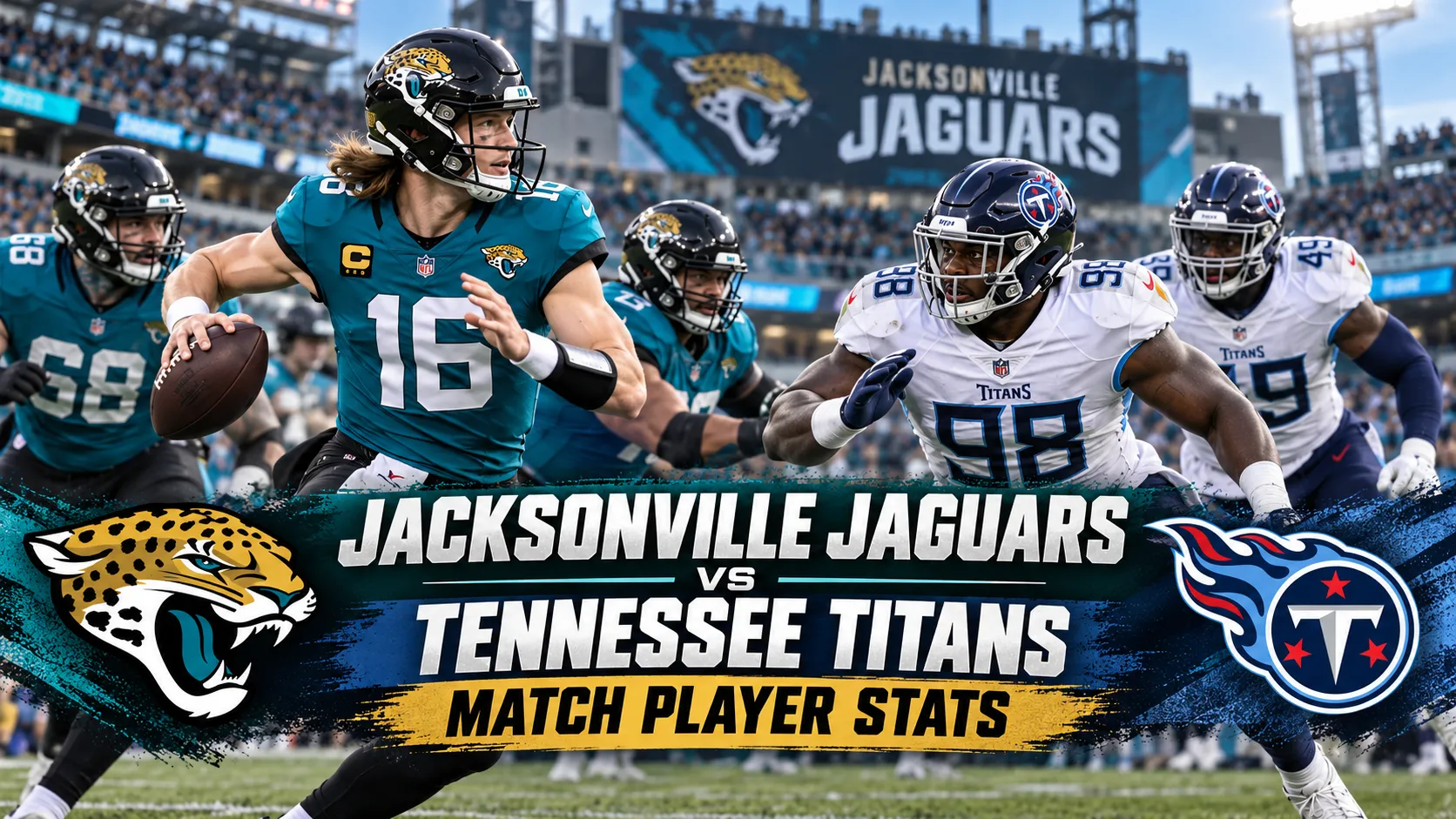
The latest completed Jacksonville Jaguars vs Tennessee Titans Match Player Stats come from Jacksonville’s 41-7 victory over Tennessee on January 4, 2026, at EverBank Stadium. Trevor Lawrence threw for 255 yards and three touchdowns, Antonio Johnson returned an interception 58 yards for a touchdown, and kicker Cam Little made field goals from 67 and 52 yards as the Jaguars clinched the AFC South.
Jacksonville entered the regular-season finale needing a victory to secure the division and responded with one of its most complete performances of the season. Tennessee actually scored first when rookie quarterback Cam Ward ran for a seven-yard touchdown, but the Jaguars answered with 41 consecutive points and controlled virtually every important statistical category from that point forward.
The result gave Jacksonville a 13-4 regular-season record, its first AFC South championship since 2022 and its fifth division title in franchise history. Tennessee finished 3-14 after a difficult season that ended with Ward leaving this game because of a right shoulder injury.

Jacksonville Jaguars vs Tennessee Titans Match Summary
| Game detail | Information |
|---|---|
| Matchup | Tennessee Titans at Jacksonville Jaguars |
| Date | January 4, 2026 |
| Week | 2025 NFL regular season, Week 18 |
| Venue | EverBank Stadium, Jacksonville, Florida |
| Final score | Jaguars 41, Titans 7 |
| Jaguars record after game | 13-4 |
| Titans record after game | 3-14 |
| Attendance | 66,015 |
| Jaguars head coach | Liam Coen |
| Titans interim head coach | Mike McCoy |
| Division impact | Jacksonville clinched AFC South |
The score suggests a game Jacksonville dominated from beginning to end, but the opening minutes were more competitive. Tennessee drove 58 yards on five plays on its first possession, and Ward finished the drive himself with a seven-yard touchdown run.
Jacksonville immediately answered. Lawrence found Parker Washington for a 23-yard touchdown, tying the game 7-7 with 6:02 remaining in the first quarter. From there, the difference between the teams became increasingly clear. Jacksonville scored 24 unanswered points in the second quarter alone and led 31-7 at halftime.
The Jaguars added a 52-yard field goal in the third quarter and Bhayshul Tuten’s five-yard rushing touchdown in the fourth. Tennessee never scored again after Ward’s opening touchdown.
Final Score by Quarter
| Team | 1st | 2nd | 3rd | 4th | Final |
|---|---|---|---|---|---|
| Tennessee Titans | 7 | 0 | 0 | 0 | 7 |
| Jacksonville Jaguars | 7 | 24 | 3 | 7 | 41 |
Jacksonville’s second quarter decided the game. The Jaguars produced three touchdowns and a 67-yard field goal in the period, while Tennessee lost its starting quarterback and later surrendered an interception return for a touchdown.
Complete Scoring Summary
| Quarter | Time | Scoring play | Score |
|---|---|---|---|
| 1st | 10:09 | Cam Ward 7-yard rushing TD, Joey Slye PAT | TEN 7-0 |
| 1st | 6:02 | Parker Washington 23-yard TD reception from Trevor Lawrence, Cam Little PAT | 7-7 |
| 2nd | 11:47 | Brenton Strange 7-yard TD reception from Lawrence, Little PAT | JAX 14-7 |
| 2nd | 8:07 | Antonio Johnson 58-yard interception-return TD, Little PAT | JAX 21-7 |
| 2nd | 1:56 | Quintin Morris 5-yard TD reception from Lawrence, Little PAT | JAX 28-7 |
| 2nd | 0:00 | Cam Little 67-yard field goal | JAX 31-7 |
| 3rd | 1:03 | Cam Little 52-yard field goal | JAX 34-7 |
| 4th | 7:28 | Bhayshul Tuten 5-yard rushing TD, Little PAT | JAX 41-7 |
The sequence shows why simply looking at total yardage does not fully explain the 34-point margin. Jacksonville generated explosive passing plays, converted scoring opportunities, produced a defensive touchdown and received nine points from Little’s kicking. Tennessee, meanwhile, produced one successful touchdown drive and almost nothing afterward.
Jacksonville Jaguars vs Tennessee Titans Match Player Stats
The individual numbers underline the difference in quarterback play. Lawrence produced three passing touchdowns without a turnover, while Tennessee lost Ward early and received only 72 passing yards from replacement Brandon Allen.
Quarterback Stats
| Player | Team | Comp/Att | Pass Yards | Pass TD | INT | Passer Rating |
|---|---|---|---|---|---|---|
| Trevor Lawrence | Jaguars | 22/30 | 255 | 3 | 0 | 131.9 |
| Nick Mullens | Jaguars | 2/2 | 16 | 0 | 0 | 100.0 |
| Cam Ward | Titans | 3/3 | 52 | 0 | 0 | 118.8 |
| Brandon Allen | Titans | 17/30 | 72 | 0 | 1 | 47.9 |
Lawrence was the clear statistical standout. He completed 73.3% of his passes, averaged 8.5 yards per attempt and threw touchdowns to three different receivers. NFL game logs list his passer rating at 131.9, while he also added 11 rushing yards.
Ward’s short appearance was effective before the injury. He completed all three of his attempts for 52 yards and rushed twice for 11 yards, including the Titans’ only touchdown. His passing total included a 39-yard completion, but the game changed immediately after he left.
Allen entered without having expected to handle almost the entire game. He completed 17 of 30 passes for just 72 yards, was intercepted once and finished with a 47.9 passer rating. Tennessee’s own postgame coverage described the offensive performance following Ward’s departure as a struggle, with repeated three-and-outs preventing the Titans from sustaining momentum.

Trevor Lawrence’s Performance Was the Offensive Difference
Lawrence did not begin the afternoon perfectly. Tennessee defensive tackle Jeffery Simmons sacked him on Jacksonville’s first offensive snap, but the Jaguars quarterback settled quickly and increasingly controlled the game.
His first touchdown came on Jacksonville’s second possession. Lawrence connected with Washington for 23 yards down the middle to answer Tennessee’s opening score.
Early in the second quarter, Lawrence completed several passes during an 82-yard drive before finding Brenton Strange from seven yards out. That touchdown put Jacksonville ahead for the first time, 14-7.
The third touchdown demonstrated Jacksonville’s ability to create long scoring drives rather than depend exclusively on short fields. Lawrence guided an 86-yard possession and hit Quintin Morris from five yards with 1:56 left before halftime.
Lawrence finished:
| Trevor Lawrence stat | Total |
|---|---|
| Completions | 22 |
| Attempts | 30 |
| Completion rate | 73.3% |
| Passing yards | 255 |
| Yards per attempt | 8.5 |
| Passing touchdowns | 3 |
| Interceptions | 0 |
| Passer rating | 131.9 |
| Rushes | 2 |
| Rushing yards | 11 |
The importance of the performance went beyond one game. Lawrence ended the 2025 regular season with 29 passing touchdowns and nine rushing touchdowns. His 38 total touchdowns set a Jacksonville franchise record, passing Blake Bortles’ previous mark of 37 from 2015. He also surpassed 4,000 passing yards for the third time in his NFL career.
During Jacksonville’s eight-game winning streak to finish the regular season, Lawrence produced 20 touchdowns against only five interceptions. That late-season efficiency was a major reason the Jaguars were able to move into first place and hold off Houston for the division championship.
Cam Ward’s Early Injury Changed Tennessee’s Offense
Ward’s numbers require context because he played only the opening portion of the game.
Tennessee’s rookie quarterback started sharply. He completed all three of his passes for 52 yards during his limited action. His first possession ended with a seven-yard touchdown run that put Tennessee ahead 7-0.
The touchdown came at a significant cost. Ward landed on his right shoulder while diving into the end zone. Titans medical staff examined him, he went to the locker room and he was eventually ruled out. He later returned to the sideline wearing a sling.
That left Allen responsible for the remaining offensive snaps. The statistical drop-off was substantial.
Ward averaged more than 17 yards per passing attempt on his three throws. Allen averaged only 2.4 passing yards per attempt, according to the official box score. The difference should not be read as a direct quarterback comparison because Ward played only a handful of snaps, but Tennessee clearly lost its early offensive rhythm after the change.
Also Read: r/bestofredditorupdates: What the Reddit Community Is and How It Works

Jacksonville Jaguars Rushing Stats
Jacksonville did not dominate on the ground. In fact, the Jaguars finished with only 64 rushing yards and averaged 2.7 yards per rushing attempt.
| Jaguars rusher | Attempts | Yards | Average | TD | Long |
|---|---|---|---|---|---|
| Travis Etienne Jr. | 14 | 32 | 2.3 | 0 | 11 |
| Bhayshul Tuten | 5 | 23 | 4.6 | 1 | 12 |
| Trevor Lawrence | 2 | 11 | 5.5 | 0 | 10 |
| Nick Mullens | 3 | -2 | -0.7 | 0 | 0 |
Etienne received the largest workload but found limited space, producing 32 yards on 14 attempts. Jacksonville did not need a major rushing performance because Lawrence consistently generated yards through the air and the defense created points.
Tuten was more efficient in a smaller role. His five carries produced 23 yards, and his five-yard touchdown with 7:28 remaining completed the scoring at 41-7.
The important point is that the Jaguars did not win because of rushing dominance. Tennessee actually produced more rushing yards, 77 to 64. Jacksonville won because its passing game was much more productive, it converted opportunities into touchdowns and its defense and special teams supplied additional points.
Tennessee Titans Rushing Stats
| Titans rusher | Attempts | Yards | Average | TD | Long |
|---|---|---|---|---|---|
| Tony Pollard | 14 | 48 | 3.4 | 0 | 10 |
| Tyjae Spears | 3 | 18 | 6.0 | 0 | 9 |
| Cam Ward | 2 | 11 | 5.5 | 1 | 7 |
Tony Pollard led Tennessee with 48 rushing yards, but the game situation prevented the Titans from staying committed to the run. Once Jacksonville built a multiple-score lead in the second quarter, Tennessee increasingly needed its passing game to move quickly.
Spears gained 18 yards on only three attempts. Ward supplied the Titans’ only touchdown and finished with 11 rushing yards before leaving the game.
Tennessee averaged 4.1 yards per rushing attempt as a team, better than Jacksonville’s 2.7. That is a useful reminder that rushing efficiency alone does not determine offensive effectiveness. The Titans accumulated only 10 first downs and 194 total net yards, so their modest rushing advantage never translated into sustained scoring.
Jacksonville Jaguars Receiving Stats
Jacksonville spread the ball effectively. Lawrence completed passes to nine different players, and three different receivers caught touchdowns.
| Jaguars receiver | Receptions | Yards | Avg. | TD |
|---|---|---|---|---|
| Parker Washington | 5 | 87 | 17.4 | 1 |
| Brenton Strange | 6 | 52 | 8.7 | 1 |
| Brian Thomas Jr. | 3 | 49 | 16.3 | 0 |
| Jakobi Meyers | 5 | 44 | 8.8 | 0 |
| Johnny Mundt | 1 | 16 | 16.0 | 0 |
| Dyami Brown | 1 | 8 | 8.0 | 0 |
| Travis Etienne Jr. | 1 | 6 | 6.0 | 0 |
| Quintin Morris | 1 | 5 | 5.0 | 1 |
| Tim Patrick | 1 | 4 | 4.0 | 0 |
Washington led the Jaguars in receiving yards despite catching only five passes. His 87 yards included the 23-yard touchdown that immediately erased Tennessee’s early lead. He finished at 17.4 yards per reception, giving Jacksonville an important intermediate and downfield threat.
Strange was Lawrence’s most reliable high-volume target. He caught all six of his recorded receptions for 52 yards, and his seven-yard touchdown early in the second quarter gave Jacksonville the lead for good.
Brian Thomas Jr. finished with three catches for 49 yards. Jacksonville did not need to force the offense through its young star because Washington, Strange, Meyers and the tight ends consistently won their matchups.
Meyers contributed five catches for 44 yards, including a 17-yard reception during the touchdown drive that ended with Strange’s score.
Perhaps the most efficient receiving contribution belonged to Morris. He recorded only one reception, but it was a five-yard touchdown late in the first half.
That distribution made the offense difficult to defend. Tennessee could not simply remove one target and expect Lawrence to struggle. Jacksonville generated 271 gross passing yards between Lawrence and backup Nick Mullens, with nine players appearing in the receiving column.

Tennessee Titans Receiving Stats
| Titans receiver | Receptions | Yards | Avg. | TD |
|---|---|---|---|---|
| Elic Ayomanor | 3 | 50 | 16.7 | 0 |
| Chimere Dike | 3 | 27 | 9.0 | 0 |
| Tony Pollard | 3 | 17 | 5.7 | 0 |
| David Martin-Robinson | 1 | 14 | 14.0 | 0 |
| Tyjae Spears | 7 | 9 | 1.3 | 0 |
| James Proche II | 1 | 5 | 5.0 | 0 |
| Chig Okonkwo | 2 | 2 | 1.0 | 0 |
Ayomanor led Tennessee with 50 receiving yards despite catching only three of 10 targets. His production was heavily influenced by a 39-yard reception.
Dike added 27 yards on three catches, including a 21-yard gain from Allen. Pollard caught all three of his targets for 17 yards.
Spears produced one of the most unusual stat lines of the afternoon. He caught seven passes but gained only nine yards, an average of 1.3 yards per reception. That illustrates how heavily Tennessee relied on very short throws and checkdowns once Allen took over.
Okonkwo was similarly restricted, gaining only two yards on two catches despite five targets.
Tennessee finished with 124 gross passing yards and 117 net passing yards after accounting for one sack. Jacksonville, by comparison, finished with 271 gross passing yards and 255 net passing yards after two sacks.
Parker Washington Gave Jacksonville the Explosive Receiving Plays It Needed
Washington’s 87 receiving yards were the most by any Jacksonville player in the game.
His first major contribution came immediately after Tennessee’s opening touchdown. Lawrence found him for a 23-yard score, ensuring the Jaguars did not spend much time playing from behind.
Washington also delivered Jacksonville’s longest receiving play at 29 yards. His five receptions averaged 17.4 yards, the highest average among Jacksonville players who caught multiple passes.
The performance was particularly valuable because it prevented Tennessee from focusing exclusively on Thomas. Jacksonville had enough receiving depth to attack different areas of the field without forcing a single receiver to carry the entire passing game.
Also Read: r/KUWTK: Inside the Kardashian Reddit Community
Brenton Strange Was Jacksonville’s Chain-Moving Target
Washington led in receiving yards, but Strange delivered one of the most complete receiving performances.
He caught six passes for 52 yards and a touchdown. His catches repeatedly helped Jacksonville move the chains, particularly during the early second-quarter drive that turned a 7-7 game into a Jacksonville lead.
That possession demonstrated how Lawrence used the middle and shorter areas of the field. Strange caught gains of four and 11 yards before eventually finishing the drive with the seven-yard touchdown.
The result was not spectacular from a raw yardage perspective, but his reliability allowed Jacksonville to stay ahead of the chains while its wider receivers provided more explosive gains.
Team Statistics Show How Jacksonville Controlled the Game
| Team stat | Titans | Jaguars |
|---|---|---|
| Final score | 7 | 41 |
| Total net yards | 194 | 319 |
| Total plays | 53 | 58 |
| Yards per play | 3.7 | 5.5 |
| First downs | 10 | 24 |
| Net rushing yards | 77 | 64 |
| Net passing yards | 117 | 255 |
| Passing completions/attempts | 20/33 | 24/32 |
| Interceptions thrown | 1 | 0 |
| Sacks allowed | 1 | 2 |
| Third downs | 4/14 | 4/9 |
| Fourth downs | 1/3 | 0/0 |
| Penalties | 6 | 3 |
| Penalty yards | 67 | 20 |
| Turnovers | 1 | 0 |
| Time of possession | 26:57 | 33:03 |
Jacksonville’s biggest statistical advantages came in passing, first downs, field position and efficiency. The Jaguars finished with 24 first downs compared with only 10 for Tennessee and more than doubled the Titans in net passing yardage, 255 to 117.
The Jaguars averaged 5.5 yards per offensive play compared with Tennessee’s 3.7. That gap becomes even more meaningful when considered alongside the turnover margin and penalty numbers.
Jacksonville committed only three penalties for 20 yards. Tennessee was flagged six times for 67 yards. Two costly penalties early in the second quarter contributed to the Jaguars gaining control of the game.
Jacksonville also held the football for 33:03 compared with Tennessee’s 26:57.
First Downs Tell an Important Part of the Story
The first-down margin was one of the clearest indicators of offensive control.
Jacksonville recorded 24 first downs. Tennessee managed only 10.
That disparity meant the Jaguars were consistently extending drives while Tennessee struggled to remain on the field after Ward’s injury.
Tennessee converted four of 14 third-down attempts, a 28.6% rate. Jacksonville went 4-of-9, or 44.4%. The raw difference of only one converted third down may not look enormous, but Jacksonville faced fewer third-down situations because it was more successful on early downs.
The Titans also attempted three fourth downs and converted only one. Jacksonville never needed to attempt a fourth-down conversion.
One failed Tennessee fourth-down play proved especially costly. Jacksonville took possession with only seconds remaining in the second quarter, giving Little the opportunity to attempt his remarkable 67-yard field goal.

Antonio Johnson’s Pick-Six Was the Defensive Turning Point
The most important defensive play occurred with Jacksonville already leading 14-7.
Allen attempted a pass over the middle on third-and-long. Johnson intercepted it and returned the ball 58 yards for a touchdown, extending the lead to 21-7.
It was Johnson’s fifth interception of the season and the first touchdown of his NFL career. More broadly, it continued one of Jacksonville’s most dramatic year-to-year improvements.
The Jaguars finished the 2024 season with only nine takeaways, the fewest in the NFL. Johnson’s interception against Tennessee gave them 31 takeaways during the 2025 regular season.
That defensive touchdown changed the structure of the game. Tennessee went from trying to answer a seven-point deficit to trailing by two touchdowns without its starting quarterback.
Jacksonville could then play more comfortably, protect against big plays and force Allen to produce longer drives through the air.
Jacksonville Defensive Player Stats and Impact
Foyesade Oluokun led Jacksonville with eight total tackles. Devin Lloyd finished with five, while Dawuane Smoot also recorded five tackles and Jacksonville’s only sack. ESPN’s defensive box score credits Smoot with one tackle for loss and one quarterback hit.
| Jaguars defender | Total tackles | Solo | Sacks | Key contribution |
|---|---|---|---|---|
| Foyesade Oluokun | 8 | 3 | 0 | Team-high tackles |
| Devin Lloyd | 5 | 2 | 0 | 1 TFL |
| Dawuane Smoot | 5 | 1 | 1 | Sack, TFL, QB hit |
| Eric Murray | 4 | 2 | 0 | Run/pass support |
| Antonio Johnson | 3 | 3 | 0 | 58-yard INT return TD |
| Jarrian Jones | 3 | 2 | 0 | TFL and pass defense |
| Travon Walker | 3 | 1 | 0 | TFL |
| Josh Hines-Allen | 2 | 1 | 0 | 3 QB hits |
Jacksonville’s pass rush produced only one official sack, but the defense did not need a high sack total because Tennessee’s passing game was producing so few yards.
Josh Hines-Allen recorded three quarterback hits according to ESPN’s defensive statistics, helping generate pressure even without recording a sack.
The secondary also limited Tennessee’s ability to turn short throws into meaningful gains. Spears and Okonkwo combined for nine receptions but only 11 yards.
Tennessee Defensive Highlights Despite the Score
The Titans surrendered 41 points, but a few defensive performances still stood out.
Jeffery Simmons made history immediately. On Jacksonville’s first offensive play, he sacked Lawrence for his 11th sack of the season. That established a new Titans-era single-season sack record for a defensive tackle, surpassing Jurrell Casey’s 10.5 sacks from 2013.
Edge rusher Jaylen Harrell was credited with Tennessee’s other sack. The play gave him 4.5 sacks for the season.
Cedric Gray led the Titans with eight tackles.
Those individual efforts could not compensate for Jacksonville’s overall passing efficiency. Lawrence completed more than 73% of his passes and averaged 8.5 yards per attempt while avoiding an interception.
Also Read: Who Delivers Your Offer to the Seller Framework: How It Works
Cam Little Produced One of the Game’s Most Memorable Stats
Jacksonville’s kicking performance deserves its own section because Little made NFL history.
With three seconds left before halftime, Jacksonville had the ball after stopping Tennessee on fourth down. The Jaguars sent Little out for a 67-yard field goal, and he converted it to make the score 31-7.
The kick became the longest successful outdoor field goal in NFL regular-season history. It was also the second-longest regular-season field goal overall, trailing only Little’s own 68-yard kick against Las Vegas earlier in the 2025 season.
Little was not finished. He added a 52-yard field goal late in the third quarter.
His final kicking line:
| Cam Little kicking stat | Total |
|---|---|
| Field goals made | 2 |
| Field goals attempted | 2 |
| Long | 67 yards |
| Extra points made | 5 |
| Extra points attempted | 5 |
| Total points | 11 |
Little therefore accounted for 11 of Jacksonville’s 41 points.
Tennessee kicker Joey Slye converted his only extra point but missed a 52-yard field-goal attempt late in the fourth quarter.
Why the Passing-Yard Difference Mattered More Than the Rushing Stats
One unusual feature of the box score is that Tennessee actually outrushed Jacksonville.
The Titans gained 77 rushing yards while Jacksonville had 64.
But Jacksonville produced 255 net passing yards compared with only 117 for Tennessee. That 138-yard passing advantage was far more important because it allowed the Jaguars to produce explosive plays and maintain scoring drives.
Lawrence averaged 8.5 yards per pass attempt. Allen averaged 2.4.
That contrast shaped almost everything else. Jacksonville reached 24 first downs and created several long drives. Tennessee repeatedly faced third-and-long situations and lacked the downfield passing efficiency needed to escape them.
The Jaguars did not need a dominant ground attack because they were winning through quarterback efficiency, receiving depth, field position and defensive takeaways.

How Jacksonville Turned a 7-0 Deficit Into a Blowout
The Titans could hardly have asked for a better start.
Ward completed three passes and scored on the ground. Tennessee led 7-0 with 10:09 remaining in the first quarter.
The Jaguars’ response was immediate and methodical.
Lawrence first tied the game with Washington’s touchdown. Strange’s second-quarter score then put Jacksonville in front.
Johnson’s interception return changed the emotional and statistical balance of the game. Tennessee had moved into Jacksonville territory but instead of potentially tying the game, the Titans suddenly trailed 21-7.
Jacksonville then drove 86 yards for another touchdown.
Finally, Tennessee failed on fourth down with only seconds remaining before halftime. Little converted from 67 yards, turning a 28-7 lead into 31-7 without Jacksonville needing a conventional offensive drive.
By halftime, Jacksonville had completely reversed the opening five minutes.
The Jaguars’ Second Quarter Was the Decisive Stretch
Jacksonville scored 24 points in the second quarter.
Those points came in four different ways or situations: a conventional offensive touchdown drive, a defensive touchdown, another long offensive touchdown drive and a record-setting field goal.
The sequence was:
- Lawrence to Strange for seven yards.
- Johnson’s 58-yard pick-six.
- Lawrence to Morris for five yards.
- Little from 67 yards.
It is difficult for an opponent to survive a quarter when all three phases contribute that efficiently.
Tennessee entered the quarter tied 7-7. It left trailing 31-7.
Tennessee’s Offense After Cam Ward Left
Tennessee’s challenge was not simply replacing Ward’s passing ability. The Titans also lost the quarterback who had just produced their most successful drive.
Allen finished with 72 yards on 30 attempts.
His completion rate was 56.7%, but the more significant number was only 2.4 yards per passing attempt. That means many completions were occurring near or behind the line to gain rather than creating meaningful downfield progress.
Spears catching seven passes for nine yards illustrates that issue. Those completions improved the completion total without materially improving Tennessee’s field position.
Allen did complete a 21-yard pass to Dike, and Ayomanor remained Tennessee’s most productive receiving option, but those isolated plays were not enough to create sustained offense.
The Titans finished with only five passing first downs.
Penalties Hurt Tennessee at the Wrong Moments
Jacksonville finished with three penalties for 20 yards. Tennessee committed six for 67.
The total yardage matters, but timing mattered more.
During Jacksonville’s early second-quarter touchdown drive, a Tennessee unsportsmanlike-conduct penalty helped the Jaguars continue moving into scoring position. Other penalties created unfavorable down-and-distance situations for an offense already struggling with its backup quarterback.
A team trying to win with limited offensive production needs to minimize self-inflicted mistakes. Tennessee did not.
Jacksonville, by contrast, committed relatively little penalty yardage and protected the ball.
Turnover Margin Favored Jacksonville
The official turnover difference was only 1-0, but the value of that one turnover was enormous.
Jacksonville did not merely intercept a pass. Johnson returned it directly for seven points.
If that return is removed, the Jaguars still controlled the game statistically, but the pick-six accelerated the separation and forced Tennessee into a more pass-heavy approach.
Jacksonville did record one fumble, by Washington, but it was not lost. Therefore the Jaguars officially finished with zero turnovers.
Tennessee’s only giveaway directly produced a Jacksonville touchdown.
Jacksonville’s Red-Zone and Scoring Efficiency
Jacksonville’s scoring possessions were varied enough that simple red-zone totals tell only part of the story.
Washington scored from 23 yards, which did not require a red-zone snap on the touchdown play itself. Strange and Morris scored from seven and five yards, respectively. Tuten later scored from five yards.
Johnson scored without the offense taking the field, while Little converted from 67 and 52 yards.
That diversity shows how many different ways Jacksonville could generate points:
- Deep or intermediate passing
- Short-yardage passing
- Rushing
- Defensive takeaways
- Long-distance kicking
Tennessee produced only one of those categories successfully, Ward’s rushing touchdown.
The 2025 Jaguars Swept the Titans Convincingly
The Week 18 game completed Jacksonville’s season sweep of Tennessee.
The Jaguars had already beaten the Titans 25-3 on November 30, 2025, at Nissan Stadium. Lawrence threw two touchdown passes in that game, while Jacksonville held Tennessee to one field goal.
Across the two 2025 regular-season meetings:
| Meeting | Result |
|---|---|
| Nov. 30, 2025 | Jaguars 25, Titans 3 |
| Jan. 4, 2026 | Jaguars 41, Titans 7 |
| Combined | Jaguars 66, Titans 10 |
Jacksonville therefore outscored Tennessee 66-10 across the season series.
That 56-point combined margin reflected the dramatically different directions of the two teams late in 2025. Jacksonville was finishing an eight-game winning streak and preparing for the playoffs, while Tennessee was concluding a 3-14 season.
Also Read: Wei Xue Beijing Normal University East China Normal
What the Win Meant for Jacksonville’s Season
The result carried far greater significance than an ordinary Week 18 divisional win.
Jacksonville officially clinched the 2025 AFC South championship and finished 13-4. It was the franchise’s first division title since 2022 and fifth division championship overall.
The Jaguars had opened Liam Coen’s first season as head coach 5-4. They then won their final eight regular-season games.
Jacksonville also finished 5-1 against AFC South opponents, its best divisional record since the AFC South was created in 2002. The Jaguars went 3-0 at home in division games for the first time.
Their 13 regular-season victories were the second-highest total in franchise history, behind only the 14-2 Jacksonville team of 1999.
The turnaround was particularly dramatic because the Jaguars had finished just 4-13 one year earlier.
What the Loss Meant for Tennessee
Tennessee finished the year 3-14.
The Titans’ Week 18 concerns went beyond the score because Ward’s shoulder injury immediately became the most important issue facing the franchise. Tennessee’s official postgame reporting said further testing would be required to determine the severity.
There were still a few individual achievements.
Simmons finished a career-best season and set the Titans-era defensive tackle sack record. Dike also completed a notable rookie year as a return specialist. Tennessee reported that his 17.3-yard punt-return average set a franchise single-season record, while his all-purpose yardage established an NFL rookie record.
Those achievements, however, could not change the broader picture of a three-win season.
Five Player Performances That Defined Jaguars vs Titans
1. Trevor Lawrence: 255 yards and three touchdowns
Lawrence delivered exactly the kind of performance Jacksonville needed in a division-clinching game.
He threw efficiently, attacked different areas of Tennessee’s secondary and avoided turnovers. His three touchdowns went to three separate receivers, making it difficult for Tennessee to isolate one matchup.
His 131.9 passer rating was one of the clearest statistical indicators of Jacksonville’s offensive advantage.
2. Antonio Johnson: 58-yard pick-six
Johnson produced the game’s most important defensive play.
His interception did not simply end a Tennessee possession. The 58-yard return immediately added seven points and changed a one-score game into a 21-7 Jacksonville advantage.
The play also continued Jacksonville’s season-long transformation from one of the NFL’s least productive takeaway defenses in 2024 into a team that produced 31 takeaways in 2025.
3. Parker Washington: 87 receiving yards and a touchdown
Washington led all Jaguars receivers in yardage.
His 23-yard touchdown answered Tennessee’s opening score, while his 29-yard long reception helped Jacksonville generate explosive passing production throughout the afternoon.
4. Cam Little: 67-yard and 52-yard field goals
Little provided an unusual special-teams advantage.
A 67-yard field goal would be remarkable in any game. Making it on the final play of the first half and establishing an outdoor NFL record made it one of the defining moments of Jacksonville’s regular-season finale.
5. Cam Ward: perfect passing before injury
Ward’s final line of 3-for-3 for 52 yards does not tell the whole story because his afternoon ended so early.
He led Tennessee to a touchdown on its first possession and personally finished the drive with a seven-yard run.
His injury changed the matchup both tactically and statistically.
What the Numbers Say About the 41-7 Final Score
The Jaguars did not overwhelm Tennessee in every category.
They were actually outrushed 77-64, recorded only one defensive sack and ran just five more offensive plays.
The decisive differences came elsewhere.
Jacksonville averaged 5.5 yards per play compared with Tennessee’s 3.7. The Jaguars more than doubled Tennessee in net passing yardage, won the first-down count 24-10 and committed 47 fewer penalty yards.
Most importantly, Jacksonville produced touchdowns in multiple ways.
Lawrence threw three. Tuten ran for one. Johnson returned an interception for another. Little added two field goals and five extra points.
Tennessee scored on its first possession and then went scoreless for the remaining 50-plus minutes.
That is why a game with only a 125-yard difference in total offense ended with a 34-point difference on the scoreboard.
FAQ
What was the final score of the latest Jacksonville Jaguars vs Tennessee Titans game?
Jacksonville defeated Tennessee 41-7 on January 4, 2026, at EverBank Stadium. The Jaguars finished the regular season 13-4 and clinched the AFC South, while Tennessee fell to 3-14.
What were Trevor Lawrence’s stats against the Titans?
Lawrence completed 22 of 30 passes for 255 yards, three touchdowns and no interceptions. He posted a 131.9 passer rating and also rushed twice for 11 yards.
What happened to Cam Ward against Jacksonville?
Ward completed all three of his passes for 52 yards and rushed for an early seven-yard touchdown. He injured his right shoulder while diving into the end zone, was ruled out and did not return.
Who had the most receiving yards in Jaguars vs Titans?
Parker Washington led Jacksonville with 87 yards on five receptions, including a 23-yard touchdown. Tennessee’s Elic Ayomanor led his team with 50 yards on three catches.
Who scored touchdowns for Jacksonville?
Washington, Brenton Strange and Quintin Morris caught touchdown passes from Lawrence. Antonio Johnson scored on a 58-yard interception return, and Bhayshul Tuten added a five-yard rushing touchdown.
How long was Cam Little’s field goal against the Titans?
Little made a 67-yard field goal as the first half ended. It became the longest outdoor field goal in NFL regular-season history and the second-longest regular-season field goal overall, behind Little’s own 68-yarder earlier in the 2025 season.
Also Read: Reddit Fauxmoi: r/Fauxmoi Reddit’s Celebrity Gossip Hub
