



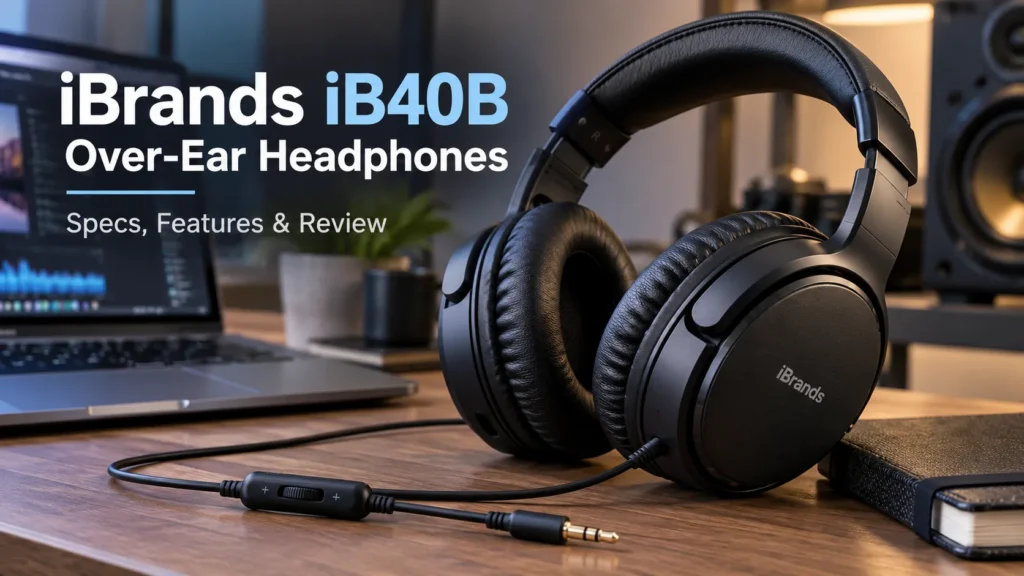
The iBrands iB40B over-the-ear headphones (black) are a legacy pair of wired stereo headphones from SDI Technologies, better documented under the iHome iB40/iB40B name. They use a standard 3.5 mm connection, include in-line volume control, and were designed as affordable full-size headphones rather than Bluetooth or modern active-noise-cancelling headphones.
One important detail should be cleared up immediately. Searches for “iBrands iB40B” often lead to this model, but iHome’s own support documentation identifies it as the iHome iB40. SDI Technologies did own the iBrands trademark for headphones and other audio accessories, and a 2013 company catalog referred to “iBrands from iHome,” which helps explain the mixed naming found online.

What Are the iBrands iB40B Over-the-Ear Headphones (Black)?
The iB40B is an older wired, full-size headphone model produced under the iHome family of products from SDI Technologies. The original manual describes the iB40 as “Studio Monitor Style Stereo Headphones with In-Line Volume Control.” iHome still maintains an official support page for the model and provides its user manual, even though major retailers no longer sell it as a normal current product.
Retail listings identify the black version as the iB40 or iB40B. Best Buy lists UPC 047532895629, while Office Depot used manufacturer number IB40BC for the black version. Newegg used the iB40B designation specifically.
iBrands vs. iHome: Why the Name Is Confusing
The “iBrands” name is not completely unrelated to the product. U.S. trademark records show that SDI Technologies registered IBRANDS for products including headphones, earphones, speakers, and battery chargers. The registration was issued in September 2011 after a claimed first commercial use in 2010.
SDI’s 2013 catalog also explicitly referred to an “iBrands from iHome” line. However, the actual iB40 manual, iHome support page, Best Buy listing, Office Depot listing, and Newegg listing all identify this particular headphone as iHome. For product identification purposes, iHome iB40/iB40B is therefore the more precise name.
iBrands iB40B Over-the-Ear Headphones (Black) Specifications
The surviving retailer listings provide a reasonably detailed picture of the hardware, although a few specifications differ between sources.
| Specification | Verified information |
|---|---|
| Brand | iHome / SDI Technologies |
| Common model names | iB40, iB40B, IB40BC |
| Color | Black |
| Headphone type | Wired, over-the-head / full-size |
| Sound | Stereo |
| Driver size | 1.57 inches, approximately 40 mm |
| Frequency response | 20 Hz to 20 kHz |
| Impedance | 32 ohms |
| Main connector | 3.5 mm stereo |
| 6.3 mm support | Supplied adapter documented by iHome |
| Volume control | In-line control on cable |
| Cable arrangement | Single-sided cable |
| Cable length | Roughly 6 to 6.56 ft depending on retailer listing |
| Wireless/Bluetooth | No |
| Active noise cancellation | Not documented |
| Original warranty | 1-year limited U.S. warranty |
Best Buy confirms the 32-ohm impedance, 20 Hz to 20 kHz frequency range, 1.57-inch driver, stereo operation, 3.5 mm connection and 6.56-foot cable. Newegg lists a six-foot cable and support for both 3.5 mm and 6.3 mm connectivity.
The cable-length difference is relatively small and may reflect rounding or packaging revisions. Because the official two-page user manual does not provide a detailed technical specification table, it is safer to report the range rather than assume one retailer’s figure is definitive.
There is also conflicting information about the magnet material. Best Buy describes the driver as using samarium cobalt, while another historical product database describes it as neodymium. With no surviving manufacturer specification confirming either version, the magnet material should be regarded as unconfirmed rather than stated as fact.
Design and Comfort
The iB40 was designed as a traditional full-size headphone with padded ear cups and an adjustable headband. The official manual says both ear cups can be moved up or down to obtain a more comfortable fit, while Newegg specifically mentions additional cushioning on the ears and headband.
Its cable exits from the left side, where the in-line volume adjustment is also positioned. That single-sided arrangement can be more convenient at a desk than a cable running independently to each ear cup.
The overall design dates to around 2010. The manual itself carries an August 25, 2010 date, while Newegg says the product was first listed there in November 2011.
That age matters if buying one today. Even unused headphones stored for many years can develop deterioration in synthetic ear-pad materials, cables, adhesives or headband padding. Condition is therefore more important than the words “new old stock” alone.
Also Read: Puma Poptop Bluetooth Speaker – New Electronics Review
Connection and Device Compatibility
The iB40B is entirely wired. Its primary connector is a standard 3.5 mm stereo plug, so no pairing, batteries, Bluetooth setup or charging is required.
iHome’s manual also confirms that a 6.3 mm plug adapter was supplied for equipment such as older stereo receivers with larger headphone sockets. That made the model suitable for both portable devices and conventional home audio equipment.
When originally sold, Office Depot described compatibility with computers, handheld game systems and Apple devices equipped with a 3.5 mm audio jack. Modern phones and tablets that lack an analog headphone port will instead require a compatible USB-C or Lightning-to-3.5 mm audio adapter.
Does It Have a Microphone?
No built-in microphone is documented in the official iB40 manual or the detailed Best Buy and Office Depot specification lists. The in-line component is described as a volume control, not a microphone or headset remote.
That makes these primarily listening headphones. Buyers wanting a headset for calls, gaming voice chat or online meetings should choose a model specifically equipped with a microphone.
Sound Performance
The iB40 uses approximately 40 mm drivers with a published frequency range of 20 Hz to 20 kHz and an impedance of 32 ohms. Those are typical specifications for consumer wired headphones from the period, but specification numbers alone do not establish sound quality.
Newegg’s archived listing describes the sound as detailed and rich, but that is manufacturer or retailer marketing rather than an independent laboratory assessment. Reliable measurements of frequency-response accuracy, distortion, isolation and channel matching for this model are difficult to find.
The available user commentary is similarly limited. In a 2014 Cheap Ass Gamer discussion, one owner described the iB40 as acceptable for the low price and another considered it good value, but such comments are anecdotal and should not be treated as controlled audio testing.
For that reason, claims that the iB40 is a genuinely neutral “studio monitor” headphone would go beyond the available evidence. Studio monitor style is how iHome described the product’s design and positioning, not proof that it offers professional reference-grade tuning.
Using the In-Line Volume Control Correctly
The official manual contains a useful detail that is easy to overlook. iHome warned that setting one volume control very low and the other very high could produce unsatisfactory or distorted sound.
The company recommended starting with the playback device around the middle of its volume range and using the headphone’s in-line control for final adjustment.
Are the iB40B Headphones Noise Cancelling?
They should not be confused with modern active noise-cancelling headphones.
Office Depot historically described the iB40 as having a “noise-canceling design,” but the official manual does not document microphones, electronic noise-cancellation circuitry, a battery or an ANC switch. Instead, iHome says the studio-monitor-style ear cups can block outside sounds.
The most defensible description is therefore passive noise isolation. The physical ear cups reduce some surrounding noise simply by covering the ears. They do not appear to generate electronic anti-noise signals like contemporary ANC headphones from Sony, Bose or similar brands.
That distinction is especially important when evaluating old product listings, where “noise cancelling” and “noise isolating” were sometimes used loosely.
Safety and Hearing Considerations
The original iHome manual specifically warns against listening at high volume for extended periods. It also cautions that the ear cups may reduce awareness of external warning sounds and says the headphones should not be used when that isolation would create a safety risk, such as while driving or cycling.
Starting at a low listening level and increasing only as needed is sensible, particularly because the headphones include a separate in-line volume control in addition to the source device’s volume setting.

Original Price and Current Availability
The iB40 was positioned as a budget headphone rather than a premium audiophile model. Office Depot’s surviving page shows a $24.99 price, while a period article from the early 2010s mentioned a $29.99 price.
By October 2026, however, the product is clearly a legacy model in normal retail channels:
- Best Buy says it is “no longer available in new condition.”
- Office Depot marks the product “Item no longer available.”
- Newegg lists the iB40B as out of stock and says it may or may not be restocked.
The official iHome support page remains online, which is useful for documentation but should not be mistaken for evidence that the headphones are still in current production.
Recent secondary-market listings show that used examples or unopened old stock can still surface. One eBay search result, for example, recently showed a new-old-stock iB40 listing at $39.99, although resale prices and availability can change quickly.
Is the iBrands iB40B Worth Buying Today?
The iB40B can still make sense if you find a clean, working pair very cheaply and specifically want simple wired over-ear headphones with an in-line volume wheel. There is no battery to age, no Bluetooth version to become obsolete and no app or account requirement.
At anything close to its original $25 to $30 price, however, newer headphones are usually easier to recommend. The age of the ear pads and cable, lack of manufacturer retail availability, absence of a microphone and lack of modern features reduce the appeal of paying a collector-style premium.
For a used pair, check:
- both left and right drivers before buying;
- the in-line volume wheel for crackling or dropouts;
- the cable near the plug and ear cup for intermittent sound;
- the ear pads for cracking or flaking;
- the headband adjustment mechanism;
- whether the original 6.3 mm adapter is included.
The model makes more sense as an inexpensive legacy headphone than as a serious upgrade over modern alternatives.
Current Alternatives to the iB40B
Koss UR20
The Koss UR20 is one of the closest current alternatives because it remains a full-size wired over-ear design. Koss currently lists it at $24.99, with 32-ohm impedance, a 30 Hz to 20 kHz response, an eight-foot single-entry cable and closed ear cushions.
Its current availability and manufacturer support make it a more straightforward purchase than hunting for an old iB40B at a similar price.
Sony MDR-ZX110
For buyers who mainly want an inexpensive wired headphone, Sony’s MDR-ZX110 is another current option. Sony’s U.S. store recently listed the black version at $9.99, with 3.5 mm connectivity, 1.38-inch dynamic drivers and a 12 Hz to 22 kHz specified frequency range.
The major difference is fit: the MDR-ZX110 is an on-ear design, so it is not a direct full-size replacement for the iB40B.
Main Advantages and Limitations
The iB40B’s strongest qualities are its simplicity and conventional connectivity. A 3.5 mm wired connection has virtually no setup, the in-line volume control is convenient, and the supplied 6.3 mm adapter expands compatibility with traditional stereo equipment.
Its weaknesses are mostly consequences of age. It lacks Bluetooth, there is no documented microphone, there is no verified active noise cancellation, current first-party retail availability has effectively disappeared, and replacement pads or model-specific spare parts may be difficult to source.
Another limitation is the lack of trustworthy modern measurement data. Specifications confirm what the headphones are, but they do not provide enough evidence to make strong claims about tonal accuracy, bass extension or professional monitoring performance.
FAQ
Are the iBrands iB40B headphones actually made by iHome?
Yes. The product is consistently documented by iHome, Best Buy, Office Depot and Newegg as the iHome iB40 or iB40B from SDI Technologies. SDI also owned the iBrands trademark and described an “iBrands from iHome” line, which likely explains why the alternative brand name appears in searches.
Are the iB40B headphones Bluetooth?
No. The iB40B is a wired stereo headphone that connects through a 3.5 mm plug. There is no Bluetooth functionality or charging requirement documented for this model.
Do iHome iB40B headphones have active noise cancellation?
There is no reliable evidence that they use electronic active noise cancellation. The official manual instead explains that the full-size design can block outside sounds, indicating passive isolation.
What is the impedance of the iB40B?
Best Buy and Office Depot both specify 32 ohms. That specification was common for consumer wired headphones intended for ordinary portable and home audio equipment.
Do the iB40B headphones work with a 6.3 mm stereo jack?
Yes, when used with the supplied adapter. iHome’s official manual specifically instructs users to attach the 6.3 mm adapter to the standard 3.5 mm plug when connecting the headphones to older receivers with larger headphone sockets.
Can you still buy the iB40B new?
Major retailers no longer appear to carry it as a current new product. Best Buy says it is no longer available in new condition, Office Depot marks it unavailable, and Newegg lists it as out of stock, although unopened old stock can occasionally appear through resale marketplaces.
Also Read: Who Delivers Your Offer to the Seller Framework: How It Works
