


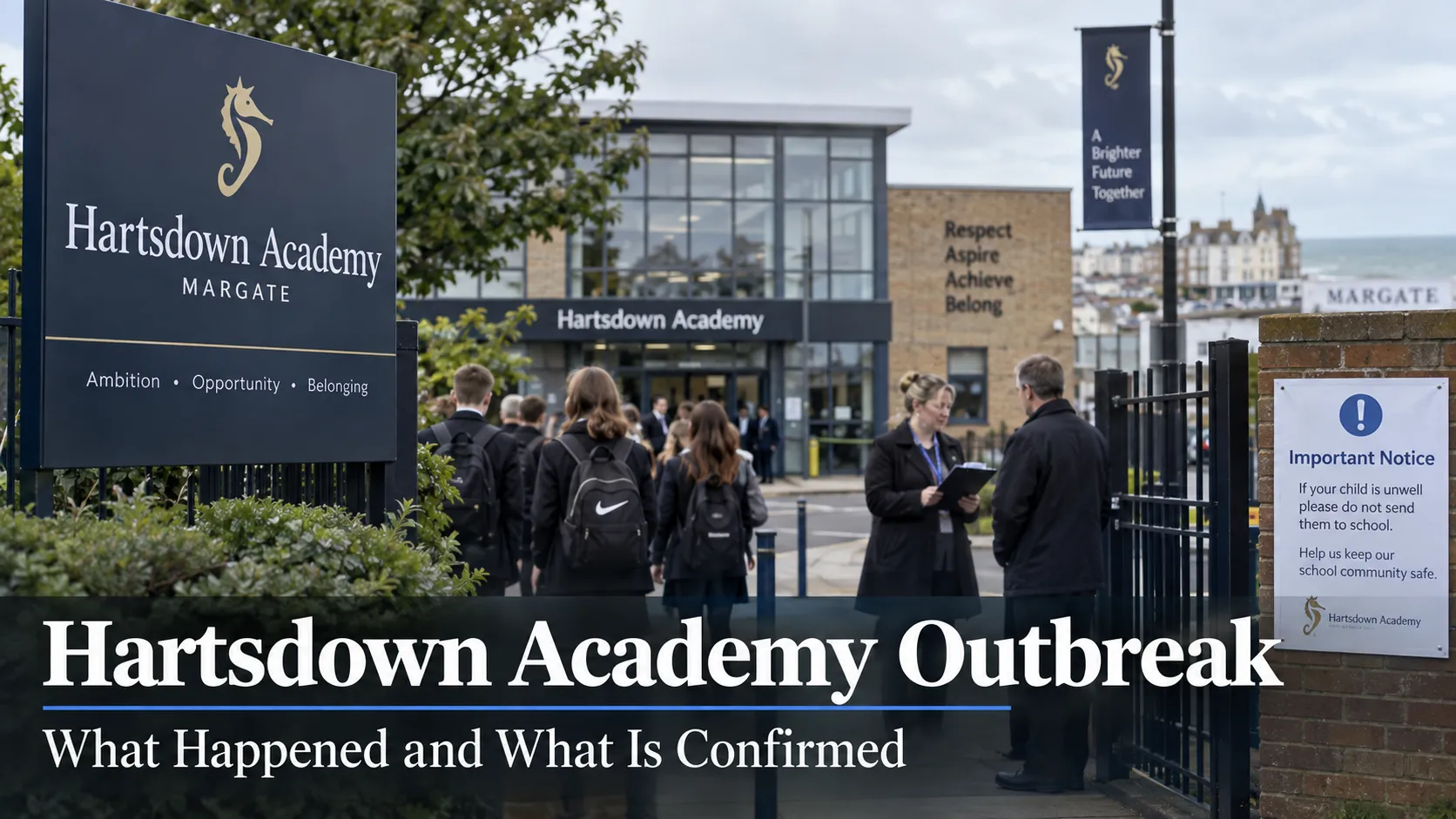
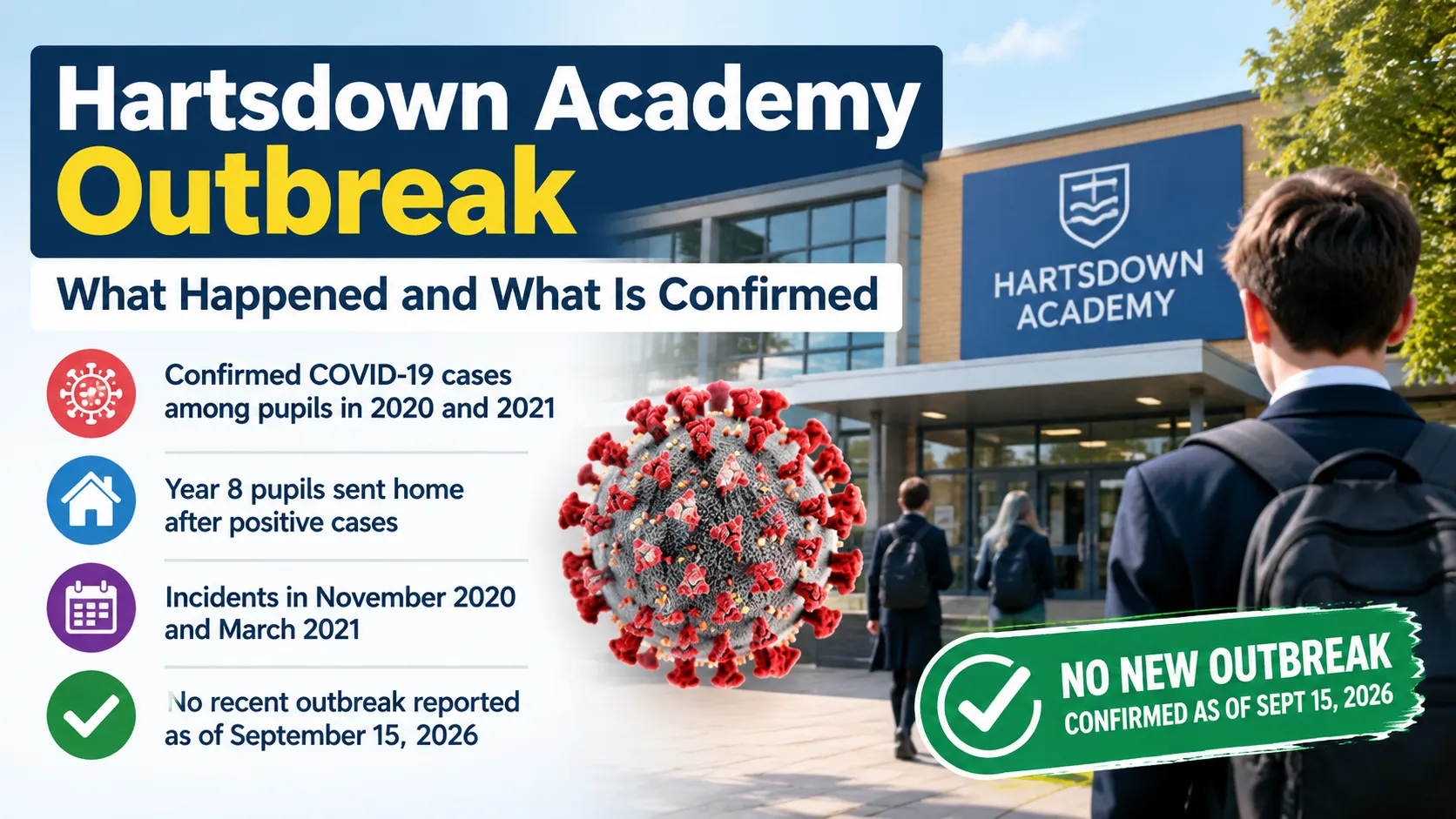
The Hartsdown Academy outbreak search appears to refer mainly to confirmed COVID-19 cases that affected pupils at the Margate secondary school during the pandemic, particularly incidents in November 2020 and March 2021. As of September 15, 2026, there is no credible recent public report identified in current sources confirming a new infectious disease outbreak at Hartsdown Academy.
Historical reporting shows that Year 8 pupils were sent home following confirmed coronavirus cases on more than one occasion. These incidents occurred while COVID-19 transmission was widespread across Thanet and schools throughout England were operating under much stricter isolation rules than those used today.
What Does the Hartsdown Academy Outbreak Refer To?
Hartsdown Academy is a mixed secondary school and sixth form on George V Avenue in Margate, Kent. Current Department for Education records list the academy as open, with Ian Wallace as headteacher and 868 pupils on roll. The school is part of Coastal Academies Trust.
There is no single recent event officially identified in available public records as the “Hartsdown Academy outbreak.” Instead, the phrase is most closely associated with coronavirus cases reported at the school during 2020 and 2021.
Importantly, contemporary reports generally described confirmed COVID-19 cases rather than stating that UK public health authorities had formally classified Hartsdown Academy itself as the site of a large outbreak. That distinction matters because a confirmed infection affecting a school cohort is not automatically the same as a formally declared outbreak involving numerous linked cases.
Hartsdown Academy Outbreak Timeline
The clearest publicly documented incidents occurred during two particularly disruptive stages of the COVID-19 pandemic.
| Date | Confirmed development | Action reported |
|---|---|---|
| Autumn 2020 | COVID-19 cases had been reported at Hartsdown Academy alongside many other Thanet schools | Affected pupils and contacts were managed under the isolation rules then in force |
| November 16, 2020 | A confirmed COVID-19 case affected Year 8 | Year 8 pupils were sent home and were expected to return on November 30 |
| March 12, 2021 | Another confirmed COVID-19 case was identified in Year 8 | Affected pupils were told to self-isolate, with return planned for March 22 if well |
November 2020: Year 8 Sent Home
On November 16, 2020, local reporting confirmed that Year 8 at Hartsdown Academy had been sent home following a confirmed COVID-19 case. Pupils were expected to return on November 30.
The incident took place during a substantial rise in coronavirus infections across Thanet. The same report, citing Kent public health data, recorded a weekly COVID-19 rate of 467.9 cases per 100,000 people in Thanet between November 6 and November 12, 2020, compared with an England rate of 269.5 at that time. Numerous schools across the district had recorded infections.
This wider context is important. Hartsdown Academy was not experiencing coronavirus in isolation. Schools across Thanet, including Ursuline College, St George’s, King Ethelbert School and several primary schools, were dealing with cases, pupil isolation and staffing pressures during the same period.
The available report does not provide evidence that the entire Hartsdown Academy campus closed because of this particular case. It specifically identifies Year 8 as the group sent home.
March 2021: Another Confirmed COVID-19 Case
A second clearly documented incident occurred shortly after pupils in England returned to face to face education following the winter lockdown.
On Friday, March 12, 2021, Hartsdown Academy became aware of a confirmed coronavirus case involving Year 8. Contemporary reporting published on March 15 said parents and carers received a letter explaining that affected children needed to self-isolate.
The school’s then headteacher, Matthew Tate, confirmed in the parent communication that there was a COVID-19 case in Year 8. The affected pupils were expected to remain isolated through March 21 and return to normal activities from Monday, March 22 if they remained well.
At the time, pupils had only recently returned to face to face lessons on March 8 following national restrictions. Testing and isolation rules were therefore considerably stricter than the public health rules used in 2026.
Was There Really a Large Outbreak at Hartsdown Academy?
Available evidence supports saying that confirmed COVID-19 cases occurred at Hartsdown Academy and caused groups of pupils to isolate, but it does not support inventing a specific case total or describing the historical incidents as a major school wide outbreak without qualification.
The November 2020 report refers to a confirmed case that led to Year 8 being sent home. The March 2021 report similarly identifies a confirmed Year 8 case and subsequent isolation. Neither of these reports provides a verified number showing a large cluster of infections inside the academy itself.
For that reason, claims online suggesting that hundreds of Hartsdown pupils were infected, that a particular disease swept through the entire school, or that the academy experienced a major unexplained health emergency should not be treated as fact unless supported by Hartsdown Academy, UK Health Security Agency, Kent public health officials or another reliable source.
Is There a Hartsdown Academy Outbreak in 2026?
There is no credible recent public report identified as of September 15, 2026 confirming an active infectious disease outbreak at Hartsdown Academy.
Current Department for Education information continues to list Hartsdown Academy as an open secondary school. The official school website is also operating normally and provides current school information, including the school day, admissions and sixth form provision.
This does not mean individual pupils can never develop COVID-19, influenza, norovirus or other common infections. Schools routinely experience isolated cases of infectious illness that never become publicly reported outbreaks.
It is therefore important to distinguish between historical COVID-19 reports and any claim circulating today. An old article from 2020 or 2021 can easily reappear in search results or on social media without its original date being immediately obvious.
Why Were So Many Pupils Sent Home for a Single COVID-19 Case?
COVID-19 rules in 2020 and early 2021 were substantially different from the rules used today.
At the time of the Hartsdown incidents, people identified as close contacts of confirmed cases could be instructed to self-isolate for extended periods. Schools often organised pupils into year group or class “bubbles,” meaning a confirmed infection could result in a large group being sent home even when only one person’s infection had initially been confirmed.
Hartsdown Academy also maintained COVID related remote learning arrangements during the pandemic. Its archived COVID information explains that students could follow live lessons remotely while national restrictions kept most pupils away from normal face to face schooling.
Those historic arrangements should not be interpreted as current school policy.
How Schools Handle COVID-19 and Respiratory Illness in 2026
UK Health Security Agency guidance has changed considerably since the period covered by the original Hartsdown reports.
Current UKHSA guidance states that children and young people with mild respiratory symptoms, such as a slight cough, sore throat or runny nose, can generally attend an education setting when they otherwise feel well and do not have a high temperature. Someone with more significant respiratory symptoms, including a high temperature, should stay away until they are well enough to return.
For someone aged 18 or younger who receives a positive COVID-19 test, current guidance says they should stay away from the education setting for three days. They can generally return after that period if they feel well and do not have a high temperature.
Routine COVID-19 testing of children is no longer recommended in the way it was during 2020 and 2021 unless a healthcare professional advises testing.
These rules can be updated, so parents dealing with an actual illness should use the latest UKHSA, NHS or school guidance rather than relying on pandemic era articles.
When Does Illness Become an Outbreak Concern?
UKHSA guidance advises education settings to pay particular attention when illness becomes unusually common or severe.
For respiratory infections, schools should consider contacting their local Health Protection Team when there is an unusually high number of absences, absences are increasing rapidly, or a serious respiratory infection has resulted in someone requiring hospital care.
During an outbreak or suspected outbreak, recommended measures may include keeping unwell people away from the setting, improving ventilation, reinforcing hand and respiratory hygiene, increasing appropriate cleaning and communicating relevant information to families.
UKHSA also stresses regular hand washing and good cough etiquette. These measures are useful not only for COVID-19 but also for influenza and many other infections that spread through schools.
What About Vomiting, Norovirus or Other Illnesses?
There is no reliable evidence in the sources reviewed linking the historical Hartsdown Academy outbreak search specifically to norovirus, food poisoning, measles, scarlet fever or another non COVID illness.
Current UKHSA rules vary according to the infection. For example, pupils experiencing diarrhoea or vomiting should generally remain away from school until 48 hours after the symptoms have stopped. The same 48 hour period applies to norovirus.
There is also no basis for assuming the historical Hartsdown incidents were caused by school food. In fact, the Food Standards Agency’s current record for Hartsdown Academy shows that an inspection on March 13, 2026 assessed hygienic food handling, the cleanliness and condition of the facilities, and food safety management as “very good.”
That inspection does not prove that illness can never occur, but it provides useful current evidence about the school’s food hygiene standards.
How Parents Can Verify a New Hartsdown Academy Outbreak Claim
A social media post, old screenshot or recycled news story should not be treated as confirmation of a current outbreak.
The most useful checks are:
- Look at the publication date. The best documented Hartsdown COVID incidents occurred in November 2020 and March 2021.
- Check communications issued directly by Hartsdown Academy.
- Look for information from UKHSA, Kent public health authorities or the NHS if a significant health incident is being reported.
- Check whether reputable local news organisations are reporting a new event with named, attributable sources.
- Do not assume that high pupil absence automatically proves an infectious disease outbreak.
The school’s current official record lists Hartsdown Academy at George V Avenue, Margate, Kent, CT9 5RE, with Ian Wallace as headteacher.
Frequently Asked Questions
Is there currently a Hartsdown Academy outbreak?
No new infectious disease outbreak at Hartsdown Academy was confirmed in the credible recent public sources reviewed as of September 15, 2026. Searches for the term mainly lead back to COVID-19 incidents from the pandemic period.
What illness caused the Hartsdown Academy outbreak?
The best documented incidents involved COVID-19. Reports confirmed coronavirus cases affecting Year 8 in November 2020 and March 2021.
Did Hartsdown Academy close because of COVID-19?
Hartsdown Academy participated in national pandemic restrictions and remote education arrangements. For the specifically reported November 2020 and March 2021 incidents, available coverage says Year 8 pupils were sent home, rather than establishing that the whole academy closed because of those particular cases.
When was the most clearly reported Hartsdown Academy COVID case?
A confirmed case affecting Year 8 was reported on November 16, 2020. Another confirmed Year 8 case was identified on March 12, 2021 and publicly reported on March 15.
How long should a child stay off school after a positive COVID-19 test now?
Under current UKHSA guidance, a person aged 18 or younger who tests positive should generally stay away from their education setting for three days. They can return after that if they feel well and do not have a high temperature.
When should a school contact public health officials about respiratory illness?
UKHSA advises education settings to seek Health Protection Team advice when respiratory illness causes unusually high or rapidly increasing absence, or when a serious case has resulted in hospital admission.
Also Read: Maidstone Romney Place Emergency Response | What Happened?
