


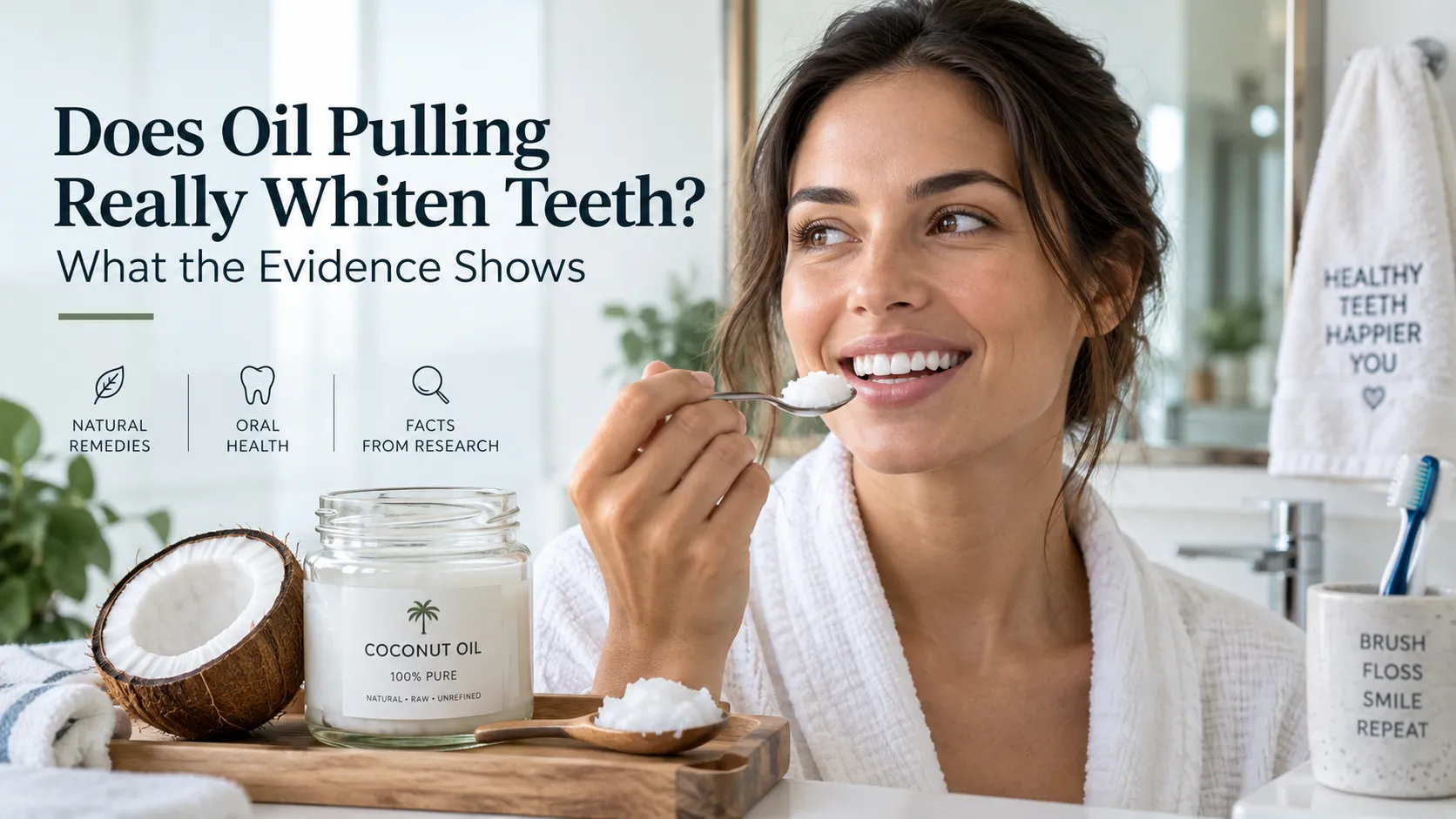
No, current scientific evidence does not show that oil pulling reliably whitens teeth. The American Dental Association says there are no reliable studies demonstrating that oil pulling changes tooth color, and modern systematic reviews of oil pulling have focused mainly on plaque, bacteria, and gum health rather than proving a whitening effect.
Oil pulling has become especially popular with coconut oil, often promoted online as a natural alternative to whitening strips or professional bleaching. Some people report that their teeth look cleaner or brighter after using it, but looking cleaner is not the same as actually bleaching or changing the natural shade of a tooth.
Understanding that difference explains why oil pulling may leave the mouth feeling fresh while still failing to qualify as a proven teeth-whitening treatment.
What Is Oil Pulling?
Oil pulling is a traditional oral practice that involves swishing edible oil around the mouth and between the teeth before spitting it out. Coconut, sesame, sunflower, and olive oils have all been used. The practice has historical roots in India and southern Asia.
Modern versions commonly involve swishing approximately a tablespoon of oil for several minutes, sometimes for as long as 20 minutes.
Claims surrounding oil pulling have expanded far beyond its traditional use. Social media posts frequently suggest that it can whiten teeth, reduce plaque, eliminate harmful bacteria, prevent cavities, improve gum health, and treat bad breath.
The evidence does not support all of those claims equally.
Does Oil Pulling Really Whiten Teeth According to Research?
There is currently no convincing clinical evidence that oil pulling produces measurable tooth whitening.
The ADA’s scientific review of tooth whitening specifically notes an absence of documented tooth whitening from oil pulling. Its consumer guidance is equally clear that reliable scientific studies have not shown oil pulling to whiten teeth.
This matters because genuine tooth whitening normally needs to be demonstrated with objective measurements, such as changes in standardized tooth shades or color measurements before and after treatment. Personal impressions in a mirror are not enough to establish a bleaching effect.
Recent research into oil pulling has instead concentrated on outcomes such as plaque scores, gingival inflammation, and bacterial levels.
A 2024 systematic review and meta-analysis included 25 trials involving 1,184 participants. It found a possible benefit for some measures of gingival health, but the overall certainty of the evidence was rated very low, and chlorhexidine was more effective than oil pulling for reducing plaque. Tooth whitening was not established as a proven benefit.
A newer 2026 systematic review also reported that coconut or sesame oil pulling may produce moderate reductions in microbial load and some improvements in gingival health. The authors emphasized substantial variation and methodological limitations in the available studies. Again, the review did not establish oil pulling as an effective tooth-whitening treatment.
Why Might Teeth Look Brighter After Oil Pulling?
Someone may genuinely feel that their smile looks cleaner after oil pulling without their teeth becoming chemically whiter.
Swishing liquid around the mouth can loosen food debris and temporarily change how clean tooth surfaces feel. A cleaner, wetter surface may also appear somewhat brighter under certain lighting.
That is different from bleaching the tooth.
Tooth whitening generally falls into two categories.
Surface stain removal removes colored material sitting on enamel. Professional polishing and many whitening toothpastes work primarily this way.
Bleaching chemically changes colored compounds within the tooth. Hydrogen peroxide and carbamide peroxide are the main bleaching ingredients used in established whitening systems.
Coconut or sesame oil does not work through the peroxide-based oxidation process used in conventional dental bleaching. There is therefore no established biological or clinical basis for expecting ordinary oil pulling to lighten intrinsic tooth color in the same way as peroxide.
Oil Pulling Versus Real Teeth Whitening
The difference becomes clearer when common methods are compared.
| Method | Main action | Evidence for whitening |
|---|---|---|
| Oil pulling | Swishes edible oil around teeth and gums | No reliable evidence of measurable whitening |
| Whitening toothpaste | Mainly removes external surface stains through polishing or other ingredients | Can reduce some extrinsic stains |
| Peroxide whitening strips | Chemically bleaches colored compounds | Established whitening effect when appropriate products are used correctly |
| Dentist-supervised home whitening | Uses controlled peroxide formulations | Established bleaching treatment |
| Professional in-office whitening | Uses professionally managed bleaching agents | Established treatment for suitable patients |
The ADA explains that hydrogen peroxide and carbamide peroxide can penetrate dental hard tissues and chemically alter compounds responsible for discoloration. Whitening toothpastes, by comparison, generally work more on external stains through mechanical stain removal.
Oil pulling has not demonstrated a comparable bleaching action.
What About Coconut Oil Specifically?
Coconut oil is the oil most strongly associated with modern oil-pulling trends, but there is no good evidence that coconut oil whitens teeth.
A 2020 systematic review examined four randomized controlled trials involving 182 participants using coconut-oil pulling. Some findings suggested possible reductions in bacterial counts and plaque, but the authors described the evidence as insufficient for firm conclusions because the trials were small, short, heterogeneous, and at risk of bias.
Importantly, reduced plaque is not equivalent to whitening.
A tooth can have less plaque without becoming a lighter shade. Likewise, removing debris from the surface may make teeth look cleaner without altering the underlying color of enamel or dentin.
The ADA therefore continues to state that there is no reliable scientific evidence showing coconut-oil pulling whitens teeth.
Can Oil Pulling Remove Yellow Teeth?
It depends on why the teeth look yellow, but oil pulling should not be expected to correct true discoloration.
Dental discoloration can be extrinsic, meaning stain is located mainly on the tooth surface, or intrinsic, meaning the color originates within enamel or dentin. Coffee, tea, tobacco, and strongly pigmented foods can contribute to external staining, while aging, certain developmental conditions, trauma, and some medications can contribute to internal discoloration.
Oil pulling has not been shown to reliably treat either type.
For surface staining, professional cleaning or an appropriately formulated whitening toothpaste may be useful. Intrinsic discoloration generally requires a bleaching approach or another treatment chosen according to the underlying cause.
A naturally yellow appearance can also come from dentin showing through enamel. Oil cannot remove that natural internal color.
Does Oil Pulling Have Any Oral Health Benefits?
The evidence is more interesting here than it is for whitening, but it remains uncertain.
A 2022 meta-analysis of nine randomized controlled trials found that oil pulling was associated with reduced salivary bacterial colony counts. However, researchers found no significant difference between oil pulling and control groups for plaque or gingival index scores overall. They concluded that better-designed trials were needed.
The larger 2024 review found a probable improvement in some measures of gingival health, but chlorhexidine remained better for reducing plaque and the overall certainty of evidence was very low.
The 2026 review reached a similarly cautious position. Some traditional oral hygiene methods, including oil pulling, may affect microbial load or gum health, but study quality and inconsistent methodologies make strong conclusions difficult.
So it is reasonable to say that oil pulling is being investigated for oral-health effects. It is not reasonable to turn those preliminary findings into a claim that it has been proven to whiten teeth, prevent cavities, or replace standard dental care.
Oil Pulling Should Not Replace Brushing and Interdental Cleaning
Even people who choose to oil pull should not treat it as an alternative to evidence-based oral hygiene.
The ADA recommends brushing twice daily with fluoride toothpaste and cleaning between the teeth every day. Regular dental care is also important for preventing and detecting cavities, gum disease, and other oral problems.
Fluoride toothpaste provides benefits that edible oils do not. Fluoride helps protect teeth against decay and supports enamel remineralization.
Oil pulling also does not physically clean all tooth surfaces as predictably as proper brushing and interdental cleaning.
Is Oil Pulling Safe?
For many healthy adults, occasionally swishing food-grade oil and spitting it out is unlikely to cause a major problem. That does not mean the practice is completely risk-free.
Swallowing significant amounts of oil may cause gastrointestinal discomfort. More importantly, rare medical case reports have linked repeated oil pulling with exogenous lipoid pneumonia, a condition caused when oily material enters the lungs. Published reports have described cases associated with both general oil pulling and repeated sesame-oil pulling.
That complication appears uncommon, but it is particularly relevant for anyone with difficulty swallowing or an increased risk of aspiration.
Oil pulling should also not delay dental treatment. Persistent tooth discoloration can occasionally result from decay, trauma, problems affecting the dental pulp, or other conditions that cannot be corrected with whitening products.
What Actually Works for Whiter Teeth?
The appropriate whitening method depends on the type of discoloration and the condition of the teeth.
For uncomplicated external staining, regular brushing and professional dental cleaning may make a significant visual difference. Whitening toothpastes can also help remove some surface stains.
For genuine bleaching, peroxide-based systems have much stronger evidence. Hydrogen peroxide and carbamide peroxide are commonly used in whitening strips, gels, dentist-provided trays, and professional procedures.
Whitening is not suitable for every situation. Tooth-colored restorations such as crowns, fillings, and veneers do not bleach in the same way as natural teeth, which can result in uneven color. The ADA also notes that temporary tooth sensitivity and gum irritation are among the most common adverse effects of conventional vital-tooth whitening.
Anyone with cavities, gum problems, significant sensitivity, extensive dental restorations, or unexplained discoloration should consider having the teeth assessed before beginning a whitening regimen.
How to Keep Teeth Looking Naturally Brighter
Daily habits can help prevent new surface staining even if they cannot change the natural internal color of teeth.
Brush twice daily with fluoride toothpaste and clean between the teeth once each day. Regular dental cleanings can remove deposits that cannot be eliminated effectively at home.
Frequent exposure to coffee, tea, red wine, tobacco, and other strongly pigmented substances can contribute to external staining. Limiting those exposures and maintaining effective oral hygiene can help preserve tooth appearance.
These habits are less dramatic than viral whitening hacks, but they have a much stronger foundation in dental science.
The Bottom Line
If the question is does oil pulling really whiten teeth, the best evidence-based answer is no, not in any reliably demonstrated way. Research suggests oil pulling may influence certain bacteria or gum-health measures, but those possible effects should not be confused with genuine tooth bleaching.
For a measurable change in tooth shade, established stain-removal methods or appropriately used peroxide-based whitening treatments have substantially better evidence. Oil pulling, if someone chooses to do it, should remain an optional practice rather than a replacement for brushing, interdental cleaning, dental treatment, or proven whitening methods.
Frequently Asked Questions
Does coconut oil actually make teeth whiter?
There is no reliable clinical evidence showing that coconut oil produces measurable tooth whitening. Teeth may temporarily appear cleaner after swishing, but the ADA does not recognize coconut-oil pulling as a proven whitening treatment.
How long does oil pulling take to whiten teeth?
There is no scientifically established whitening timeline because oil pulling itself has not been shown to reliably whiten teeth. Claims that noticeable bleaching occurs after several days or weeks are not supported by strong clinical evidence.
Can oil pulling remove coffee or tea stains?
It has not been demonstrated to reliably remove these stains. Coffee and tea commonly cause extrinsic discoloration, which is better addressed through effective brushing, professional cleaning, stain-removing toothpaste, or appropriate whitening treatment.
Should I oil pull before or after brushing?
There is no clinically established sequence that improves whitening because oil pulling is not a proven whitening method. Regardless of when someone chooses to oil pull, it should not replace twice-daily brushing with fluoride toothpaste or daily interdental cleaning.
Can I oil pull every day?
Some people do, but evidence is insufficient to establish meaningful benefits from long-term daily use. People with swallowing difficulties or aspiration risk should be particularly cautious because rare cases of lipoid pneumonia associated with oil pulling have been reported.
What is the most evidence-based way to whiten teeth?
For genuine bleaching, hydrogen peroxide or carbamide peroxide products have a well-established role in dentistry. The most suitable method depends on the cause of discoloration, existing restorations, sensitivity, and overall dental health.
Also Read: Full Mouth Reconstruction vs Smile Makeover Contribute to Our Blog
