


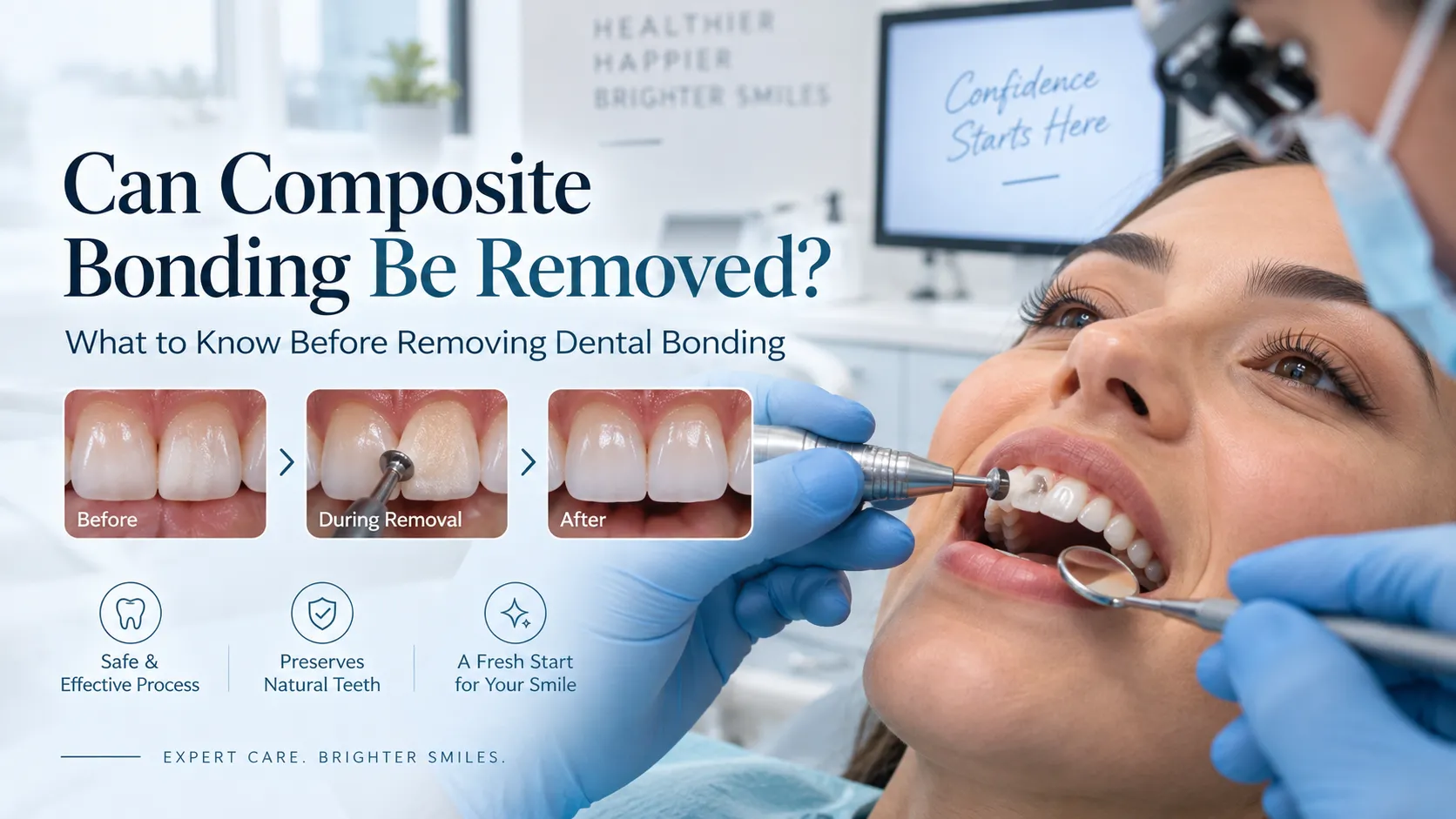
Yes, composite bonding can usually be removed by a dentist. However, describing it as completely “reversible” can be misleading because the condition of the natural tooth afterward depends on how the tooth was prepared originally and how carefully the resin is removed.
Composite bonding uses tooth-colored resin that is attached to enamel, dentine, or existing restorative material. In many cosmetic cases, little or no natural tooth structure is intentionally removed before the resin is placed. That makes composite easier to alter, repair, replace, or remove than many indirect restorations, but removal is still a clinical procedure that requires precision.
Can Composite Bonding Be Removed Completely?
In many cases, a dentist can remove virtually all visible composite resin and polish the tooth so that it closely resembles its appearance before treatment.
The important question is not simply whether the composite can be removed. It is whether the underlying tooth was altered before the bonding was placed.
A small piece of additive bonding used to repair a chipped edge may involve almost no mechanical reduction of the tooth. Removing that material may therefore leave a tooth that is very close to its original shape.
A full composite veneer can be different. Some direct composite veneers are created with minimal preparation, while others require contouring or reduction of enamel to make room for the restoration. A clinical study of direct composite veneers, for example, described a minimally invasive preparation approach rather than assuming that every veneer was placed without tooth preparation.
If enamel was deliberately removed before the bonding was placed, taking away the resin cannot restore that lost enamel.
Why Composite Bonding Is Often Called Reversible
Composite bonding is frequently described as reversible because it can be considerably more conservative than treatments that require substantial tooth preparation.
The term needs context.
Composite resin is held to the tooth through an adhesive process. Conventional bonding commonly involves conditioning enamel with phosphoric acid. Research published in the British Dental Journal explains that acid etching produces microscopic porosities in enamel that allow resin to achieve strong micromechanical retention.
That microscopic change is very different from deliberately drilling away a large amount of tooth structure. Still, it means that “nothing whatsoever happens to the tooth” is not an accurate description of bonded dentistry.
A more useful way to think about reversibility is this:
| Original treatment | What removal may mean |
|---|---|
| Small additive edge bonding with no tooth reduction | The tooth may remain very close to its original shape |
| Gap closure mainly created by adding composite | Much of the original enamel may remain intact |
| Full composite veneer with minimal preparation | Removal is possible, but some surface alteration may remain |
| Composite placed after deliberate enamel reduction | The original tooth shape cannot be fully restored simply by removing the resin |
| Composite replacing missing, worn, fractured, or decayed tooth structure | Removal would expose the underlying defect or missing tooth structure |
This is why patients considering removal should ask what was done to the teeth before their original bonding procedure.
How Is Composite Bonding Removed?
Composite bonding is normally removed mechanically by a dentist using fine dental instruments designed to reduce resin while protecting the underlying tooth as much as possible.
The dentist first needs to identify where the composite ends and the natural enamel begins. This can be challenging because modern composite is specifically selected to imitate the color and optical characteristics of natural teeth.
The bulk of the composite may be gradually reduced with fine burs. As the dentist approaches the enamel surface, progressively finer instruments and polishing systems can be used to remove residual resin and smooth the surface.
A Brazilian clinical study registered in 2026 specifically investigating conservative removal of direct composite veneers illustrates this approach. Its protocol uses a multilaminated bur for initial reduction, a finer 30-blade bur for residual composite and adhesive, followed by progressive polishing. The researchers are measuring changes including tooth dimensions, color, occlusion, gingival condition and marginal integrity.
As of September 2026, the registry lists that study as recruiting, so it should not be treated as evidence that the technique has already been proven to cause no enamel loss. It does, however, show how carefully controlled composite veneer removal is being studied.
Can Removing Composite Bonding Damage Enamel?
Yes, enamel can potentially be altered during composite removal. The objective is to minimize that alteration, not to assume that zero enamel change is guaranteed.
Direct high-quality research specifically examining cosmetic composite veneer removal remains limited. Much of the detailed evidence about removing bonded resin from enamel comes from orthodontic dentistry, where adhesive left after brackets are removed must also be cleaned from the tooth.
A systematic review examining orthodontic adhesive removal found that no technique could reliably remove resin without some alteration of the enamel surface. Tungsten carbide burs were effective but could remove enamel and increase surface roughness, while finishing and polishing helped produce a smoother final surface.
A more recent systematic review similarly found that orthodontic debonding and removal of adhesive generally produce some degree of enamel alteration, even when that damage is not obvious clinically.
These orthodontic findings should not be interpreted as an exact measurement of the risks of removing cosmetic bonding. The amount, location and thickness of resin are different. They are useful, however, because they demonstrate an important principle: removing material that has been strongly bonded to etched enamel requires careful control.
Operator technique matters considerably. Speed, pressure, instrument choice, visibility and the ability to distinguish composite from enamel can all affect how much natural tooth structure is disturbed.
What Determines Whether Your Teeth Can Return to Their Original Appearance?
The most important factor is the condition of the tooth underneath the bonding.
If composite was simply added to an intact tooth, there may be relatively little structural difference after careful removal. If the tooth was reshaped before treatment, its previous anatomy no longer physically exists.
Existing dental problems can also become visible after removal. Bonding may have been used to cover:
tooth wear, fractures, developmental enamel defects, old restorations, discoloration or irregular tooth shape.
Removing the composite does not correct those underlying conditions.
Color can also be an issue. The exposed natural tooth may not match neighboring teeth exactly, particularly if teeth have changed color over time or whitening has been performed while composite restorations were present.
When Might Someone Want Composite Bonding Removed?
Removal does not necessarily mean the original treatment has failed. People may choose it because their dental or cosmetic goals have changed.
Common reasons include old composite that has stained or lost surface polish, chipped restorations, bonding that feels too thick, dissatisfaction with tooth shape, replacement of older restorations, preparation for another cosmetic treatment, or a desire to reassess the natural teeth.
Sometimes complete removal is unnecessary. Composite is repairable, so a dentist may be able to polish staining, correct an uneven contour, repair a chipped section, or replace only part of the restoration.
That can preserve more tooth structure than repeatedly removing and replacing an entire restoration.
Can Composite Bonding Be Removed and Redone?
Yes. Existing bonding can often be replaced with new composite when there is a good clinical reason to do so.
The dentist should first check why the old restoration needs replacement. If the problem is only superficial staining or minor damage, repair may be more conservative.
When replacement is necessary, the existing material can be reduced, defective areas removed and new composite bonded according to the condition of the remaining tooth and restoration.
The final result will depend on the amount of healthy enamel remaining, the bite, the position of the teeth, the condition of the gums and the reason the original bonding deteriorated.
Can You Leave the Teeth Natural After Composite Removal?
Sometimes, yes.
If bonding was predominantly additive and the underlying teeth remain healthy and cosmetically acceptable, a dentist may polish the enamel and leave the teeth without another restoration.
That option is less realistic when the original treatment involved substantial reshaping, when composite replaced lost tooth structure, or when removal exposes an aesthetic or structural problem that still requires treatment.
The decision should therefore be based on the actual tooth underneath rather than on the assumption that every bonded tooth can simply be returned to exactly how it looked before treatment.
What Can Replace Composite Bonding After Removal?
Removing bonding does not automatically mean another restoration is required.
Depending on the reason for removal, options may include leaving the natural tooth untreated, replacing the composite, orthodontic treatment for spacing or alignment, whitening natural teeth, or using another restorative treatment when clinically justified.
Porcelain veneers should not be viewed as an automatic upgrade. They have different indications and generally involve a less easily reversible restorative pathway because tooth preparation may be required.
The most conservative suitable option should be considered before healthy tooth structure is removed.
Does Composite Bonding Removal Hurt?
Removing surface composite from a healthy tooth is not necessarily painful because enamel itself does not contain nerves.
The experience can change if the restoration extends onto exposed dentine, the tooth has previously been prepared, there is decay underneath the restoration, or the tooth is already sensitive.
A dentist may use local anaesthetic when the clinical situation requires it. Sensitivity afterward should also be assessed rather than assumed to be normal, particularly if it persists or is severe.
How Does a Dentist Know Where Composite Ends and Enamel Begins?
This is one of the main technical challenges during removal.
Well-matched composite can be extremely similar in color to enamel. Dentists therefore use visual inspection, surface texture, changes in material appearance, magnification where available and careful instrumentation to judge the transition.
The goal becomes increasingly conservative as the instrument approaches natural tooth structure.
This distinction matters because aggressively removing the last traces of resin can potentially sacrifice more enamel than leaving a microscopic amount that poses no clinical or cosmetic problem. The appropriate endpoint depends on the individual case.
Is Composite Bonding Easier to Remove Than Porcelain Veneers?
Generally, yes.
Composite is a directly applied resin that can be progressively reduced and modified inside the mouth. Porcelain veneers are fabricated restorations bonded to prepared teeth and cannot simply be polished away in the same manner.
The bigger issue is what happened to the natural tooth before either restoration was placed. A minimally prepared composite restoration often provides more flexibility for future treatment than a restoration placed after significant enamel reduction.
That is why people considering cosmetic dentistry should ask not only how a restoration will look today, but also how much natural tooth structure will remain available if their treatment needs change later.
Never Try to Remove Composite Bonding Yourself
Composite should not be filed, scraped or drilled off at home.
Because the resin may visually blend into enamel, it is easy to remove natural tooth structure without realizing it. Home filing can also create scratches, irregular tooth contours, sensitivity, rough surfaces and bite problems.
Once enamel has been physically removed, the body does not regenerate it. Professional removal is therefore much safer than trying to make the bonding thinner with household or cosmetic tools.
Questions to Ask Before Having Bonding Removed
Before treatment, it is useful to establish whether the original bonding was completely additive, whether enamel was reduced, whether any of the composite covers dentine or existing restorations, and what the teeth are likely to look like afterward.
A dentist should also examine the health of the teeth and gums, check the bite and determine whether complete removal is actually necessary.
For someone whose main concern is one rough edge, small chip or minor color change, polishing or repair may achieve the goal while preserving more of the existing restoration.
FAQ
Can composite bonding be removed without damaging teeth?
It can often be removed very conservatively, particularly when the original bonding was placed mainly by adding resin to intact enamel. However, no dentist can responsibly guarantee that removal will produce absolutely zero microscopic change to the enamel, and the risk depends on the original preparation and removal technique.
Do teeth go back to normal after composite bonding is removed?
They may look close to their original appearance if no tooth structure was removed before bonding. If enamel was previously reshaped or the composite replaced missing tooth structure, removal cannot recreate the tooth exactly as it existed before treatment.
Can composite bonding be removed and replaced?
Yes. Composite restorations can often be repaired or replaced. A dentist should first determine whether complete replacement is necessary because polishing or localized repair may preserve more healthy tooth structure.
Does removing composite bonding remove enamel too?
It can. Research on removal of bonded dental resin shows that mechanical cleanup can alter enamel, although careful technique and appropriate finishing can minimize unnecessary removal. Evidence specifically studying cosmetic composite veneer removal is still developing.
Can composite bonding be removed for Invisalign or braces?
Sometimes removal or modification may be useful during orthodontic treatment, but it is not automatically required. Orthodontists can also bond attachments to existing composite surfaces using specific surface-conditioning techniques, so the decision depends on the location and condition of the restoration.
Is composite bonding permanently attached to the tooth?
It is intended to stay securely bonded during normal use, but it is not impossible to remove. A dentist can mechanically reduce and remove composite when necessary, although the underlying tooth may not be identical to its pretreatment condition.
Also Read: Can Veneers Cover Severely Crooked Teeth?
