


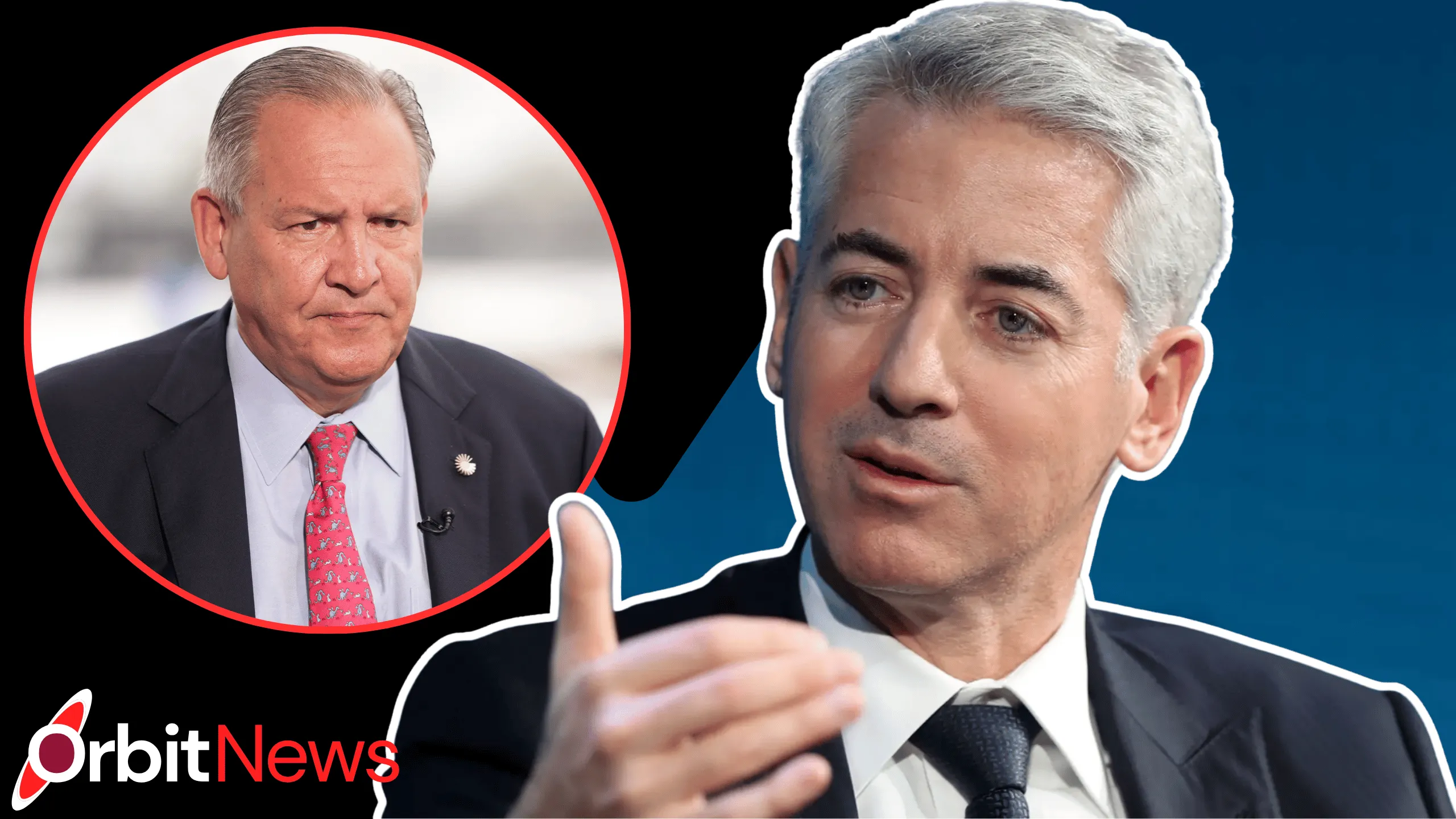
Bill Ackman and Greg Hayes became directly connected through United Technologies Corporation (UTC) in 2018 and 2019. Ackman, through Pershing Square, invested in UTC and pushed for a breakup of the conglomerate while Hayes was its chairman and CEO. Their relationship became more contentious when Hayes backed UTC’s 2019 merger with Raytheon, a transaction Ackman strongly opposed.
The documented connection between the two men is corporate rather than personal. Public records show an activist investor dealing directly with the chief executive of one of his portfolio companies, first over UTC’s structure and later over one of the largest aerospace and defense combinations of the period.

Who Are Bill Ackman and Greg Hayes?
Bill Ackman is the founder and chief executive of Pershing Square, an investment firm known for taking concentrated positions in publicly traded companies and sometimes pressing management teams for strategic changes. Pershing Square’s current corporate biography says Ackman founded the firm in 2003 and remains its CEO and chairman.
Gregory J. Hayes, commonly known as Greg Hayes, spent more than two decades at United Technologies. He became UTC chief executive in 2014 and chairman in 2016, later leading the company through major acquisitions, spinoffs and the Raytheon transaction that created Raytheon Technologies, now RTX.
Their paths crossed because Ackman became a significant UTC shareholder while Hayes was responsible for determining the industrial conglomerate’s long-term strategy.
How Bill Ackman and Greg Hayes Became Connected
Pershing Square made United Technologies a new investment in 2018. The investment thesis was straightforward: Ackman believed UTC contained several strong businesses whose combined stock-market valuation failed to reflect what those businesses could be worth independently.
At the time, UTC included major operations in:
| Business | Main area |
|---|---|
| Pratt & Whitney and UTC Aerospace Systems | Aircraft engines and aerospace systems |
| Otis | Elevators and escalators |
| Carrier and related operations | Heating, ventilation, air conditioning and building systems |
Pershing Square said that after publicly disclosing its investment in February 2018, it met with UTC management and argued that the three major businesses would have better strategic focus and could achieve fairer market valuations as separate companies.
This placed Ackman directly into Hayes’s strategic decision-making environment.
Ackman’s argument for breaking up UTC
Ackman’s case centered on what investors call a conglomerate discount. This occurs when investors value a diversified corporation at less than the combined value they might assign to its individual businesses.
Pershing believed UTC’s aerospace operations, elevator business and climate-control operations had different economics, investment requirements and investor audiences. It argued that separating them could make each business easier to manage, analyze and value.
Ackman was not the only shareholder pressing the issue. Daniel Loeb’s Third Point also accumulated a UTC position and advocated strategic change. That matters because UTC’s eventual restructuring should not be attributed to Ackman alone.
Hayes ultimately moved toward separation
On November 26, 2018, UTC announced that it intended to separate into three independent companies after completing its acquisition of Rockwell Collins.
The plan called for Otis to become an independent elevator company, Carrier to become an independent building-systems company, and the remaining UTC to focus on aerospace through Pratt & Whitney and Collins Aerospace. Hayes described the decision as a way to give each company greater strategic focus and financial flexibility.
That announcement closely resembled the corporate structure Pershing Square had been advocating.
Still, the evidence does not establish that Ackman single-handedly caused the breakup. Hayes and UTC’s board conducted their own strategic review, and other investors were advocating similar action. The safest conclusion is that Pershing Square was an influential shareholder whose preferred strategy became broadly aligned with UTC’s eventual decision.
Why the Relationship Changed in 2019
The more significant conflict between Bill Ackman and Greg Hayes came several months later.
By early 2019, Pershing remained optimistic about the planned three-way separation. The investment firm said UTC was trading at roughly a 30% sum-of-the-parts discount to comparable companies and expected the separation to help investors recognize the individual businesses’ value.
Then UTC announced another major transaction.
On June 9, 2019, United Technologies and Raytheon Company announced an agreement to combine UTC’s aerospace businesses with Raytheon in an all-stock “merger of equals.” The combined business was expected to have more than $74 billion in annual revenue and substantial aerospace and defense research capabilities.
Ackman objected.
Why Bill Ackman Opposed Greg Hayes’s Raytheon Deal
Ackman’s objection was not primarily to UTC separating Otis and Carrier. Pershing supported those spinoffs.
The disagreement concerned what Hayes intended to do with the aerospace company left behind.
Pershing’s view was that UTC aerospace, particularly Pratt & Whitney and Collins Aerospace, was the company’s most attractive asset. Ackman argued that combining it with Raytheon reduced the quality and growth profile of the business that UTC shareholders would otherwise own independently.
Pershing later described the proposed Raytheon combination as “value-destructive.” That was Pershing Square’s investment judgment, not an independently established fact. Its 2019 interim report said the firm believed the transaction valued UTC’s aerospace operations below their intrinsic value and conflicted with the rationale for separating UTC in the first place.
Ackman contacted Hayes directly
This was not merely public commentary.
Reports at the time documented that Ackman sent Hayes a message criticizing the proposed transaction. During a June 12, 2019 interview with Fox Business, Hayes was explicitly asked whether he had responded to Ackman.
Hayes said he expected to speak with Ackman within the following days. In the same interview, he defended the Raytheon transaction, arguing that investors should take a longer-term view of the combined company’s technology, engineering resources and growth opportunities.
That exchange is one of the clearest pieces of evidence defining the Ackman-Hayes relationship. Ackman was a shareholder challenging a major capital-allocation decision, while Hayes was the CEO defending it.
Pershing Square Sold Its United Technologies Stake
Ackman ultimately chose not to conduct a prolonged campaign against Hayes and the UTC board.
Pershing Square Holdings disclosed that it exited its United Technologies investment on June 10, 2019, immediately after the Raytheon transaction was announced.
Its later financial report said the UTX investment had generated a modest gain of approximately 3%. Pershing explained that rather than engage in a broader fight over the company’s leadership and strategic direction, it decided to redeploy its capital elsewhere.
The timing is important. Ackman opposed the deal, but Pershing ceased being a UTC shareholder months before investors formally voted on the transaction.
Did Ackman Stop the Raytheon Merger?
No.
On October 11, 2019, shareholders of both United Technologies and Raytheon approved the proposals necessary to complete their combination. The companies said the proposals received overwhelming support at their respective shareholder meetings.
The transaction was completed on April 3, 2020, after UTC separated Carrier and Otis.
The remaining United Technologies aerospace operations combined with Raytheon Company, and United Technologies changed its name to Raytheon Technologies Corporation. Greg Hayes became chief executive of the combined company.
The company later adopted the shorter corporate name RTX.
So the history contains two distinct outcomes. UTC did carry out the separation of Otis and Carrier that Ackman had advocated, but Hayes also proceeded with the Raytheon combination that Ackman opposed.
Timeline of Bill Ackman and Greg Hayes at United Technologies
| Date | What happened |
|---|---|
| February 2018 | Pershing Square disclosed its United Technologies investment and subsequently engaged with management about separating the company. |
| May 2018 | Pershing publicly developed its case for separating UTC’s aerospace, Otis and climate-control operations. |
| November 26, 2018 | Hayes and UTC announced plans to separate the company into three businesses after completing the Rockwell Collins acquisition. |
| June 9, 2019 | UTC and Raytheon announced their proposed merger of equals. |
| June 10, 2019 | Pershing Square exited its United Technologies investment. |
| June 12, 2019 | Hayes publicly addressed Ackman’s objections and said he planned to speak with him. |
| October 11, 2019 | UTC and Raytheon shareholders approved the merger proposals. |
| April 3, 2020 | Carrier and Otis had been separated and the Raytheon-UTC merger closed, creating Raytheon Technologies. |
What the Dispute Says About Their Different Roles
The conflict illustrates the tension that can arise between activist investors and corporate management even when they initially agree on part of a company’s strategy.
Ackman approached UTC primarily from the standpoint of a shareholder seeking higher long-term value from the company’s underlying assets. His argument was that simplifying UTC and allowing its businesses to trade independently would expose value hidden inside the conglomerate.
Hayes had a broader managerial responsibility. While he ultimately supported separating Carrier and Otis, he believed combining the aerospace business with Raytheon offered technological scale, research capabilities and long-term growth opportunities.
The disagreement was therefore not simply about whether UTC should change. Both sides supported major change. They disagreed about what the aerospace company should become after the breakup.
That distinction explains why Ackman could support Hayes’s separation plan in late 2018 yet strongly oppose his Raytheon strategy only months later.
Where Are Bill Ackman and Greg Hayes Now?
Their UTC confrontation is now a historical episode rather than an ongoing corporate dispute.
Ackman remains the chief executive of Pershing Square and chairman of Pershing Square Inc. His investment activities continue to center on concentrated positions in large businesses.
Hayes stepped down as RTX CEO in May 2024 and became executive chairman. RTX subsequently announced that he would leave that position and the company’s board in April 2025, then serve as a special adviser to the CEO through January 2, 2026.
His post-RTX work includes corporate board positions. Becton, Dickinson and Company appointed Hayes to its board in March 2025, and Phillips 66 appointed him lead independent director effective May 13, 2026.
Is There a Personal Relationship Between Bill Ackman and Greg Hayes?
Publicly documented information establishes a professional relationship arising from Pershing Square’s ownership of United Technologies shares and Ackman’s engagement with Hayes over company strategy.
There is no reliable evidence in the records reviewed for this article showing that the two men are relatives or that their connection originated as a personal partnership. Their widely documented interaction centers on UTC’s restructuring and the contested Raytheon merger.
FAQ
Why are Bill Ackman and Greg Hayes connected?
Bill Ackman became a United Technologies investor in 2018 and pushed for the company to separate its aerospace, elevator and climate businesses. Greg Hayes was UTC’s chairman and CEO, putting the two men on opposite sides of important strategic decisions.
Did Bill Ackman convince United Technologies to break up?
Ackman and Pershing Square publicly supported a three-way separation, and UTC later adopted a broadly similar structure. However, other investors also supported a breakup and UTC’s board conducted its own strategic review, so it would be misleading to credit the decision entirely to Ackman.
Why did Bill Ackman oppose the Raytheon merger?
Pershing Square believed UTC’s aerospace business had greater standalone value and that combining it with Raytheon would reduce the quality and growth characteristics of the investment. That was Pershing Square’s investment assessment, while Hayes argued that the merger would create substantial long-term technological and strategic benefits.
Did Pershing Square vote against the Raytheon merger?
Pershing Square sold its United Technologies position on June 10, 2019, months before the October shareholder vote. UTC and Raytheon shareholders subsequently approved the transaction.
What company resulted from the United Technologies and Raytheon merger?
The April 2020 transaction created Raytheon Technologies Corporation, with Greg Hayes as CEO. The company was later renamed RTX Corporation.
Are Bill Ackman and Greg Hayes still working together?
Their main documented corporate interaction concerned United Technologies between 2018 and 2019. Pershing Square exited UTC in June 2019, while Hayes continued leading the business through its transformation into Raytheon Technologies and later RTX.
