


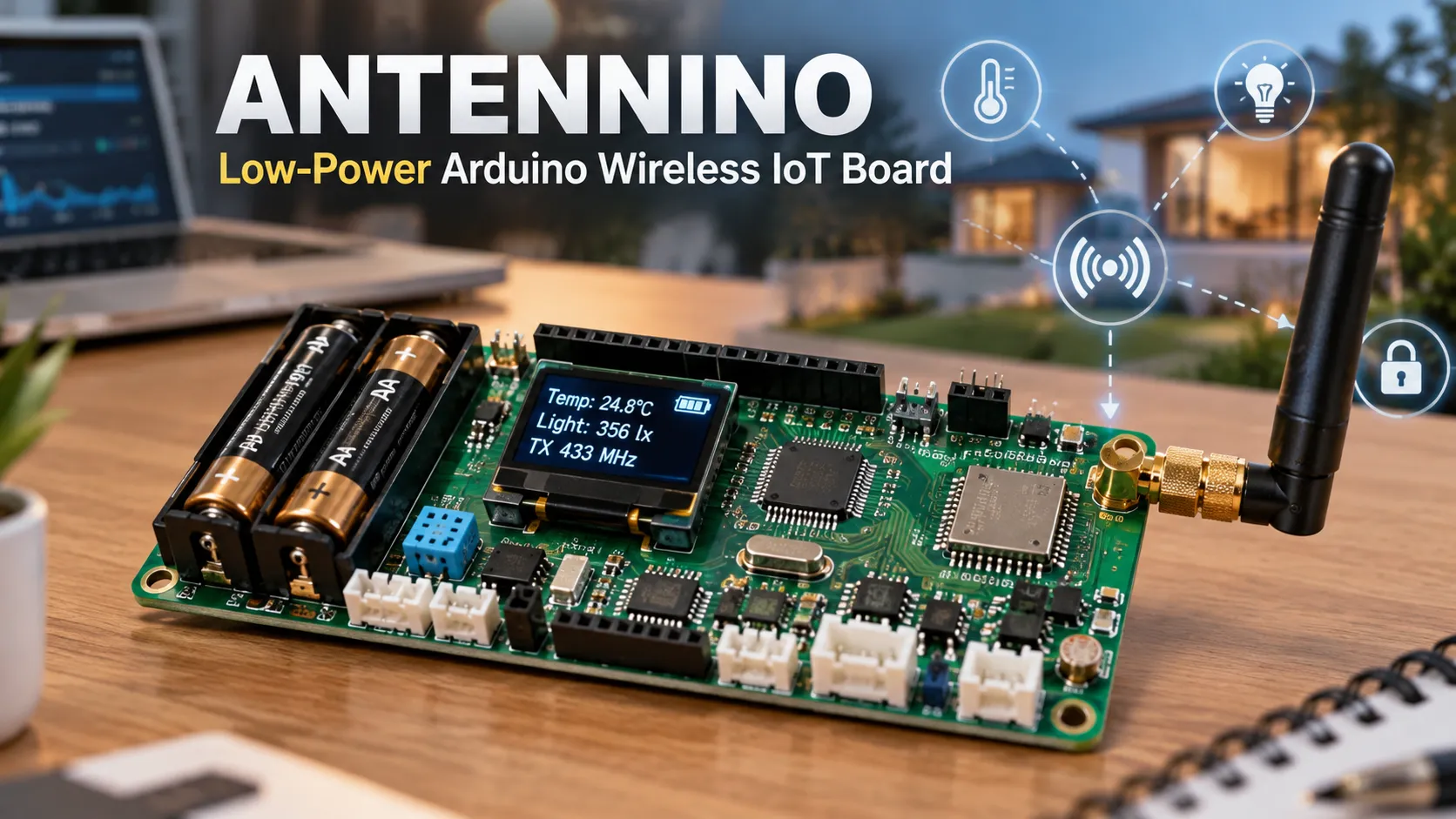
Antennino is a compact, low-power Arduino-compatible development board built for wireless sensors, remote actuators, and small Internet of Things projects. The documented Antennino project from Open-Electronics combines an ATmega328P microcontroller with an RFM69 433 MHz radio, onboard sensing, low-power circuitry, and support for wireless firmware updates.
The name can cause confusion because “antennino” may appear informally in Italian references to small antennas. However, when the term is used as the product or project name Antennino, the strongest primary-source documentation points to the Arduino-like board developed and published by Open-Electronics. The organization says the name itself combines “Antenna” and “Arduino.”
What Is Antennino?
Antennino is an Arduino Uno-style embedded computing board designed specifically for low-power wireless applications. Unlike a standard Arduino Uno, it includes a radio transceiver, onboard sensors, extra flash memory, battery-management hardware, and connectors intended for sensor expansion.
Open-Electronics describes the board as capable of operating in two broad roles:
- a remote node, collecting sensor data or controlling an actuator
- a gateway or concentrator, receiving information from multiple wireless nodes
This makes Antennino particularly relevant to battery-powered monitoring systems where devices may be distributed around a house, workshop, agricultural site, or other location.
The original Open-Electronics project appeared in 2018. Its public project archive lists the introductory Antennino article dated October 2, 2018.
Antennino Key Specifications
| Feature | Documented specification |
|---|---|
| Microcontroller | ATmega328P |
| Radio | RFM69 transceiver |
| Wireless frequency | 433 MHz |
| Extra memory | AT25F512B, 512 Kbit flash |
| Temperature sensing | DS18B20 |
| Light sensing | Photoresistor |
| Expansion | Serial, I²C, digital I/O and analog Grove connections |
| Display support | Optional I²C OLED |
| Battery power | Two AA cells |
| External supply | 3.6 to 12 V |
| Direct regulated supply | 3.3 V |
| Programming | Arduino IDE compatible |
| Wireless firmware update | Supported through the project bootloader and flash arrangement |
| Board size | 109 × 50 × 19 mm |
These specifications come from the current Open-Electronics product documentation.
How Antennino Works
Antennino follows the same general model as other microcontroller-based IoT nodes. The ATmega328P runs the application, sensors provide measurements, and the RFM69 module sends or receives data over a sub-GHz wireless link.
The board does not natively rely on Wi-Fi, Bluetooth, or LoRa. Its documented radio system uses the RFM69 at 433 MHz.
A typical installation might work like this:
- An Antennino node wakes from its low-power state.
- It reads a temperature, light, switch, motion, or other sensor.
- The ATmega328P processes the reading.
- The RFM69 sends the data to another Antennino or a compatible gateway.
- The node returns to a low-power state until the next measurement.
The same hardware can also drive outputs, so the system is not limited to monitoring. Open-Electronics gives remote switching and actuator control as possible applications.
The ATmega328P at the Heart of Antennino
Antennino uses the ATmega328P, the AVR microcontroller closely associated with the classic Arduino Uno architecture. Microchip’s current specification lists 32 KB of flash program memory, 2 KB of SRAM, 1 KB of EEPROM, analog-to-digital conversion, SPI, I²C-compatible two-wire communications and multiple power-saving modes.
That architecture explains why Antennino can use the Arduino development environment and familiar Arduino-style programming techniques.
There is an important modern consideration, though. Microchip currently marks the ATmega328P as “Not Recommended for new designs.” That does not make existing Antennino hardware unusable, but it matters for anyone planning a new commercial product expected to remain in production for many years.
For learning, experimentation, maintenance of existing installations, or hobby IoT projects, the chip can still be practical. For a new production design, developers should also consider newer microcontrollers with longer-term manufacturer support.
RFM69 Wireless Communication
Wireless communication is provided by an RFM69 transceiver operating in the 433 MHz band in the documented Antennino configuration. Open-Electronics states that the radio communicates with the ATmega through SPI and supports hardware AES encryption.
The project also discusses Automatic Transmission Control, or ATC, in compatible RFM69 libraries. The idea is to avoid transmitting at unnecessarily high power when a lower level is sufficient for reliable communication, reducing energy consumption.
Antennino should therefore be understood as a proprietary-project wireless node architecture built around RFM69, not as a general wireless protocol.
It is also important not to confuse RFM69 communication with LoRa. Both can operate in sub-GHz spectrum, but the underlying modulation, libraries, network behavior, and hardware are different.
Why Antennino Was Designed for Low Power
Battery life is one of the central ideas behind Antennino. The board includes a Texas Instruments TPL5110 timer that can shut down most of the circuit between operating intervals.
Open-Electronics documents a TPL5110 timing range from about 100 milliseconds to 7,200 seconds and describes standby consumption of roughly 35 nA for the timer itself. Rather than leaving the main microcontroller continuously awake just to count time, the timer can remove power from much of the system and wake it when required.
This architecture is particularly useful for sensors that only need to operate periodically.
For example, a battery-powered temperature monitor might:
- wake every few minutes
- measure temperature
- transmit the reading
- signal that its job is finished
- shut back down
That can consume dramatically less energy than leaving the complete microcontroller and radio powered continuously.
Actual battery life still depends on transmission interval, radio power, attached sensors, battery chemistry, temperature, firmware efficiency, and other factors. There is no reliable single battery-life figure that applies to every Antennino project.
Onboard Sensors and Expansion
Antennino comes with two useful sensing elements already integrated into the design.
The DS18B20 provides temperature measurement, while a photoresistor can be used for basic ambient-light sensing.
For projects requiring more hardware, the board provides Grove-style connections for:
- serial communication
- I²C devices
- general digital I/O
- analog input
An optional small OLED display can also be fitted, particularly when an Antennino is used as a local concentrator or user-interface device.
This arrangement allows the board to work with external sensors rather than limiting projects to the components mounted directly on the PCB.
Antennino and OTA Firmware Updates
One of Antennino’s more interesting features is support for OTA, or over-the-air, firmware updating.
Traditional Arduino boards normally require a physical USB or serial connection to upload a new sketch. That can be inconvenient when a sensor is installed on a roof, inside an enclosure, behind equipment, or in another difficult-to-access location.
The Antennino project documents a wireless-capable bootloader based on work associated with the Moteino ecosystem. The approach uses the board’s radio and external flash memory to support firmware transfer before updating the microcontroller.
This feature does not mean every Antennino installation automatically receives secure remote updates. OTA behavior still depends on the installed bootloader, firmware configuration, radio network, and update process.
What Can Antennino Be Used For?
Antennino works best in projects where small amounts of information need to move wirelessly while power consumption remains low.
Environmental Monitoring
The onboard temperature and light sensing make basic environmental monitoring an obvious application. Additional humidity, pressure, air-quality, water, or soil sensors can be connected through the available interfaces.
Door and Window Monitoring
A magnetic contact or other digital sensor can turn Antennino into a wireless door, gate, cabinet, or window monitor.
Remote Switching
Digital outputs can be connected to suitable driver electronics or relays for remote control of lights, pumps, alarms, or other equipment. Open-Electronics explicitly discusses remote actuators among the intended uses.
Distributed Sensor Networks
Several Antennino nodes can report to a concentrator or gateway. This is useful where running cables to every sensing point would be inconvenient.
Educational IoT Projects
Because the platform is Arduino-compatible and its example code is publicly available, it can also be used to study microcontrollers, SPI radio communication, wireless networking, power management, sensors, and embedded firmware.
Also Read: The Originote Brightening Moisturizer Ingredients Explained
Using Antennino as an IoT Gateway
The original Antennino radio nodes do not contain native Internet connectivity. Open-Electronics later documented a gateway architecture that uses an ESP32 together with an RFM69 radio.
In that setup, the RFM69 side communicates with Antennino nodes while the ESP32 connects the local wireless network to IP-based services. Open-Electronics demonstrated the architecture with ThingsBoard and MQTT.
The general data path is:
Antennino sensor → RFM69 radio → gateway → Wi-Fi/Internet → MQTT → ThingsBoard
That distinction matters. An individual Antennino node is not itself a Wi-Fi device. Internet access requires an appropriate gateway or another bridge.
Open-Electronics subsequently published a ThingsBoard dashboard implementation capable of displaying telemetry such as temperature, brightness, battery information, and radio data, while also demonstrating remote GPIO control.
Software and Open-Source Resources
Open-Electronics maintains a public Antennino repository on GitHub. The repository contains examples and project directories for functions including low-power nodes, OTA gateways, standard data gateways and ThingsBoard integration.
As of the latest accessible repository view, GitHub shows:
- 8 commits
- no published releases
- folders for
Gateway_Dati,Gateway_OTA,Node-LowPower,Node-TPL5110andgateway_thingsboard
The limited commit history suggests developers should treat Antennino as a comparatively mature or legacy-style project rather than assume it has the development pace of newer Arduino, ESP32, Matter, Thread, or LoRa ecosystems.
That does not prevent the code from being useful. It simply means anyone building a new system should inspect library compatibility, toolchain requirements, dependencies, and hardware availability before committing to the platform.
Antennino Power Options
The board supports several power arrangements.
Open-Electronics documents support for:
- two 1.5 V alkaline AA cells
- two 1.2 V rechargeable AA cells
- an external supply between 3.6 and 12 V
- a direct regulated 3.3 V supply that bypasses the onboard regulators
The direct 3.3 V option requires particular care. Open-Electronics warns that exceeding 3.3 V when using this connection can damage the microcontroller and other circuitry.
Antenna Requirements
The board’s RFM69 radio still requires a suitable antenna. The standard product listing states that the 433 MHz antenna, SMA-to-U.FL adapter and batteries are not included.
Open-Electronics’ related technical documentation discusses using a quarter-wave conductor for 433 MHz operation. A full free-space wavelength at 433 MHz is roughly 69 cm, making a quarter wavelength about 17 cm before practical antenna effects and tuning are considered.
For better RF performance, Antennino provides a U.FL connection for an external antenna. Real-world range depends heavily on antenna design, orientation, obstacles, interference, radio configuration, local regulations, and installation environment.
Because 433 MHz radio regulations differ between countries and regions, users should check the applicable local transmission-power, duty-cycle, frequency, and equipment rules before deploying a transmitter.
Antennino Price and Availability in 2026
As of September 26, 2026, the Open-Electronics product page lists Antennino as in stock at €39 including Italian VAT, or €31.97 excluding VAT. Final tax can vary according to the buyer’s delivery location.
The listing identifies the product as SKU 7305-ANTENNINO and describes it as an assembled Arduino-compatible board.
Availability and pricing can change, so buyers should check the current vendor listing before ordering.
Advantages of Antennino
Antennino still has several useful characteristics for the right project.
Its biggest strengths are the integrated 433 MHz radio, familiar Arduino-style programming, dedicated low-power circuitry, onboard sensors, multiple power options and OTA capability. A basic wireless sensor can therefore be built without assembling as many separate modules as would be required with a plain Arduino Uno.
It is also useful educationally because the platform exposes many important embedded-system concepts rather than hiding them behind a cloud service.
Limitations to Consider
Antennino is not the most modern choice for every IoT application.
The ATmega328P offers far fewer computing and memory resources than contemporary ESP32-class boards, and Microchip now marks the ATmega328P as not recommended for new designs.
Other limitations include:
- no native Wi-Fi
- no native Bluetooth
- no documented native LoRa support
- Internet access generally requires a separate gateway
- a relatively small public software ecosystem
- a GitHub repository with limited visible development activity
- dependence on older Arduino-era libraries in some examples
- 433 MHz regulatory considerations that vary by country
For a simple battery-powered 433 MHz sensor network, these restrictions may be acceptable. For a new commercial product needing modern security, cloud connectivity, Bluetooth provisioning, large memory or long-term silicon support, newer hardware may be easier to design around.
Is Antennino the Same as a Small Antenna?
Not in the context of the documented Open-Electronics project.
Some web pages use “antennino” informally to describe a small antenna, and Italian product listings can use the word in that everyday sense. For example, marine-equipment vendors use “antennino” for a compact replacement radio antenna.
The Antennino discussed in Open-Electronics documentation, however, is a specific Arduino-compatible wireless board. Its name was intentionally formed from “Antenna” and “Arduino.”
This distinction is important because several newer articles online blur the two meanings and sometimes describe Antennino as a generic miniature-antenna technology. The primary project documentation does not support that interpretation.
Is Antennino Still Useful Today?
Antennino remains useful for experimentation, existing RFM69 installations, Arduino education, low-power sensor networks and projects where 433 MHz communication is appropriate.
Its current official product listing remains active and in stock, while project software is still publicly accessible.
For a completely new long-lived commercial design, however, its older ATmega328P foundation deserves consideration because Microchip no longer recommends that MCU for new designs. Newer platforms may provide more processing power, integrated networking, stronger contemporary security features and broader active ecosystems.
Frequently Asked Questions
What is Antennino?
Antennino is an Arduino-compatible low-power wireless development board created for remote sensors, actuators and IoT networks. It combines an ATmega328P processor, RFM69 433 MHz radio, onboard sensors, external flash memory and low-power circuitry.
Does Antennino use LoRa?
No. The documented Antennino board uses an RFM69 transceiver operating at 433 MHz. It should not be described as a LoRa board unless separate compatible LoRa hardware has been added to a custom project.
Can Antennino connect directly to Wi-Fi?
The original Antennino node does not contain native Wi-Fi. Open-Electronics demonstrated an Internet gateway using an ESP32 to bridge RFM69 Antennino nodes to Wi-Fi, MQTT and ThingsBoard.
Can Antennino be programmed with Arduino IDE?
Yes. Open-Electronics describes Antennino as compatible with the traditional Arduino IDE and based on the same ATmega328P processor family associated with Arduino Uno-style systems.
Does Antennino support over-the-air updates?
Yes. The project includes a wireless-update approach using a compatible bootloader, the RFM69 radio and onboard flash storage. Open-Electronics specifically documented OTA programming as part of the Antennino platform.
Is Antennino still available to buy?
As of September 26, 2026, Open-Electronics lists the assembled Antennino board as in stock for €39 including Italian VAT. Pricing and availability can change after that date.
Also Read: Levapioli: What the Tool Is and How It Works
