


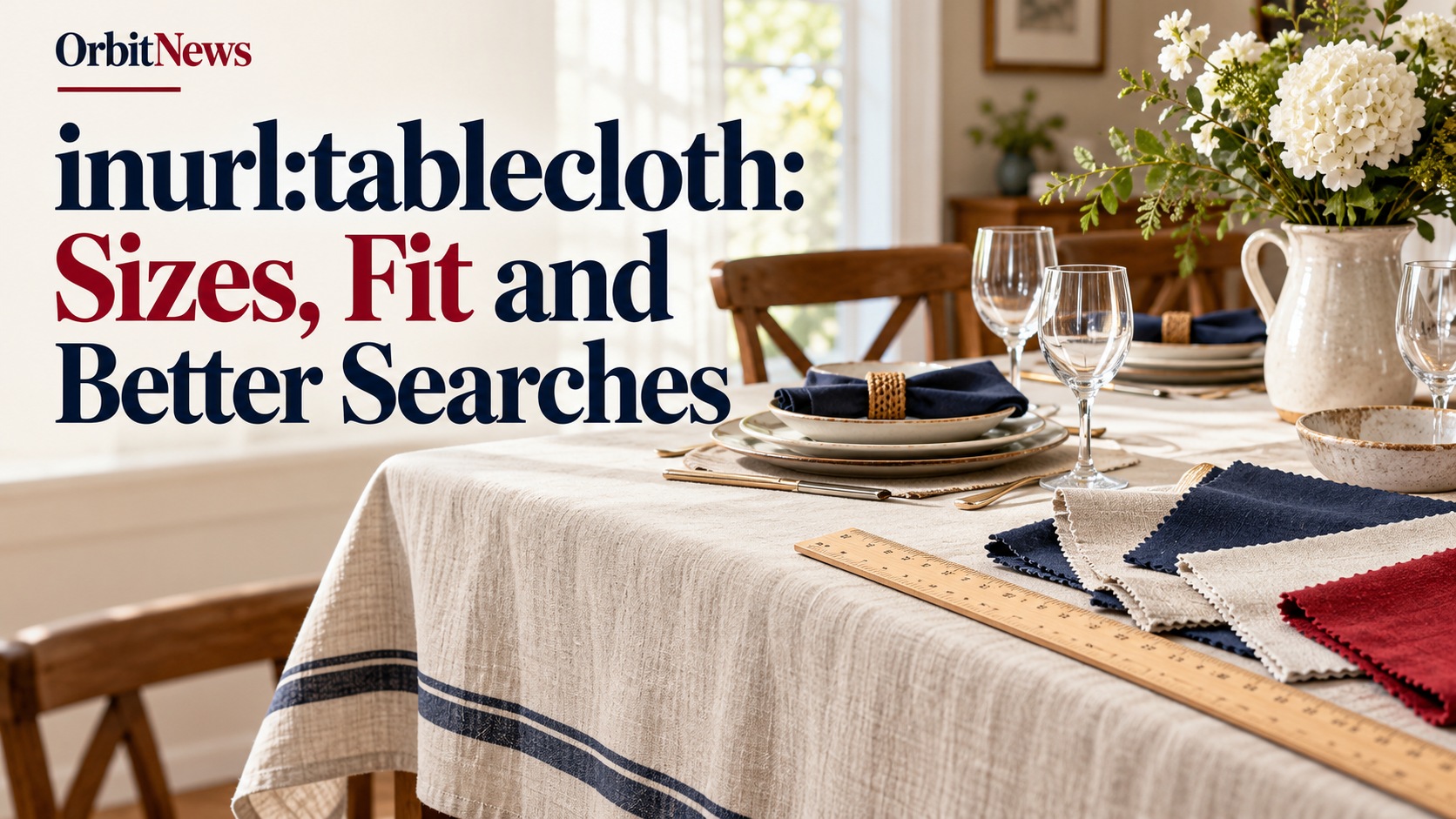
inurl:tablecloth is intended to find tablecloth in web addresses. It can help discover product pages and buying guides, but the search expression itself does not identify the size or fabric that will work for your table.
Measure the tabletop first, decide how far you want the cloth to hang, and then compare product specifications. Those three steps are more useful than choosing from a photograph alone, especially when similar-looking listings use different dimensions or packaging.

Measure the table in its actual setup
For a rectangular table, record its length and width. For a round table, measure the diameter across the centre. Include any extension leaves that will be in place when the cloth is used. A measurement taken before extending the table can lead to the wrong purchase.
Keep the units consistent. Do not compare a table measured in centimetres with a product listing in inches until both have been converted appropriately. Record the dimensions in your notes rather than relying on a remembered description such as a six-person table.
The number of seats is not a substitute for measurement. Tables with the same intended seating can have different shapes and dimensions. A product page that suggests a seating capacity can offer a rough shopping cue, but the actual tabletop and cloth measurements determine the fit.
Before placing an order, draw a simple outline and write the measurements beside it. Note whether the table is round, rectangular, oval, or extended. This small record makes it easier to compare listings later without repeating the measurement or accidentally mixing the dimensions of two different tables.
Understand the drop before calculating the size

The drop is the part of the cloth that extends beyond the tabletop edge. Williams Sonoma’s table-linen guidance emphasises measuring the table and considering size and drop together. There is no single drop that suits every table, occasion, and seating arrangement.
For a rectangular table with an even drop, add twice the intended drop to both the table length and the table width. For a round cloth on a round table, add twice the intended drop to the table diameter. These are straightforward geometric relationships, not product-specific recommendations.
Consider an invented measuring example: a tabletop is 150 centimetres long and 90 centimetres wide. A 20-centimetre drop on each edge calls for a cloth measuring 190 by 130 centimetres. The example explains the arithmetic and is not a claim that this is an available retail size or the best choice for every setting.
Compare options without treating a size label as a guarantee
| Illustrative query | Purpose |
|---|---|
inurl:tablecloth size guide | Explore pages with tablecloth-related address wording. |
"tablecloth" "190 x 130 cm" | Search a measured example rather than a seating label. |
"retailer name" tablecloth care instructions | Locate the seller’s details for a specific product. |
"round tablecloth" diameter guide | Focus on the shape and measurement method you need. |
Use your own measurements in place of the example dimensions. If the exact calculated size is not sold, assess the actual drop produced by the nearest suitable option. Do not assume that a product labelled large or banquet has standard dimensions across different retailers.
Allow for the way the table will be used

Look at chair arms, benches, table legs, and the available clearance. A cloth that appears attractive in an empty-table photograph may hang differently when people are seated. Consider the practical setting instead of treating a styled image as a fit test.
For an oval or irregular table, use the seller’s shape-specific guidance and compare how the cloth will fall at different points. A rectangular cloth may cover an oval tabletop, but that does not mean the overhang will look identical around the edge. The shape needs its own assessment.
If you intend a floor-length look, measure the relevant table height and discuss the arrangement with the venue where appropriate. Do not select it simply because a general buying guide associates a longer drop with a formal occasion. Access, movement, and the actual layout also matter.
Read fabric and care information separately from appearance
A photograph can show colour and styling, but it cannot establish every aspect of texture, laundering, or treatment. Read the composition and care label for the exact product. Similar-looking cloths can have different washing, drying, ironing, or storage requirements.
If a listing describes stain resistance, check what the seller actually claims and whether care conditions apply. Do not convert a marketing phrase into a guarantee that no stain is possible. Likewise, do not assume shrinkage behaviour from a broad fabric name without the product’s own instructions.
For a repeated-use purchase, think about how the cloth will be maintained between occasions. A lower initial price may not answer questions about cleaning or replacement. This guide does not rank products or quote prices because those decisions require current product-specific information.
Use inurl:tablecloth as one search route
The commonly used inurl: syntax targets address wording. Google’s Advanced Search interface also documents a URL-terms filter. Neither method guarantees a complete product catalogue, and the current general help does not comprehensively promise every legacy operator combination.
A relevant retailer may organise linens under dining, tabletop, or an item number rather than tablecloth. If the query becomes restrictive, remove the operator and retain the important attributes: shape, dimensions, colour, material, and the seller you want to check.
Once you find a product, verify the chosen variant, stock status, delivery details, and return policy on the seller’s current page. Search snippets and older buying guides can help discovery, but they cannot confirm the conditions of a purchase being made today.
For related reading, see checking quantities and units and reading a product claim in context.
Frequently asked questions
Does inurl:tablecloth recommend a size automatically?
No. Measure the tabletop and choose a drop before comparing product dimensions. The query only helps locate candidate pages.
How do I calculate a rectangular cloth size?
For an even drop, add twice that drop to both the table length and width. Keep all measurements in the same unit.
Can I choose by seating capacity alone?
It is better to measure. Tables with the same seating description can have different dimensions and shapes.
Does a product photograph prove the fabric is easy to wash?
No. Read the composition and care instructions for the exact product and selected variant.
Sources
Williams Sonoma: table-linen size and drop guidance; Williams Sonoma: tablecloth product specifications; Google Advanced Search filters.
