


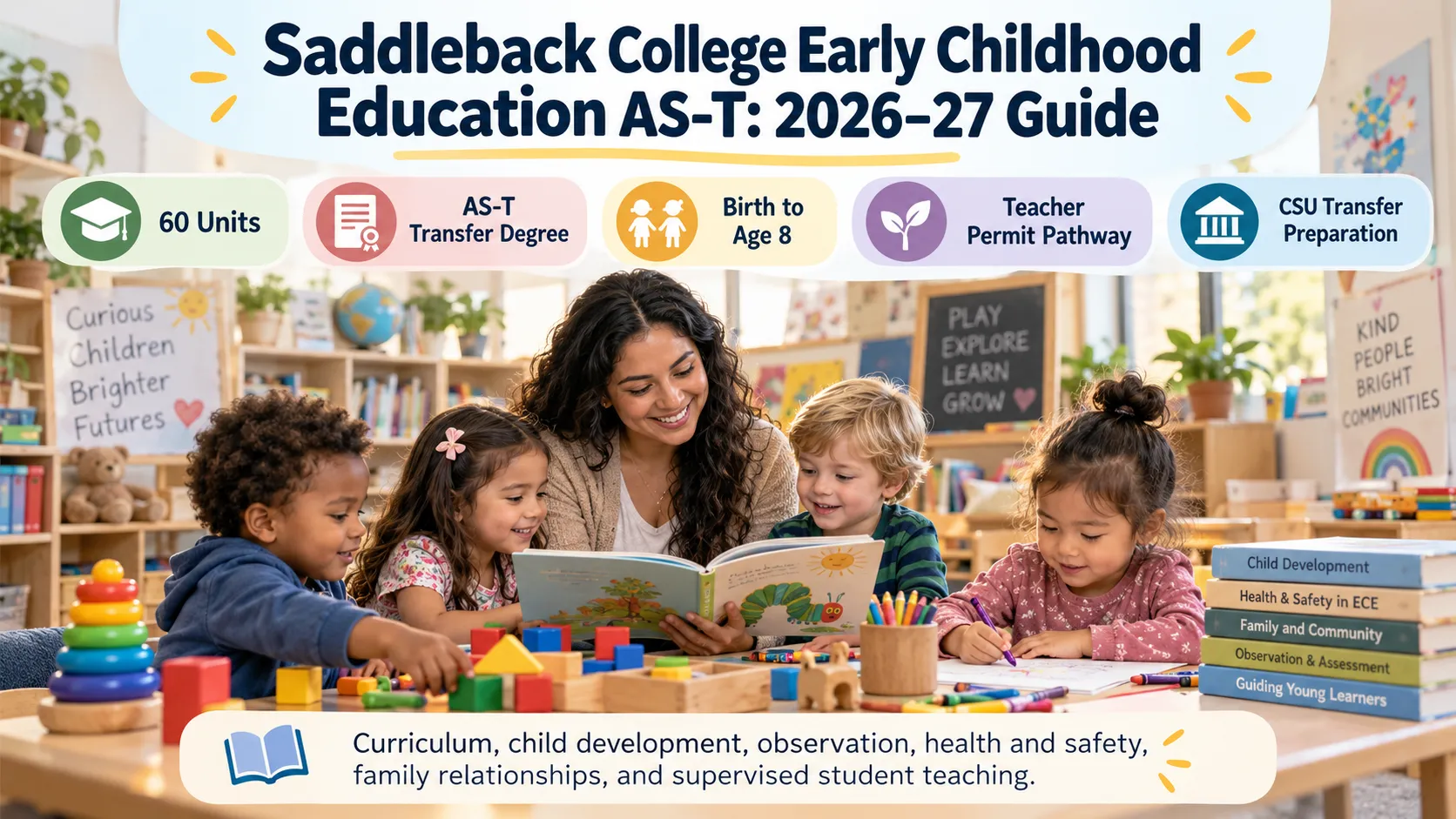

The Saddleback College Early Childhood Education AS-T is a 60-unit Associate in Science for Transfer designed for students preparing to work with young children and continue into a related bachelor’s program in the California State University system. The 2026–27 curriculum includes a 25-unit early childhood education core, Cal-GETC general education, a minimum 2.0 GPA, and a grade of C or Pass or better in courses required for the major.
The program focuses on the development, care, and education of children from birth through age 8. It covers child development theory, curriculum planning, observation and assessment, health and safety, culturally responsive teaching, family relationships, and supervised student teaching. Saddleback also states that graduates meet the educational requirements for the Teacher level of California’s Child Development Permit, although receiving the permit requires a separate application and satisfaction of the California Commission on Teacher Credentialing’s current requirements.

What Is the Saddleback College Early Childhood Education AS-T?
AS-T stands for Associate in Science for Transfer. California created these degrees to provide community college students with a more structured route into compatible CSU bachelor’s programs.
Saddleback describes its Early Childhood Education curriculum as preparation for teachers and caregivers working with children ages 0 to 8. Students study developmental and learning theory while learning how to translate that knowledge into classroom curriculum, assessment, teaching practices, family collaboration, and culturally responsive care.
This makes the degree relevant to two overlapping goals. A student may use it as preparation for employment in early childhood settings, or as the lower-division portion of a longer path toward a bachelor’s degree and more advanced education careers.
| 2026–27 program fact | Requirement |
|---|---|
| Degree | Associate in Science for Transfer |
| Main field | Early Childhood Education |
| Total transferable units | 60 semester units |
| ECE major core | 25 units |
| General education | Cal-GETC |
| Minimum overall GPA | 2.0 |
| Major-course grade standard | C or Pass or better |
| Age range emphasized | Birth through age 8 |
| Transfer destination | Primarily CSU programs deemed similar |
| Practicum | CDE 121, including 100 hours of student teaching |
Saddleback’s catalog specifies that an ADT requires 60 CSU-transferable semester units, including Cal-GETC and at least 18 units in the major. The Early Childhood Education curriculum exceeds that minimum with its 25-unit ECE core.

Saddleback College Early Childhood Education AS-T Course Requirements
The current 2026–27 catalog identifies eight courses totaling 25 units for the ECE core. These subjects match the central areas expected in an early childhood professional preparation program.
| Course | Course title | Units |
|---|---|---|
| CDEV C1000 | Child Growth and Development | 3 |
| CDE 15 | Child, Family, and Community | 3 |
| CDE 101 | Principles and Practices of Teaching Young Children | 3 |
| CDE 110 | Introduction to Curriculum | 3 |
| CDE 112 | Health, Safety, and Nutrition | 3 |
| CDE 117 | Teaching in a Diverse Society | 3 |
| CDE 120 | Observation and Assessment | 3 |
| CDE 121 | Practicum: The Student Teaching Experience | 4 |
| Total | 25 |
The course sequence is broader than simply learning how to supervise young children. CDEV C1000 establishes the developmental foundation, while courses such as CDE 110 and CDE 120 address curriculum and evidence-based observation. CDE 117 examines diversity, inclusion, culture, language, bias, and the social influences affecting children’s learning experiences.
Students registering for Spring 2027 should check the newest catalog addendum rather than relying only on older course numbers. Saddleback says Child Development/Human Development is among the disciplines receiving updated course numbering in the Spring 2027 schedule as California’s Common Course Numbering changes continue.
Why CDE 121 Practicum Requires Advance Planning
CDE 121 is not simply another lecture course. It is a four-unit practicum combining classroom instruction with supervised work in an approved early childhood education setting.
For 2026–27, Saddleback lists CDE 110, CDEV C1000, CDE 15, CDE 101, and CDE 120 as prerequisites. Students must also provide proof of required immunizations and a negative tuberculosis test. Most importantly, the course requires 100 hours of student teaching in an approved early childhood classroom.
That prerequisite chain makes CDE 121 one of the courses students should plan around from the beginning. Waiting until the final semester to discover that a prerequisite is missing can delay completion of the degree.
How Cal-GETC Fits Into the AS-T
The Early Childhood Education courses are only one part of the degree. Students must also complete the California General Education Transfer Curriculum, or Cal-GETC, while reaching at least 60 CSU-transferable semester units.
Saddleback’s 2026–27 Cal-GETC curriculum requires a minimum of 34 units, completed with grades of C or better or Pass. It covers English communication, quantitative reasoning, arts and humanities, social and behavioral sciences, physical and biological sciences, and ethnic studies.
Cal-GETC is now the common California community college general education pathway used for CSU and UC transfer. That does not mean the ECE AS-T itself provides a UC admission guarantee. The special ADT admission benefits discussed below apply specifically to the CSU system.
Students should build an educational plan with a counselor because transfer preparation is more than simply adding the listed major and GE unit totals together. Course selection can depend on prior credit, AP or IB examinations, the intended CSU campus, and requirements of the bachelor’s major.
What the CSU Transfer Guarantee Actually Means
Completing the AS-T can provide a significant CSU transfer advantage, but it does not guarantee admission to a particular university or competitive major.
The California State University states that students who earn an Associate Degree for Transfer and meet CSU eligibility requirements receive guaranteed priority admission to a CSU campus. If the student enters a CSU bachelor’s program considered similar to the completed ADT, the CSU also guarantees that the bachelor’s can be completed with no more than 60 additional semester units, assuming the student follows the applicable conditions and does not add requirements such as a second major or minor.
That creates the familiar 60 plus 60 model: up to 60 transferable community college units followed by up to 60 semester units at CSU for a similar bachelor’s program.
The key word is similar. Not every child development, human development, liberal studies, or education major at every CSU campus will necessarily be considered a similar program for this particular ADT. Students should verify their intended university and major through the CSU’s current ADT tools and California’s official transfer-articulation resources before choosing courses.
Also Read: Wei Xue Beijing Normal University East China Normal: What Records Show
Does the Degree Qualify You for a California Child Development Permit?
Saddleback states that students completing the Early Childhood Education AS-T meet the educational requirements for the Teacher level of the Child Development Permit. The college degree and the state permit are nevertheless separate credentials.
As of October 2026, the California Commission on Teacher Credentialing’s current Child Development Permit matrix still lists the Teacher permit with a pathway requiring 24 semester units of ECE or child development coursework, including specified core areas, 16 general education units, and 175 days of qualifying experience at three or more hours per day within the previous four years. An alternative qualification is an associate degree or higher in ECE or a related field that includes three semester units of supervised field experience.
CDE 121 provides the degree’s supervised field experience, but students should not assume that completing 100 practicum hours automatically satisfies every possible employment-experience requirement under every permit route. The Commission evaluates permit eligibility under its own rules.
There is another reason to check the requirements immediately before applying. California’s Commission on Teacher Credentialing is actively revising the Child Development Permit structure. A new rulemaking action was posted on August 28, 2026, but the Commission’s current public matrix, updated October 1, 2026, still displays the existing Assistant, Associate Teacher, Teacher, Master Teacher, Site Supervisor, and Program Director levels. The proposed changes should therefore not be treated as effective requirements until the regulatory process is complete.

Can the Early Childhood Education AS-T Be Completed Online?
Saddleback lists Early Childhood Education among its Associate in Science for Transfer degrees available through its online-learning offerings.
There is an important practical limitation, however. CDE 121 requires 100 hours of supervised student teaching in an approved early childhood classroom. Students considering the online pathway should therefore interpret “online degree” as online academic coursework where offered, not necessarily a degree that can be completed without an approved field placement.
Saddleback also offers on-campus, hybrid, synchronous online, and asynchronous online class formats, with the actual options varying by term and course.
Tuition and 2026–27 Costs
For California residents, Saddleback’s enrollment fee is $46 per unit. The college lists a $28 health fee for Fall 2026 and Spring 2027 and notes that some classes may have separate instructional-material charges.
For nonresidents in the 2026–27 academic year, Saddleback lists an additional $409 per unit in nonresident tuition and a $57 per-unit capital outlay fee, on top of the standard enrollment fee.
Saddleback’s official 2026–27 cost-of-attendance budget estimates $1,436 in tuition and fees for Fall 2026 plus Spring 2027, based on 15 units per semester. The college’s total cost-of-attendance figures are much higher because they also estimate housing, food, transportation, books, supplies, and personal expenses. Those broader figures should not be confused with tuition alone.
Eligible students may have ways to reduce the cost. The California College Promise Grant can waive the $46-per-unit enrollment fee for qualifying California residents or students with eligible AB 540 status. Saddleback’s Full-Time Promise Program also covers specified registration costs for eligible students for two consecutive years.
The Child Development and Education department also participates in an educational funding program through the Child Development Training Consortium. Saddleback specifically lists the Early Childhood Education AS-T among the programs whose students may qualify, subject to employment/enrollment conditions, an approved academic plan, deadlines, and funding approval.
Career Options After the Degree
The AS-T can support entry-level work in early childhood settings while creating a pathway to further study. Possible environments include preschools, child development centers, early-learning programs, Head Start settings, and other licensed childcare programs, depending on the employer’s requirements and the state permit level held by the applicant.
For national context, the U.S. Bureau of Labor Statistics reported a median annual wage of $38,140 for preschool teachers in May 2025. BLS also notes that education and training requirements vary by state and work setting, with preschool teachers typically needing at least an associate degree nationally.
The degree should not be confused with a California public-school teaching credential. Students ultimately seeking public-school teaching roles such as elementary education generally need additional university education and state credentialing. In that situation, the AS-T is a lower-division academic foundation rather than the final professional qualification.
For someone whose primary goal is a bachelor’s degree in early childhood studies, child development, human development, or a similar field at CSU, the transfer structure is one of the degree’s strongest advantages. Someone interested only in entering the ECE workforce as quickly as possible may also want to compare Saddleback’s shorter Associate Teacher and Early Childhood Teacher certificate pathways before committing to the full 60-unit transfer degree.
Credit for Prior Learning
Students who already have significant early childhood education experience should ask about Credit for Prior Learning, rather than automatically repeating material they may already know.
Saddleback’s 2026–27 catalog identifies portfolio assessment opportunities for CDEV C1000, CDE 15, CDE 101, CDE 110, CDE 112, CDE 117, CDE 120, and CDE 121. Portfolio credit is not automatic. Students begin through counseling, and the department evaluates whether submitted evidence demonstrates mastery of the official course content.
Because the college is also implementing course-number changes, students bringing prior coursework, a CDA credential, or professional training should have it formally evaluated rather than assuming an old course number is still equivalent to a current requirement.
A Note on Accreditation
Saddleback College itself is institutionally accredited by the Accrediting Commission for Community and Junior Colleges, an accrediting body recognized by the Council for Higher Education Accreditation and the U.S. Department of Education.
Program-level accreditation is less straightforward in the college’s current public information. Saddleback’s Child Development and Education page still states that the ECE AS-T received NAEYC accreditation for a term running from Spring 2018 through Spring 2025, while CHEA’s current institutional directory continues to identify the AST Early Childhood Education program as NAEYC-accredited. Because Saddleback’s own program page does not show a newer accreditation term, students for whom current NAEYC programmatic accreditation is important should verify the latest status directly with the college or NAEYC rather than assuming that the older displayed term was automatically renewed.
This uncertainty does not change Saddleback College’s current institutional ACCJC accreditation.
Who Is This Degree Best For?
The Saddleback College Early Childhood Education AS-T is particularly well suited to students who want a structured community-college pathway into a related CSU bachelor’s program while also building practical preparation for work with young children.
It is also a sensible option for students pursuing California Child Development Permit preparation because its curriculum covers the educational areas Saddleback associates with the Teacher permit and includes supervised student teaching.
A different pathway may make more sense for someone whose sole goal is a short workforce certificate, whose first-choice university is outside the CSU system, or whose main objective is a California K-12 teaching credential. In those cases, comparing the AS-T with Saddleback’s certificate programs, Elementary Teacher Education pathway, and the exact requirements of the intended four-year institution can prevent unnecessary coursework.
How to Plan the Degree Without Losing Transfer Credits
A student should start with the current Saddleback catalog and a counselor-approved educational plan, then select a target CSU major early enough to verify whether it is considered similar to the ECE AS-T.
Course sequencing deserves particular attention because CDE 121 has five prerequisites. General education should be planned around the current Cal-GETC pattern rather than an older CSU-GE or IGETC checklist, and Spring 2027 students should verify the new Common Course Numbering codes before registering.
Students pursuing a Child Development Permit should separately compare their degree, field experience, and employment history with the CTC’s current permit matrix shortly before applying. Transfer requirements and state credential regulations can change independently of Saddleback’s degree requirements.
FAQ
How many units is the Saddleback College Early Childhood Education AS-T?
The degree requires 60 CSU-transferable semester units overall. Within those 60 units, the 2026–27 ECE major contains 25 units of required early childhood education coursework, and students must also complete Cal-GETC.
How long does the Early Childhood Education AS-T take?
An AS-T is structured as a 60-unit, roughly two-year full-time community college degree. Actual completion time can be longer or shorter depending on a student’s semester load, transferred credit, course availability, previous education, and ability to complete CDE 121’s prerequisites and field placement.
Does the Saddleback ECE AS-T guarantee admission to CSU?
Eligible students who complete an ADT receive a CSU system admission guarantee and priority consideration, but not guaranteed admission to a particular CSU campus or major. Students entering a CSU program officially deemed similar to their ADT can also receive the 60-unit bachelor’s completion protection described by CSU.
Does the degree automatically give me a Child Development Teacher Permit?
No. Saddleback states that the degree meets the educational requirements for the Teacher level, but the Child Development Permit is issued separately by the California Commission on Teacher Credentialing. Applicants must satisfy the applicable current route, including any experience and documentation requirements.
Can I complete the Saddleback Early Childhood Education AS-T online?
Saddleback lists Early Childhood Education as an online AS-T option. However, CDE 121 requires 100 hours of student teaching in an approved early childhood classroom, so students must still plan for the program’s supervised field-experience component.
How much does Saddleback College charge per unit?
For 2026–27, the California-resident enrollment fee is $46 per unit. Nonresidents pay the standard enrollment fee plus $409 per unit in nonresident tuition and a $57 per-unit capital outlay fee, with other applicable college fees charged separately.
Also Read: Cypress College Early Childhood Education AS-T: 2026 Guide
