


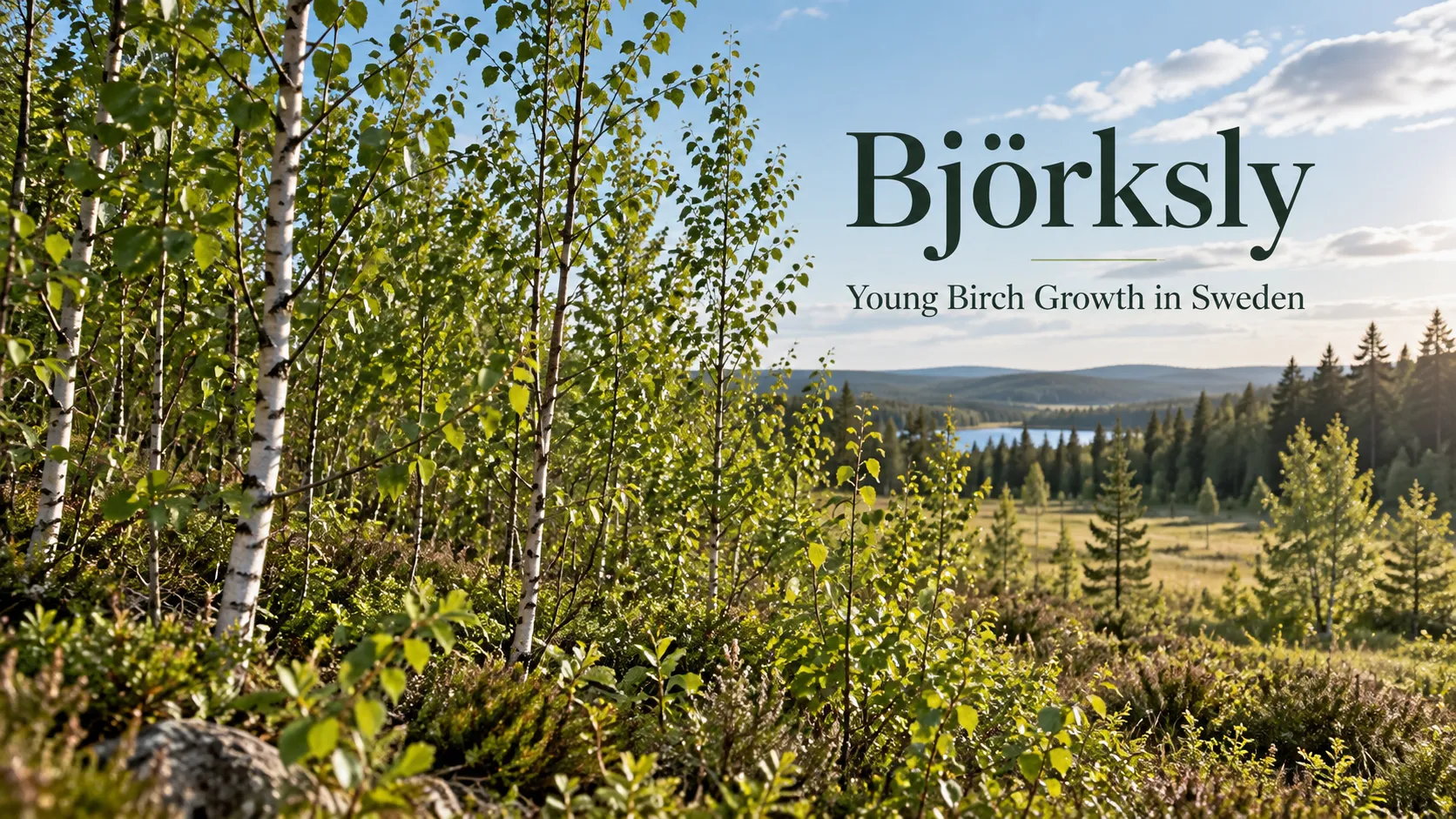
Björksly is a Swedish term for dense young growth of birch, usually made up of saplings and shoots that establish naturally on clear-cuts, roadsides, abandoned fields, forest edges, and other open ground. It is often treated as vegetation that needs clearing, but young birch also has real ecological and forestry value.
The word is a compound of björk, meaning birch, and sly, referring to scrub or dense young woody growth. Swedish usage shows that björksly can describe anything from unwanted birch regrowth along infrastructure to useful young birch vegetation in managed forests and wildlife habitat.
What Does Björksly Mean?
Björksly does not refer to a separate plant species. It describes young, often dense birch vegetation, rather than mature birch woodland.
A useful English translation depends on context. Possible equivalents include:
- birch scrub
- birch thicket
- young birch growth
- birch brush
- birch saplings
Swedish sources use the word for vegetation growing on forest land, along railways, around historical sites, in unmanaged open areas, and in places undergoing natural succession.
The grammatical form is also well established in Swedish. Björksly is a neuter noun, with björkslyet as the definite singular form.
What Kind of Birch Makes Up Björksly?
In Sweden, björksly is commonly formed by the country’s two widespread tree-forming birches:
| Birch species | Scientific name | Typical preference |
|---|---|---|
| Silver birch, Swedish vårtbjörk | Betula pendula | Generally brighter, somewhat drier sites |
| Downy birch, Swedish glasbjörk | Betula pubescens | Often more common on moist ground |
SLU notes that these are Sweden’s two common birch species. Both occur widely, although downy birch becomes relatively more dominant toward northern Sweden, while silver birch is particularly important in southern parts of the country. Hybrids can also occur.
Young plants are not always easy for an untrained observer to distinguish. Differences can be seen in leaves, shoots, bark and overall growth form, but characteristics may overlap. Research at the Swedish University of Agricultural Sciences has therefore examined methods for reliably separating the two species in young stands.
Why Does Björksly Appear So Quickly?
Birches are highly effective pioneer trees. Pioneer species are plants adapted to colonizing open or recently disturbed ground before slower-growing forest vegetation becomes established.
Birch produces large quantities of lightweight seeds that can travel on the wind. Once suitable exposed soil is available, seedlings may establish rapidly. SLU describes both silver and downy birch as pioneer species particularly well suited to open, well-lit conditions following disturbances such as clear-cutting and fire.
Ground conditions matter considerably. Research on natural birch regeneration found that soil preparation can be important on dry sites, while birch often establishes more readily without intervention on wetter ground.
That helps explain why dense björksly often appears after:
forest harvesting, removal of competing vegetation, disturbance of the soil, abandonment of previously maintained land, or creation of open corridors along roads and railways.
The same ability that makes birch useful for natural regeneration can make it seem invasive or untidy where land managers want to maintain open space.
Also Read: x2VOL: How Student Service Hour Tracking Works
Is Björksly a Weed?
Not botanically.
Calling björksly a weed is mainly a management judgment. Young birch may be undesirable in one place and valuable in another.
Historically, birch has sometimes been viewed as competition in Swedish production forests dominated by spruce and pine. Modern forestry research gives it a more nuanced role. SLU reports growing interest in birch for timber production, mixed stands, biodiversity and diversification of forest management.
This distinction matters. Removing every young birch simply because it looks like scrub can eliminate trees that could have become valuable future stems or contributed to a more diverse stand.
Björksly in Swedish Forestry
Birch is far from a minor component of Swedish forests. Skogskunskap’s figures based on the 2026 Swedish National Forest Inventory show that birch makes up a particularly large share of young forest, although its proportion declines sharply in larger diameter classes.
That pattern tells an important story. Birch establishes successfully, but much of it disappears as forests mature because of competition, clearing, thinning and harvesting.
SLU research has estimated that silver and downy birch together account for about 12 percent of Sweden’s standing timber volume.
From Björksly to Valuable Birch Trees
A dense patch of young birch does not automatically have to be cleared completely.
Foresters can instead identify promising stems and manage them for continued growth. Skogskunskap recommends active thinning of young birch stands so selected trees receive adequate space, light and growing resources. Its guidance generally favors staged clearing rather than leaving very dense stands untouched.
Research on naturally regenerated birch also shows that management decisions during the young-stand stage have significant effects on future stand development.
So when a forest owner sees björksly, the real decision is not simply “remove it or keep it.” The better question is which stems should remain, and what should the future stand become?
Why Björksly Can Be Valuable for Wildlife
Dense young birch can provide both food and cover.
Birch forms part of the diet of Scandinavian browsing animals. SLU’s wildlife research identifies silver and downy birch among the plant groups consumed by deer species. Depending on season, animals may browse leaves, twigs or bark.
Young birch environments can also benefit certain birds. The Swedish Forest Agency notes, for example, that willow ptarmigan can use early forest stages containing abundant young birch. Its guidance describes areas with birch regrowth as useful habitat because the vegetation can provide both shelter and food.
An SLU publication discussing birch ecology likewise points out that young birch supports insects, which in turn become food for birds. As birches age, additional organisms associated with bark, dead wood and mature trees appear.
This means a patch of apparently untidy björksly may still have an ecological function.
Björksly and Biodiversity
The biodiversity value of björksly depends heavily on location, age, density and surrounding habitat.
Young birch is not equivalent to an old natural forest, but it can contribute structural diversity within landscapes dominated by other tree species. Allowing some birch to develop into mature trees is particularly important because ecological communities change as trunks become larger and older.
Swedish forestry data indicate that birch is disproportionately common among small trees and much rarer in large diameter classes.
That means retaining selected young birch can eventually help address the relative shortage of older, larger birches.
Mixed forests are another reason birch is attracting attention. SLU notes that birch can be grown alongside other tree species, including Norway spruce, and can contribute to more varied forest systems.
When Does Björksly Become a Problem?
Björksly becomes undesirable when its location or density conflicts with how land needs to function.
Along Roads and Railways
Dense vegetation can interfere with sight lines, maintenance access and infrastructure management. Swedish usage of the word includes examples of birch scrub growing alongside railway tracks and contributing to reduced visibility.
On Open Grassland
If grazing or regular mowing stops, woody plants can gradually colonize formerly open land. Björksly may therefore be part of the early stages of succession from grassland toward woodland.
This is not necessarily ecologically harmful in itself, but it can be undesirable where the conservation objective is specifically to preserve open meadow, pasture or culturally maintained landscapes.
In Young Production Forests
Large numbers of unwanted birches can compete with chosen crop trees for space and light. At the same time, indiscriminate removal may also eliminate useful birch stems.
Management therefore depends on whether the goal is spruce production, pine production, mixed forest, birch production or conservation.
How Björksly Is Cleared
The appropriate method depends on stem size, land area, terrain and the reason for clearing.
Small amounts around gardens or buildings can often be cut using hand tools such as pruning shears or saws. Larger forest areas may require professional clearing equipment and a planned forestry treatment.
Municipal guidance provides a practical example. In 2026, Tranemo Municipality invited residents to collect birch brush for graduation celebrations and instructed them to bring a saw or secateurs, while explicitly excluding chainsaws at that location.
Forest management is more complicated than simply cutting all visible growth. Birch can produce new shoots after cutting, and the timing and intensity of clearing influence subsequent stand development. An SLU field study found differences in stump-shoot development between clearing strategies for silver birch and downy birch.
Should You Remove All Björksly?
Usually, that decision should depend on the objective for the land.
If the priority is maintaining visibility beside infrastructure, preserving an open meadow or protecting a particular crop-tree stand, substantial removal may be appropriate. If the objective includes biodiversity, mixed forestry or producing future birch timber, retaining selected trees may be more useful.
Skogskunskap recommends identifying good future stems when managing young birch rather than treating every birch tree identically.
For woodland owners, this makes selective management more useful than assuming all björksly is worthless.
Can Björksly Become Commercial Timber?
Potentially, yes, although a dense stand of saplings has little immediate timber value.
If suitable individuals are retained and managed, young birches can eventually produce pulpwood, fuelwood, sawlogs or higher-quality timber depending on stem quality and future diameter.
Swedish forestry research has long documented birch as a raw material for pulp, firewood, furniture, flooring and plywood.
Interest in higher-value birch is increasing. SLU reported in 2025 that birch has traditionally had a larger role in timber and veneer production in countries such as Finland and Latvia than in Swedish production forestry, while Swedish interest has been growing.
This is another reason why automatically clearing every young birch may sacrifice future value.
Björksly in Swedish Traditions
Young birch branches are also associated with seasonal decoration.
Birch greenery is traditionally used in Sweden for celebrations such as school graduations and midsummer. In June 2026, Tranemo Municipality specifically made björksly and birch branches on municipal land available to people needing greenery for student and school-ending celebrations.
A Church of Sweden parish has similarly encouraged visitors preparing a midsummer pole to bring birch brush and flowers.
So while forestry discussions may frame björksly as vegetation to manage, the same material has a familiar cultural and decorative role.
Björksly Is More Than Unwanted Brush
The simplest definition of björksly is dense young birch growth, but the term carries different meanings depending on where that growth appears.
Along a railway it may be an obstruction. On abandoned land it can indicate natural succession. In a young forest it may represent competition, future timber trees, wildlife habitat, or all three at once.
Current Swedish forestry research increasingly supports thinking of birch as a resource that can be actively managed rather than automatically removed. The key distinction is between uncontrolled density and strategically retained birch.
FAQ
What does björksly mean in English?
Björksly is usually translated as birch scrub, birch thicket, young birch growth or birch brush. It refers to young, often densely growing birches rather than a particular birch species.
Is björksly a type of tree?
No. Björksly is a descriptive Swedish term. In Sweden, the vegetation commonly includes young silver birch (Betula pendula) and downy birch (Betula pubescens).
Why does björksly grow so quickly after forest clearing?
Birches are pioneer species that produce wind-dispersed seeds and establish efficiently on bright, disturbed ground. Soil moisture and soil preparation also strongly influence regeneration success.
Should björksly always be cleared?
No. Removal depends on land-management objectives. Young birch can compete with other crop trees, but selected trees can also contribute to timber production, mixed forests, wildlife habitat and biodiversity.
Can animals use björksly for food?
Yes. Birch is consumed by Scandinavian browsing wildlife, and young birch habitat can provide both food and cover for some species.
Can björksly grow into valuable forest?
Yes. Properly selected and managed young birches can mature into productive trees. Forestry guidance recommends thinning and selecting promising future stems rather than allowing excessively dense stands to develop without management.
