


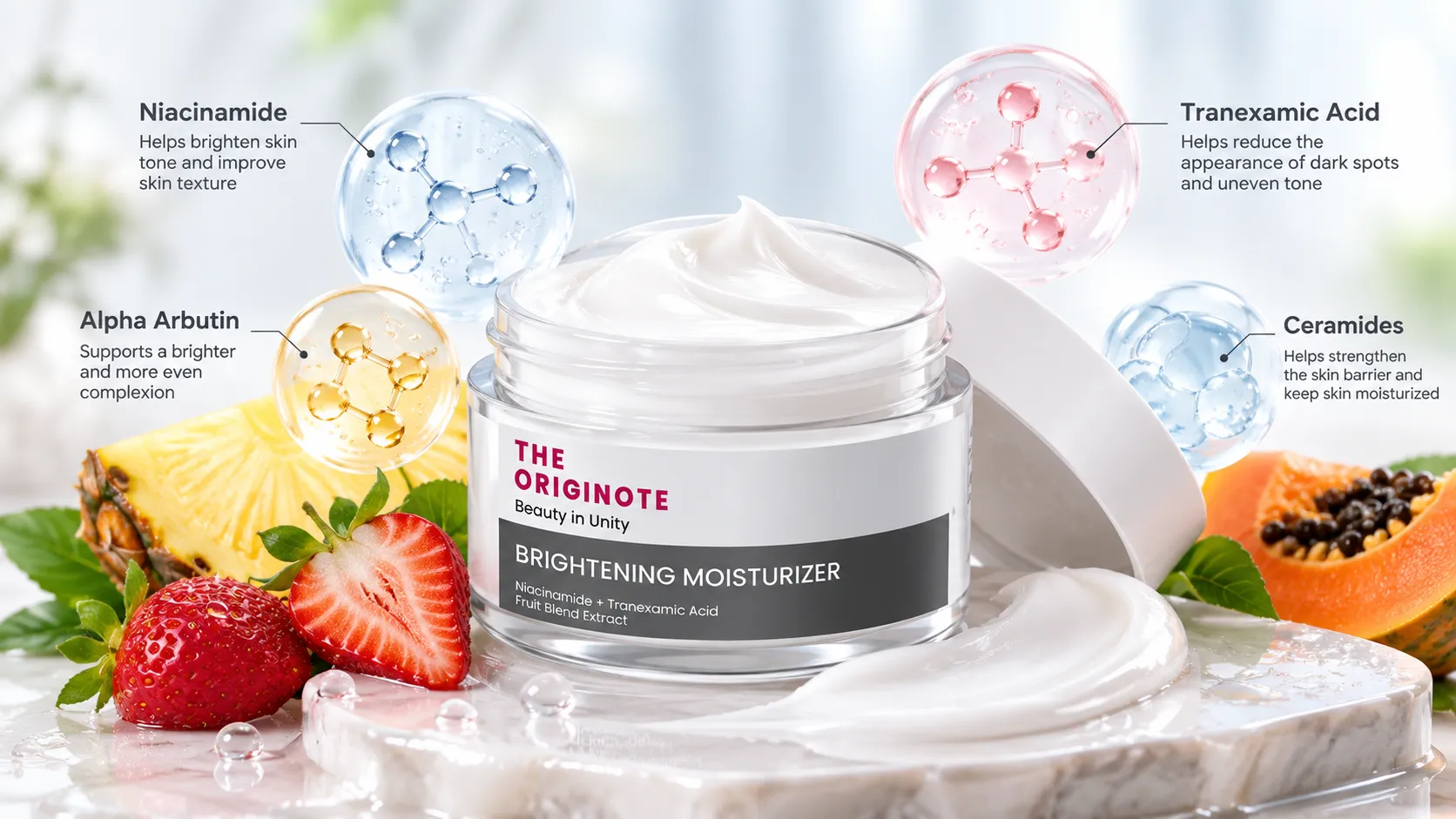
The Originote Brightening Moisturizer ingredients combine niacinamide, tranexamic acid, alpha-arbutin, phenylethyl resorcinol, moisturizing humectants, plant extracts, and multiple ceramides. The formula is designed primarily to improve hydration and the appearance of dull, uneven or hyperpigmented skin rather than work as a simple basic moisturizer.
The most important point is that this is a multi-pathway brightening formula. Niacinamide and tranexamic acid have comparatively strong evidence for improving uneven pigmentation, while glycerin and ceramides support hydration and the skin barrier. The exact percentages of most ingredients are not publicly disclosed, so the ingredient list can tell us what is present, but not precisely how powerful the finished product will be.
What Is The Originote Brightening Moisturizer?
The Originote Brightening Moisturizer is a 50 ml facial moisturizer marketed for brighter, more even-looking and hydrated skin. The brand specifically highlights niacinamide, tranexamic acid and a fruit blend containing pineapple, strawberry and papaya extracts.
Its formula goes further than those headline ingredients. A current retailer ingredient disclosure also lists alpha-arbutin, licorice root extract, phenylethyl resorcinol, green tea, allantoin, vitamin E and several types of ceramides.
Watsons Indonesia lists the product under BPOM notification number NA11230100078 and identifies its origin as Indonesia.
The Originote Brightening Moisturizer Ingredients: Full List
The ingredient list currently published by Watsons Malaysia is:
Water, Glycerin, Butylene Glycol, Aloe Barbadensis Leaf Water, Niacinamide, Glycosyl Trehalose, Hydrogenated Starch Hydrolysate, Hydroxyacetophenone, 1,2-Hexanediol, Cetearyl Alcohol, Bellis Perennis (Daisy) Flower Extract, Diglycerin, PEG/PPG-17/6 Copolymer, Tranexamic Acid, Acrylates/C10-30 Alkyl Acrylate Crosspolymer, Cetearyl Glucoside, Arginine, Ammonium Acryloyldimethyltaurate/VP Copolymer, Sorbitan Olivate, Alpha-Arbutin, Allantoin, Glyceryl Glucoside, Glycyrrhiza Uralensis (Licorice) Root Extract, Portulaca Oleracea Flower/Leaf/Stem Extract, Paeonia Suffruticosa Root Extract, Paeonia Lactiflora Extract, Polysorbate 80, Glucose, Sorbitan Oleate, Caprylic/Capric Triglyceride, Camellia Sinensis Extract, Fragaria Ananassa (Strawberry) Fruit Extract, Phenylethyl Resorcinol, Phenoxyethanol, Phospholipids, Ananas Sativus (Pineapple) Fruit Extract, Potassium Sorbate, Sodium Benzoate, Carica Papaya (Papaya) Fruit Extract, Ceramide NP, Ceramide EOP, Ceramide AS, Ceramide AP, Ceramide NS, Ethylhexylglycerin, Tocopheryl Acetate.
Independent ingredient databases reproduce substantially the same formula, although some display the ceramides in a slightly different order. Cosmetic formulas can also be reformulated, so the packaging of the specific product being purchased should remain the final reference.
Key Brightening Ingredients and What They Do
Niacinamide
Niacinamide, a form of vitamin B3, appears fifth on the published ingredient list, making it one of the most prominent named skincare actives in the formula. It is used extensively in skincare for pigmentation, barrier support, texture and redness.
Clinical research gives the ingredient reasonable support. In a 12-week randomized, double-blind study involving 50 women, a moisturizer containing 5% niacinamide produced greater improvements in hyperpigmented spots, fine lines, texture and red blotchiness than its control formulation.
Another randomized study comparing topical 4% niacinamide with 4% hydroquinone in melasma patients reported pigmentation improvement with both treatments, although the study was small and should not be interpreted as proof that every niacinamide cosmetic will perform like a prescription-strength pigmentation treatment.
The Originote does not publicly state the niacinamide percentage on its current product page, so it would be inaccurate to assume it contains 4%, 5% or another specific concentration.
Tranexamic Acid
Tranexamic acid is another important pigmentation-focused ingredient. It appears after diglycerin and PEG/PPG-17/6 copolymer in the published formula.
Topical tranexamic acid has been studied primarily for hyperpigmentation and melasma. A 2026 systematic review and meta-analysis of randomized controlled trials found that topical tranexamic acid was associated with improvements in melasma measures, with noticeable effects appearing from around eight weeks in the analyzed studies.
There is also research directly relevant to the combination used here. An eight-week randomized, double-blind trial involving 42 Korean women found that a moisturizing formulation containing 2% niacinamide plus 2% tranexamic acid reduced irregular facial pigmentation more effectively than the vehicle control when both groups also used sunscreen.
That study supports the ingredient pairing in principle. It does not establish that The Originote contains the same concentrations or will produce identical results.
Alpha-Arbutin
Alpha-arbutin is another pigmentation-targeting ingredient in the moisturizer. It is related to arbutin and is commonly incorporated into cosmetic products intended to reduce the visible appearance of dark spots by interfering with processes involved in melanin production.
Clinical evidence for alpha-arbutin alone is less extensive than the evidence available for some better-established pigmentation ingredients. One prospective study using 7% alpha-arbutin together with laser therapy reported improvement in refractory melasma, but because two treatments were used simultaneously, the results cannot establish how much of the improvement came from alpha-arbutin itself.
Its inclusion nevertheless makes sense within a formula already targeting uneven pigmentation through several mechanisms.
Phenylethyl Resorcinol
Phenylethyl resorcinol is another notable brightening ingredient, sometimes associated with the cosmetic ingredient trade name SymWhite 377.
Laboratory research has found that phenylethyl resorcinol can decrease melanin production and tyrosinase activity in experimental cell models. Tyrosinase is an enzyme involved in melanin production.
The limitation is important. Much of the mechanistic evidence is laboratory-based, so the presence of phenylethyl resorcinol does not allow a precise prediction of how much fading a consumer will see from this moisturizer.
Licorice Root Extract
Glycyrrhiza uralensis root extract, or licorice root extract, is included alongside several other botanical ingredients.
Licorice-derived ingredients are commonly used in brightening and soothing formulations. In this product, licorice should be viewed as a supporting ingredient rather than the central active, particularly because the manufacturer does not disclose its concentration.
Hydrating Ingredients
Brightening treatments are more useful when the skin remains hydrated and comfortable. The Originote formula includes several ingredients that perform that role.
Glycerin
Glycerin is the second ingredient after water, making hydration one of the formula’s clearest strengths.
Glycerin is a humectant, meaning it helps the outer layers of the skin retain water. Scientific reviews have linked topical glycerin with improved stratum corneum hydration, barrier function and skin mechanical properties.
That high position in the ingredient list is significant because it suggests that hydration is a fundamental part of the formulation rather than an afterthought.
Butylene Glycol
Butylene glycol appears third. It functions mainly as a humectant and solvent and can improve the feel and distribution of a cosmetic formula.
It works alongside glycerin, diglycerin, glyceryl glucoside, glucose and other water-binding ingredients to build the moisturizer’s hydration system.
Aloe Barbadensis Leaf Water
Aloe leaf water appears fourth. Aloe-based ingredients are commonly used for skin conditioning and soothing purposes.
Its presence relatively high in the list is notable, although consumers should avoid interpreting aloe content alone as evidence that the moisturizer will treat inflammatory skin conditions.
Glycosyl Trehalose and Hydrogenated Starch Hydrolysate
These ingredients help support hydration and the texture of the finished formula.
They are less recognizable than niacinamide or glycerin but contribute to the product’s broader moisture-retention system.
Five Types of Ceramides for Skin-Barrier Support
A particularly interesting feature of the formula is the presence of five ceramide types:
| Ingredient | Primary role |
|---|---|
| Ceramide NP | Skin-conditioning and barrier lipid |
| Ceramide EOP | Skin-barrier support |
| Ceramide AS | Skin-conditioning lipid |
| Ceramide AP | Skin-barrier support |
| Ceramide NS | Skin-conditioning and barrier support |
Ceramides are lipids naturally found within the stratum corneum, the outermost layer of skin. Together with other lipids, they play a major part in limiting excessive water loss and maintaining an effective protective barrier.
Clinical literature indicates that properly formulated ceramide-containing moisturizers can help improve dry skin and barrier function, although results depend on the complete formulation rather than merely the number of ceramide names on the label.
There is one limitation here. The Originote’s ceramides appear near the end of the ingredient list, and their concentrations are not disclosed. It is therefore reasonable to describe them as supportive ingredients, but not to claim that this is a high-dose therapeutic ceramide treatment.
Also Read: Motivian: Company, Services, Qualco Deal and Current Status
Fruit Blend Extracts
The brand prominently highlights three fruit extracts.
Pineapple Extract
Ananas sativus fruit extract is included toward the end of the formula. Pineapple is naturally associated with compounds such as bromelain, but a cosmetic pineapple extract should not automatically be treated as equivalent to purified bromelain or a strong exfoliating treatment.
The ingredient is best understood here as a supplementary botanical skin-conditioning component.
Strawberry Extract
Fragaria ananassa fruit extract appears before phenylethyl resorcinol. Strawberry contains naturally occurring antioxidant compounds, although the exact composition and concentration of the extract in this moisturizer are not disclosed.
Papaya Extract
Carica papaya fruit extract is also part of the advertised fruit blend. Papaya is often associated with papain, but an INCI listing for papaya fruit extract does not establish that the product contains a clinically meaningful concentration of active papain.
For that reason, describing this moisturizer as a strong enzymatic exfoliant would overstate what the ingredient list actually proves.
Other Useful Supporting Ingredients
Allantoin
Allantoin is commonly used as a soothing and skin-conditioning ingredient. Its presence can be helpful in a formulation that contains several pigmentation-targeting actives.
Green Tea Extract
Camellia sinensis extract provides another botanical component. Green tea contains antioxidant compounds, but its exact amount and extraction method in this formula are not publicly specified.
Vitamin E
Tocopheryl acetate is a stable vitamin E derivative used primarily for antioxidant and skin-conditioning purposes.
Caprylic/Capric Triglyceride
This lightweight emollient helps soften the skin and improves the texture of many creams and lotions.
Cetearyl Alcohol
Despite the word “alcohol,” cetearyl alcohol is a fatty alcohol, not the same type of volatile alcohol commonly associated with a drying sensation. It is used as an emollient, thickener and emulsion stabilizer.
Does It Contain Fragrance or Drying Alcohol?
No separate parfum/fragrance ingredient appears in the current full list published by Watsons, and independent ingredient databases also characterize this version as fragrance-free.
There is also no ethanol, denatured alcohol or SD alcohol listed. Cetearyl alcohol is present, but it is a fatty alcohol used to soften and stabilize cosmetic formulations rather than a volatile drying alcohol.
People with very reactive or allergy-prone skin can still react to fragrance-free products because botanical extracts, preservatives or active ingredients can also cause irritation in susceptible individuals.
Preservatives in the Formula
The product contains a conventional preservative system including:
- Phenoxyethanol
- Potassium sorbate
- Sodium benzoate
- Ethylhexylglycerin
- 1,2-Hexanediol
Preservatives are necessary in water-based skincare products because they help limit microbial contamination during normal storage and use.
Their presence should not automatically be interpreted as a negative feature.
How Strong Is the Brightening Formula?
On paper, the ingredient selection is more comprehensive than that of a moisturizer containing only one brightening active.
It targets pigmentation through several ingredients including:
Niacinamide + tranexamic acid + alpha-arbutin + phenylethyl resorcinol + licorice extract, supported by hydrating ingredients and ceramides.
The strongest evidence relevant to the formula comes from niacinamide and tranexamic acid. Clinical research has shown that a topical combination of these two ingredients can improve irregular pigmentation.
However, ingredient names alone do not establish product efficacy. The manufacturer has not publicly disclosed the concentrations of its headline actives on the current official product page, and independently published clinical trials specifically testing the finished Originote moisturizer were not identified in the sources reviewed for this article.
Is It Good for Dark Spots?
The ingredient profile is logically suited to people trying to improve the appearance of post-acne marks, uneven tone and general hyperpigmentation, especially because niacinamide, tranexamic acid and other pigment-focused ingredients appear in the same product.
Results should still be expected gradually. Pigmentation studies involving topical niacinamide or tranexamic acid commonly measure improvement over several weeks rather than days.
Persistent melasma, rapidly changing pigmentation or unexplained dark patches may require a dermatologist because cosmetic moisturizers cannot address every cause of pigmentation.
Which Skin Types May Like It?
The formula appears most naturally suited to normal, combination, dehydrated and moderately oily skin looking for hydration alongside brightening ingredients.
Dry skin may benefit from glycerin, fatty alcohols, caprylic/capric triglyceride and ceramides, although very dry skin can require a richer, more occlusive cream on top.
Sensitive skin requires more individual judgment. The absence of listed fragrance is useful, but the formula still contains multiple actives and botanical extracts. Patch testing is sensible when the skin is especially reactive.
Can Acne-Prone Skin Use It?
There is nothing in the ingredient list that automatically means acne-prone skin cannot use the product. Niacinamide is commonly found in formulas intended for oily or blemish-prone skin, while a moisturizer can help counteract dryness associated with acne routines.
Still, acne compatibility is individual. A product being marketed as lightweight or having no obvious heavy occlusive ingredient does not guarantee that every acne-prone user will tolerate it.
People using retinoids, benzoyl peroxide, salicylic acid or prescription acne treatments may want to introduce any new moisturizer gradually.
How to Use The Originote Brightening Moisturizer
Watsons’ directions recommend using the moisturizer after cleansing and after toner or serum, then gently spreading it over the face and allowing it to absorb.
A simple routine would be:
Morning: cleanser → optional serum → The Originote Brightening Moisturizer → broad-spectrum sunscreen.
Evening: cleanser → treatment or serum if required → moisturizer.
Sunscreen is particularly important when the goal is fading dark spots. UV exposure can stimulate pigmentation and make discoloration harder to control, meaning even a well-formulated brightening product can produce disappointing results without consistent photoprotection.
Important Limitations of the Ingredient List
The formula looks sophisticated, but several things cannot be determined from the label alone.
First, The Originote does not disclose the percentages of niacinamide, tranexamic acid, alpha-arbutin, ceramides or phenylethyl resorcinol on the current official page. Ingredient order provides clues but cannot reliably reveal exact concentrations.
Second, evidence supporting an individual ingredient does not prove that the complete moisturizer will produce exactly the same outcomes as formulations tested in clinical trials.
Third, several botanical and fruit extracts occur relatively far down the list. They may contribute to the formula, but marketing emphasis should not be confused with evidence that they are present at high concentrations.
Finally, skincare formulas can change. Consumers comparing this article with a jar purchased months or years later should check the ingredient list printed on their own packaging.
FAQ
What are the main ingredients in The Originote Brightening Moisturizer?
The main advertised actives are niacinamide, tranexamic acid and pineapple, strawberry and papaya extracts. The full formula also contains alpha-arbutin, phenylethyl resorcinol, licorice extract, glycerin, allantoin, vitamin E and five types of ceramides.
Does The Originote Brightening Moisturizer contain niacinamide?
Yes. Niacinamide appears fifth on the current published ingredient list. The brand does not state its exact percentage on the official product page.
Does it contain tranexamic acid?
Yes. Tranexamic acid is one of the product’s headline ingredients. Topical tranexamic acid has clinical evidence supporting its use for reducing the appearance of certain forms of hyperpigmentation, although the concentration in this specific moisturizer is not publicly disclosed.
Does The Originote Brightening Moisturizer contain alpha-arbutin?
Yes. Alpha-arbutin appears in the full ingredient list published by Watsons. It is part of the product’s broader combination of pigmentation-focused ingredients.
Is The Originote Brightening Moisturizer fragrance-free?
No separate parfum or fragrance ingredient appears in the current Watsons ingredient disclosure, and an independent ingredient database categorizes the formula as fragrance-free. Botanical extracts are still present, so fragrance-free does not necessarily mean irritation is impossible.
Does it contain ceramides?
Yes. The current formula lists Ceramide NP, Ceramide EOP, Ceramide AS, Ceramide AP and Ceramide NS. Ceramides are naturally important components of the skin barrier and can contribute to moisture retention when appropriately formulated in skincare products.
Also Read: Levapioli: What the Tool Is and How It Works
