


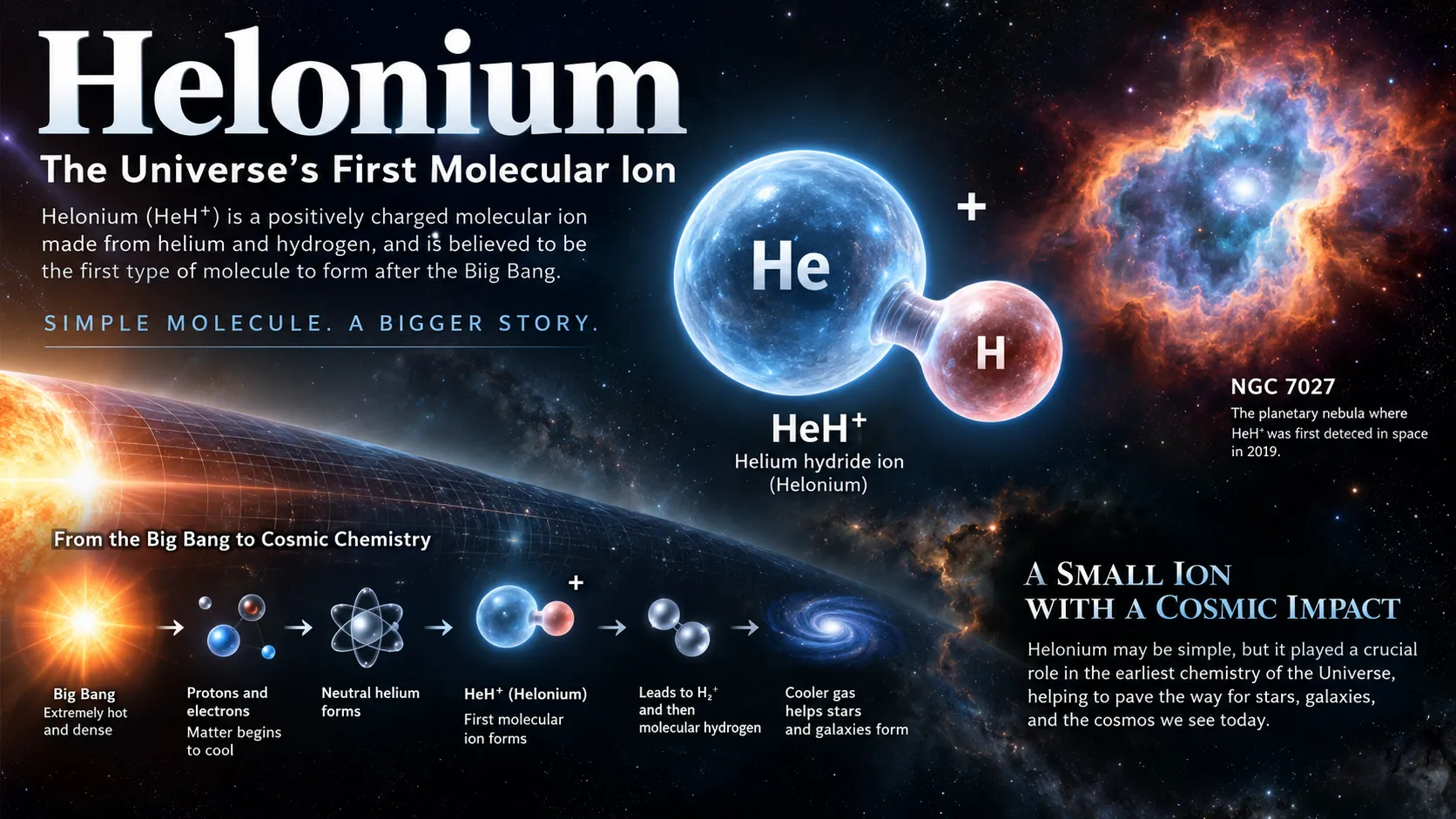
Helonium is another name for the helium hydride ion, HeH⁺, a positively charged molecular ion made from helium and hydrogen. It is not a chemical element. Helonium is scientifically important because current models identify HeH⁺ as the first type of molecule to form after the Big Bang, marking the beginning of chemistry in the Universe.
The term can be confusing because “helonium” sounds like the name of an element similar to helium, uranium, or plutonium. In chemistry, however, it refers to a very simple molecular ion whose systematic IUPAC name is hydridohelium(1+).
What Is Helonium?
Helonium is the helium hydride cation, represented by the chemical formula HeH⁺. It contains a helium nucleus and a hydrogen nucleus associated in a two-atom molecular ion carrying one positive electrical charge.
In simple terms:
| Property | Helonium |
|---|---|
| Chemical formula | HeH⁺ |
| Common scientific name | Helium hydride ion or helium hydride cation |
| Systematic name | Hydridohelium(1+) |
| Type | Positively charged molecular ion |
| Elements present | Helium and hydrogen |
| Number of atoms | Two |
| Electrical charge | +1 |
| Element on periodic table? | No |
IUPAC’s inorganic chemistry nomenclature specifically lists HeH⁺ as hydridohelium(1+), confirming that the species is a molecular ion rather than a newly recognized element.
The name helonium appears as an alternative name for this ion in chemical reference material, although scientific papers more commonly use HeH⁺, “helium hydride ion,” or “helium hydride cation.”
Is Helonium a Chemical Element?
No. Helonium is not an element and has no atomic number on the periodic table.
Helium is an element with atomic number 2, while hydrogen is an element with atomic number 1. Helonium refers to a species formed when helium and hydrogen participate in a molecular ion.
That distinction is especially important because some online explanations incorrectly describe helonium as an exotic or hypothetical element. Established chemical and astronomical literature instead uses the term for HeH⁺. The IUPAC nomenclature for the ion is hydridohelium(1+).
Why Helonium Is So Important
Helonium matters far beyond its simple formula. According to standard models of primordial chemistry, HeH⁺ represents the first molecular bond formed in the young Universe.
After the Big Bang, the Universe was initially too hot for ordinary neutral atoms and molecules to survive. As expansion caused temperatures to fall, electrons began combining with atomic nuclei. Neutral helium appeared while much of the hydrogen was still present as positively charged protons.
Neutral helium could then react with a proton:
He + H⁺ → HeH⁺ + photon
This process is known as radiative association because the formation of the molecular ion is accompanied by the emission of radiation. Nature’s 2019 report on the first astronomical detection of HeH⁺ describes this reaction as the formation of the Universe’s first molecular bond.
NASA similarly describes helium hydride as the first type of molecule expected to have formed in the early Universe.
An Important Scientific Distinction
Scientists have not directly observed primordial HeH⁺ left over from shortly after the Big Bang.
Instead, theoretical chemistry and cosmological models predict that HeH⁺ formed first. The molecule detected astronomically in 2019 was found in the much more recent planetary nebula NGC 7027. That observation demonstrated that the same molecular ion really can occur under natural astrophysical conditions.
This distinction prevents a common exaggeration. The 2019 discovery did not amount to seeing a surviving molecule from the birth of the Universe.
How Helonium Helped Start Cosmic Chemistry
Helonium was probably short-lived in the primordial Universe, but that did not make it unimportant.
Once neutral hydrogen became more abundant, HeH⁺ could react with it:
HeH⁺ + H → He + H₂⁺
The resulting molecular hydrogen ion could participate in additional reactions that ultimately produced molecular hydrogen, H₂. Nature and the SOFIA Science Center describe the destruction of HeH⁺ as one of the early pathways toward molecular hydrogen formation.
Molecular hydrogen later became enormously important in astrophysics because molecules can lose energy through rotational and vibrational radiation. Cooling makes it easier for clouds of gas to contract gravitationally, an essential step in the formation of the earliest stars.
This is why HeH⁺ is more than a chemistry curiosity. It sits near the beginning of the reaction network that transformed a Universe dominated by simple atoms into one capable of producing increasingly complicated chemistry.
How Can Helium Form a Molecule If It Is a Noble Gas?
Helium is famous for being chemically unreactive, but “unreactive” does not mean that helium can never participate in a bound molecular species.
A normal neutral helium atom already has a very stable electron configuration. Under unusual conditions involving ions, energetic radiation, or extremely low-density astrophysical environments, however, helium can participate in molecular ions such as HeH⁺.
Helonium is therefore not evidence that helium behaves like an ordinary reactive element. Instead, it demonstrates how chemical behavior can change when electrical charge and extreme physical conditions are involved.
The ion is also highly reactive, so it does not accumulate in familiar terrestrial materials such as rocks, water, or the atmosphere in quantities that people could collect or use.
When Was Helonium First Discovered?
HeH⁺ has an unusual scientific history because researchers produced evidence for it in the laboratory many decades before they could detect it in space.
1925: Laboratory Discovery
The helium hydride ion was identified experimentally in 1925 in work by T. R. Hogness and E. G. Lunn involving ionized gases. The 2019 Nature paper cites their work as the laboratory discovery of HeH⁺.
1970s: Astronomical Interest Grows
By the late 1970s, scientists were investigating whether HeH⁺ could exist in astronomical environments and whether its spectral fingerprints might be detectable.
Planetary nebulae became particularly promising targets because they contain intense radiation and regions where ionized hydrogen and neutral helium can coexist.
2019: First Unambiguous Detection in Space
The major breakthrough came in April 2019.
Rolf Güsten and colleagues reported the first unambiguous astrophysical detection of HeH⁺ in NGC 7027, a young planetary nebula. Their results appeared in Nature on April 17, 2019.
The team used the GREAT spectrometer aboard SOFIA, the Stratospheric Observatory for Infrared Astronomy.
They detected the fundamental rotational transition of HeH⁺ at approximately 149.1 micrometres, corresponding to a frequency near 2.010 terahertz.
The discovery ended decades of unsuccessful astronomical searches.
Why Scientists Found Helonium in NGC 7027
NGC 7027 provides unusually favorable conditions for forming HeH⁺.
It contains a very hot central star surrounded by expanding gas. Different parts of the nebula contain helium and hydrogen in different ionization states. In the transition region between highly ionized gas and cooler material, neutral helium can encounter hydrogen ions, allowing HeH⁺ to form.
This made NGC 7027 something of a natural laboratory for a reaction that resembles chemistry expected in the young Universe.
The 2019 observation was significant not merely because another interstellar molecule had been added to the catalog. Scientists finally had a natural astrophysical example of a molecular ion that had occupied a central place in models of primordial chemistry for decades.
Further Confirmation Came in 2020
Scientists obtained additional evidence for HeH⁺ in NGC 7027 the following year.
A 2020 study reported two rovibrational emission lines from helium hydride at wavelengths of approximately 3.516 and 3.608 micrometres. The observations were made with the iSHELL spectrograph at NASA’s Infrared Telescope Facility on Maunakea.
These measurements independently supported the original SOFIA discovery while also revealing differences between some predicted and observed line strengths.
Those discrepancies are scientifically useful. They allow researchers to refine models describing how quickly HeH⁺ forms, how it is destroyed, and how collisions and radiation populate its energy levels.
How Scientists Detect Helonium
Astronomers cannot simply photograph an individual HeH⁺ ion.
Instead, they use spectroscopy.
Molecules have discrete rotational and vibrational energy levels. When a molecule changes from one energy state to another, it can absorb or emit radiation at highly specific frequencies.
These frequencies operate like molecular fingerprints.
For HeH⁺, researchers can therefore search space for radiation corresponding to accurately measured laboratory transitions. If a spectral feature appears at the correct frequency and alternative explanations can be excluded, scientists can identify the molecular species responsible.
This is why extremely accurate laboratory spectroscopy remains important even after the molecule has been discovered in space.
New Helonium Research in 2025
Research into HeH⁺ remains active.
In 2025, scientists at the Max Planck Institute for Nuclear Physics reported laboratory measurements of reactions between HeH⁺ and deuterium under conditions designed to resemble the cold early Universe.
The experiments indicated that the reaction remains fast at low temperatures rather than slowing sharply as some earlier theoretical calculations had predicted. Researchers described it as a barrierless reaction.
This finding matters because reactions with neutral hydrogen were a major way of destroying HeH⁺ in primordial gas. If those reactions were faster than older models assumed, the abundance of HeH⁺ at very high redshift could have been lower.
The result therefore changes details of early-Universe chemical modeling rather than overturning the basic idea that HeH⁺ was the first molecular ion to form.
2026 Measurements Made the Helonium Fingerprint More Precise
Laboratory spectroscopy also produced a significant update in 2026.
Researchers led by Oskar Asvany remeasured the fundamental J = 1 ← 0 rotational transition of HHe⁺ using cryogenic ion-trap spectroscopy. Their result refined the transition frequency to:
2010.183312(8) GHz
The authors reported roughly an order-of-magnitude improvement in accuracy and precision over the previous value.
The Cologne Database for Molecular Spectroscopy subsequently updated its HeH⁺ entry in February 2026 to incorporate the improved laboratory measurements.
Better frequencies make astronomical searches more reliable because observatories can compare incoming radiation against a much more precise laboratory fingerprint.
Does Helonium Have Practical Uses?
Helonium currently has no everyday commercial or industrial use comparable with helium gas, hydrogen, or common chemical compounds.
Its importance is primarily scientific.
Researchers study HeH⁺ to understand:
- primordial chemistry after the Big Bang
- molecular formation in planetary nebulae
- ion-molecule reactions
- molecular spectroscopy
- quantum chemistry
- formation pathways leading to molecular hydrogen
- the thermal evolution of early cosmic gas
Calling HeH⁺ a potential new fuel, energy source, industrial material, or exotic element would therefore be misleading without compelling new evidence.
Helonium vs Helium
Helonium and helium should not be treated as interchangeable names.
| Helium | Helonium |
|---|---|
| Chemical element | Molecular ion |
| Symbol He | Formula HeH⁺ |
| Atomic number 2 | No atomic number |
| Neutral under ordinary conditions | Positively charged |
| Noble gas | Helium-hydrogen molecular ion |
| Widely used commercially | Mainly studied in chemistry and astrophysics |
Helium has major practical uses in cryogenics, research equipment, aerospace systems, and other technologies. Helonium is fundamentally a research subject associated with molecular physics and astronomy.
Why Helonium Remains Scientifically Valuable
HeH⁺ gives scientists an unusually direct connection between laboratory chemistry and cosmology.
Researchers can create or trap the ion in laboratories, precisely measure its spectrum and reaction rates, use those measurements in astronomical searches, and then apply the resulting data to models of conditions billions of years in the past.
That chain of evidence is why helonium remains relevant more than a century after its first laboratory identification.
The scientific story is also still evolving. The 2019 astronomical discovery solved the question of whether HeH⁺ occurs naturally in space, while experiments published in 2025 and 2026 continue refining how scientists understand its reactions and spectroscopic behavior.
Frequently Asked Questions About Helonium
What does helonium mean?
Helonium is an alternative name for the helium hydride ion, HeH⁺. It is a positively charged molecular ion made from helium and hydrogen.
Is helonium a real element?
No. Helonium is not an element on the periodic table and does not have an atomic number. The systematic IUPAC name for HeH⁺ is hydridohelium(1+).
Was helonium the first molecule in the Universe?
Current models of primordial chemistry identify HeH⁺ as the first type of molecular ion to form after the Big Bang. Scientists have not directly observed those original primordial ions, so this conclusion comes from well-developed physical and chemical models rather than direct observation of a surviving ancient molecule.
Where has helonium been found in space?
The first unambiguous astrophysical detection was reported in 2019 in the planetary nebula NGC 7027. Researchers detected its rotational spectral signature using the GREAT instrument aboard SOFIA.
Why is HeH⁺ difficult to detect?
HeH⁺ is highly reactive and generally exists only under particular physical conditions. Astronomers must also identify very specific infrared or terahertz spectral transitions, requiring accurate laboratory measurements and sensitive instruments.
Is helonium still being researched?
Yes. Experiments published in 2025 changed scientists’ understanding of important low-temperature HeH⁺ reactions, while a 2026 spectroscopy study produced a substantially more precise measurement of its fundamental rotational transition.
Also Read: To Visit Vuzillfotsps | What This Internet Mystery Really Means
