


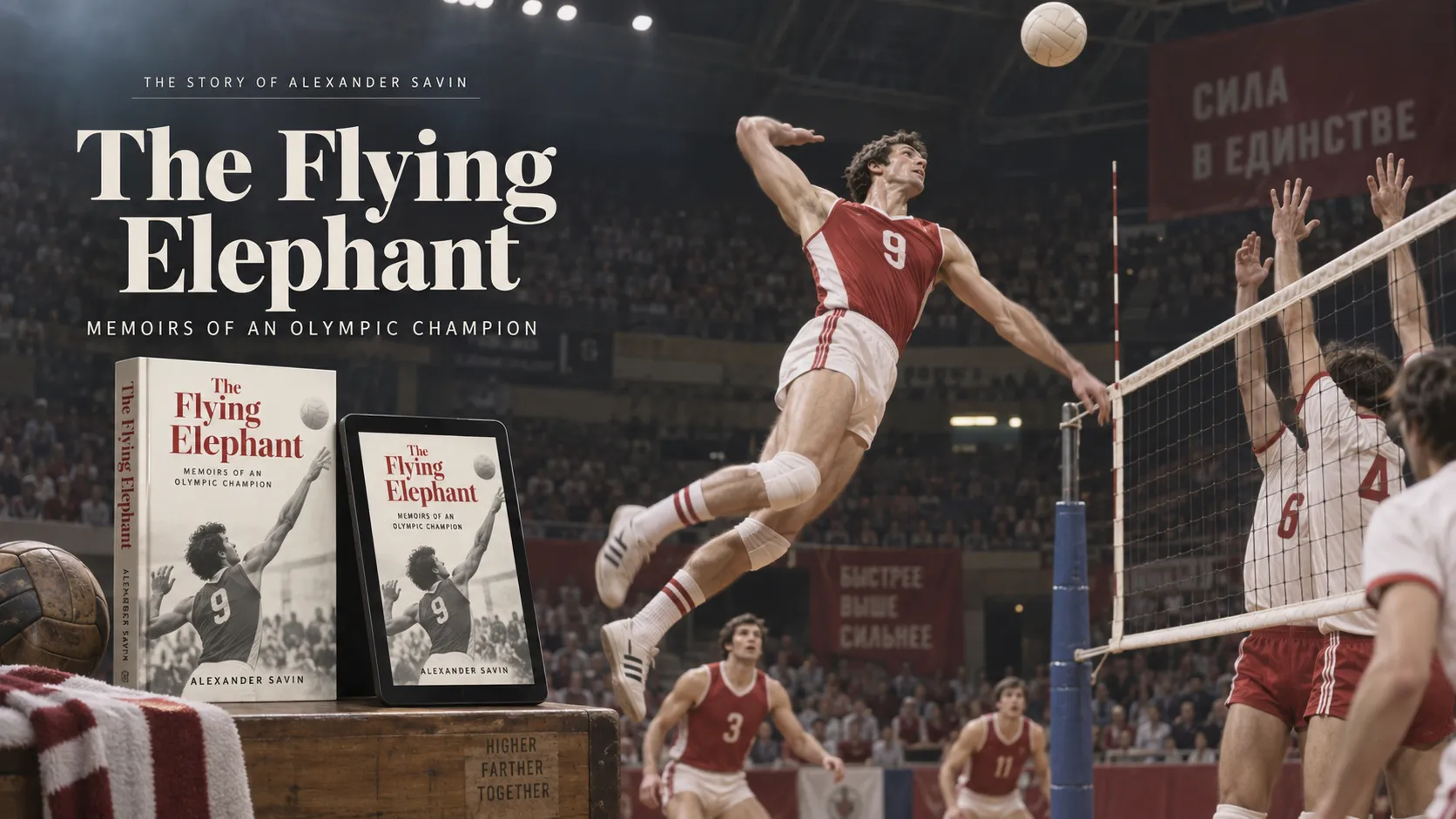
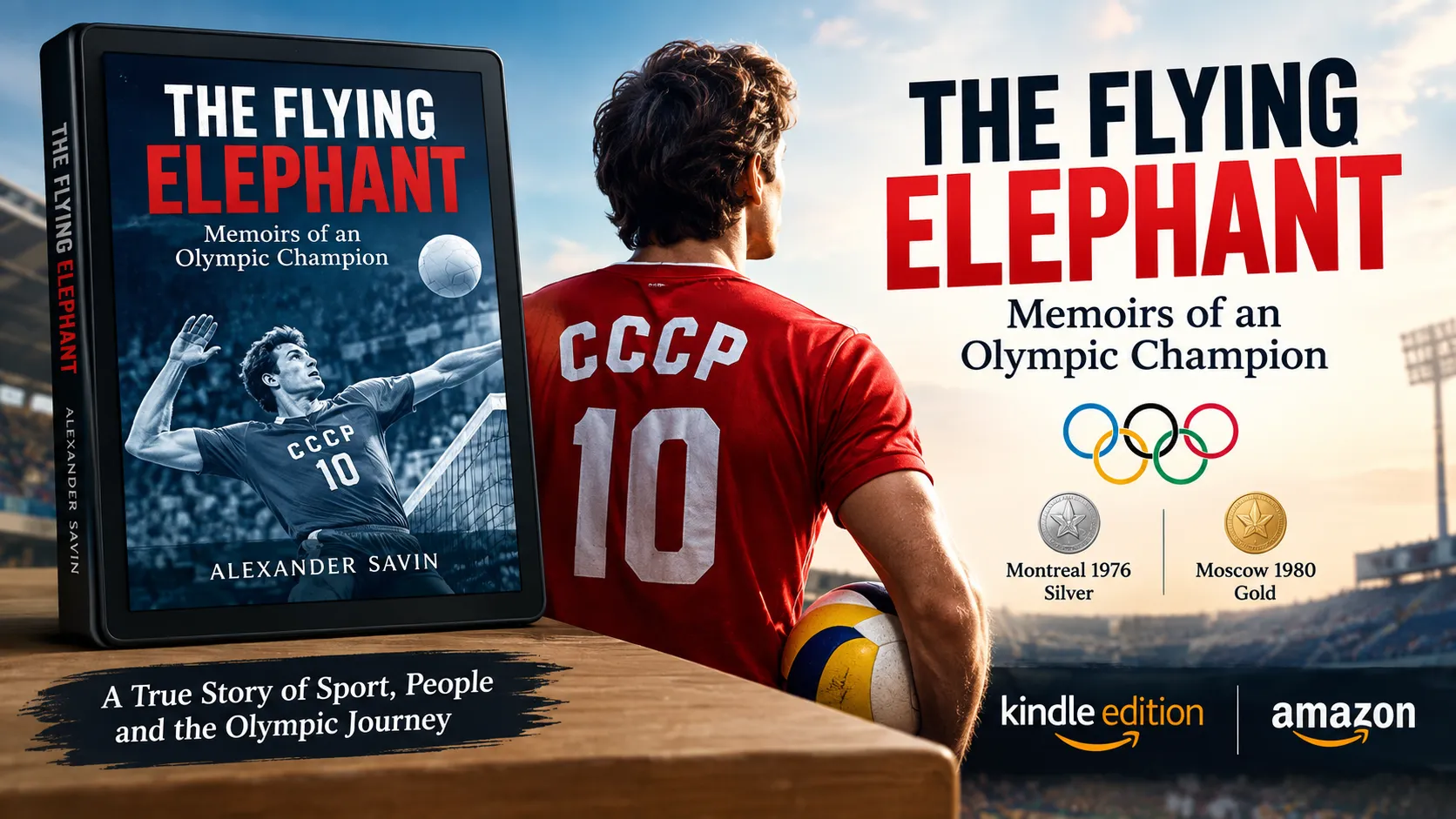
The Flying Elephant: Memoirs of an Olympic Champion is the English-language memoir of Soviet volleyball great Alexander Savin, available in Kindle format through Amazon. Savin was part of the Soviet team that won Olympic silver in Montreal in 1976 and Olympic gold in Moscow in 1980, and his memoir looks beyond those medals to the people, training, competition, and sporting culture surrounding his career.
For readers searching for the flying elephant memoirs of an olympic champion kindle edition amazon, the key point is that this is a substantial sports autobiography rather than a short account of one Olympic tournament. The English edition was created through a family-led translation project and is linked to Amazon under the product identifier B0FXVDWW16.
What Is The Flying Elephant: Memoirs of an Olympic Champion?
The Flying Elephant: Memoirs of an Olympic Champion is Alexander Savin’s account of his life in elite volleyball. It places his Olympic career within the wider story of Soviet volleyball, including teammates, coaches, international tournaments, demanding training environments, and the relationships that surrounded decades of high-level competition.
The memoir is especially notable because Savin’s achievements can already be documented through independent sporting records. Olympedia records him as a two-time Olympic medalist, while the International Volleyball Hall of Fame inducted him in 2010 in the Male Indoor Player category.
The English-language project adds something those record books cannot provide. Andrei Savine, Savin’s half-brother, has described spending more than a year translating the memoir with collaborators and said the project became an effort to preserve the memories of Savin’s teammates, coaches, friends, and generation of Soviet volleyball players. He also confirmed that the resulting English book was released in Kindle format on Amazon.
The Flying Elephant Memoirs of an Olympic Champion Kindle Edition Amazon Details
The book project’s current information describes the Kindle edition as a large, illustrated digital publication. Its website lists a 514-page print length, English language, an October 26, 2025 publication date, and a file size of approximately 68.8 MB. It also says the edition contains more than 240 photographs.
| Book detail | Information |
|---|---|
| Full title | The Flying Elephant: Memoirs of an Olympic Champion |
| Author | Alexander Savin |
| Format | Kindle edition |
| Language | English |
| Listed publication date | October 26, 2025 |
| Listed length | 514 pages |
| Photographs | More than 240 reported |
| Listed file size | About 68.8 MB |
| Amazon identifier | B0FXVDWW16 |
| Main subject | Alexander Savin, Olympic volleyball and Soviet-era sport |
The Amazon identifier comes directly from links shared publicly by people involved in producing the English edition. Andrei Savine linked to Amazon’s U.S. and French stores using ASIN B0FXVDWW16, while collaborator Alfredo Cabero also linked to the same product identifier when discussing the completed Kindle project.
Kindle pricing, regional availability, subscription eligibility and retailer features can change. Anyone planning to purchase The Flying Elephant Memoirs of an Olympic Champion Amazon Kindle edition should therefore check the live Amazon listing rather than relying on an old quoted price.
Who Is Alexander Savin?
Alexander Borisovich Savin, also transliterated from Russian as Aleksandr Savin, was born on July 1, 1957, in Taganrog. Olympedia lists him at 200 cm and 97 kg and records his club affiliation as CSKA Moskva.
The different spellings do not indicate different volleyball players. Alexander Savin is the form used for the English memoir, while organizations such as Olympedia and the International Volleyball Hall of Fame commonly use Aleksandr Savin.
Savin emerged as part of an exceptionally successful generation of Soviet men’s volleyball. The International Volleyball Hall of Fame records that he entered the 1976 Montreal Olympics after the Soviet Union had won the 1975 European Championship and silver at the 1974 World Championship.
His reputation was not built on one Olympic performance. During his international career, Savin was associated with multiple European titles, World Championship success and World Cup victories as the Soviet Union became a dominant force in men’s volleyball. Olympedia records European Championship gold medals in 1975, 1977, 1979, 1981, 1983 and 1985, plus World Championship gold medals in 1978 and 1982.
That sustained career is important to understanding Alexander Savin The Flying Elephant Memoirs of an Olympic Champion. The book concerns an athlete who spent years competing at the highest level rather than someone whose fame came from a single breakthrough tournament.
From Montreal Silver to Moscow Gold
Savin’s two Olympic appearances provide a natural backbone for his sporting story.
At the 1976 Montreal Olympics, Savin competed in all five Soviet matches. The USSR reached the men’s volleyball final after progressing unbeaten through its preliminary group and defeating Cuba in the semifinal. Poland then beat the Soviet Union 3-2 in the gold-medal match, leaving Savin with an Olympic silver medal.
Four years later, Savin returned for the 1980 Moscow Olympics. The Soviet Union advanced through the tournament and defeated Bulgaria 3-1 in the final to claim gold. Olympedia records Savin as appearing in all six Soviet matches during that Olympic competition.
| Olympic Games | Team | Result | Savin’s medal |
|---|---|---|---|
| Montreal 1976 | Soviet Union | 2nd | Silver |
| Moscow 1980 | Soviet Union | 1st | Gold |
The progression from a five-set defeat in the 1976 final to a home Olympic victory four years later gives Savin’s career a dramatic competitive arc that a simple medal tally does not fully convey.
Why Was Alexander Savin Known as “The Flying Elephant”?
The title reflects the striking combination of physical size and aerial ability associated with Savin’s play.
Olympedia lists Savin at two metres tall, and contemporary reporting emphasized how extraordinary his jumping ability looked for such a large athlete. A 1981 Washington Post article quoted a 1978 Volleyball Magazine description that focused specifically on the amount of time Savin appeared to spend airborne and his ability to attack or block above the net.
That contrast explains why “The Flying Elephant” works so well as a sporting image. The elephant suggests size and power, while “flying” describes the explosive vertical movement that made Savin stand out.
The International Volleyball Hall of Fame’s career account similarly presents him as a central figure in the Soviet team’s return to Olympic supremacy.
The nickname therefore is not simply an unusual title invented for an English book. It captures the athletic contradiction that defined Savin’s reputation.
What Does the Memoir Cover?
Available descriptions of the flying elephant memoirs of an olympic champion alexander savin present the book as much broader than an Olympic diary.
The memoir reportedly follows Savin through elite Soviet volleyball while paying considerable attention to teammates, coaches, mentors and other sporting figures. The people involved in the English translation have repeatedly described preservation of volleyball history as an important purpose of the project.
Readers can expect the central subject areas to include Savin’s competitive career, the Soviet national team, major international tournaments, relationships within the sport, training and the personal memories attached to his era of volleyball.
Alfredo Cabero, who worked on the project, described the memoir as revealing not only Savin’s sporting life but also his attachment to his mother, wife and family. Cabero also said he contributed historical photographs and helped secure messages from players who had competed against Savin.
That makes the book potentially useful on two levels. It is an athlete’s autobiography, but it also preserves first-person recollections and visual material from a period of volleyball history for which English-language personal accounts are relatively limited.
The English Translation Was a Family Project
One of the most interesting parts of the book’s publication history is how the English edition came together.
Andrei Savine publicly described Alexander Savin as his half-brother and explained that translating The Flying Elephant began while they were reconnecting. He worked on the project with Alfredo Cabero and his wife, Ioulia Soudakova, eventually seeing the translation as a way of preserving stories that might otherwise disappear.
The book’s website lists Andrei Savine as editor and translator, Julia Savine as editor, Alfredo Cabero as translator and Peter Murphy as the writer of the introduction.
Cabero independently described spending more than a year working on Savin’s memoir and said the finished English edition became available through Amazon Kindle. His account provides useful first-hand confirmation that this was not merely a reissued English text, but a substantial translation and archival project.
Why the 240-Plus Photographs Matter
Book materials report that the Kindle edition contains more than 240 photographs.
That is unusually extensive for a sports memoir and means the digital edition can also function as a visual record of Savin’s volleyball world. Cabero specifically refers to providing archival photographs during his work on the project, while Andrei Savine has highlighted the inclusion of rare archival images.
For readers interested in sports history, photographs can supply context that career statistics cannot. Images of teammates, uniforms, competitions and sporting environments help identify the people and places mentioned in the narrative.
The amount of visual content also helps explain why the book project lists a comparatively large Kindle file size of around 68.8 MB.
Readers who particularly value the photography may prefer a tablet or larger Kindle-compatible display, where images can be viewed more comfortably than on a small phone.
How Accurate Are Savin’s Sporting Achievements in the Book’s Promotion?
The most important career claims associated with Savin can be independently verified.
The International Volleyball Hall of Fame confirms his July 1, 1957 birth date, his Soviet volleyball career, his 1976 Olympic silver medal, his 1980 Olympic gold medal and his induction into the Hall of Fame in 2010.
Olympedia independently records the same Olympic medals and identifies him as Aleksandr Borisovich Savin, born in Taganrog. It also documents his World and European Championship medal record.
These sources matter because promotional descriptions of sports memoirs sometimes exaggerate achievements. In Savin’s case, the central claims about his Olympic status and major international career are supported by established historical records.
Why the Book Is Relevant Beyond Volleyball
A reader does not necessarily need to follow volleyball closely to understand the broader value of Savin’s story.
His career overlapped with a period when international sport was closely connected to Cold War politics and national prestige. Moscow 1980 in particular became one of the most politically contentious Olympics of the era, even though Savin’s own career extended across many competitions before and after those Games.
The memoir can therefore be approached as several kinds of book at once: an athlete autobiography, a record of Soviet sporting life, a story about high-performance teamwork and a collection of memories about people who participated in an important period of international volleyball.
Its greatest historical value may be precisely in those ordinary details. Olympic databases preserve scores, medals and rosters exceptionally well, but they cannot preserve how athletes remembered their coaches, friendships, routines or disappointments.
Who Should Consider Reading The Flying Elephant?
The book is particularly relevant to readers interested in:
- Olympic and volleyball history
- Soviet-era international sport
- Athlete autobiographies
- Coaching and team culture
- CSKA Moscow and the Soviet national volleyball program
- Historical sports photography
- First-person accounts of elite competition
At a listed 514 pages, however, it is considerably more detailed than a short sports biography.
Someone who needs only Savin’s Olympic results can get those facts from Olympedia or the Volleyball Hall of Fame in minutes. The appeal of the memoir is the material around those results: the people, relationships, memories, photographs and experiences that do not appear in official statistics.
How to Find the Correct Book on Amazon
Searching only for “The Flying Elephant” can return unrelated material, so readers should verify the author and subtitle before purchasing.
Look for:
Title: The Flying Elephant: Memoirs of an Olympic Champion
Author: Alexander Savin
Format: Kindle
Subject: Soviet and Olympic volleyball
Amazon ASIN: B0FXVDWW16
The same ASIN was shared by both Andrei Savine and Alfredo Cabero in their public posts about the completed English translation.
View The Flying Elephant on Amazon
Before purchasing, check the retailer page for the current Kindle price, availability in your country, device compatibility and any subscription options. Those details are controlled by Amazon and can change over time.
FAQ
Who wrote The Flying Elephant: Memoirs of an Olympic Champion?
Alexander Savin is the author and athlete at the center of the memoir. The English edition was developed with translators and editors including his half-brother Andrei Savine and collaborator Alfredo Cabero.
Is The Flying Elephant Memoirs of an Olympic Champion available on Amazon Kindle?
Yes. People directly involved in translating the book have confirmed that the English edition was released in Kindle format on Amazon and linked to Amazon product identifier B0FXVDWW16.
What Olympic medals did Alexander Savin win?
Savin won silver with the Soviet men’s volleyball team at Montreal 1976 and gold at Moscow 1980. Both results are documented by Olympedia and the International Volleyball Hall of Fame.
How long is The Flying Elephant Kindle edition?
The book’s current project website lists a print length of 514 pages. Because Kindle metadata can be updated, readers should confirm the latest specifications on their regional Amazon listing.
Does The Flying Elephant contain photographs?
Yes. The English-edition materials report more than 240 photographs, and people who worked on the translation have specifically discussed the inclusion of archival volleyball images.
Are Alexander Savin and Aleksandr Savin the same volleyball player?
Yes. “Alexander” and “Aleksandr” are alternative English transliterations of the Russian name Александр. The memoir uses Alexander Savin, while Olympedia and the International Volleyball Hall of Fame use Aleksandr Savin for the same Soviet Olympic volleyball champion.
Also Read: The Flying Elephant Memoirs of an Olympic Champion Kindle Edition Alexander Savin
