


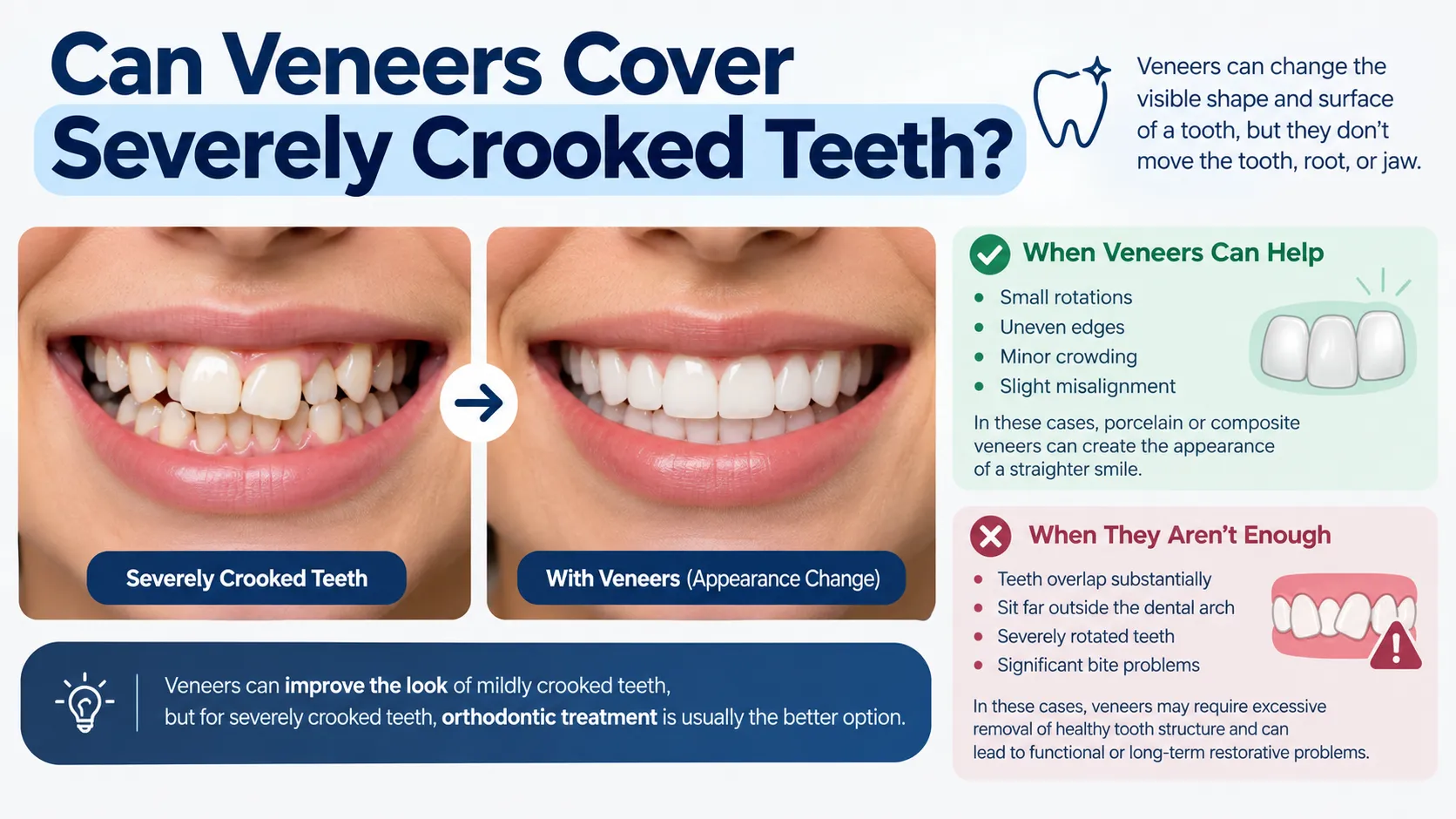
Veneers can sometimes disguise crooked teeth, but severely crooked teeth usually need orthodontic treatment rather than veneers alone. Veneers change the visible shape and surface of a tooth. They do not physically move the tooth, its root, or the jaw into a healthier position.
For small rotations, uneven edges, minor crowding, or slight misalignment, porcelain or composite veneers may create the appearance of a straighter smile. When teeth overlap substantially, sit far outside the dental arch, are severely rotated, or contribute to a significant bite problem, covering them with veneers may require excessive removal of healthy tooth structure and can create functional or long-term restorative problems.
Can Veneers Cover Severely Crooked Teeth?
Technically, veneers can sometimes be placed on significantly misaligned teeth, but that does not mean they are the safest or most conservative treatment.
The American Dental Association describes veneers as custom-made coverings placed over the front surfaces of teeth and lists crooked or misshapen teeth among the cosmetic problems they can improve. The ADA also emphasizes that veneer treatment can be irreversible because enamel may need to be removed.
The important distinction is between making a tooth look straighter and actually straightening it.
A veneer changes the external contour of the crown, which is the part of the tooth visible above the gum. Orthodontic treatment moves the entire tooth, including its root, through the surrounding bone. The American Association of Orthodontists explains that braces gradually move crooked or crowded teeth by applying controlled pressure over time and can also address bite problems.
That difference becomes increasingly important as the severity of crookedness increases.
How Veneers Can Make Crooked Teeth Look Straighter
A veneer is a thin layer of porcelain or composite material placed over the visible surface of a tooth. By altering its shape, width, length, color, and apparent angle, a dentist can sometimes make a mildly misaligned tooth appear more symmetrical with neighboring teeth.
For example, veneers may help when:
- one front tooth is slightly rotated
- the front teeth have small gaps
- teeth are mildly uneven in shape or length
- a tooth appears slightly set back
- mild alignment problems exist alongside discoloration or worn enamel
A review of dental veneer applications identified minor tooth alignment as an indication for minimally invasive veneers. The same review listed severely malpositioned teeth among situations in which laminate veneers may be contraindicated.
This is why photographs showing dramatic “instant orthodontics” can be misleading. The teeth may look aligned from the front after treatment, but their biological positions have not changed.
Why Severe Crookedness Is Different
Severely crooked teeth often involve more than an imperfect front surface. There may be substantial rotation, overlapping, crowding, abnormal tooth angulation, displaced roots, insufficient space in the dental arch, or an underlying bite problem.
Trying to mask these problems entirely with veneers can require the dentist to remove much more tooth structure from some areas while adding significant restorative material to others.
This can create several concerns.
Too Much Healthy Tooth May Need to Be Removed
Imagine a front tooth that projects significantly farther forward than its neighbors. To make a veneer on that tooth line up visually with the rest of the smile, the dentist may need to reduce the projecting part of the natural tooth.
With severe malposition, that reduction can extend beyond enamel and into dentin, the softer tooth structure underneath.
That matters because modern evidence consistently favors preserving enamel when veneers are used. A 2025 systematic review and meta-analysis found that ceramic veneers bonded primarily to enamel had better survival and success outcomes than veneers placed where substantial dentin was exposed.
Another long-term clinical study following 672 ceramic veneers for up to 15 years also found lower estimated survival as dentin exposure increased. The authors concluded that enamel preservation is important for optimizing veneer outcomes.
For an elective cosmetic treatment, unnecessarily sacrificing healthy tooth structure is an important consideration.
Veneers Do Not Correct the Tooth Roots
A tooth that looks severely rotated above the gum usually has a root whose orientation also differs from neighboring teeth.
A veneer can alter the visible crown, but it does not reposition that root. Orthodontic treatment is designed to move teeth biologically into different positions.
This distinction can affect more than appearance. Tooth position influences spacing, contact points, bite forces, brushing access, flossing, and the way upper and lower teeth meet.
A Veneer May Become Too Bulky
If a crooked tooth sits too far inward, a dentist may be tempted to build the veneer outward to make its facial surface line up with neighboring teeth.
Small contour changes can work well in suitable cases. Large additions, however, can produce an unnaturally thick or overcontoured restoration.
The final result has to work from several angles, not just look straight in a front-facing photograph. Gum contours, tooth proportions, lip position, bite relationships, and cleaning access all matter.
The Bite May Still Be Abnormal
Severe crookedness frequently occurs together with malocclusion, meaning the upper and lower teeth do not meet ideally.
Veneers cannot correct the underlying position of the jaws and generally cannot substitute for comprehensive orthodontic correction of crowding, overbite, underbite, crossbite, or other significant alignment problems.
The American Association of Orthodontists notes that braces can treat a wide range of malocclusions, including severe crookedness and problematic bites. Clear aligners can also treat many forms of crowding and crooked teeth, although some complex cases are treated more predictably with braces.
How Crooked Is Too Crooked for Veneers?
There is no single universal measurement that determines whether veneers can be used. Treatment depends on the position of each tooth, the available enamel, the bite, gum health, facial proportions, and the amount of tooth reduction that would be required.
A simplified way to understand the difference is:
| Dental situation | Possible role of veneers |
|---|---|
| Slightly uneven front teeth | Often worth evaluating |
| Minor rotation | May be cosmetically correctable |
| Small gaps with mild misalignment | Veneers may be an option |
| Mild crowding | Possible in carefully selected cases |
| Major tooth rotation | Orthodontics usually deserves consideration first |
| Significant overlapping | Veneers alone may require excessive preparation |
| Severe crowding | Orthodontic treatment is generally more appropriate |
| Major overbite, underbite or crossbite | Requires orthodontic evaluation |
| Tooth far outside the dental arch | Orthodontic movement is often preferred before restorative treatment |
This table is only a general guide. Two smiles that look similarly crooked in photographs can require very different treatment once the bite, roots, bone, gums, and tooth structure are evaluated.
Can Veneers Ever Be Used in Severe Cases?
Yes, there are published clinical cases in which veneers were used for substantially malpositioned teeth. They should not, however, be interpreted as evidence that veneers are routinely appropriate for severe crowding.
One published case report described ceramic veneers being used for crowded upper front teeth after the patient declined orthodontic treatment. Another case report described veneer treatment for markedly misplaced anterior teeth following dental trauma.
Case reports show what may be technically possible for an individual patient. They do not establish that the same approach is the best option for most people with severe crookedness.
A broader review of porcelain veneer cementation noted that when correcting alignment would require a large volume of ceramic, orthodontic correction should be considered before veneer treatment.
That is a more useful principle for treatment planning.
Orthodontics Before Veneers Can Preserve More Natural Tooth
For patients who want both straighter teeth and cosmetic improvements to tooth shape or color, treatment does not always have to be a choice between orthodontics and veneers.
Sometimes the most conservative approach is to use both.
Orthodontics can first move severely rotated, crowded, protruding, or recessed teeth into more favorable positions. Veneers or bonding can then be used only where necessary to correct shape, proportions, wear, discoloration, or other cosmetic problems.
Published interdisciplinary treatment reports describe using orthodontics first to position teeth so that later veneers could be prepared more conservatively.
This approach can reduce the amount of healthy enamel that must be removed solely to compensate for poor tooth position.
Braces, Clear Aligners or Veneers: What Actually Changes?
The three treatments solve different problems.
Braces
Braces physically move teeth through bone using brackets, wires, and controlled forces. They can address substantial crowding, rotations, spacing, and many bite problems.
The AAO states that braces can treat a broad range of malocclusions, including very crooked teeth and difficult bite problems.
Clear Aligners
Clear aligners also move teeth rather than covering them. The AAO lists crowded teeth, crooked teeth, overbites, underbites, open bites, and crossbites among conditions aligners may treat.
They are not suitable for every case, and some complex movements can be handled more predictably with conventional braces or a combined approach.
Veneers
Veneers primarily change appearance. They can modify tooth color, shape, apparent width, visible orientation, and proportions, but they do not provide true orthodontic movement.
That makes them particularly useful when the major problem involves tooth appearance rather than severe tooth position.
Do No-Prep Veneers Work for Severely Crooked Teeth?
Usually, severe crookedness is not the ideal situation for no-prep veneers.
No-prep veneers are designed to minimize or eliminate removal of natural enamel. They work best when there is enough space to add a thin restoration without making the tooth excessively thick.
A severely protruding or rotated tooth presents the opposite problem. Material may need to be removed to bring the visible surface inward.
Modern research supports conservative veneer preparation because preserving enamel improves bonding and long-term outcomes. A recent review of veneer performance found that enamel preservation plays a major role in veneer survival and success.
No-prep marketing therefore should not be treated as proof that every crooked smile can be corrected without altering natural teeth.
What Are the Risks of Using Veneers to Hide Severe Crookedness?
The exact risks depend on the individual treatment plan, but important concerns can include loss of healthy enamel, dentin exposure, sensitivity, restoration fracture, debonding, difficult contours, bite interference, gum irritation, and eventual need for repair or replacement.
The ADA advises patients that veneers can chip, crack, wear, loosen, or eventually require replacement. It also notes that people with deep overbites or tooth grinding may not be good candidates. Existing decay and gum disease should be treated before veneers are placed.
Long-term veneer research also shows that failures can occur. A systematic review involving 6,500 porcelain laminate veneers estimated a 95.5% cumulative survival rate at 10 years, with fracture and debonding among the principal causes of failure.
That figure reflects veneers used across clinical indications. It should not be interpreted as a guaranteed survival rate for veneers placed specifically on severely crooked teeth.
Porcelain or Composite Veneers for Crooked Teeth?
Both can alter the visible appearance of mildly crooked teeth, but the materials behave differently.
Porcelain veneers are laboratory-made ceramic restorations. They generally offer good color stability, strength, and a highly natural appearance when appropriately planned.
Composite veneers use tooth-colored resin applied and shaped directly on the tooth. According to the ADA, composite veneers may require less enamel removal and are easier to repair, but they are less resistant to staining and wear than porcelain.
For severe malposition, however, choosing porcelain instead of composite does not solve the underlying problem. The more important question is whether a veneer should be used at all before the tooth is orthodontically repositioned.
What Should Be Checked Before Putting Veneers on Crooked Teeth?
A cosmetic evaluation should look beyond whether a veneer can physically be attached to the tooth.
A dentist or orthodontist needs to consider the degree of rotation and crowding, the patient’s bite, enamel thickness, existing restorations, tooth and gum health, grinding habits, available space, tooth proportions, and how much natural tooth would have to be removed.
The ADA specifically recommends having veneers placed by a licensed dentist and warns that placing restorations over unhealthy teeth or altering teeth without proper diagnosis can lead to irreversible harm.
For substantial crowding or bite problems, an orthodontic assessment can help determine whether moving the teeth first could produce a healthier and more conservative final result.
When Veneers Make Sense for Crooked Teeth
Veneers are most reasonable when the misalignment is limited enough that the desired cosmetic result can be achieved without aggressive removal of healthy tooth structure and without creating an unhealthy bite or bulky restoration.
They become less attractive as a treatment option when the cosmetic correction requires increasingly large changes in the apparent position of the teeth.
The goal should therefore not simply be to ask, “Can veneers cover this tooth?” A better question is, “How much healthy tooth would have to be sacrificed to make that correction, and could orthodontics achieve it more conservatively?”
For severely crooked teeth, that distinction can completely change the treatment plan.
Frequently Asked Questions
Can veneers make very crooked teeth look straight?
They sometimes can improve the appearance of crooked teeth from the front, but severe rotations, overlapping, or protrusion may require substantial tooth reduction. Orthodontics is usually considered when significant tooth movement is needed.
Do veneers actually straighten teeth?
No. Veneers alter the visible shape and surface of teeth. Braces and clear aligners physically move teeth and their roots into new positions.
Can I get veneers instead of braces?
For mild cosmetic misalignment, veneers may sometimes provide an alternative appearance-based solution. For significant crowding, severe rotations, or bite problems, braces or aligners address the underlying tooth positions in a way veneers cannot.
Can I get veneers after braces or clear aligners?
Yes. Orthodontics followed by conservative bonding or veneers can be useful when teeth need both positional correction and improvements in shape, color, size, or wear. Moving the teeth first may allow the later restorative work to preserve more enamel.
Will veneers damage crooked teeth?
Properly planned veneers do not automatically damage teeth, but treatment often requires permanent alteration of enamel. The risk becomes more important when severe misalignment requires deeper preparation and greater dentin exposure, which is why careful case selection matters.
Should I see a cosmetic dentist or orthodontist first?
If the problem is mainly severe crowding, major rotation, overlapping teeth, or an abnormal bite, an orthodontic evaluation is particularly useful. When both alignment and cosmetic concerns are present, coordinated planning between an orthodontist and restorative dentist may provide a more conservative approach.
Also Read: Dental Tourism for Cosmetic Work Risks | A Safety Guide
