


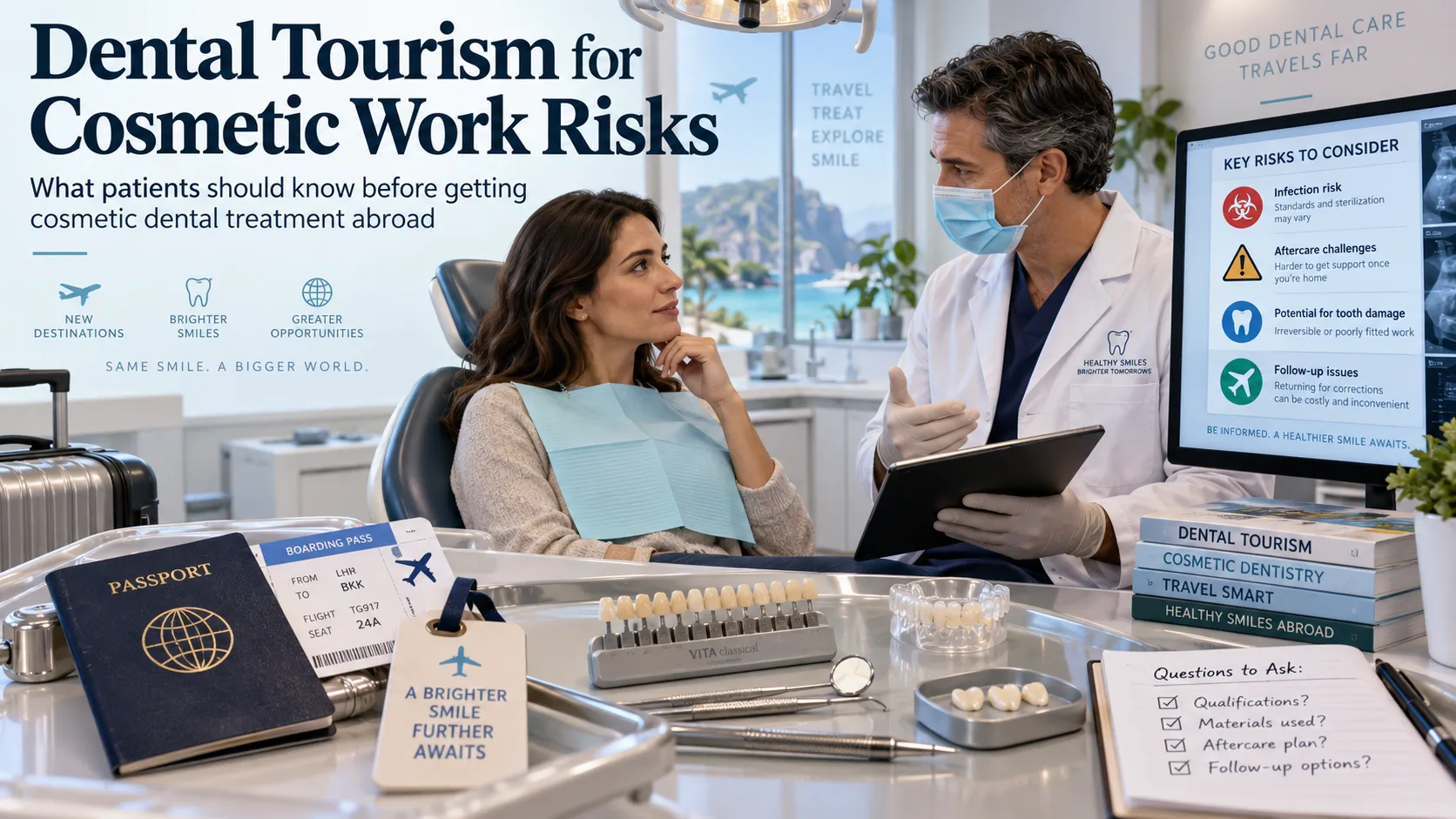
Dental tourism for cosmetic work can reduce the upfront price of veneers, crowns, implants, whitening, or full-smile rehabilitation, but the financial saving does not remove the clinical risks. The biggest concerns are unnecessary or irreversible tooth preparation, infection, poor-fitting restorations, implant complications, limited aftercare, communication problems, and difficulty obtaining corrective treatment once you return home.
Dental tourism simply means travelling to another country specifically to receive dental care. The U.S. Centers for Disease Control and Prevention describes dental care as one of the major forms of medical tourism and warns that standards for licensing, infection control, medical devices, medicines, record keeping, and follow-up can vary between countries and facilities.
That does not mean dentistry abroad is automatically unsafe. Highly trained dentists and well-regulated clinics operate in many countries. The real issue is whether an individual clinic, dentist, treatment plan, and aftercare arrangement can be independently verified before irreversible work begins.
What Does Cosmetic Dental Tourism Usually Involve?
Cosmetic dental tourism typically involves travelling overseas for elective treatment intended mainly to change the appearance of the smile. Common procedures include porcelain or composite veneers, crowns, dental implants, bridges, whitening, gum contouring, and larger “smile makeover” packages involving multiple teeth.
Cost is a major reason people travel. The CDC notes that lower prices are a major motivation for medical tourism, while dental care is particularly common among U.S. medical tourists. A British Dental Association survey of more than 1,000 dentists also found that respondents overwhelmingly viewed lower prices as the main factor driving patients abroad.
Price differences can be genuine, reflecting different labour costs, overheads, taxation, and healthcare systems. The mistake is assuming that a lower price alone tells you whether the treatment is appropriate or whether the same treatment would even have been recommended by an independent dentist.
Dental Tourism for Cosmetic Work Risks at a Glance
| Risk | Why it matters |
|---|---|
| Excessive tooth preparation | Healthy enamel and dentine may be permanently removed for crowns or veneers |
| Pulp damage | Heavily prepared teeth can later develop inflammation, loss of vitality, or require root canal treatment |
| Poor fit or bite | Incorrect crown or veneer contours can cause pain, chewing problems, gum irritation, or restoration failure |
| Infection | Invasive dental procedures can introduce infection if clinical or sterilization standards are inadequate |
| Implant complications | Problems can include infection, implant failure, nerve injury, sinus involvement, or difficult-to-service implant components |
| Limited follow-up | Problems may appear after the patient has already flown home |
| Difficult remedial treatment | A local dentist may need to diagnose work without complete records or compatible components |
| Legal and regulatory differences | Complaint procedures, compensation, professional regulation, and legal remedies differ across jurisdictions |
| Unexpected costs | Flights, accommodation, emergency treatment, replacement restorations, and repeat visits can erase initial savings |
These complications are not exclusive to overseas dentistry. Veneers, crowns, implants, and other restorative procedures can develop problems wherever they are performed. Dental tourism adds another layer of risk because treatment, recovery, records, regulation, and future care may be divided between different countries.
Irreversible Tooth Reduction Is One of the Most Important Risks
The distinction between a veneer and a crown matters enormously.
A veneer normally covers mainly the visible front surface of a tooth, while a crown surrounds much more of the tooth. Both may require tooth preparation, but the amount can differ substantially depending on the patient’s teeth, material, design, and clinical situation.
The American Dental Association’s MouthHealthy guidance states that veneer treatment is generally irreversible because enamel is removed. It also notes that decay or gum disease should be treated before veneers are placed and that veneers may later chip, crack, loosen, or require replacement.
Removing healthy tooth tissue is not a trivial step. A 2026 systematic review comparing conventional and no-preparation veneers described conventional preparation as involving irreversible loss of tooth structure and recognized potential pulpal and periodontal complications, although the evidence base comparing the techniques remains limited.
For that reason, patients should know exactly what is being proposed before travelling. If an advertisement says “veneers,” ask whether the planned restorations are actually veneers, full crowns, partial crowns, or another type of restoration.
Can Cosmetic Crowns or Veneers Damage the Dental Pulp?
Yes, pulp complications can occur after indirect restorative treatment, although the risk varies considerably with the condition of the tooth and how treatment is performed.
The dental pulp is the living tissue inside a tooth containing nerves and blood vessels. Preparing a tooth for an indirect restoration exposes it to mechanical, thermal, chemical, and biological stresses.
A systematic review and meta-analysis involving indirect restorations on vital teeth estimated an overall pulp-necrosis incidence of about 5% and periapical disease incidence of about 3.6%. The authors rated the overall certainty of the evidence as low, so these figures should not be treated as precise predictions for an individual patient or specifically for dental tourists.
Risk depends on factors such as how much tooth structure is removed, whether the tooth was already heavily restored or decayed, preparation technique, temporary restoration quality, cementation, and long-term follow-up.
This is why extensive cosmetic treatment on otherwise healthy teeth deserves careful consideration. Once substantial natural tooth structure has been removed, it cannot simply be replaced if the patient changes their mind.
Poorly Planned Cosmetic Work Can Affect the Bite and Gums
A cosmetic restoration has to do more than look white and symmetrical. Its shape, margins, contacts, bite, and relationship with the gums all matter.
Crowns or veneers that are too bulky, too long, poorly positioned, or inadequately fitted can make cleaning difficult and may irritate surrounding tissues. Poor bite relationships can also produce discomfort or place excessive forces on restorations and supporting teeth.
Good cosmetic dentistry therefore starts with diagnosis, not with selecting a shade or copying a photograph. A dentist should evaluate gum health, decay, existing restorations, tooth position, bite, grinding or clenching, enamel thickness, and the patient’s expectations before choosing a treatment.
The ADA specifically advises that veneers may be unsuitable for some people who clench or grind their teeth or have certain bite relationships.
Infection and Cross-Border Healthcare
Every invasive dental procedure carries some risk of infection. Dental tourism does not automatically mean poor infection control, but a patient may find it harder to confirm what standards a foreign clinic follows.
The CDC warns that infection-control standards can differ among international healthcare facilities. It identifies blood-borne infections, bloodstream infections, surgical-site infections, and antimicrobial-resistant organisms among the concerns associated with medical tourism generally.
Antimicrobial resistance adds another complication. The World Health Organization explains that resistant organisms can make infections harder to treat and increase the risk associated with medical procedures.
Patients considering dental implants, bone grafting, sinus procedures, or other surgical treatment should pay particular attention to sterilization protocols, clinician qualifications, emergency arrangements, and postoperative monitoring.
Dental Implants Create Extra Follow-Up Challenges
Dental implants are highly successful in appropriately selected patients, but they are not maintenance-free and complications can occur even with competent treatment.
Potential implant problems include infection, failure to integrate with bone, peri-implant inflammation, bone loss, screw loosening, prosthetic fracture, nerve injury, and problems involving the maxillary sinus. The exact risk varies with the procedure and patient.
Dental tourism can make management harder when the implant brand or component system is unclear. A published report on complications involving unfamiliar implant systems noted that dentists treating patients who received implants elsewhere can face difficulty identifying components and obtaining appropriate tools or parts.
Patients should therefore leave the clinic with a complete implant record. It should identify the manufacturer, system, implant dimensions, component details, placement sites, relevant radiographs, surgical information, and prosthetic components.
Short Treatment Schedules Can Be a Warning Sign
A fast treatment plan is not automatically unsafe. Digital scanning, CAD/CAM manufacturing, and modern restorative techniques can shorten some workflows considerably.
The problem arises when biological healing or proper diagnosis is compressed simply to fit a flight schedule. Some procedures need staged treatment, laboratory work, healing, reassessment, or adjustments.
Implant dentistry is a clear example. The appropriate timing for implant loading depends on factors including primary stability, bone quality, implant position, surgical technique, restoration design, and the patient’s health. A package promising the same timetable for almost everyone should therefore be examined carefully.
Cosmetic work should fit the patient’s clinical needs. The patient’s clinical needs should not be forced to fit a seven-day holiday.
Aftercare Is Often the Weakest Part of Dental Tourism
A restoration may look satisfactory on the day it is fitted yet develop pain, bite problems, sensitivity, inflammation, debonding, fracture, or infection later.
The General Dental Council advises patients considering treatment overseas to establish in advance what aftercare is included, who will handle complications, how long support lasts, whether additional treatment is included in the original fee, and who pays for additional travel and remedial treatment.
The CDC similarly recommends discussing complication management before travel and obtaining copies of overseas medical records for subsequent healthcare professionals.
A guarantee has limited value unless the practical details are clear. If the clinic promises to replace a failed crown for free but requires the patient to purchase another international flight and hotel stay, the true cost may be substantial.
What the British Dental Association Survey Does and Does Not Show
The British Dental Association reported in its survey that 95% of participating dentists had examined patients who had travelled abroad for dental treatment. Among that group, 86% said they had treated patients who developed complications, with crowns and implants frequently requiring follow-up.
The same survey reported substantial remedial costs in some cases.
These figures are useful evidence that UK dentists are seeing real problems following overseas treatment, but they must be interpreted correctly. The survey questioned dentists, not a representative sample of all people receiving dentistry abroad, so it cannot establish that 86% of dental tourists develop complications.
Many people may receive satisfactory treatment overseas and never need remedial care. Good risk communication should acknowledge both realities.
Regulation and Qualifications May Be Harder to Verify
Professional regulation varies internationally. Some countries have robust dental licensing, inspection, disciplinary, and complaints systems, while arrangements elsewhere may be different.
The General Dental Council advises prospective dental tourists to establish whether the destination has a dental regulator, whether registration is compulsory, what qualifications are required, what standards are enforced, and where complaints can be made.
The ADA also notes that standards comparable with those in the United States may exist abroad but can sometimes be difficult for a patient to verify where regulatory systems differ.
Do not rely entirely on clinic websites, influencers, testimonials, or before-and-after photographs. They can help you discover a provider, but they are not substitutes for checking professional registration and independent regulatory information.
Informed Consent Can Become More Difficult
Proper consent is more than signing a form on the morning of treatment.
A patient should understand the diagnosis, proposed procedure, reasonable alternatives, expected benefits, significant risks, limitations, costs, maintenance requirements, and likely consequences of doing nothing. For cosmetic work, it is particularly important to understand how much healthy tooth structure will be removed.
The GDC recommends that patients be assessed by a qualified dentist before receiving a treatment plan and cost estimate and that the assessment include relevant medical history.
Language barriers can complicate this process. The dentist should be able to explain the treatment in a language the patient understands well enough to make an informed decision, or an appropriate interpreter should be available.
Travel Insurance May Not Pay for Complications
Ordinary holiday insurance should not be assumed to cover planned cosmetic dental treatment.
The UK’s Royal College of Surgeons warns in its guidance on treatment abroad that standard travel insurance generally does not cover complications arising from planned surgery and advises patients to establish exactly what their insurance covers.
Policies differ, so the wording of the individual contract matters. Dental tourists should check coverage for treatment complications, emergency care, additional accommodation, changed flights, medical evacuation where relevant, and follow-up after returning home.
A low clinic quote should therefore never be treated as the final financial exposure.
How Much Can Corrective Treatment Cost?
There is no reliable universal figure because corrective treatment depends entirely on what has gone wrong.
A simple bite adjustment or re-cementation is very different from replacing multiple crowns, performing root canal treatment, treating infection, removing an implant, rebuilding bone, or restoring extensively damaged teeth.
The BDA survey found that many responding dentists had treated patients facing significant remedial expenses after overseas dental work, with some reporting costs running into thousands of pounds. Again, these results describe the dentists’ reported cases rather than the average cost for all dental tourists.
The most useful comparison is therefore not “local price versus overseas price.” It is total expected cost, including diagnostics, treatment, flights, hotels, time away from work, maintenance, possible repeat travel, and potential corrective care.
Cosmetic Dental Tourism Is Not Automatically Bad Dentistry
Location alone does not determine quality.
A dentist abroad may have excellent qualifications, modern equipment, strong infection-control procedures, careful treatment planning, transparent consent, and reliable follow-up. A dentist closer to home can also deliver poor treatment.
The important difference is how easily the patient can evaluate the provider and deal with a problem later. Dental tourism can introduce distance, different legal systems, unfamiliar professional regulation, travel costs, and fragmented aftercare.
This is why the safest assessment focuses on the individual dentist, clinic, proposed treatment, and long-term care plan rather than stereotypes about a particular country.
Warning Signs Before Booking Cosmetic Dental Work Abroad
Be particularly cautious when:
- a salesperson rather than the treating dentist designs the treatment plan; the clinic recommends large numbers of crowns or veneers without a full examination; treatment is confirmed only from photographs; you cannot verify the dentist’s registration; the provider will not explain how much natural tooth structure will be removed; risks and alternatives are barely discussed; there is pressure to pay immediately; success or complication figures cannot be explained; implant brands are not disclosed; the clinic will not provide complete records; or there is no clear written plan for aftercare and complications.
A polished website, airport transfer, luxury hotel, or large social-media following does not answer any of these clinical questions.
Questions to Answer Before You Travel
The General Dental Council’s overseas-treatment guidance provides a useful framework for evaluating a clinic. Patients should know who will perform the procedure, what qualifications and professional registration that person holds, how often they perform the treatment, what complication and infection information is available, what aftercare is included, how complaints work, and who pays when additional treatment is needed.
For veneers or crowns, also establish which teeth will be treated and why, whether the teeth are currently healthy, exactly how they will be prepared, what material will be used, what alternatives exist, and what happens if a tooth later needs root canal treatment.
For implants, obtain the implant system and component information in writing before returning home.
Should You Get a Second Opinion Before Cosmetic Dental Tourism?
For irreversible cosmetic work, an independent second opinion is one of the most useful safeguards available.
A local dentist who has no financial interest in the overseas package can examine your teeth and tell you whether extensive veneers, crowns, implants, orthodontics, whitening, bonding, or no treatment at all might be reasonable alternatives.
The GDC specifically advises speaking with your own dentist before considering treatment abroad because they can provide advice based on your dental history and will be better prepared if complications later occur.
A second opinion becomes especially valuable when a clinic proposes treating many healthy teeth primarily for cosmetic reasons.
What Records Should You Bring Home?
Before leaving the destination, obtain complete clinical records in a format another dentist can understand. The CDC recommends that medical tourists obtain overseas records and provide them to professionals responsible for later follow-up.
Useful dental documentation includes the diagnosis, treatment plan, pre-treatment and post-treatment radiographs, clinical photographs where available, details of restorations and materials, laboratory information, prescriptions, surgical notes, implant manufacturer and component information, and a written aftercare plan.
These records may become extremely important years later when a restoration needs maintenance or replacement.
When to Seek Urgent Dental or Medical Care After Treatment
Do not wait for a scheduled trip back to the original clinic if you develop symptoms suggesting a significant complication.
Urgent assessment may be needed for rapidly increasing facial or neck swelling, difficulty breathing or swallowing, uncontrolled bleeding, severe or worsening pain, fever with dental swelling, pus or spreading infection, persistent numbness after implant surgery, or another sudden deterioration.
The CDC advises medical tourists not to delay seeking care when complications are suspected, because earlier diagnosis and treatment can improve outcomes.
For less urgent problems such as persistent sensitivity, a changed bite, loose restorations, gum inflammation, unpleasant taste, or recurrent discomfort, arrange dental evaluation rather than assuming the problem will resolve on its own.
FAQ
Is dental tourism safe for veneers?
It can be, but safety depends on the dentist, clinic, diagnosis, preparation technique, material, infection control, and aftercare rather than the country alone. Veneers often require irreversible enamel removal, so treatment planning should be conservative and based on a full dental examination.
What is the biggest risk of cosmetic dentistry abroad?
There is no single biggest risk for every patient. For healthy teeth receiving extensive cosmetic work, irreversible removal of natural tooth structure and inadequate long-term follow-up are particularly important concerns, while surgical procedures such as implants add infection and surgical risks.
Are crowns abroad more dangerous than veneers?
Not inherently, but crowns generally involve more extensive coverage of the tooth and may require greater tooth reduction than conservative veneers. The appropriate restoration depends on the condition of the tooth, so healthy teeth should not automatically receive crowns simply to achieve a cosmetic change.
What happens if overseas veneers or crowns go wrong?
Treatment depends on the problem. Management might involve adjustment, re-bonding, replacement, gum treatment, root canal therapy, or more extensive reconstruction. Patients may also have to pay locally for corrective treatment or travel back to the original clinic depending on the clinic’s guarantee and insurance arrangements.
Can my regular dentist fix dental work done abroad?
Often they can assess and treat complications, but the situation may be more difficult if records are incomplete, the restoration design is unfamiliar, or an implant system cannot easily be identified. Bringing complete records and implant component information home can make future care easier.
How can I reduce the risks of dental tourism for cosmetic work?
Obtain an independent dental examination before travelling, verify the treating dentist’s registration and qualifications, understand exactly what will be done to each tooth, compare less-invasive alternatives, investigate infection-control and aftercare arrangements, confirm insurance coverage, and obtain complete clinical records before returning home. These precautions reduce uncertainty but cannot guarantee a complication-free result.
Also Read: Dental Phobia and Cosmetic Procedures
